A western bracelet is unusually visible in real life. It appears while you hold a coffee cup, type, drive, adjust a hat, open a door, or reach for a bag. A turquoise-colored cuff can turn rolled denim sleeves into a complete look. A cross, heart, floral, beaded, leather-look, or geometric bracelet can repeat one detail from boots or a belt. A stack can add movement and color, but it can also slide, collide, scratch a watch, press into the wrist, or catch a sleeve if the fit is not planned.
The first step is not choosing a motif. It is identifying the bracelet's construction, because a clasp bracelet, open cuff, closed bangle, stretch bracelet, rigid link, and multi-piece set are measured differently. This guide explains each structure, shows how to measure at home, and adds a contact-map method for stacks. Browse the Oroxen western bracelets collection while comparing the examples.
Structure Comes Before Size
A listing may use “bracelet,” “cuff,” and “bangle” loosely, so study the photographs and closure instead of relying on the title. The path onto the wrist determines the measurement you need.
| Construction | How it goes on | Primary measurement | Extra fact to verify |
|---|---|---|---|
| Clasp bracelet | Wraps around the wrist and closes | Wrist circumference and wearable inner length | Closure, extender, charm drop, link thickness |
| Open cuff | Slides over the side of the wrist through an opening | Wrist circumference plus cuff's documented inner size | Opening width and whether adjustment is allowed |
| Closed bangle | Slides over the compressed hand and knuckles | Hand circumference or diameter, following the seller's method | Interior diameter and shape |
| Stretch or elastic | Expands over the hand, then contracts | Wrist circumference and stated fit range | Bead size, elastic construction, care |
| Hinged bracelet | Opens at a hinge and closes around the wrist | Wrist circumference and interior dimensions | Latch, safety mechanism, hinge placement |
| Multi-piece set | Each component may use a different method | Every bracelet, not one average number | Exact number of pieces and individual fit |
This distinction prevents the most common sizing error: using a wrist measurement to buy a rigid closed bangle that must pass over the hand. The hand is usually the limiting point for that construction. Conversely, a clasp bracelet can open, so the wrist and desired movement matter more than knuckle width.
How to Measure Your Wrist
Use a flexible measuring tape. If you do not have one, use non-stretch string, a narrow strip of paper, or a ribbon and measure the marked length against a ruler. Keep the measuring tool flat against the skin without pulling it tight enough to indent. Record the number in the same unit used by the product page, or convert carefully.
- Choose the wearing position. Decide whether the bracelet will sit at the wrist bone, closer to the hand, or slightly higher on the forearm.
- Wrap the tape at that point. Measure the skin, not over a watch or existing stack.
- Record the exact circumference. Do not add an allowance yet.
- Define the preferred movement. Do you want the bracelet to stay near one point, move slightly, or drape toward the hand?
- Use the seller's chart. Match your base measurement to the construction-specific instructions instead of applying one universal addition.
Jewelers Mutual's bracelet measurement guide also distinguishes wrist-based sizing from the hand measurement needed for a slip-on bangle. The exact allowance between body measurement and finished jewelry depends on style, width, construction, and personal preference, so the product's own size system remains the final reference.
Measure more than once
Repeat the measurement and compare the numbers. A twisted tape, a diagonal path, or pulling the string too tightly can change the result. If the bracelet will be worn at different places on the arm, measure those locations separately. The forearm widens as it moves away from the hand.
Compare with a bracelet you own
A comfortable existing bracelet is a valuable reference, but record it in the correct way. A chain bracelet may be listed end to end, while thick beads reduce the usable interior space. A cuff may be described by its inner circumference plus opening. A bangle may use inside diameter. Ask how the seller takes the measurement if the diagram is missing.
How to Measure for a Closed Bangle
A closed bangle has no clasp or open side, so it must pass over the widest compressed part of the hand. Bring the thumb and little finger toward one another as if sliding on a bangle. Measure around the broadest knuckle area using the method shown by the seller, or measure the interior diameter of a bangle that already passes comfortably.
Do not assume that a bangle whose inner circumference equals the wrist circumference will fit over the hand. Also confirm whether the bangle is circular, oval, or another shape. Interior dimensions describe usable space more clearly than exterior width.
Open Cuff Fit: Opening, Interior, and Shape
An open cuff enters from the narrower side of the wrist rather than sliding over all the knuckles. Three measurements can matter: the interior circumference of the metal or other structure, the opening between the ends, and the height or width of the band. A cuff may be round, oval, or contoured, which changes how it rotates and where it rests.
Do not repeatedly bend a cuff without permission
Some cuffs are designed for limited adjustment; others can weaken, lose shape, damage a finish, loosen a set component, or break when repeatedly opened and closed. Never assume that “open” means “freely adjustable.” Follow the product instructions. If the listing does not say, ask whether the cuff should be fitted once, adjusted occasionally, or left unchanged.
Use the side-entry method supplied by the maker
Many open cuffs are placed over the side of the wrist where the profile is narrower, then rotated into position. The correct motion depends on the cuff's shape and material. Do not force the ends apart or press the cuff straight over a wider part of the arm.
Check end placement
Decorative tips should not press into a sensitive area, catch hair, or dig in during wrist flexion. Test the bracelet while typing, gripping a steering wheel, and fastening clothing. A beautiful front view cannot show how the open ends interact with the underside of the wrist.
Clasp Bracelets, Chains, Charms, and Extenders
A clasp bracelet may have a lobster clasp, spring ring, toggle, hook, magnetic mechanism, fold-over closure, box clasp, or another design. Check whether you can operate it with the opposite hand. If dexterity is a concern, test a similar closure before buying.
An extender creates a range rather than one fit. Record the shortest and longest wearable settings. Charms and heavy centerpieces can pull the bracelet toward the underside of the wrist. A safety chain changes how far the bracelet opens. Thick links, beads, leather, and layered strands can occupy interior space even when the end-to-end length appears generous.
Magnetic closures should be evaluated using the product's warnings and may not be appropriate near certain medical devices or in every activity. A general style guide cannot determine personal medical compatibility. Follow the manufacturer and healthcare professional guidance relevant to you.
Stretch and Beaded Bracelets
Stretch bracelets are convenient, but “one size” is not the same as universal fit. Ask for the intended wrist range, bead diameter, number of strands, and elastic construction. Large beads take more room on the inside of the circle, so an exterior measurement does not describe wearable space.
Roll the bracelet over the hand instead of pulling one section of elastic far away from the others, unless the maker gives different instructions. Avoid overstretching. Inspect knots, covered connections, and bead edges. A multi-strand design may feel warmer, wider, and less flexible than one narrow strand.
Width, Thickness, Weight, and Wrist Movement
Bracelet width controls how much skin or sleeve area the piece occupies. A broad cuff can look clean and architectural, but it covers more of the flexing zone. A narrow chain or beaded strand follows movement more easily but may slide under a watch or toward the hand. Thickness and raised decorations affect contact with desks, keyboards, jacket cuffs, and bag handles.
Weight should be considered together with distribution. One heavy charm can make a bracelet rotate; a wide cuff may spread mass more evenly. Several individually light bracelets can create a substantial combined stack. When the listing supplies weight, confirm whether it refers to one item or the complete set and compare it with pieces you already wear.
There is no honest universal weight or looseness threshold that guarantees comfort. Try a new bracelet at home for the same type of activity and duration you expect outside. Remove it if it pinches, restricts movement, causes numbness, catches, heats uncomfortably, or irritates the skin. Obtain exact material information for known sensitivities or persistent reactions.
The Stack Contact Map
Most stacking advice focuses on color and number. A useful stack also needs a contact plan. Draw the wrist as a short horizontal line and place each item in order from hand toward elbow. Note which surfaces can touch during normal movement.
| Contact pair | What to inspect | Possible adjustment |
|---|---|---|
| Bracelet ↔ watch | Hard edges, raised stones, case and crystal contact | Separate wrists or place a soft/slim piece beside the watch |
| Bracelet ↔ bracelet | Clashing, tangling, finish abrasion, trapped charms | Change order, reduce pieces, separate rigid shapes |
| Bracelet ↔ skin | Pressure points, heat, pinching, movement over the wrist bone | Choose another fit or construction |
| Bracelet ↔ sleeve | Snagging, hidden details, tight cuff competition | Roll the sleeve, choose lower relief, or wear one piece |
| Bracelet ↔ workspace | Keyboard, laptop, desk, tools, steering wheel | Move to the other wrist or use a compact bracelet |
Perform the map with the actual watch and clothing you plan to use. A good stack in a still photograph may be noisy or inconvenient at a desk. A stack for a short concert can be more expressive than one intended for an eight-hour workday.
Build a Western Bracelet Stack with a Hierarchy
Choose one anchor. It may be a turquoise-colored cuff, a wide leather-look piece, a cross, a watch, or a strong beaded strand. Supporting bracelets should repeat one or two elements—color, metal tone, motif, or texture—without matching every detail.
Start with two pieces
One anchor plus one quieter partner is easier to test than a complete stack. Check fit, movement, and contact before adding another. If the two pieces already occupy the full wrist zone, stop there.
Mix width deliberately
A broad cuff beside several equally broad bracelets can restrict flexion and create a solid visual block. Pair a wide anchor with slimmer accents, or wear it alone. Several narrow pieces create rhythm and movement but may produce more collisions.
Use soft and rigid textures thoughtfully
Beads, cord, leather-look material, fine chain, and rigid cuffs interact differently. A softer piece may buffer a watch, but its decorations can still scratch. Do not assume that a material name guarantees harmless contact; inspect the hardware and raised surfaces.
Split the wrists when needed
A watch and one slim bracelet can share a wrist, while a statement cuff can lead on the opposite side. This creates visual balance without forcing every piece into one contact zone. Dominant-hand activity, writing, tools, and desk position may decide the most practical arrangement.
Western Bracelet Motifs and Styling Language
Western bracelet collections may include turquoise-style color, crosses, hearts, horses, cow skulls, longhorns, stars, feathers, concho-inspired forms, rope-like borders, leather-look textures, floral engraving, geometric patterns, beads, crystals, and distressed finishes. Some pieces communicate the theme through shape; others rely on color and texture.
Keep product language precise. “Turquoise color” does not establish natural turquoise. “Silver tone” is not a sterling silver claim. “Vintage-inspired” describes appearance, not verified age. “Western,” “cowgirl,” or “concho-inspired” does not prove a maker, geographic origin, or cultural authorship. The live product page should state the material and construction facts actually documented.
The U.S. FTC Jewelry Guides offer useful truth-in-marketing context. Oroxen's western turquoise jewelry guide provides a deeper checklist for blue-green accents and material wording.
Two Oroxen Examples: Cuff Set Versus Geometric Cross Bracelet
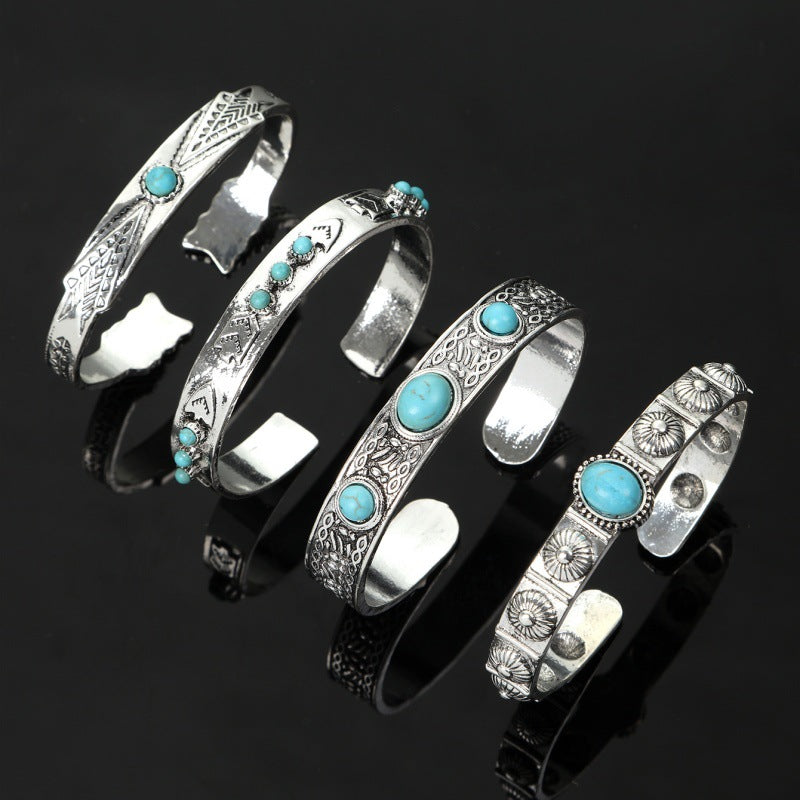
The Turquoise Western Cuff Bracelet Set contains four open cuffs with turquoise-colored accents and varied vintage-inspired motifs. The set illustrates why each component should be evaluated separately. A wearer may use one as a compact accent, combine two after checking contact, or build the full four-piece visual when movement and comfort allow.
The Turquoise Boho Vintage Geometric Cross Bracelet for Women uses turquoise-style color, geometric structure, and a cross motif as one theme-forward piece. It can act as the anchor beside a quiet watch, a simple ring, or compact earrings. Give its central details enough visual space rather than surrounding it with several equally symbolic bracelets.
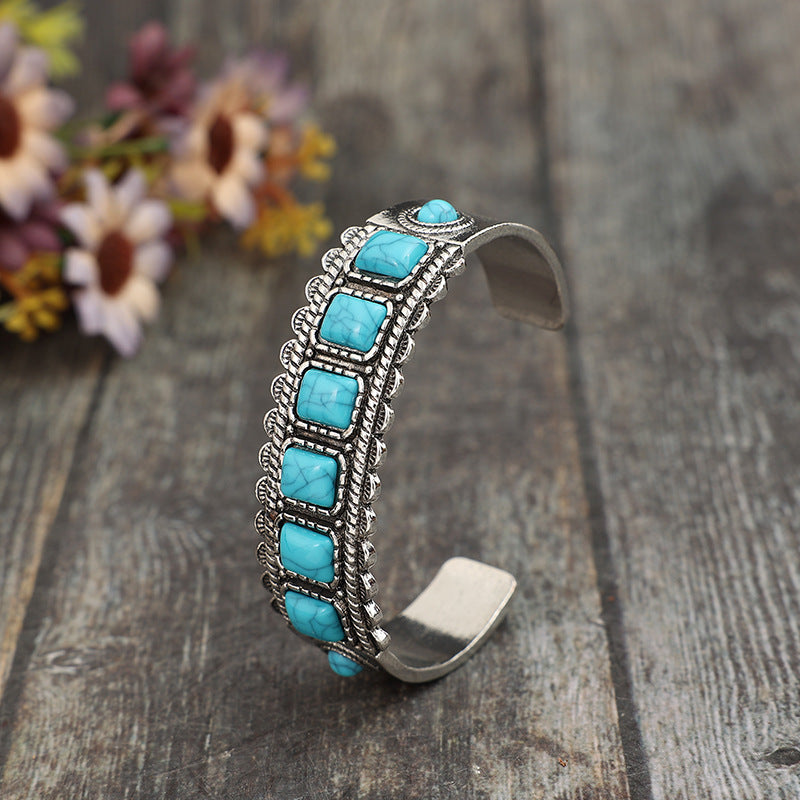
These examples demonstrate two styling jobs; they do not add unlisted claims about measurements, natural stones, metals, adjustability, age, or origin. Review the current product page, images, selected option, price, shipping, and return information before ordering.
Five Western Bracelet Outfit Formulas
1. Rolled denim sleeves with one turquoise-colored cuff
Roll the sleeve above the wrist and use one visible cuff as the focal point. Add small earrings or a restrained ring. The open skin around the bracelet makes the color and shape readable without requiring a complete stack.
2. White shirt with a two-piece stack
Pair one turquoise-style anchor with a quieter beaded or metal-toned bracelet. Keep both on the wrist that experiences less desk or bag contact. Use the contact map before wearing them for a full day.
3. Black dress with a geometric cross bracelet
A dark solid background lets turquoise-style color, silver tones, and geometric details stand out. Keep the necklace small or absent if the bracelet and earrings already communicate the theme. The cowgirl jewelry style guide shows how to distribute focal points across the complete outfit.
4. Concert or rodeo wrist with controlled movement
Choose one secure bracelet or a tested two-piece stack. Make sure charms, open ends, and edges clear fringe, jacket cuffs, bag straps, and the other wrist. Leave emotionally irreplaceable pieces at home for crowded or highly active events.
5. Watch plus a western accent
Let the watch anchor the wrist and add one slimmer bracelet only after checking contact with the case, crown, and crystal. If the bracelet has hard raised details, wear it on the other wrist. Repeat a color or tone elsewhere to connect the arrangement.
Bracelets with Earrings, Necklaces, and Rings
Bracelets occupy a different visual zone, so they can support statement earrings or a pendant more easily than another face-level piece. Repeat one cue rather than every motif. Turquoise-style color at the wrist can connect with a small stud. A cross bracelet can echo a necklace's metal tone without requiring another cross.
Use the western earrings guide to control the face zone, the western necklace guide for the neckline, and the western turquoise ring guide for hand-level scale and fit. A coordinated outfit needs hierarchy, not a literal matching set.
How to Read a Bracelet Listing
- Name the construction: clasp, open cuff, closed bangle, stretch, hinge, wrap, or set.
- Find the correct interior measurement: do not substitute an exterior dimension.
- Check the opening or closure: confirm how the bracelet enters and leaves the wrist.
- Record width and thickness: these affect flexion, sleeve clearance, and usable interior space.
- Identify the exact quantity: one bracelet, multiple strands fixed together, or separate pieces.
- Ask whether adjustment is allowed: never repeatedly bend a cuff unless the maker permits it.
- Separate material statements: body, finish, clasp, elastic, cord, beads, accent, coating, and adhesive may differ.
- Look for weight: determine whether the number applies to one piece or the full set.
- Review front, side, back, and scale images: each view answers a different fit question.
- Check current shipping and returns: especially for gifts and dated events.
Giving a Western Bracelet as a Gift
Observe the recipient's current jewelry. Do they wear a watch? Are their bracelets close, loose, rigid, elastic, or adjustable? Do they work at a keyboard, with tools, around children, or in a setting where dangling charms are inconvenient? A bracelet can be easier than a ring, but it is not size-free.
Measure a bracelet they already wear if possible and describe its construction to the seller. For a closed bangle, measure a bangle rather than a chain bracelet. For a cuff, record the interior and opening using the product's stated method. Confirm sensitivities, preferred motifs, current policy, and whether the item is one bracelet or a set.
Care and Storage
Use care instructions for the documented materials. As a conservative routine, allow lotion, sunscreen, fragrance, and other products to dry before wearing jewelry. Remove fashion bracelets before showering, swimming, sleeping, exercise, or manual work unless the maker confirms that every component is appropriate.
Wipe accessible surfaces with a soft, dry cloth after wear. Store bracelets separately so rigid ends, crystals, charms, and raised motifs do not scratch neighboring pieces. Keep a multi-piece set organized without forcing cuffs inside one another. Do not hang an elastic bracelet under tension.
Avoid repeated cuff bending, harsh dips, abrasive polishing, steam, or ultrasonic cleaning unless the product instructions approve the method for the body, finish, accent, elastic, cord, adhesive, and patina. A process suitable for one metal can damage coatings or porous decorations.
Video: How to Measure Wrist Circumference
This independent tutorial from BillyTheTree Jewelry demonstrates how to measure around the wrist using a flexible tape and alternatives when a tape is unavailable. Use it to understand the base body measurement, then follow the specific product's instructions for allowance, cuff interior, or bangle hand size. The video is third-party educational content; it does not verify any Oroxen product's fit or materials.
Watch “How To Properly Measure Your Wrist Size For Bracelets and Jewelry” on YouTube.
Frequently Asked Questions
How do I know my western bracelet size?
Identify the construction, measure the correct body point, and use the seller's size chart. Measure the wrist for clasp, cuff, or stretch styles. For a rigid closed bangle that must slide over the hand, follow the seller's hand-circumference or diameter method.
How tight should a bracelet be?
The answer depends on construction, width, movement, and preference. A bracelet should not restrict circulation, pinch, cause numbness, or repeatedly fall over the hand. Start with your exact wrist measurement and choose the fit using the product's instructions rather than one universal allowance.
Can I make an open cuff fit by bending it?
Only when the maker says the design allows adjustment and explains how. Repeated bending can weaken materials, damage a finish, loosen decorations, or change shape. “Open cuff” does not automatically mean freely adjustable.
Why does a beaded bracelet fit smaller than its listed length?
Large beads and thick components occupy interior space. An end-to-end or exterior measurement may not equal the usable inner circumference. Look for an inside measurement or stated wrist range.
How do I stack western bracelets with a watch?
Use the watch as the anchor, begin with one slim bracelet, and inspect contact with the case, crystal, crown, and band. Separate hard raised surfaces or wear the statement cuff on the opposite wrist. Test the stack during real movement.
Does a turquoise western bracelet contain natural turquoise?
Not necessarily. The phrase can describe color or style. The accent may be natural turquoise, another stone, composite material, glass, resin, enamel, or something else. Use the live product specification as evidence.
Are bracelet sets always intended to be worn together?
No. Some sets provide styling options rather than one mandatory stack. Confirm how many pieces are included and whether each bracelet has its own fit. Wear only the number that remains comfortable and practical for the occasion.
Which wrist should I wear a western bracelet on?
Choose by comfort, activity, watch placement, and visual balance. The non-dominant wrist may experience less contact for some people, but a keyboard, tools, steering wheel, or watch can change the decision. There is no universal required side.
Your 60-Second Western Bracelet Check
- I know whether this is a clasp bracelet, open cuff, closed bangle, stretch style, hinge, wrap, or set.
- I measured the correct body point for that construction.
- I know the usable interior measurement, opening, width, and closure.
- I know whether adjustment is permitted.
- I confirmed whether the listing includes one piece or several.
- The bracelet clears my watch, sleeves, desk, keyboard, bag, and adjacent jewelry.
- I considered weight, movement, and duration.
- I separated style words from verified material, age, and origin claims.
- The current shipping and return terms suit my purchase.
Once those checks are complete, select the wrist story that feels natural with your wardrobe. Explore western bracelets by construction and motif, follow the live product page for current facts, or return to the Oroxen homepage to browse the complete western jewelry shop. A strong bracelet choice is not the largest stack—it is the construction, fit, and combination you will comfortably wear again.
For a category-wide view beyond the wrist, read What Is Western Jewelry?. Its motif-by-placement map shows when a cuff should lead and when earrings, a pendant, or a ring can carry the stronger western signal.