Western turquoise jewelry can change the mood of an outfit faster than almost any other accessory. A single blue-green pendant can make denim and a white shirt feel intentional. A pair of statement earrings can bring frontier character to a simple black dress. A stack of cuffs can add color and movement without asking you to rebuild your wardrobe. The challenge is not finding turquoise-colored jewelry; it is choosing pieces that fit your proportions, your clothes, your comfort level, and the occasions where you actually plan to wear them.
This guide explains how to choose western turquoise jewelry with confidence, from earrings and necklaces to rings and bracelets. You will learn how scale, color, silhouette, styling, care, and product information affect the decision. You can also explore Oroxen's full turquoise jewelry collection, compare the broader western jewelry collection, or start with the most approachable pieces in our western jewelry bestsellers.
What makes turquoise jewelry feel western?
The western look is created by a combination of color, shape, scale, and styling rather than by one stone or motif alone. Turquoise blue naturally stands out against leather brown, denim indigo, cream, black, rust, silver tones, and weathered neutrals. Western-inspired pieces often use noticeable silhouettes, geometric settings, teardrop forms, crosses, floral details, horses, feathers, cow skulls, or layered compositions. You do not need to wear every motif at once. In fact, one well-chosen focal piece usually looks stronger than several unrelated statement pieces competing for attention.
It is also important to separate visual style from material claims. A blue-green color does not by itself prove that a piece contains natural turquoise. Jewelry may use natural stone, stabilized material, composite material, dyed stone, glass, resin, or another decorative element. Always review the current product description, specifications, photographs, dimensions, and care information before buying. Oroxen presents western and turquoise-inspired fashion jewelry, and each product page should be used as the source for the details of that particular item.
The U.S. Federal Trade Commission’s gemstone shopping guidance recommends learning the seller’s terminology and asking whether a gemstone has been treated. That consumer guidance is useful when a listing makes a gemstone claim; it does not convert an unspecified blue-green accent into turquoise.
Start with the way you already dress
The easiest turquoise jewelry to wear is the piece that connects with clothes you already own. Before shopping, look at the colors and necklines that appear most often in your wardrobe. If you live in white shirts, denim jackets, solid tees, and neutral dresses, a bright turquoise statement piece can become a repeat accessory. If your clothes already contain prints, fringe, embroidery, or multiple colors, a smaller earring or pendant may create balance. Someone who wears high necklines may get more use from earrings and bracelets, while someone who prefers open collars may enjoy pendants and layered necklaces.
Think about your real weekly routine rather than an imaginary special occasion. A compact stud set may be useful for work, travel, and daily errands. A larger teardrop pendant may become your signature piece for dinners, concerts, rodeos, festivals, and photographs. A cuff set can move between casual denim and an evening dress. There is no universal "best" choice; the best choice is the one that earns a regular place in your wardrobe.
Choose a jewelry category by its visual job
| Category | What it changes | Check before buying | Best first use |
|---|---|---|---|
| Earrings | Frame the face and show in portraits | Length, width, closure, weight, ear-contact material | Daily color accent or event statement |
| Necklaces | Create the main neckline focal point | Total length, pendant size, closure, neckline overlap | A repeat piece for plain tops and dresses |
| Bracelets and cuffs | Add color and movement away from the face | Wrist range, closure, desk and sleeve contact | When a necklace or long earring is inconvenient |
| Rings | Turn the hand into a controlled accent zone | Exact size, top dimensions, profile, adjacent-finger clearance | A personal statement or planned stack |
How to choose western turquoise earrings
Earrings frame the face, so their length, width, movement, and visual weight matter. Small turquoise earrings introduce color without dominating the outfit. Medium geometric earrings are often the most versatile because they remain visible with loose hair but can still work with casual clothing. Long or wide statement earrings create the strongest effect and look especially clear when hair is pulled back or when the neckline is simple.
For an easy starting point, compare the Turquoise Western Stud Earring Set with the larger Turquoise Western Statement Earrings. The stud set supports a quieter, mix-and-match approach, while the statement silhouette is intended to be noticed. You can browse more shapes in the western earrings collection.
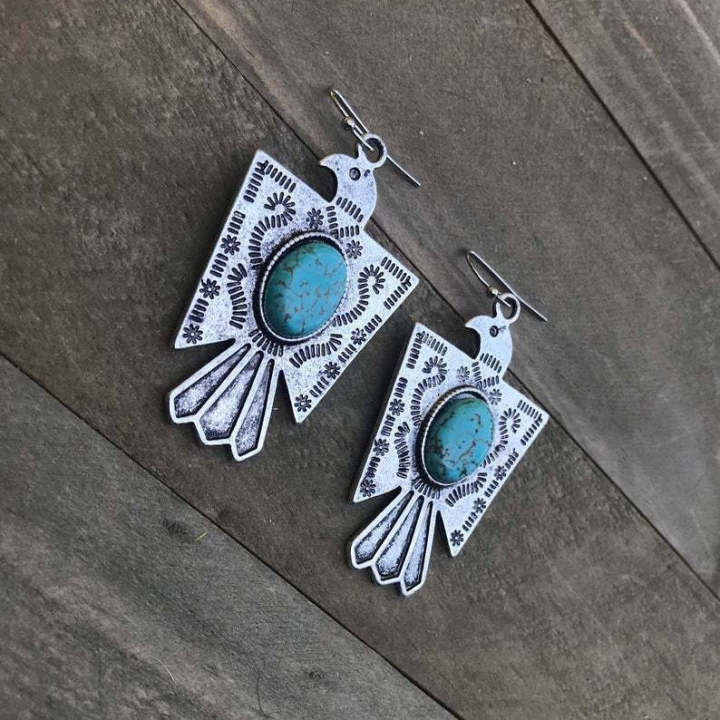
Earring proportion checklist
- Choose smaller silhouettes when you want the turquoise color to act as an accent rather than the main event.
- Use elongated shapes to add a vertical line beside the face and neck.
- Pair wide statement earrings with uncomplicated necklines so the design has breathing room.
- Check the listed measurements and fastening style instead of judging scale only from a close-up photograph.
- Consider comfort and expected wear time, especially for events that last several hours.
How to choose a western turquoise necklace
A necklace affects the entire upper half of an outfit. The first question is where the focal point should sit. Short necklaces draw attention toward the neck and collarbone. Mid-length pendants work with many crew necks, open collars, and dresses. Longer necklaces create a vertical line and can break up a large area of solid fabric. When measurements are available, compare them with a necklace you already own instead of relying on a model photograph alone.
To turn those measurements into an exact neckline and layering plan, compare the current sizes and silhouettes in Western Necklaces. Map the full pendant endpoint—including its bail and extender—rather than relying on a chain-length label by itself.
A teardrop pendant is a useful first western necklace because the shape creates a clear focal point without requiring complicated layering. The Turquoise Western Teardrop Pendant Necklace is one example of this approach. Wear it over a white tee and denim jacket, inside an open button-down shirt, or against a plain black or cream dress. For additional silhouettes, visit the western necklaces collection.
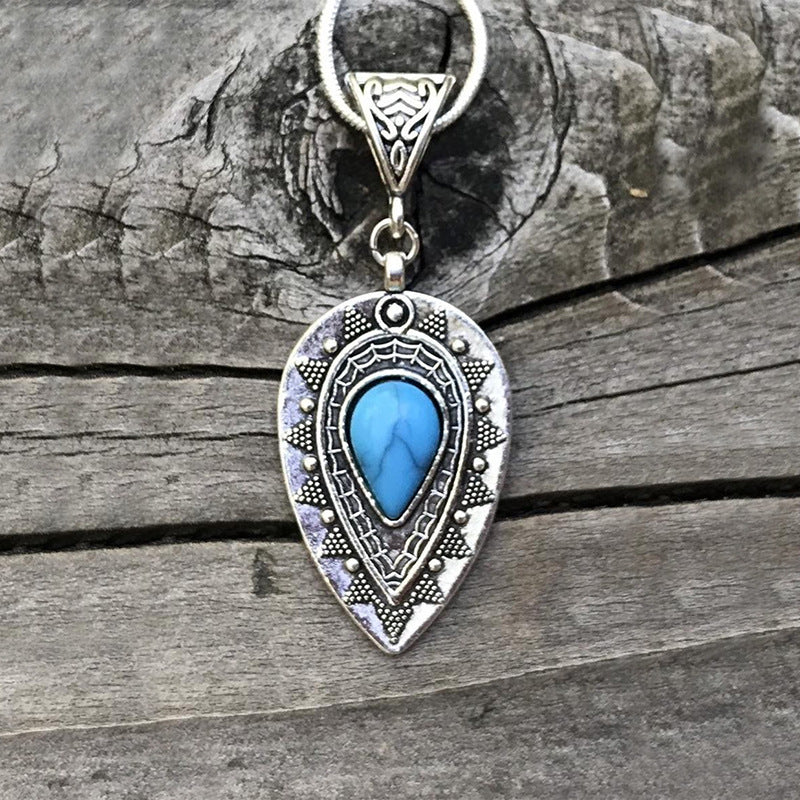
Simple necklace layering rules
Layering works best when each necklace has a distinct role. Begin with the turquoise pendant as the focal layer. Add one simpler chain above or below it, leaving enough distance for each outline to remain visible. Repeating one metal tone creates continuity, while varying chain texture adds depth. If the pendant is large, stop at two layers. More necklaces are not automatically more stylish; the goal is a readable arrangement rather than a crowded neckline.
How to choose turquoise bracelets and cuffs
Bracelets are ideal when you want color that does not sit close to the face. They are visible when you move, hold a bag, use a phone, or rest your hands on a table. A single cuff can be the focal point, while a coordinated set creates a fuller western stack. Compare wrist measurements and closure information when available, and think about whether you prefer a close fit or more movement. Browse Western Bracelets and compare cuffs, clasp bracelets, closed bangles, and beaded styles, including contact with a watch, sleeve, and work surface.
The Turquoise Western Cuff Bracelet Set offers a ready-made stacked effect. It can be worn with rolled denim sleeves, a sleeveless dress, or a neutral knit. If earrings and a necklace already make strong statements, a simpler bracelet keeps the outfit from becoming top-heavy. Explore additional options in the western bracelets collection.
How to choose western turquoise rings
Rings bring western detail into your line of sight throughout the day. A single noticeable ring can work like a miniature statement piece, while smaller rings can be distributed across several fingers. Comfort depends on band shape, height, width, and fit. Look for size information on each product page and consider how a ring will interact with daily activities. A tall decorative setting may be perfect for an evening but less convenient when wearing gloves or working with your hands.
When building a ring combination, use one dominant shape and keep the surrounding bands simpler. Repeating turquoise color across every finger can flatten the look; varying scale usually creates a more natural stack. Visit the western rings collection to compare available shapes and proportions.
Choosing color and metal tone
Turquoise-inspired jewelry ranges from green-blue to clear sky blue, with varying amounts of dark veining, brown pattern, black detail, or pale matrix. Product photography, display brightness, and lighting can affect the color you see on a screen, so examine more than one image. If you want maximum versatility, choose a mid-tone blue-green that contrasts with both light and dark clothing. A brighter blue feels crisp against white and black, while greener tones often blend naturally with olive, rust, camel, and brown.
Silver-tone settings produce the classic cool contrast many people associate with western turquoise style. Warmer metal tones can connect the blue-green color with tan leather, gold accessories, and earth-toned clothing. Mixing metal tones is possible when it looks intentional. One easy method is to repeat each tone at least once, such as a warm belt buckle with a warm bracelet detail and a cool necklace with cool earrings.
How much turquoise should one outfit include?
Use the focal-point rule: decide where you want the eye to land first. If the answer is the face, choose statement earrings and keep the necklace quiet or skip it. If the answer is the neckline, lead with a pendant and use small earrings. If the answer is the hands and wrists, build a cuff or ring story while keeping the upper half simple. Matching sets can look polished, but they are not mandatory. Pieces feel related when they share color, metal tone, geometry, or mood.
For a minimal outfit, one turquoise element may be enough. For a coordinated western look, use two pieces with different scales, such as small earrings plus a pendant or a pendant plus a cuff. For a festival or special event, three pieces can work when only one is visually dominant. Let solid clothing act as negative space around the jewelry.
Western turquoise jewelry outfit ideas
Everyday denim
Start with straight-leg jeans, a white or cream top, and a denim or suede-look jacket. Add a teardrop pendant or medium earrings. Brown boots and a structured belt complete the western direction without turning the outfit into a costume. This formula is useful because every component can be worn separately.
Black dress contrast
A plain black dress creates a clean background for turquoise color. Choose either larger earrings or a pendant, then repeat a small amount of blue-green at the wrist. The result can work for dinner, a concert, or an event where you want the jewelry to be the memorable detail.
Soft neutral layers
Combine cream, oatmeal, camel, and light denim, then use turquoise as the only saturated color. A compact earring set is appropriate for a quiet daytime version. A larger pendant or cuff makes the same palette stronger for evening.
Country concert or rodeo styling
Begin with boots, denim, and one strong jewelry piece. Add a hat, fringe, or embellished belt only if it supports the same focal point. A common mistake is using every western element at once. The jewelry looks more valuable when the rest of the outfit has a clear hierarchy.
Office-friendly western detail
Use small turquoise earrings, a restrained pendant, or one ring with a blazer, button-down shirt, or knit dress. Keep the silhouette compact and let the color provide personality. This approach introduces western style without conflicting with a polished workplace wardrobe.
Watch: a beginner's introduction to turquoise jewelry
The following video, A Beginners Guide To Turquoise Jewelry by LaCkore Couture, provides additional visual context about turquoise jewelry and terminology. It is an independent third-party video and is not an Oroxen product endorsement. Use it as general education, then review each Oroxen product page for the specifications of the item you are considering.
If the embedded player is not available, watch the turquoise jewelry guide on YouTube.
A practical buying checklist
- Choose the job of the piece. Decide whether it should be an everyday accent, a signature accessory, an event statement, or a gift.
- Check scale. Review measurements and compare them with jewelry you already own.
- Read the product information. Do not assume material, stone type, or construction from color or styling language.
- Review every available image. Look at the front, side, closure, texture, and how the piece appears against a person or surface.
- Consider comfort. Think about weight, movement, fastening style, wrist fit, ring size, and the number of hours you expect to wear it.
- Match your wardrobe. Identify at least three outfits you can wear with the piece before buying.
- Check current policies. Review shipping, returns, and product-specific information before completing the order.
How to care for turquoise-inspired fashion jewelry
Care requirements vary by material and construction, so follow any product-specific guidance first. As a general habit, keep fashion jewelry dry and remove it before swimming, showering, exercising, applying lotion, or using perfume and household chemicals. Put jewelry on after beauty products have dried. Wipe pieces gently with a soft, dry cloth after wear, then store them separately so chains, settings, and surfaces do not rub against harder objects.
Avoid abrasive cleaners and aggressive polishing unless the product instructions specifically approve them. Do not soak a piece simply because the color resembles natural stone. Separate storage is especially helpful for large pendants, statement earrings, and cuffs because their edges can catch on other jewelry. Good care protects appearance and also makes it easier to see which pieces you genuinely wear often.
If a product is specifically documented as containing turquoise, the Gemological Institute of America’s turquoise care guide warns against steam and ultrasonic cleaning and notes that heat, chemicals, cosmetics, oils, and perspiration can affect the material. For an unspecified accent or mixed-material fashion piece, use the more conservative product-specific instructions instead of assuming gemstone care is universally appropriate.
How to choose turquoise jewelry as a gift
When buying for someone else, observe the jewelry they already wear. Do they choose studs or long earrings? Are their necklaces close to the neck or longer? Do they wear bracelets at work? Which metal tone appears most often? A gift that resembles the recipient's existing habits is more likely to be worn. Earrings can be easier than rings when size is uncertain, while a pendant creates a clear gift moment without requiring a complicated stack.
For a recipient who loves bold western fashion, consider a statement earring or noticeable pendant. For someone new to the style, begin with compact earrings or one versatile necklace. The jewelry gifts for her collection offers additional ideas, while the cowgirl jewelry collection focuses on a stronger country-inspired direction.
Frequently asked questions
Can turquoise jewelry be worn every day?
Yes, if the design is comfortable for your routine and you follow the care instructions for that specific item. Smaller earrings, a moderate pendant, or a simple ring are often easier to repeat than a large event piece. Everyday wear still requires protection from moisture, chemicals, impact, and abrasive storage.
Does western turquoise jewelry have to match?
No. Pieces can coordinate through color, metal tone, shape, or overall mood without belonging to a formal set. A small earring and a larger pendant may look more natural than several pieces with identical scale.
Can I mix turquoise jewelry with black clothing?
Black is one of the easiest backgrounds for turquoise color because it creates strong contrast. Use one focal piece for a clean look or repeat the blue-green color once at the wrist or hand for a more coordinated outfit.
How can I tell whether turquoise is natural?
Color and photography are not enough to verify material. Review the seller's product specifications and ask for clarification when information is missing. This guide discusses western turquoise style and should not be treated as authentication advice.
What is the easiest first western turquoise piece?
A moderate pendant or a small-to-medium pair of earrings is usually the easiest starting point. Both can add color to basic outfits without requiring ring sizing or bracelet fit decisions.
Build your own western turquoise look
Continue by decision: compare complete outfits in the cowgirl jewelry style guide, learn the difference between a concho form and other earring terms in the concho earrings guide, or compare current hand-level silhouettes in Western Rings.
Start with one piece that fits your real wardrobe, then build slowly. The goal is not to collect the largest number of turquoise accessories; it is to find a scale, color, and silhouette that you will wear repeatedly. Begin with the Oroxen turquoise jewelry collection, compare pieces by type through all western jewelry collections, and review the product pages for current details before ordering.
For a concise first combination, pair the Turquoise Western Teardrop Pendant Necklace with the smaller Turquoise Western Stud Earring Set. For a stronger focal point, choose the Turquoise Western Statement Earrings and leave the neckline simple. For movement at the wrist, add the Turquoise Western Cuff Bracelet Set.
Visit the Oroxen home page to see current featured pieces, shipping messages, and new collection links.
Styling turquoise color with denim: use the turquoise jewelry and denim jacket outfit guide to compare light, medium, dark, black and white washes; check collar, hardware and sleeve interference; and test the jacket open, closed and removed.
Statement or everyday purchase: use the Turquoise Jewelry for Women comparison to evaluate visibility, owned-wardrobe matches, physical contact, real settings and verified product facts with the 30-Wear Decision Grid.
Giving Turquoise-Style Western Jewelry
If you are choosing for a recipient, color preference alone is not enough. The western jewelry gifts for her guide helps you match category, size, comfort, motif meaning, occasion, delivery timing, and an exchange plan while keeping turquoise-style language separate from unverified material claims.
Place turquoise-style color inside the broader category with the western jewelry definition and buying guide. It explains how placement, motif, color, documented composition, and provenance require different levels of evidence.