Concho earrings are easy to recognize but surprisingly easy to misunderstand. Their decorative metal shapes can feel vintage, western, sculptural, or bold, yet the word concho does not tell you everything about an earring's material, maker, age, or cultural origin. That distinction matters when you are comparing styles online.
This guide explains what concho earrings are, how the design developed, which details change their visual impact, and how to choose a pair that suits your wardrobe and comfort preferences. You will also find practical outfit formulas, shopping questions, care tips, and a featured Oroxen example. If you are building a broader western jewelry wardrobe, use this article together with our western turquoise jewelry buying guide and cowgirl jewelry style guide.
Concho Is Not the Same as Conch
| Term | Usually means | What to search or verify |
|---|---|---|
| Concho earring | An earring using a decorative western/Southwestern disk or related ornament | Disk shape, stamping, drop size, maker and material documentation |
| Conch earring | Jewelry for a conch cartilage piercing, or sometimes shell-inspired jewelry | Piercing placement, gauge, post length, hoop diameter, shell material |
The missing letter changes the shopping intent. Someone looking for concho-style western earrings needs overall scale and ornament information; someone shopping for a conch piercing needs body-jewelry measurements and piercing-specific guidance. Oroxen’s article and featured product concern the concho-inspired western design.
What Is a Concho Earring?
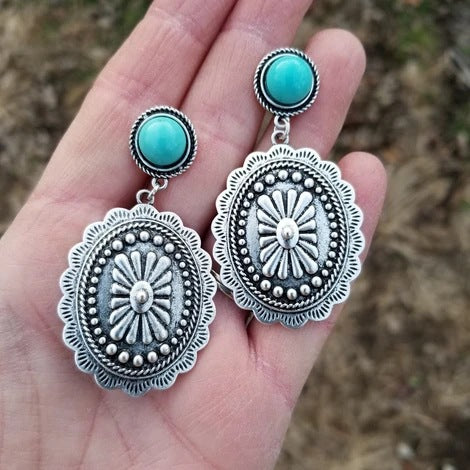
In one sentence, a concho earring is an earring whose design uses a decorative round, oval, scalloped, stamped, or radiating ornament associated with concho forms. Many contemporary versions translate the look of a belt ornament or tack decoration into a smaller, wearable format. Some are simple studs. Others suspend one or more concho-like pieces from hooks, crosses, chains, hoops, or gemstone-colored components.
The word describes a visual form more reliably than it describes a material. A concho earring can be silver toned, gold toned, copper colored, mixed metal, or made from another jewelry material. It can include natural stones, manufactured stones, glass, resin, enamel, or no colored accent at all. It may be handmade or factory produced. Read the individual listing instead of treating the style name as a guarantee.
A Brief, Careful Note on Concho History
The historical story is richer than a single fashion label. The Timothy S. Y. Lam Museum of Anthropology explains that the term is connected to the Spanish word concha, meaning a conch or shell, and came to refer to decorative silver disks. Museum scholarship discusses influences that include Mexican horse tack and Plains traditions. The Heard Museum's overview of Southwest silverwork also places concho forms within the development of Diné, or Navajo, silversmithing and describes the influence of Spanish Colonial buckles.
Those histories deserve specificity and respect. A modern earring sold with the word “concho” is not automatically Native-made, Navajo-made, antique, sterling silver, or culturally authenticated. Those are separate claims that should be supported by a named artist, material disclosure, provenance, hallmark, or other reliable documentation. In this guide, “concho-inspired” refers to the design vocabulary, not an unsupported claim about origin.
This is also a truth-in-marketing issue, not only a wording preference. The U.S. Department of the Interior explains that the Indian Arts and Crafts Act prohibits selling or displaying art or craftwork in a way that falsely suggests Indian production or the work of a particular tribe. Oroxen therefore should use “western” or “concho-inspired” for style unless the exact product has qualifying maker documentation.
For additional museum context, the Oklahoma State University Museum of Art overview dates the first Navajo concho belts to around 1870 and describes multiple design influences. That careful account is more reliable than assigning one universal spiritual meaning to every modern concho-shaped earring.
How Concho Earrings Differ from Belts, Buttons, and Tack
Traditional concho belts use a sequence of decorative ornaments connected along a leather or metal structure. Conchos also appear on hatbands, bridles, bags, cuffs, and clothing. Earrings borrow that recognizable ornament but must solve different design problems: they hang beside the face, move with the wearer, and place weight on a small piercing or clip.
That change in scale has a major effect. A shallow stamped pattern may look subtle on a belt but catch the light beside the jaw. A scalloped edge becomes a distinct silhouette. A small turquoise-colored center can act as a bright focal point. Movement that is barely noticeable on a bag can make an earring feel lively. When evaluating earrings, look beyond the motif and consider total length, width, articulation, closure, and apparent thickness.
The Design Details That Create the Concho Look
Round and oval silhouettes
Round shapes feel balanced and graphic. Ovals often appear slightly longer and can visually echo the line of a drop earring. Both shapes work as studs or pendants. A repeated pair of disks creates rhythm, while one larger ornament makes a cleaner statement.
Scalloped, sunburst, and stamped edges
Concho designs frequently use radiating lines, petal-like edges, rope borders, dots, or geometric stamping. These details produce contrast even when the earring uses only one metal color. Deeper relief generally reads as more dramatic; fine shallow marks can feel more delicate.
Crosses and geometric extensions
Modern western earrings often combine a concho-like ornament with crosses, diamonds, fans, bars, or linked geometric drops. The combined silhouette may be more noticeable than either element alone. If your clothes already feature embroidery, fringe, or a large buckle, a simpler earring can keep the outfit focused.
Turquoise-colored accents
Blue-green accents create strong contrast against antiqued or warm metal tones and are popular in western styling. Color alone does not identify the substance. A listing should tell you whether an accent is natural turquoise, stabilized stone, composite material, glass, resin, enamel, or another material. If it does not, ask before assuming. Browse our turquoise jewelry collection by appearance, then verify the specifications on each product page.
Choose Scale Before You Choose an Outfit
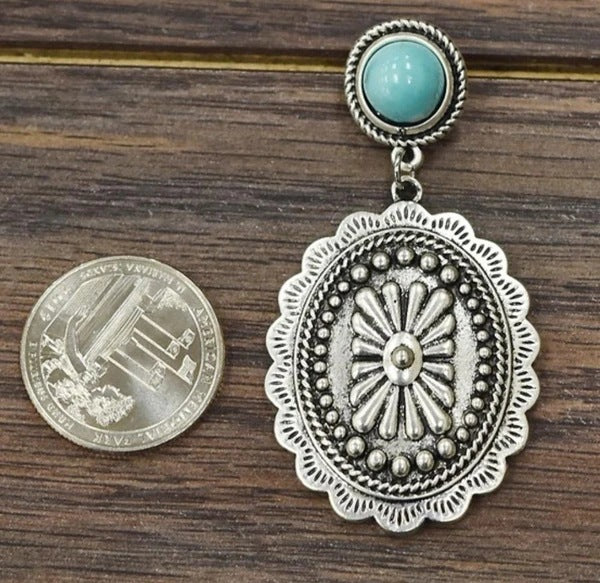
A product photograph often fills the screen, so a small earring can appear enormous and a large one can appear manageable. Start with measurements. Compare the listed length and width with an earring you already own. If there is no measurement, contact the seller. A ruler held beside your ear is more informative than guessing from a close-up image.
Small concho studs and compact drops are useful when you want a western note without making the jewelry the center of the outfit. Medium drops usually show clearly with loose hair and can move from daytime denim to dinner. Oversized designs create the most visible silhouette and often work best with open necklines, tied-back hair, or a deliberately minimal necklace.
Face shape rules are optional, not laws. More useful questions are practical: Does the lower edge touch your jaw? Does the earring compete with your glasses? Will your hair cover the central detail? Does the width feel proportional to the collar or hat you plan to wear? Choose the effect you enjoy, then make sure the dimensions support it.
Comfort: Weight, Movement, and Closures
A dramatic earring is only valuable if you can wear it for the intended occasion. Total weight, how that weight is distributed, and the closure all influence comfort. A broad but thin ornament may feel lighter than a smaller solid component. A long articulated drop can move more than a compact design, even at a similar weight.
- Stud posts keep the design close to the ear and can provide a stable base for a drop.
- Fishhooks create easy movement; silicone stoppers can help prevent loss.
- Leverbacks close around the wire and may feel more secure during active events.
- Clip-ons offer a non-pierced option, but pressure varies by mechanism.
If you are sensitive to metals, look for a precise statement about the part that touches the ear. “Silver color” is not the same as sterling silver, and a description of the decorative face may not describe the post or hook. For a festival, rodeo, or full day of travel, try the earrings at home for an hour before committing to extended wear.
Four Reliable Outfit Formulas
1. Everyday denim with one focal point
Combine straight-leg jeans, a white or chambray shirt, leather boots or loafers, and medium concho drops. Roll the sleeves and keep the neckline uncomplicated. The earrings provide pattern and color without requiring a themed outfit. A small ring or narrow cuff can repeat the metal tone.
2. A black dress with western texture
A simple black dress gives a detailed earring visual space. Add a textured belt, suede jacket, or boots, but do not feel required to use all three. This formula works because the clothing is a quiet background and the earring supplies the decorative language. For more dressy options, explore western earrings and compare silhouettes rather than matching every element literally.
3. Concert or rodeo layers
Start with a fitted tank or tee, high-rise denim, and an overshirt or cropped jacket. Choose earrings that remain visible under a hat and do not catch on fringe. If you expect dancing or frequent movement, use secure backs and avoid a length that brushes your collar. The cowgirl jewelry collection can help you coordinate an expressive event look.
4. Soft neutrals for gifting or brunch
Cream knitwear, tan trousers, muted green, and soft denim let turquoise-colored accents stand out gently. This is a useful approach when the recipient or wearer prefers restrained color. If you are shopping for someone else, review our jewelry gifts for her, but confirm allergies, piercing style, and preferred earring weight before buying.
How to Mix Concho Earrings with Other Jewelry
Coordination does not require an exact set. Instead, repeat one or two visual cues: metal tone, blue-green color, stamped texture, geometric shape, or overall scale. A large concho earring often works with a fine chain or no necklace. A smaller stud can support a more substantial pendant. If both pieces are highly detailed and occupy the same visual area, they may compete.
Bracelets and rings sit farther from the face, so they are easier places to add another strong shape. Mixed metals can look intentional when each tone appears more than once—for example, a silver-toned earring with a two-tone ring and a warm buckle. For a coordinated starting point, compare pieces in western jewelry or see the western jewelry bestsellers.
A Featured Oroxen Concho-Inspired Example
The Turquoise Vintage Geometric Concho Cross Earrings combine turquoise color, vintage-inspired surface character, geometric structure, and a cross motif. They are a stronger statement than a plain disk, so they fit particularly well into the black-dress and concert formulas above.
The product name describes the look; it should not be read as an unlisted claim about natural stone, sterling silver, Native authorship, or antique age. That same reading habit is useful across any online jewelry store. Separate the aesthetic description from the measurable product specifications.
How to Read a Concho Earring Listing
A trustworthy buying decision starts with concrete information. Before ordering, look for several views, a scale reference, measurements, closure type, material details, and the return policy. Zoom in on edges and connection points. If the pair is articulated, a video or alternate angle can help you understand movement.
- Identify what is documented. Write down the stated base metal, finish, accent material, dimensions, and closure.
- Separate description from evidence. Words such as “western,” “vintage-inspired,” and “turquoise-colored” describe appearance. They do not independently establish age, origin, or composition.
- Check the unit. Confirm whether the listing is for a pair or a single earring.
- Review practical policies. Shipping time and return conditions matter when buying for a dated event or gift.
- Ask focused questions. Instead of “Is this good quality?” ask for the earring weight, post material, stone type, or maximum drop length.
If a seller makes a specific cultural attribution or names an artisan, look for supporting details. Buying directly from a documented artist or an established representative is the clearest route when cultural authorship is central to your purchase. A style keyword should never substitute for that documentation.
Care and Storage
Follow the care instructions supplied for the actual materials. As a conservative routine, put earrings on after fragrance, hairspray, lotion, and makeup have dried. Remove them before swimming, showering, sleeping, or exercising unless the maker says those conditions are safe. Wipe surfaces gently after wear with a soft, dry cloth.
Store each pair separately so raised details do not scratch another item and hooks do not tangle. Keep backs with their posts. Avoid dipping an earring into a chemical cleaner unless the product instructions confirm compatibility with every component, including coatings, adhesives, stones, and patina. Aggressive polishing can remove an intentionally antiqued finish that gives the design its contrast.
See How Concho Elements Are Styled
This independent video from FashioNica demonstrates concho elements used in chokers and hatbands. It is helpful for seeing how the ornament reads at different scales and how it interacts with western accessories. The video is third-party educational inspiration; it is not an Oroxen endorsement and does not document the materials or origin of any Oroxen product.
Watch “How to: DIY Concho Chokers and Bands | Styling Concho” on YouTube.
A 60-Second Buying Checklist
- Can you find the exact length and width?
- Is the weight listed, or can the seller provide it?
- Which material touches the ear?
- Does the listing identify the accent material precisely?
- Is the design a stud, fixed drop, or moving articulated drop?
- Will it clear your collar and work with your glasses or hat?
- Are cultural origin, artist, sterling content, or age claims documented?
- Do the shipping date and return policy suit your occasion?
Once those questions are answered, choose by personality. A compact stamped disk offers quiet western detail. A turquoise-colored geometric drop adds contrast. A cross or multi-part design makes a more obvious statement. The best pair is not the one with the most decoration; it is the pair whose scale, comfort, and meaning fit the way you will actually wear it.
Frequently Asked Questions
What does “concho” mean in jewelry?
In jewelry, concho generally refers to a decorative disk or disk-like ornament, often round or oval and sometimes stamped, scalloped, or embellished. The term is historically connected to the Spanish concha, or shell. Contemporary designers also use looser concho-inspired shapes.
Are all concho earrings Native American jewelry?
No. Concho forms have an important place in Southwestern and Native jewelry history, including Diné silversmithing, but a modern product using the style word is not automatically Native-made. Look for a named artist, tribal affiliation where supplied by the artist, seller documentation, and provenance when authorship is important.
Are concho earrings always sterling silver?
No. They can be made from many metals and other materials. “Silver toned” describes color, while “sterling silver” is a specific material claim. Check the listing and any hallmark information.
Does a blue-green accent mean natural turquoise?
No. It may be natural turquoise, treated or composite material, another stone, glass, resin, enamel, or a colored decorative element. The seller should identify the material if it is known. Appearance by itself is not enough.
Can concho earrings be worn every day?
Yes, if the scale, closure, weight, and materials are comfortable for you. Small studs and compact drops are often easiest for routine wear. Save heavier or longer statement pairs for shorter occasions if your ears become tired.
What necklace works with concho earrings?
With large or detailed earrings, try a fine chain, a short simple pendant, or no necklace. With small concho studs, a more substantial western pendant can work. Repeat one color or texture and allow one piece near the face to lead.
How do I style concho earrings without looking like a costume?
Use one clear western focal point and keep the rest of the outfit familiar. Denim and a white shirt, a black dress, or neutral knitwear provide an easy base. Add texture through one belt, boot, or jacket rather than stacking every western symbol at once.
Find Your Version of the Concho Look
Next useful step: compare concho proportions with studs, hoops, and other drops in Western Earrings. Then compare hand-level scale in Western Rings, or return to the cowgirl outfit formulas to plan the full look.
Concho earrings can be historically resonant, visually bold, and surprisingly versatile, but thoughtful shopping requires more than recognizing the shape. Begin with documented specifications, choose a scale you will enjoy wearing, and treat material and origin claims with care. Then style the pair as an intentional focal point rather than an obligation to build a complete theme.
Explore the featured geometric concho cross earrings, compare more options in Western Earrings, browse all Oroxen collections, or return to the Oroxen homepage. Choose the details that feel like you—and verify the facts that matter before you buy.