Women’s turquoise jewelry can play two very different wardrobe roles. A large cross earring, wide cuff or bold pendant may organize an entire outfit from conversation distance. A compact ring, moderate necklace or smaller earring may contribute color without deciding what every other item has to do. The first role is usually called statement styling; the second is usually called everyday styling. Neither is automatically better, more flattering or more valuable.
The useful question is not simply “Is this piece big?” It is: How many real outfits, settings and hours of movement can this specific piece support? A visually bold earring can become a weekly uniform when it clears the wearer’s hair, glasses and collars. A small ring can remain an occasional item when its fit, raised surface or care needs conflict with daily routines. This guide uses an original 30-Wear Decision Grid to separate appearance from repeatability and help shoppers compare earrings, necklaces, bracelets and rings before buying.
Statement Jewelry vs Everyday Jewelry: The Practical Difference
Statement and everyday are wearing roles, not permanent product categories. The same necklace can be the lead against a black dress, a color echo under a denim jacket or a hidden non-factor beneath a high collar. A ring may look strong in a close-up photograph but subtle at full-length distance. Earrings may appear moderate on a product page and become the outfit’s main event when hair is pulled back.
| Decision | Statement role | Everyday role |
|---|---|---|
| First visible detail | Jewelry is intended to lead | Jewelry supports the outfit or wearer |
| Competing elements | Usually fewer near the same body zone | Can coexist with familiar wardrobe details |
| Movement test | Must remain intentional while walking, sitting and turning | Must remain comfortable through repeated routine tasks |
| Buying priority | Visual impact plus a clear occasion plan | Repeatability, contact comfort and outfit compatibility |
Do not use price, product naming or a close crop as the shortcut. Instead, compare the item with your body proportions, clothing structure, activities and the seller’s stated specifications. The What Is Western Jewelry? guide explains why motif, color, composition and documented origin are separate evidence questions.
The 30-Wear Decision Grid
The grid asks whether you can imagine wearing the piece 30 times without inventing a new wardrobe or ignoring physical contact. It is not a mathematical promise. It is a structured pre-purchase test that replaces “I like it in this photo” with five observable questions.
1. Visibility: where is the piece readable?
Check the item at mirror-close, conversation and full-length distance. A ring may dominate close-up but disappear at conversation distance. Earrings often remain readable near the face. A necklace depends on neckline, pendant endpoint, hair and outerwear. A bracelet may be visible mainly to the wearer unless sleeves are rolled or the hands are moving.
For a statement role, the jewelry should be recognizable at the distance that matters for the intended setting. For an everyday role, visibility may be smaller, but the piece should still contribute something the wearer values: color at the hand, a bright point near the face or a pendant visible inside a jacket opening.
2. Wardrobe matches: can you name ten real outfits?
List clothing you already own, not imaginary future purchases. Try to name ten combinations across at least three categories: jeans and tees, dresses, workwear, knitwear, outerwear, concert outfits or travel layers. If a piece only works with one special dress, treat it as an occasion statement. If it fits black, white, cream, denim, brown and several necklines, it may have stronger everyday potential.
The Western Jewelry Styling Guide provides broader formulas for denim, dresses, boots and workwear. Use those formulas to count realistic matches rather than buying another garment to rescue one accessory.
3. Contact: what does the jewelry touch?
Contact often decides repeatability. Earrings may touch hair, jaw, collars, glasses or a hat. A pendant may strike buttons, a desk edge, a seat belt or a belt buckle. A bracelet may meet a sleeve, watch, keyboard, bag strap or table. Rings meet pockets, phones, steering wheels, gloves, door handles and handwashing.
Simulate the intended day: walk, sit, reach, turn your head, put on a jacket, use a phone and carry a bag. A statement item does not need to be invisible, but it should not create contact you are unwilling to manage. An everyday item should survive ordinary movement without constant repositioning.
4. Setting flexibility: where can you actually wear it?
Write down the settings you enter in a normal month: home, office, customer meetings, commuting, driving, school runs, dinner, worship, concerts, travel or outdoor events. Apply real dress-code, safety, hygiene and personal-comfort rules. Loose or dangling jewelry may be unsuitable around machinery, tools, food preparation, clinical work, sports, childcare, gloves or other personal protective equipment.
A piece does not need to work everywhere to be a good purchase. It only needs a clear role. The mistake is paying for imagined frequency while ignoring the rules of the places you actually go.
5. Evidence completeness: what does the listing prove?
Before assigning “daily,” “lightweight,” “natural,” “silver,” “adjustable,” “hypoallergenic,” “handmade” or an origin claim, check whether the live listing explicitly supports it. Review dimensions, closure, option names, ring sizes, set contents, stated materials, care, shipping and returns. A blue-green appearance proves color in a photograph, not natural turquoise. “Silver tone” describes appearance and does not establish sterling silver.
A Simple Statement-to-Everyday Scorecard
Mark each line clear, uncertain or conflict. A statement purchase can tolerate fewer wardrobe matches when it has a strong occasion plan. An everyday purchase needs fewer contact conflicts and broader repeatability.
- I can identify the body zone and viewing distance where the piece is visible.
- I can name ten outfits I already own that support it.
- I tested or estimated contact with hair, collar, sleeves, watch, pockets, phone and bag.
- I can name at least three real settings where it fits the rules and activity.
- The live product page states the dimensions, options and materials I need to decide.
- I know whether I am buying one lead piece, a supporting accent or a coordinated set.
- I can describe how the item will work when outerwear is added or removed.
If wardrobe matches and contact are both conflicts, the piece is unlikely to become an everyday anchor. If impact is clear, an event is real and contact is manageable, it may be an excellent statement purchase. If evidence is missing, pause the material or fit conclusion instead of filling the gap with photography.
Three Verified Oroxen Examples
Statement example: cross earrings
The Turquoise Vintage Statement Cross Earrings for Women are explicitly titled for women and tagged in the store as Women’s Jewelry and Turquoise. Their strongest role is likely near the face, where cross form and blue-green color can be seen without another necklace competing at the neckline. Before buying, inspect the current option images and listing details; the word “turquoise” in the title does not by itself authenticate a gemstone.
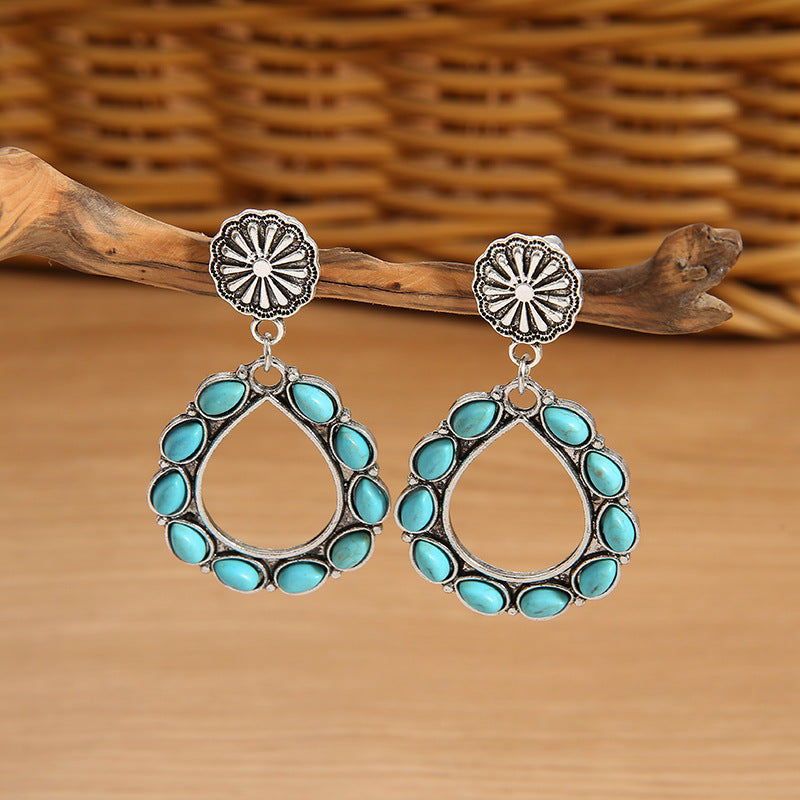
For statement styling, clear the collar and decide whether hair should reveal or partly soften the earrings. Use a black, white, cream, rust or simple denim base. For a more repeatable role, keep the neckline quiet, repeat the blue-green color only once at the hand or bag, and test the earrings with the wearer’s most common glasses, hat and jacket.
Bridge example: geometric necklace
The Turquoise Vintage Geometric Necklace for Women can operate as the bridge between categories. A geometric pendant may lead against a solid open neckline, but the same item may become an everyday accent inside a denim-jacket opening or over a simple knit. The deciding factors are the current pendant scale, chain or cord details, endpoint and contact with buttons or graphics.
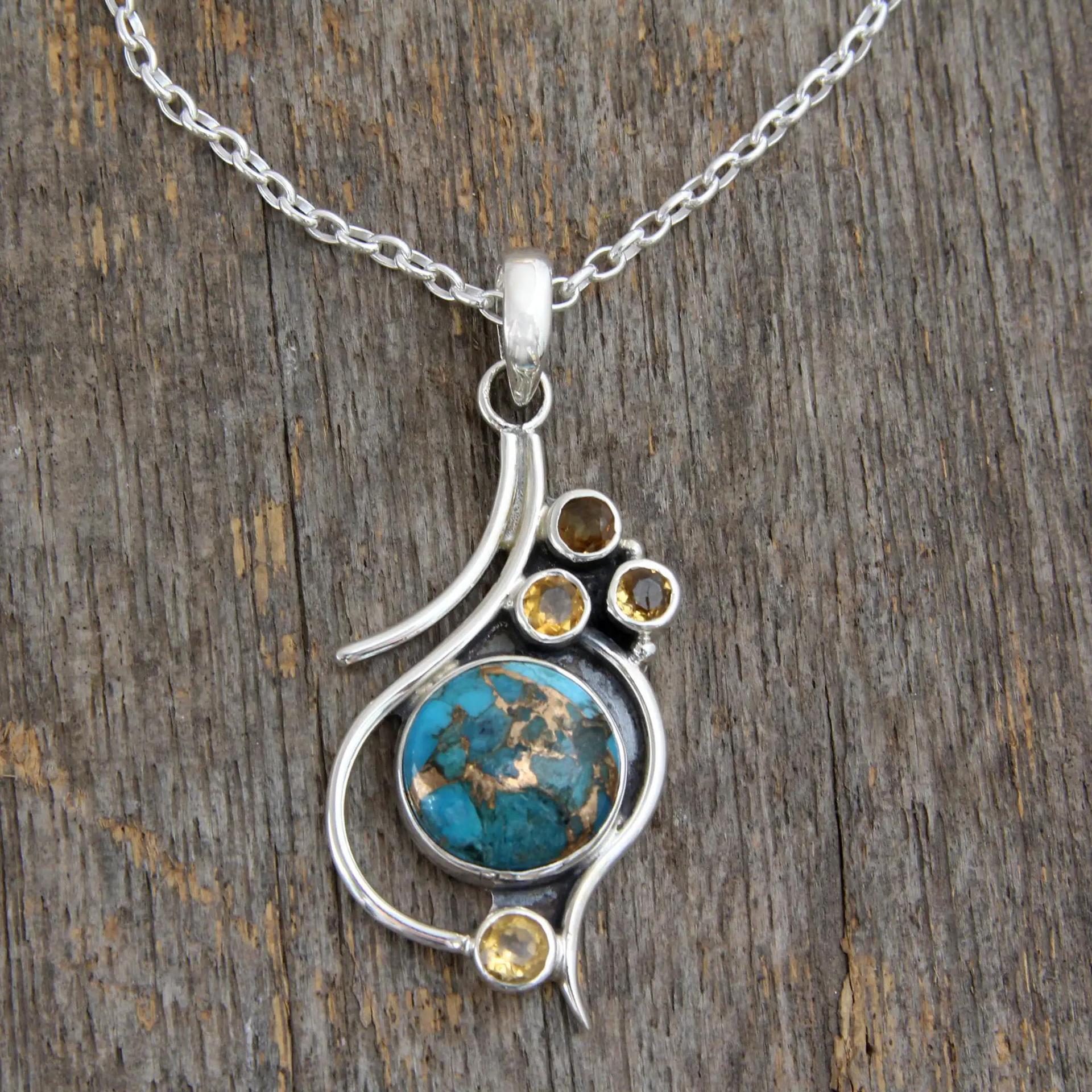
Compare the live measurements and silhouettes in Western Necklaces to place the pendant inside a stable background. If it lands on a button, pocket edge, print or buckle zone, change the neckline or length plan rather than assuming the product photograph predicts the result.
Everyday candidate: resin ring
The Turquoise Vintage Resin Ring for Women is explicitly titled for women, tagged Turquoise and Women’s Jewelry, and currently presents US size options 6 through 10. A ring can become a repeatable color accent because it stays away from hair and necklines, but hand contact matters more: phone grip, pockets, typing, steering, gloves and washing.
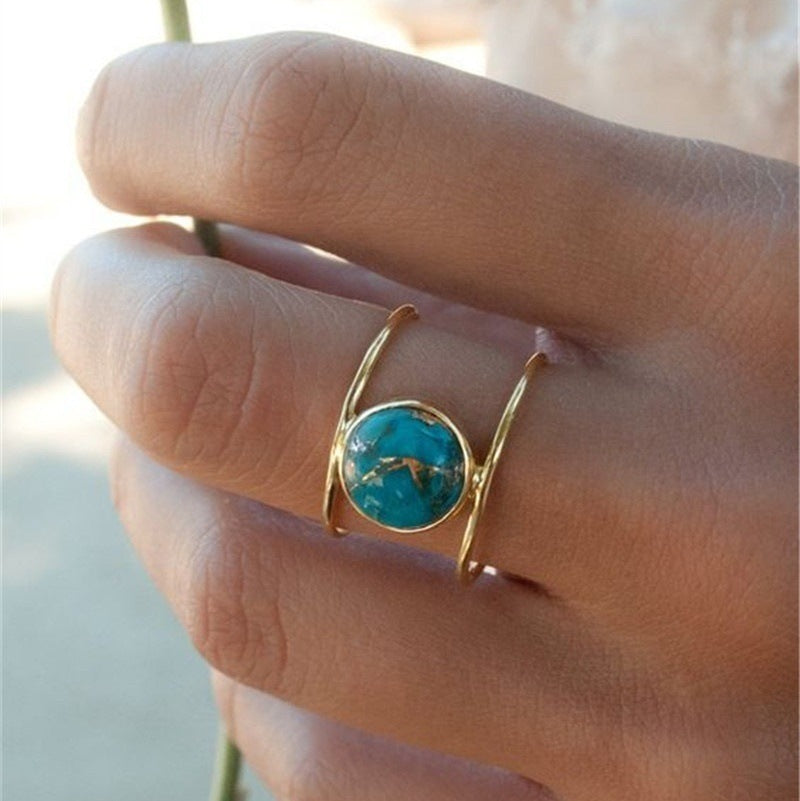
Use the current size selector and product images rather than estimating fit from the title. For deeper ring decisions, compare the current options in Western Rings. Separate visible scale, finger fit, profile and care from unverified gemstone claims.
How to Make a Statement Piece More Repeatable
Give it one clean background
A bold piece becomes easier to repeat when it does not fight nearby clothing. Place earrings beside a quiet collar, a pendant against a solid top, a cuff below a deliberate sleeve edge or a ring beside a simple manicure and uncluttered sleeve. The goal is not minimalism; it is readable separation.
Repeat only one property
Echo the lead through one smaller feature: blue-green color, cross form, geometric shape, textured surface or cool/warm metal appearance. Do not duplicate every property at the same scale. A statement earring plus a moderate ring can feel coordinated; statement earrings, statement necklace, wide cuff, large ring, buckle and embroidered yoke may divide attention.
Use the Three-Outfit Conversion Test
- Casual: jeans or a simple skirt, solid top and everyday shoes.
- Structured: jacket, blazer, button-down or clean dress.
- Event: concert, dinner or celebration outfit with real movement and outerwear.
If the same jewelry remains clear and comfortable in all three, it may be a wardrobe statement rather than a one-event statement. For denim-jacket specifics, use the Denim Jacket Control Panel to check wash, collar, hardware, sleeves and the jacket open, closed and removed.
How to Make an Everyday Piece Feel More Intentional
An everyday item does not have to disappear. Increase its role with one controlled change:
- Move hair away from a compact earring instead of adding a second large piece.
- Place a pendant against black, white or cream for stronger edge contrast.
- Roll one sleeve cleanly to reveal a bracelet or ring zone.
- Repeat the blue-green color once in a belt, bag, scarf or shoe detail.
- Use a monochrome outfit so a moderate piece becomes the color interruption.
- Remove a competing buckle, print, scarf or necklace rather than increasing jewelry scale.
Category-by-Category Buying Decisions
Earrings
Earrings usually have high conversation-distance visibility. Statement candidates need clearance from hair, glasses, hat, jaw and collar. Everyday candidates need comfortable closures and a scale compatible with the wearer’s normal hairstyle. Compare measurements, closures and current silhouettes in Western Earrings before making weight or fit assumptions.
Necklaces
Necklaces depend on neckline and endpoint. A large pendant may be easy with a plain dress but difficult with chest pockets, buttons, a scarf or buckle. An everyday pendant needs at least two or three reliable neckline zones. Compare current options in Western Necklaces.
Bracelets and cuffs
A cuff may create a strong statement beside an exposed wrist, while a smaller bracelet may layer with a watch. Both require contact checks with sleeves, desks, keyboards, bags and wrist bend. Browse Western Bracelets and compare each product’s construction, inner dimensions, opening and closure before choosing.
Rings
Rings can be visually strong in close-up yet easy to integrate into outfits. Everyday suitability depends on correct size, inner fit, profile, neighboring fingers and hand tasks. Compare Turquoise Rings and Western Rings, then verify the current size and option selector on the individual product page.
Eight Outfit Formulas
- Everyday color point: white tee + jeans + geometric necklace + simple shoes.
- Face-zone statement: black dress + cross earrings + no competing necklace.
- Hand-level everyday: cream knit + dark denim + resin ring + quiet wrist.
- Denim bridge: open denim jacket + solid top + pendant inside the opening.
- Workwear accent: clean button-down + compact ring or earring, subject to actual workplace rules.
- Concert statement: black top + denim bottom + boots + one strong earring or cuff zone.
- Warm-neutral balance: rust or camel dress + blue-green necklace + controlled metal echoes.
- Double-denim separation: two denim washes + white underlayer + one turquoise-colored lead.
These formulas are starting points, not proof of fit or material. If the outfit is for a country concert, the Country Concert Jewelry Guide adds venue, weather, bag, movement and crowd-contact checks.
Third-Party Video Context
JTV’s Wear It With Style: Turquoise Jewelry is a short third-party reference whose public description specifically contrasts a bold statement with a subtle styling contribution. It is included as context for the role decision. It is not an Oroxen endorsement or product demonstration, and it does not establish that any Oroxen item contains natural turquoise or matches a featured gemstone, metal, treatment, construction, maker or origin.
Product-Page Checklist Before Buying
- Exact product title and the option currently selected
- Dimensions, pendant endpoint, earring drop, bracelet construction or ring size
- Closure, chain, cord, cuff opening, stretch or adjustment instructions
- Set contents and whether every pictured item is included
- Stated material language, separated from color and style words
- Care instructions and any chemical, moisture or storage limits
- Current price, availability, shipping timing and return terms
- Photos for color variation and scale, without treating them as authentication
Explore the broad Turquoise Jewelry collection, the complete Western Jewelry collection or the shorter Western Jewelry Bestsellers edit. Use the live product page as the source for current commercial facts.
Gifting: Buy the Role, Not Just the Color
For a gift, decide whether the recipient already wears statement jewelry or prefers repeatable accents. Review piercings, ring size, preferred body zone, work rules, neckline habits, metal appearance, color preference and willingness to manage larger pieces. A bright item that photographs well can still be the wrong role for someone who only wears compact jewelry.
The Western Jewelry Gifts for Her Guide adds occasion, giftability, delivery and exchange planning. Preserve the receipt and avoid making unverified claims about natural stone, precious metal, maker or origin in the gift message.
Women's Turquoise Jewelry FAQ
Is statement turquoise jewelry only for special occasions?
No. A bold piece can become a weekly wardrobe statement when it works with several owned outfits, clears physical contact and fits the wearer’s real settings. The 30-Wear Grid helps separate repeatable statements from one-event statements.
Can small turquoise-colored jewelry still be a statement?
Yes. Visibility depends on placement, contrast and viewing distance. A moderate ring against a simple hand zone or compact earrings with pulled-back hair may lead more clearly than a larger necklace hidden by a collar.
Should women wear a turquoise necklace and earrings together?
They can, but give the two pieces different roles. Let one lead while the other repeats color, shape or metal appearance at smaller scale. Check whether hair, neckline and outerwear create crowding.
What colors work with turquoise-colored jewelry?
Black and white create clear contrast; cream, brown, camel and rust create warmer support; denim can be soft or high contrast depending on wash. Bright colors can work when one hue is intentionally repeated and nearby competition is controlled.
How do I know whether a piece will become everyday jewelry?
Name ten owned outfits, three real settings and the routine movements it must survive. Then verify current dimensions, options, construction and care. High outfit compatibility with low contact conflict is stronger evidence than a lifestyle photo.
Does turquoise jewelry mean natural turquoise?
Not necessarily. “Turquoise” may identify color or style. Natural turquoise requires an explicit product-page statement or other appropriate documentation. A blue-green photograph is not authentication.
Can I wear statement earrings to work?
Only if they fit the actual dress, safety, hygiene and activity rules. Check contact with phones, headsets, collars, hair and protective equipment. In some workplaces, compact or removable jewelry is more practical.
What is the easiest everyday turquoise-colored category?
It depends on the wearer. A ring avoids neckline and hair conflicts but needs size and hand-task checks. A moderate pendant can work across several tops. Earrings can be highly visible but must clear hair and collars.
How do I make a turquoise statement piece look less costume-like?
Use familiar clothing, one clear lead, one smaller echo and at least one quiet adjacent zone. Remove competing themed signals before shrinking the jewelry. The goal is deliberate hierarchy rather than a rule against bold style.
Should everyday jewelry be lightweight?
Comfort matters, but do not label a product lightweight without stated weight or a reliable comparison. Review dimensions, construction, contact and return terms, then test the piece for the intended wear time when possible.
Your 60-Second 30-Wear Check
- I know whether the piece is the lead, an echo or an everyday anchor.
- I checked it at close, conversation and full-length distance.
- I can name ten outfits I already own.
- I can name three settings where it fits the rules.
- I checked hair, collar, sleeves, watch, pockets, phone, desk and bag contact.
- I tested casual, structured and event outfit roles.
- I verified size, options, construction, stated materials, care, price, availability, shipping and returns.
- I separated turquoise color/style from natural-stone claims.
Comparing women’s western pieces beyond turquoise color? Browse the smart Western Jewelry for Women collection and use the RIDER purchase check for role, listing evidence, dimensions, daily contact and return readiness.
A successful purchase does not have to be quiet or dramatic. It has to match the role you will actually use. Start with the Oroxen Turquoise Jewelry collection, compare the three verified examples above, or return to the Oroxen home page. Choose the piece whose visibility, wardrobe matches, comfort, settings and evidence still make sense after the thirtieth wear—not only in the first photograph.