Western jewelry does not require a head-to-toe costume. One turquoise-colored earring, cross ring, floral cuff, leather-accented pendant, or geometric necklace can give familiar clothes a western direction when the scale and placement are intentional. The challenge is not finding enough themed pieces. It is deciding which part of the outfit should lead, which detail should echo it, and where the eye needs a quiet place to rest.
This guide turns that decision into a repeatable styling method for denim, dresses, boots, jackets, button-downs, knitwear, uniforms, and practical work clothes. It focuses on visual balance and real-life wear rather than rigid rules. Personal style, dress codes, sensory needs, piercings, mobility, work restrictions, climate, and the exact product construction all matter. Use the outfit formulas as starting points, then verify every current product fact on the live listing.
The Lead–Echo–Quiet Method
Most competing styling advice begins with “wear one statement piece.” That is useful, but it does not explain how to coordinate several western signals already present in an outfit. The Lead–Echo–Quiet method treats the outfit as a conversation between three roles.
- Lead: the first intentional detail you want someone to notice. It might be statement earrings beside pulled-back hair, a pendant against a plain shirt, a cuff below a rolled sleeve, or a broad ring beside a simple manicure.
- Echo: one smaller repetition that makes the lead feel connected rather than accidental. Echo blue-green color with a compact ring, repeat a cross at a different scale, or carry a silver-tone look from earrings to a narrow bracelet.
- Quiet: the visual space that protects the lead. Quiet can mean no necklace under dramatic earrings, a plain neckline below a large pendant, one unstacked hand beside a cuff, or simple boots below an embroidered dress.
The method is descriptive, not restrictive. A maximal outfit can have several strong pieces, but it still benefits from hierarchy. Decide which detail leads from a normal conversation distance, which details support it, and which areas do not need another message.
Build an Outfit Signal Map
Before adding jewelry, scan five zones. Give each zone a low, medium, or high signal level. The goal is not to make every zone low; it is to avoid accidental competition between several high-signal details.
| Zone | Existing outfit signals | Good jewelry questions |
|---|---|---|
| Face and head | Hat brim, hair volume, glasses, makeup, scarf, ornate hatband | Will the earring remain visible? Can it move without catching? Does the hat already lead? |
| Neckline and chest | Yoke, embroidery, snaps, lapels, bandana, high collar, print | Does the pendant land on open fabric or collide with a seam, button, scarf, or pattern? |
| Waist and torso | Belt buckle, fringe, vest, pockets, contrasting stitching, tucked shirt | Is a long necklace competing with the buckle or moving into fringe? |
| Hands and wrists | Watch, sleeves, gloves, manicure, stacked rings, work tools | Can the wrist bend? Will metal strike a desk, keyboard, bag, steering wheel, or neighboring piece? |
| Lower outfit | Boot stitching, studs, patterned shafts, tooled bag, hem detail | Should jewelry repeat one lower-outfit signal, or stay simple because boots and bag already carry the story? |
A plain white shirt, straight denim, and quiet boots may register low in four zones, leaving room for long earrings or a substantial pendant. An embroidered pearl-snap shirt, patterned boots, large buckle, hat, and fringe bag may already register high in three or four zones. In that outfit, compact studs, one ring, or a clean cuff can feel more deliberate than another large motif.
How to Style Western Jewelry with Denim
Denim is visually textured but usually color-stable, which makes it a flexible background. The wash, stitching, distressing, silhouette, and number of denim pieces determine how much jewelry the outfit can support.
Formula 1: White tee + blue jeans + statement earrings
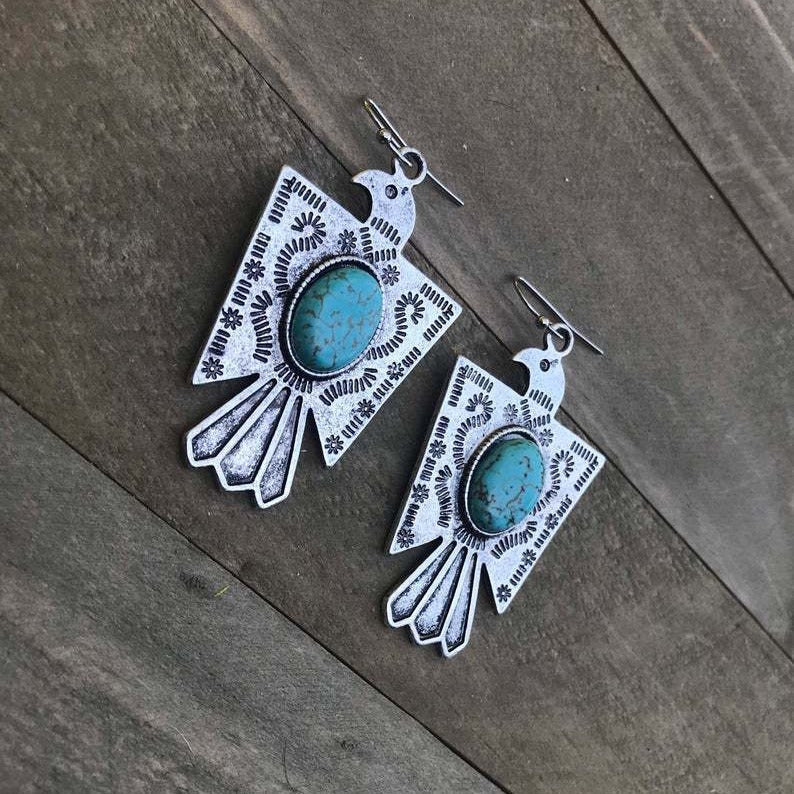
Use the face as the lead zone. A pair such as the Turquoise Western Statement Earrings adds blue-green contrast and movement near the face. Keep the neckline open or use no necklace. Echo the earrings with one compact ring or a small amount of the same color in a bag, belt, or manicure. If you add a hat, compare the earring length with the brim and your hair before leaving.
Formula 2: Denim shirt + pendant + plain boots
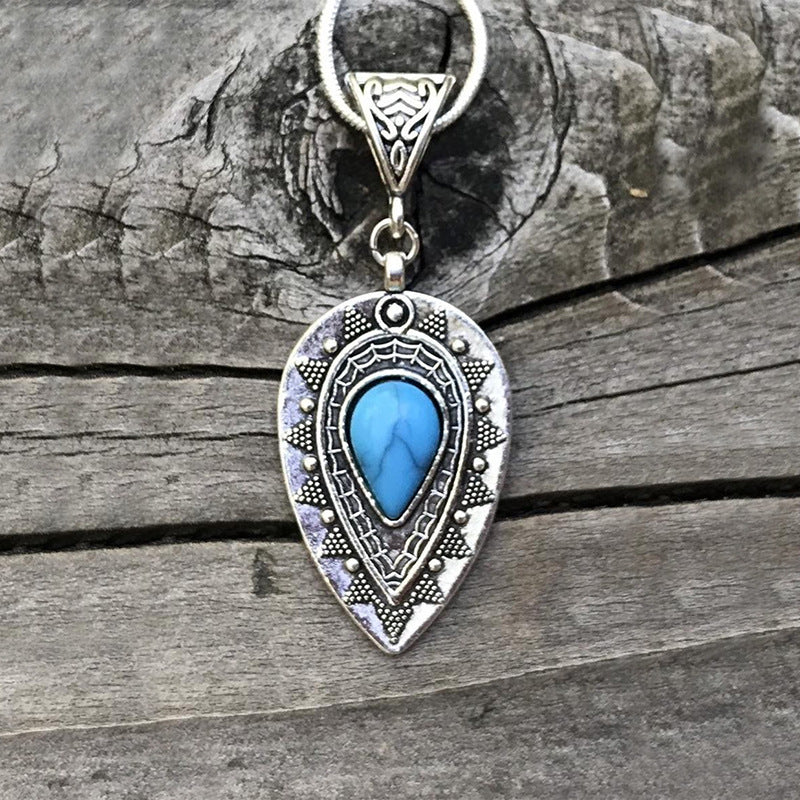
Open one or two upper buttons only as far as you are comfortable, then place the pendant in a clear zone above the first competing seam. A Turquoise Western Teardrop Pendant Necklace can create a vertical focal line against denim. If the shirt has heavy embroidery, piping, or contrasting snaps, shorten the pendant or move the lead to earrings or a ring. The goal is a visible landing point, not a pendant sitting directly on a button.
Formula 3: Double denim + one warm or blue-green accent
A denim jacket and jeans already repeat color and texture. Break the repetition with one contrasting jewelry lead rather than adding several unrelated colors. Blue-green accents can stay within the cool family; warm wood, brown leather, or a mixed-metal look can provide contrast. A pair of Geometric Floral Heart Wood Earrings can soften a structured denim jacket, especially when the neckline and wrist remain quiet.
Formula 4: Black denim + silver-tone or turquoise-colored geometry
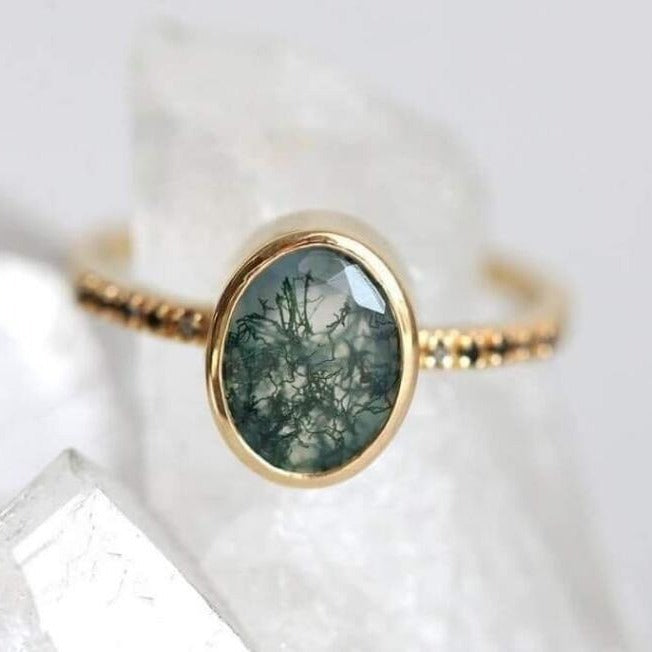
Black denim creates a high-contrast field. Use a cross, floral, or geometric shape as the lead and keep the palette narrow. A Boho Vintage Geometric Cross Ring can anchor the hand while earrings and necklace stay compact. Repeat either shape or tone once, not both everywhere.
For more category context, browse Western Jewelry or use the What Is Western Jewelry? guide to separate visible style signals from verified product facts.
How to Style Western Jewelry with Dresses
A dress creates one continuous silhouette, so jewelry placement has a strong effect on proportion. Start with the neckline, sleeve, print scale, waist emphasis, and hem movement.
Formula 5: Solid black dress + one strong motif
A solid black dress can support a broad cross ring, turquoise-colored earring, or longer pendant. Choose the body zone that matches the dress construction. Open necklines give a pendant room. High necklines often give earrings or a cuff more space. If the dress has dramatic sleeves, move the lead away from the wrist and toward the face or hand.
Formula 6: Floral dress + clean geometric jewelry
Do not try to match every flower. Let the print lead and use one clean geometric shape as the echo. Small turquoise-colored studs, a compact cross ring, or a narrow cuff can work better than another ornate floral necklace. If the print is low contrast and small scale, you can increase jewelry scale. If it is bright, dense, and high contrast, create more quiet space.
Formula 7: Denim dress + pendant or earrings, not both at maximum scale
A denim dress combines the stability of denim with the uninterrupted shape of a dress. Use a pendant to emphasize the vertical line, or choose statement earrings to move attention upward. Add boots only after the jewelry lead is set. Highly patterned boots may serve as the echo; plain boots allow a second compact jewelry detail.
Formula 8: Cream, rust, olive, or brown dress + blue-green accent
Earthy clothing colors can make blue-green accents more visible. Repeat the accent once in a ring, bracelet, stitching detail, or small bag. Do not infer natural turquoise from the color. If the exact stone or metal matters, check the live listing for an explicit material statement.
Formula 9: Slip dress + structured western contrast
A fluid slip dress can take a structured cross necklace, broad cuff, denim jacket, or boots as contrast. Choose either the neckline or wrist as the jewelry lead. If you add a large buckle belt, reassess the pendant length so it does not terminate at the buckle. For a softer version, choose the Vintage Floral Ring for Women as the lead and keep the upper body minimal.
How Boots Change the Jewelry Plan
Boots are not physically adjacent to jewelry, but they can carry a large share of the outfit's visual theme. A plain boot is almost neutral. A bright embroidered shaft, metal toe detail, studs, contrast piping, or an unusual silhouette can be a lead signal.
- Plain brown or black boots: leave room for a stronger earring, pendant, cuff, or ring.
- Embroidered boots: echo one color or motif at smaller jewelry scale instead of repeating the entire pattern.
- Metal-detailed boots: repeat the metal appearance once near the face or wrist, then stop.
- Bright or white boots: let the boots lead and use compact jewelry unless the clothing between them is very quiet.
- Boots plus large buckle: avoid sending a long pendant into the same torso zone; move the jewelry lead upward or to the hands.
If the outfit is for a venue, add movement, heat, hair, bag straps, security rules, and long wear time to the plan. The detailed Country Concert jewelry guide covers those event-specific checks.
How to Style Western Jewelry with Workwear
“Workwear” can mean chore-inspired clothing, office clothes, uniforms, studio clothing, or garments used for physical work. Styling advice must begin with the actual environment. Follow employer, PPE, hygiene, sport, school, and safety rules. Remove loose or dangling jewelry wherever it could catch on equipment, gloves, tools, products, animals, children, or moving parts.
Formula 10: White button-down + straight trousers + cuff
Roll the sleeves only if appropriate, then use the wrist as the lead. A Turquoise Western Cuff Bracelet Set can add western color without filling the neckline. Check inner fit, opening, movement, and contact with a desk or keyboard. If you wear a watch, let the cuff sit on the opposite wrist or verify that the two pieces do not strike each other.
Formula 11: Blazer + plain top + compact earrings
A blazer already creates lapels, shoulders, and a strong frame. Use earrings to lift attention above it. Compact drops or studs may be more practical than a long pendant that disappears under the lapels. Keep the ring and wrist quiet if you type, write, present, or handle objects throughout the day.
Formula 12: Chore jacket + tee + one cross necklace
A chore jacket has pockets, seams, and hardware, so choose a pendant with a clear endpoint on the tee. The Cross Necklace can provide one explicit motif while the jacket remains the structural lead. Close the jacket and test again; a necklace that works when open may become hidden or trapped when zipped or buttoned.
Formula 13: Knitwear + ring or earrings
Soft or fuzzy knits can catch prongs, hooks, chains, and textured edges. Move the lead to a smooth ring or secure earring if the neckline fabric is vulnerable. Put the outfit on and remove it slowly while testing; comfort during wear does not guarantee safe dressing and undressing.
Formula 14: Practical field clothes + removable jewelry
For travel, outdoor work, markets, or long active days, choose pieces that can be removed and stored safely. A ring may interfere with gloves; a cuff may contact a tool or pack strap; long earrings may catch in hair or headwear. The most successful western signal may be one compact piece worn only after the work portion of the day ends.
Choose the Lead Zone by Jewelry Type
Western earrings
Earrings work well with simple necklines, pulled-back hair, denim jackets, and solid dresses. Check visible length beside your jaw and collar, not only the total listed dimensions. Consider piercing type, weight if stated, closure, movement, hair, hat brim, glasses, scarves, headphones, and mask straps. Compare the current details in Western Earrings before choosing a large drop.
Western necklaces
Necklaces control a vertical line through the outfit. Plot the wearable length and pendant height against the exact neckline. Check whether a yoke, button, scarf, lapel, pocket, belt, or buckle already occupies the endpoint. For layering, give each pendant a separate visible zone. Compare current measurements in Western Necklaces.
Western bracelets
Bracelets are strong with rolled sleeves, sleeveless dresses, and simple shirts, but they interact with desks, cuffs, watches, bags, steering wheels, and tools. Confirm construction, inner fit, opening or closure, width, weight if available, and permitted adjustment. Browse Western Bracelets for wrist and contact checks.
Western rings
Rings create a close-range focal point. A broad top can lead even when the face and neckline remain quiet. Verify available sizes or adjustment method, top dimensions, band profile, and finger movement. Consider typing, driving, handwashing, gloves, tools, neighboring rings, and metal sensitivities. Compare fit, style and live product details in Western Rings.
Coordinate Color, Motif and Metal Appearance
You do not need a perfect matching set. A small amount of repetition is usually enough.
- Color echo: repeat a blue-green accent once in a ring, earring, stitching detail, bag, or manicure.
- Motif echo: use one large cross and one compact geometric detail instead of several identical crosses.
- Shape echo: pair a teardrop earring with a long pendant line, or a broad ring with a structured buckle.
- Surface echo: repeat one aged, polished, matte, leather, or wood appearance without assuming the underlying material.
- Metal-tone echo: keep visible metal appearances related, or mix deliberately by repeating each tone at least once.
When a motif has religious, cultural, regional, family, or personal meaning, choose it thoughtfully and describe only what the listing and your own reasons support. A visible cross is a cross motif; it does not establish the wearer's belief. A turquoise-colored center creates a color story; it does not establish a gemstone. A concho-like form creates a visual reference; it does not establish a maker or origin. The broad western-jewelry definition guide explains this evidence boundary.
Maximal Western Styling without Accidental Clutter
Maximalism is not the same as wearing every available piece. It works when repetition and spacing make the layers readable. Use one of these structures:
- Strong face + quiet neck + active hands: large earrings, no necklace, cuff and rings.
- Quiet face + layered neckline + one hand lead: studs, two separated necklace lengths, one broad ring.
- Hat lead + compact jewelry echo: ornate hatband, small earrings, narrow cuff, no long pendant.
- Boot lead + one upper echo: patterned boots, solid clothing, one earring or pendant repeating a color.
Take a full-length photo, a seated photo, and a close-up. The mirror can make each detail feel separate because you inspect it one zone at a time. A photograph reveals whether the lead is still clear at normal viewing distance. Then walk, sit, reach, put on a jacket, carry your bag, and turn your head. Remove any piece that loses comfort or function.
Video Inspiration: Building a Western Outfit
For an independent visual discussion of western clothing materials, colors, silhouettes, denim, fringe, vests, lace, skirts, and accessories, watch Mary Marino's Styling The Western Aesthetic | How to Dress Like a Cowgirl. The video is third-party inspiration and is not an Oroxen endorsement or product demonstration. Its clothing examples do not verify the construction, material, fit, or suitability of any Oroxen product.
A 10-Minute Outfit-Building Workflow
- Set the context. Write down venue, weather, dress code, walking, sitting, work, security, PPE, and wear time.
- Choose the clothing base. Put on the real denim, dress, boots, jacket, or workwear rather than planning around a photograph.
- Map existing signals. Rate face, neckline, torso, hands, and lower outfit as low, medium, or high.
- Select one lead zone. Decide whether face, neckline, wrist, or hand should carry the jewelry focus.
- Add one echo. Repeat a single color, motif, shape, surface, or metal appearance at smaller scale.
- Create quiet space. Remove or reduce the detail nearest the lead if the outfit feels crowded.
- Check real movement. Walk, sit, reach, turn, use pockets, handle the bag, and add outerwear.
- Verify the listing. Confirm size, dimensions, construction, materials, options, included items, care, price, availability, shipping, and returns.
- Photograph the result. Check full-length, seated, and close-up views for hierarchy and proportion.
- Save the formula. Record what worked so the jewelry earns repeat wear instead of becoming a one-event purchase.
Shopping and Listing Checklist
Styling cannot solve missing product information. Before ordering, check:
- Exact item or set included
- Wearable dimensions and decorative dimensions
- Size options or adjustment method
- Closure, backing, chain, cuff, band, and connector construction
- Weight if comfort depends on it
- Explicitly stated materials rather than color-based assumptions
- Several photographs and a sense of scale
- Care instructions and expected contact limits
- Current price, variant availability, processing, shipping, delivery, and returns
Browse the focused Western Jewelry Bestsellers edit for a shorter starting point, or compare Western Earrings, Western Necklaces, Western Bracelets, and Western Rings by body zone. Continue by color in Turquoise Jewelry, by outfit direction in Cowgirl Jewelry, or by recipient in Jewelry Gifts for Her.
Western Jewelry Styling FAQ
Can I wear western jewelry with regular clothes?
Yes. A plain tee, button-down, knit, blazer, denim jacket, solid dress, or simple trousers can provide a clear background. Use one western jewelry lead and one smaller echo rather than changing the entire wardrobe.
Can I wear western jewelry without cowboy boots?
Yes. The jewelry can carry the western signal by itself. Loafers, sneakers, sandals, flats, heels, work boots, or simple ankle boots can keep the lower outfit quiet.
How much western jewelry is too much?
There is no universal number. It becomes accidental clutter when several adjacent pieces demand equal attention or interfere with movement. Assign lead, echo, and quiet roles and test the result from full-length distance.
Should earrings and a necklace match?
They can, but exact matching is optional. Repeat one element—color, shape, motif, surface, or metal appearance—while varying scale. Large earrings often read more clearly beside a compact necklace or no necklace.
What jewelry works with a high neckline?
Statement earrings, a cuff, or a ring can move the lead away from the crowded neckline. A long pendant can also work if it has a clear landing zone and does not catch on buttons, texture, scarves, or outerwear.
What jewelry works with a patterned dress?
Let the print lead and choose a clean jewelry silhouette. Repeat one print color at smaller scale, or use a compact ring, cuff, or earring. Increase jewelry scale only when the print is low contrast and visually quiet.
How do I wear western jewelry to work?
Follow the actual dress, safety, hygiene, and PPE rules. For low-risk office settings, try compact earrings, a single ring, or a smooth cuff. For machinery, tools, gloves, clinical, food, sport, or childcare environments, loose or dangling jewelry may need to be removed.
Does turquoise-colored jewelry contain natural turquoise?
Not necessarily. “Turquoise” may refer to color or style. Natural turquoise should be supported by an explicit material statement on the live product page.
Can I mix silver-tone and warm-tone jewelry?
Yes. Make the mix deliberate by repeating each visible tone at least once or using one piece that already combines them. Keep the number of motifs and accent colors controlled while the tones vary.
How can I make a western outfit look less costume-like?
Start with clothes you already wear, add one western lead, and keep literal themed signals limited. Denim plus one earring, a black dress plus one ring, or workwear plus one pendant can communicate direction without requiring hat, boots, buckle, fringe, and several motifs at once.
Your 60-Second Western Jewelry Styling Check
Need a denim-jacket-specific plan? The turquoise jewelry and denim jacket guide adds a wash-contrast grid plus collar, yoke, hardware, sleeve and three-state try-on checks for a more precise blue-green outfit decision.
- I know whether face, neckline, wrist, or hand is the lead zone.
- I repeated one color, motif, shape, surface, or metal appearance as an echo.
- I left at least one adjacent zone quiet.
- The jewelry does not collide with hair, hat, glasses, collar, scarf, yoke, lapel, buckle, sleeve, watch, bag, boots, or work tools.
- I tested walking, sitting, reaching, turning, outerwear, pockets, and my bag.
- The outfit follows venue, workplace, dress-code, safety, hygiene, and PPE rules.
- I verified dimensions, construction, options, stated materials, care, price, availability, shipping, and returns.
- I photographed the result from full-length and close-up distance.
Turning an outfit idea into a women’s purchase? Start with the focused Western Jewelry for Women collection and apply the RIDER buying guide before checkout. It adds product-page evidence, dimensions, daily-contact and return-readiness checks to this styling method.
When those checks are complete, keep the combination that feels expressive and repeatable. Start with the broad Western Jewelry collection, use the Cowgirl Jewelry Style Guide for category ideas, or return to the Oroxen home page to explore the full store. The strongest outfit is not the one with the most western signals. It is the one whose lead, echo, quiet space, comfort, and context work together.