A western jewelry gift feels personal because it sits close to the wearer and can become part of birthdays, holidays, anniversaries, graduations, and ordinary days. That emotional potential also makes the choice easy to overcomplicate. A beautiful piece can still be wrong for the recipient if the earrings require pierced ears, the ring size is unknown, the bracelet conflicts with her daily work, the motif carries a meaning she does not share, or the parcel arrives after the occasion.
The safest method is to replace guessing with evidence. Observe what she actually wears, identify the category with the least uncertainty, match the visual strength to her routine, and verify the live product details before checkout. This guide applies that method to earrings, necklaces, bracelets, and rings, with special attention to turquoise-style color, cross and floral motifs, vintage-inspired texture, and other western design language. Compare the current edit in the Oroxen Jewelry Gifts for Her collection as you work through the steps.
Use the Gift Friction Map
“Giftability” is not a promise that everyone will like the same design. It is a way to count the decisions that must go right before a piece can be worn. Every unknown creates friction. The goal is to choose a gift with an expressive upside that is greater than its unresolved fit, comfort, meaning, care, and timing risks.
| Friction | Question to answer | Low-risk evidence | If unknown |
|---|---|---|---|
| Category | Does she wear this type now? | The category appears repeatedly in recent photos or daily outfits | Choose together or begin with the most observable category |
| Fit | Is an exact size, opening, or length needed? | A verified measurement from a piece she already wears | Avoid fixed-size rings and closed bangles |
| Comfort | Will weight, movement, projection, or closure suit her? | Comparable dimensions and construction in current favorites | Choose a quieter silhouette with fewer contact points |
| Material | Can she wear the documented composition? | Known preferences plus complete listing information | Do not guess around allergies or sensitivities |
| Meaning | Does the symbol fit her values and story? | She already wears, collects, or discusses the motif | Use color, texture, or a nonliteral geometric form |
| Timing | Can it arrive before the event? | Current delivery information leaves a buffer | Give a note and choose the piece together later |
A low-friction gift is not necessarily small, neutral, or inexpensive. A large turquoise-style earring can be low friction for a recipient who repeatedly wears broad earrings, has pierced ears, knows the closure, and enjoys visible color. A tiny ring can be high friction when its size, profile, material, and meaning are all uncertain.
Build a Recipient Evidence Snapshot
Look at what she wore during ordinary weeks rather than one wedding, themed party, or formal photo. Repetition is stronger evidence than ownership. A jewelry box may contain inherited pieces, gifts, and items she no longer chooses. Recent outfit photos, video calls, shared trips, and the pieces she reaches for before leaving home show her real operating style.
Write a one-line answer to each question before browsing:
- Does she wear earrings, necklaces, bracelets, or rings most often?
- If she wears earrings, are her ears pierced and what closures appear repeatedly?
- Does she prefer silver-tone, gold-tone, mixed metal, leather, or colorful accents?
- Are her favorite pieces compact, medium, broad, long, layered, or deliberately mismatched?
- Does she repeat turquoise-style blue-green, black, red, white, warm brown, or another color?
- Which motifs does she already choose: cross, horse, floral, moon, heart, geometric, cow skull, or none?
- Does her work involve gloves, headsets, young children, machinery, healthcare routines, food service, sports, or frequent handwashing?
- Does she wear hats, high collars, scarves, long hair, or headphones that change earring and necklace contact?
- Has she mentioned metal sensitivity, heavy earrings, loose bangles, tight rings, or difficult clasps?
- Is the gift meant for daily wear, occasional outfits, travel, a country concert, or a keepsake moment?
- Do you know her measurements from a currently comfortable piece?
- Would she enjoy a surprise more than participating in the choice?
You do not need twelve perfect answers. You need enough evidence to see where the uncertainty is concentrated. If you know her earring scale, piercing, closure, and metal preferences but not her ring size, the category decision is already becoming clear. If you know only that she “likes western things,” keep observing; western style includes many different color, motif, scale, and material directions.
Compare Earrings, Necklaces, Bracelets, and Rings
| Category | Main uncertainty | Best evidence | Useful when |
|---|---|---|---|
| Earrings | Piercing, closure, ear-contact material, weight, movement | A frequently worn pair with comparable dimensions | Her face-level style is easy to observe |
| Necklaces | Chain endpoint, pendant scale, clasp, neckline and hair contact | Length of a necklace she wears with similar tops | Exact finger or bangle size is unknown |
| Bracelets | Wrist fit, opening, closure, watch and work contact | Inside measurements from a comfortable bracelet | She already treats the wrist as a style zone |
| Rings | Exact size, finger choice, band width, setting profile | Verified size from the same finger and similar band | Size and symbolism are confidently known |
Earrings: easy to see, not automatically easy to gift
Earrings reveal scale and color near the face, so they are often the simplest category to observe. Yet an attractive photo cannot answer whether the recipient has pierced ears, prefers hooks or posts, avoids movement, or tolerates a particular weight. Compare the total length, maximum width, closure, ear-contact composition, articulated sections, and pair quantity with an earring she already wears for hours.
A statement pair is appropriate when the evidence supports a statement wearer. Compact studs or short drops reduce movement, but they should not be called universally safe. Compare the listed size, weight, closure and materials across Western Earrings.
Necklaces: lower size friction, but length still matters
A necklace often avoids exact finger sizing and closed-bangle fit. It still needs to land in the right place. Chain length, extender range, pendant height including the bail, hair, collar, neckline, and clasp all affect wearability. Measure a comfortable necklace from end to end and note where its pendant lands on the tops she wears most. Do not assume that “adjustable” means every possible endpoint.
A centered pendant can be useful when her earrings are hard to evaluate or when she regularly wears open necklines. A very long, layered, or heavy pendant may create more daily contact. Compare chain length, pendant height and closure in Western Necklaces to map the visible endpoint.
Bracelets: investigate structure before wrist size
Open cuffs, closed bangles, clasp bracelets, stretch styles, and multi-piece sets do not share one sizing system. Identify the construction, inside dimensions, opening, closure, and any maker-approved adjustment before comparing fit. Notice whether she wears a watch and which hand handles a phone, mouse, tools, steering wheel, or children. A raised bracelet can be visually strong but impractical on an active wrist.
A coordinated set gives the wearer options only when the contents and individual structures are clear. She may use one piece, a pair, or a full stack after checking contact. Compare each construction and current measurements in Western Bracelets.
Rings: choose only with strong size evidence
Rings concentrate style into a small area, but the gift must match a specific finger. A ring that fits one finger or hand may not fit another. Band width and the height of the decorative top can also change the sensation. A visible gap may be decorative rather than an invitation to reshape the band. Do not repeatedly bend a ring unless the maker explicitly permits adjustment.
A ring can communicate more relationship meaning than the buyer intends. If the occasion is not a proposal, confirm that the design, finger, presentation, and wording will not create confusion. When the size or meaning is uncertain, present the idea and choose together. Browse the live Turquoise Rings collection to compare current styles and available product-page size information before choosing.
Match the Gift to the Occasion Without Letting the Calendar Decide Everything
| Occasion | Strong starting point | Common mistake | Personal detail |
|---|---|---|---|
| Birthday | Her most repeated category with a fresh color or motif | Buying for an age stereotype instead of the person | Reference a shared outfit, trip, hobby, or memory |
| Anniversary | A wearable piece connected to your actual story | Assuming a ring or romantic symbol is required | Explain why the color, shape, or date matters |
| Holiday | A versatile piece that can be tried without schedule pressure | Ordering too late or ignoring seasonal returns | Include a plan to style it together |
| Graduation | A piece suitable for the next stage of daily life | Choosing a formal keepsake that never fits her routine | Connect the note to her work, study, or independence |
| Mother’s Day | Her personal style rather than a generic “mom” motif | Reducing her identity to the occasion | Describe a quality or memory you value |
| Everyday surprise | A low-friction category she already wears | Making the gift carry unspoken relationship pressure | Keep the message simple and specific |
The calendar provides context, not a universal product rule. A dramatic pair of earrings can be a better anniversary gift than a ring when it matches the recipient. A compact necklace can be more meaningful than an elaborate set if it echoes something she already loves. Price, size, and literal symbolism do not measure thoughtfulness; accurate attention does.
Choose the Western Style Lane She Already Uses
Western jewelry is not one fixed look. A cowgirl maximalist may layer visible turquoise-style color, engraved texture, leather, crosses, cow skulls, and broad silhouettes. A vintage-inspired wearer may prefer aged-looking surfaces, floral details, geometric forms, and muted tones. A modern western dresser may use one clean pendant or compact earring with denim and tailoring. A concert-focused wardrobe may welcome movement and scale that would be inconvenient at work.
Separate four signals: color, scale, surface, and motif. Color may be blue-green, silver-tone, gold-tone, black, white, red, brown, or mixed. Scale may be compact, medium, statement, layered, or intentionally oversized. Surface may be smooth, engraved, beaded, floral, geometric, textured, or leather-accented. Motif may be cross, horse, cow skull, boot, hat, moon, heart, flower, or a nonliteral pattern.
A recipient can like western clothing without wanting literal motifs. She may prefer a turquoise-style color accent with a geometric setting. Another person may collect horse or cross pieces specifically. Treat every motif as evidence-based and personal. Religious, cultural, equestrian, and relationship meanings should never be assigned from the product title alone.
For a broader styling map, read the cowgirl jewelry style guide. If blue-green color is the main clue, the western turquoise jewelry guide explains how to separate color language from material claims.
Four Oroxen Gift Directions
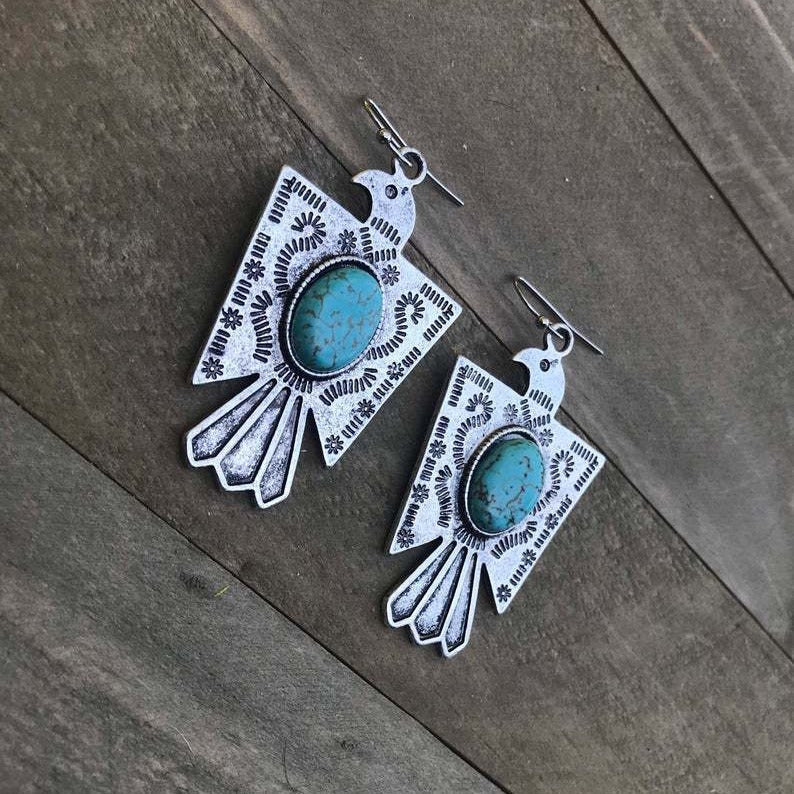
Turquoise Western Statement Earrings: for a proven statement-earring wearer
The Turquoise Western Statement Earrings use a broad silhouette, turquoise-style center color, and vintage-inspired detailing. Consider them when the recipient repeatedly chooses visible earrings and when you have checked piercing, closure, approximate dimensions, movement, and ear-contact information. Keep the gift note focused on the color or styling connection you observed rather than making an unverified claim about the accent material.
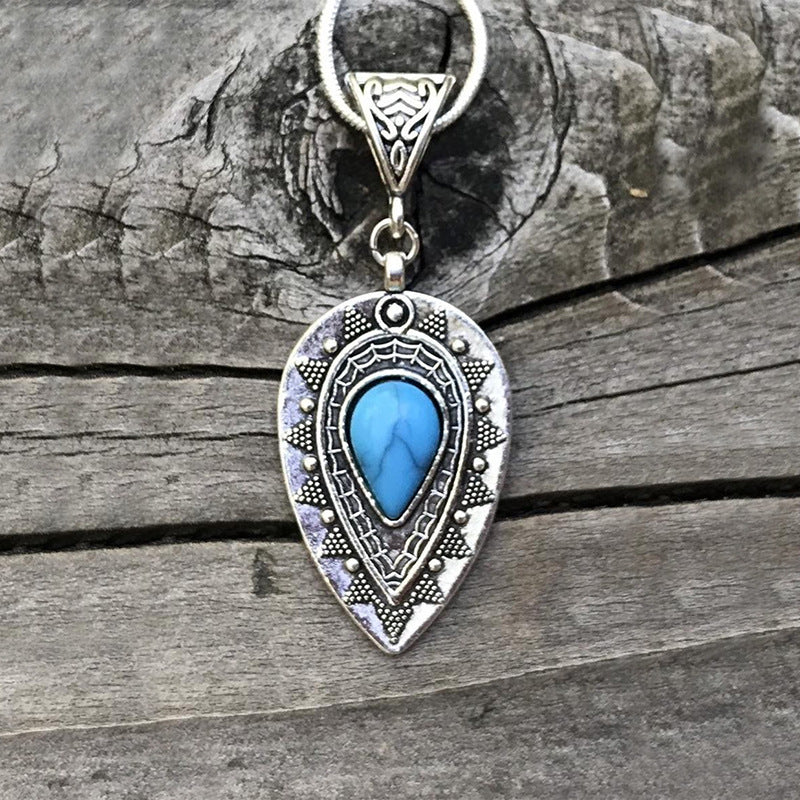
Turquoise Western Teardrop Pendant Necklace: for a neckline focal point
The Turquoise Western Teardrop Pendant Necklace centers the color near the neckline and avoids fixed finger sizing. Compare the chain and pendant measurements with a necklace she wears now, and check the endpoint against her common collars and tops. It can suit a recipient who uses one pendant as the outfit focal point and keeps earrings quieter.
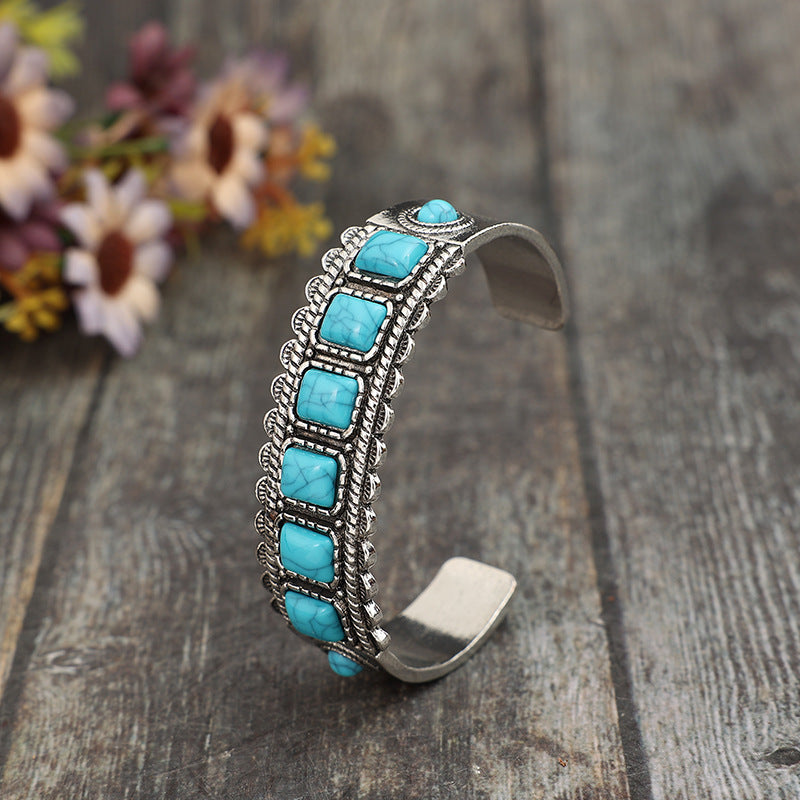
Turquoise Geometric Cross Bracelet: for a recipient who styles the wrist
The Turquoise Boho Vintage Geometric Cross Bracelet for Women combines turquoise-style color, geometric structure, and a cross motif. It belongs on the shortlist only when the recipient’s comfort with the motif is known. Confirm the current construction, dimensions, opening or closure, and materials. Check how it would share space with a watch and daily wrist activity.
Boho Vintage Geometric Cross Ring: for known size and known meaning
The Boho Vintage Geometric Cross Ring places the visual story on the hand. Verify the exact size system, selected variant, band width, profile, and permitted adjustment. A cross should match the recipient’s preferences, and the presentation should make the occasion clear. If you cannot confirm the finger and size discreetly, show her the design and choose the variant together.
These examples are starting points, not declarations that one item fits every recipient. The live pages govern current options, materials, dimensions, price, availability, processing, shipping, and return terms. Browse the complete Jewelry Gifts for Her edit to compare more curated earrings, necklaces, bracelets, and rings.
Material and Product Language: Verify, Do Not Upgrade the Claim
Style words and material words perform different jobs. “Turquoise,” “silver,” “vintage,” “boho,” and “western” may describe color or aesthetic context in a title. They do not automatically prove natural turquoise, sterling silver, historical age, handmade origin, or affiliation with a particular community. Read the specification fields and product description, and repeat only what the current page documents.
For a recipient with allergies or skin sensitivity, incomplete information is a stop signal. Do not infer safety from color, plating appearance, price, or a generic category. Compare every component that touches the body, including posts, hooks, backs, chains, clasps, ring bands, and bracelet interiors. If the necessary composition is not stated clearly enough for her needs, choose another item or ask before buying.
Natural stones and stone-like accents may show variation, while composite, glass, resin, enamel, and other materials behave differently. The correct care method depends on documented composition and construction. Avoid promising water resistance, sweat resistance, non-tarnish performance, hypoallergenic wear, or permanent color unless the product information explicitly supports that promise.
Match the Gift to the Recipient’s Real Life
A gift that fits her routine is more likely to leave the box. For office work, consider how earrings interact with a headset and how bracelets contact a keyboard. For healthcare, food service, manual work, childcare, or sports, daily wear may exclude projecting rings, loose bracelets, and long earrings. For frequent travel, think about compact storage, security, and whether she would feel comfortable carrying the piece.
Hair and clothing matter too. Long hair and high collars change earring and necklace contact. Hats and scarves can occupy the same space as statement earrings. Knitwear can catch raised edges. A watch can collide with a broad cuff. The goal is not to remove personality; it is to put the strongest design in a zone where she can enjoy it.
If the piece is mainly for concerts or styled weekends, name that intention. The country concert jewelry guide maps movement, venue, hair, hats, bags, and outer layers. A statement item can be a good occasional gift even when it is not an everyday basic, provided the recipient enjoys that role.
Budget, Shipping, Returns, and Presentation Are Part of the Gift
Set a complete budget before browsing. Include the item, taxes, shipping, any packaging you plan to add, and enough time to handle a problem. A higher price does not repair a weak category match. A lower-priced piece is not less thoughtful when the design and routine fit are accurate.
Read the current processing, shipping, delivery estimate, and return terms before ordering for a dated occasion. Leave a buffer for weekends, holidays, address problems, and the possibility that the option needs to be changed. Keep the relevant order information available without turning the gift into a test she must pass. An exchange path protects the recipient from having to wear something uncomfortable just to protect the giver’s feelings.
Presentation should clarify rather than inflate the product. Use a clean box or pouch appropriate to the item, keep separate pieces from rubbing, and include a short note explaining the real observation behind the choice. “I noticed you always wear blue-green earrings with denim” is more personal than a generic claim that a symbol represents her. Do not state that packaging, gift wrapping, certifications, or accessories are included unless the current offer says so.
A Third-Party Video for Reading Jewelry Style
The following independent YouTube video by verified creator Urmila Nimbalkar focuses on matching jewelry with outfits and occasions. It is not an Oroxen endorsement and does not verify any Oroxen product. Use it as a visual prompt for noticing scale, color, neckline, outfit detail, and the difference between a focal piece and supporting pieces. Then return to the live product page for factual specifications.
Watch “Jewellery Matching Tips” on YouTube. Third-party content can change, and its creator is responsible for its claims.
A Ten-Minute Decision Workflow
- Name the recipient evidence: write the category, color, scale, motif, and routine you have actually observed.
- Choose one category: favor the category with the most evidence and the fewest unresolved measurements.
- Open the live page: confirm options, dimensions, materials, construction, quantity, price, and availability.
- Compare to a known piece: use a necklace, earring, bracelet, or ring she already wears comfortably.
- Run the friction map: mark category, fit, comfort, material, meaning, timing, and return questions as known or unknown.
- Remove unverified assumptions: separate color from composition, aesthetic from age, and motif from personal meaning.
- Check the complete cost: include delivery and leave a timing buffer.
- Plan the message: explain the observation that led to the piece without pressuring her to love or wear it.
- Preserve choice: keep the exchange path practical or invite her to select the final variant.
- Recheck at checkout: confirm the exact option, address, quantity, and current policies before paying.
If this workflow produces several unanswered questions, that is useful information. A shared shopping moment can be more thoughtful than a surprise built on guesses. You can still wrap a card, a printed image, or a note that says why you wanted her to choose the piece herself.
Frequently Asked Questions
What is the safest western jewelry gift when I do not know her size?
A necklace can reduce exact sizing friction, but it is not automatically correct. Compare the length and pendant endpoint with something she wears. Earrings can also avoid finger sizing only when you know her piercing, closure, weight, and material preferences. If those facts are unknown, choose together.
Are earrings a good surprise gift?
They can be when the recipient already wears earrings and you can compare the new pair with a comfortable favorite. Confirm pierced-ear requirements, closure, dimensions, movement, ear-contact information, and whether the listing is for a pair. Do not assume compact size guarantees comfort.
Should I buy a ring as a romantic gift?
Only when the finger, exact size system, design preference, and relationship meaning are clear. A ring may imply more than the giver intends. For a non-proposal occasion, make the message explicit and avoid guessing. Choosing the final size and style together is a strong option.
Does turquoise in a title mean natural turquoise?
Not necessarily. It may describe a color or style. Use the live specification and description to determine what material is documented. Do not upgrade a style term into a gemstone, origin, or authenticity claim.
How do I choose between a necklace and a bracelet?
Choose the zone she already uses. A necklace may have less fit friction when the chain length is known. A bracelet needs its construction and wrist measurements checked and may contact a watch, desk, phone, or tools. Her repeated behavior is better evidence than a universal category ranking.
Is a cross motif appropriate for every recipient?
No. A cross can have religious, cultural, fashion, or personal meaning. Use it when the recipient already wears it or has expressed a preference. Do not assign the meaning for her. A floral or geometric design may be more suitable when symbolism is uncertain.
How early should I order jewelry for a birthday or holiday?
Review the current processing and delivery information and leave a practical buffer. Timing varies by destination, option, carrier, and season, so a fixed universal number would be misleading. If timing is too tight, give a note and choose the piece together after the event.
What if she does not like the jewelry?
Make the exchange path easy and emotionally neutral. A gift should not become an obligation to wear an uncomfortable or unsuitable piece. Keep the order details, follow the current policy, and treat her feedback as useful information about future gifts.
Final Checklist
- I chose from repeated evidence rather than a stereotype about women, age, relationship, or occasion.
- I confirmed the category, size method, dimensions, closure or opening, materials, quantity, and selected option.
- I separated turquoise-style color, silver-tone appearance, vintage inspiration, and motif language from unverified material or origin claims.
- I considered work, hair, hats, collars, watches, children, handwashing, movement, and care.
- I checked current price, availability, processing, shipping, delivery, and returns.
- I left enough time and kept a practical exchange path.
- I can explain the real observation behind the gift in one sentence.
Western jewelry becomes a stronger gift when the design reflects the person rather than the category label. Begin with what she wears, choose the zone with the clearest evidence, verify every fact that affects comfort and use, and let the note carry the personal meaning. Browse Jewelry Gifts for Her, explore more Cowgirl Jewelry, or return to the Oroxen home page to compare current collections and product information.
If the recipient likes “western jewelry” but you need to define that preference more precisely, read What Is Western Jewelry? before choosing. It separates category, silhouette, motif, color, surface, documented composition, and provenance so the gift can match her actual style.