Western earrings can change an outfit faster than almost any other accessory. A compact turquoise-colored stud adds a quiet point of color. A moving drop can frame the jaw and remain visible beneath a hat. A sculptural cow skull, cross, floral, horse, or concho-inspired design can become the entire story of a denim-and-boots look. The difficult part is not finding an expressive pair. It is knowing whether the pair will look, move, and feel the way you expect after it leaves the product photograph.
This guide replaces guesswork with a practical sequence: identify the effect you want, compare actual dimensions, investigate weight and closure, check how the silhouette interacts with your hair and clothing, and confirm every product-specific claim on the listing. Face shape appears here as one optional styling experiment—not a rule about who is “allowed” to wear a particular earring. For a broader category view, open the Oroxen western earrings collection in another tab while you work through the checklist.
The Measurement-First Western Earring Checklist
Close-up photography is designed to show detail, not real-world scale. The same earring may fill a phone screen even though it is a compact stud, while a long drop may look modest when photographed on a large background. Before deciding whether a design is subtle or dramatic, look for the full dimensions and a photograph on a person. When a listing does not provide enough information, ask the seller rather than inferring scale from cropping.
| Your goal | Read the listing for | Compare at home | Useful starting direction |
|---|---|---|---|
| Easy everyday wear | Length, width, closure, ear-contact material | A pair you comfortably wear for several hours | Stud, compact hoop, or short drop |
| Visible beneath long hair | Total length, maximum width, color contrast | Where your hair falls beside the jaw | Wider silhouette, brighter accent, or longer drop |
| Concert or rodeo statement | Weight, articulation, back or hook security | Hat brim, collar, fringe, and bag strap clearance | Recognizable motif or multi-part drop |
| A gift with fewer surprises | Pair versus single, dimensions, closure, returns | Recipient's usual scale and piercing type | Familiar silhouette in a favorite color or motif |
Notice that “face shape” is not the first line in the table. The most flattering earring in a photograph is still a poor purchase if it catches a collar, feels uncomfortable, conflicts with a headset, or requires a piercing style you do not have. Practical compatibility comes first; visual refinement comes after it.
Know the Main Western Earring Silhouettes
Studs and stud sets
Studs sit close to the ear and offer a controlled amount of color or symbolism. A turquoise-colored stud, tiny flower, star, horseshoe, or geometric motif can introduce western character without taking over the outfit. Sets offer variety and can make a useful gift, but check whether every design is included, whether the listing is for pairs, and whether the post and back materials are stated.
Hoops and hoop variations
A hoop creates a clear outline rather than a vertical line. Western versions may use rope-like texture, beading, small charms, engraved details, or turquoise-colored accents. Outside diameter, tube thickness, closure mechanism, and charm movement all affect the result. Do not assume that “small,” “medium,” or “large” is standardized across stores.
Drops and dangles
A drop introduces a line below the earlobe; a dangle may have additional movement or articulated sections. These categories overlap in everyday retail language, so look at the construction instead of relying on the name. A fixed teardrop behaves differently from several linked parts. Long movement can be beautiful in a still outfit and distracting near fringe, a high collar, or loose hair.
Concho-inspired and stamped-looking designs
Round, oval, scalloped, radiating, and stamped-looking ornaments create a recognizably western or Southwestern-influenced vocabulary. “Concho-inspired” describes the appearance; it does not prove a particular metal, maker, tribal affiliation, or age. Read What Are Concho Earrings? for the history, terminology, origin cautions, and concho-specific buying checks.
Motif earrings
Cow skulls, longhorns, horses, boots, hats, crosses, feathers, stars, flowers, and desert forms communicate a theme immediately. One recognizable motif is often enough. If the earring already combines a horse, cross, bright color, texture, and movement, the shirt and necklace can be quieter. Use the cowgirl jewelry style guide when you want complete outfit formulas rather than an earring-only decision.
How to Judge Earring Size Online
Start with total length
Total length is usually measured from the highest point of the hook or top component to the lowest point of the earring, but sellers may use a different convention. If a long hook is included, the decorative portion may be shorter than the headline number suggests. Ask how the measurement was taken when the diagram is unclear.
Use a ruler beside your ear, then compare the number with the lower edge of your jaw, collar, and hair. You do not need to decide that one length is universally “best.” Decide whether you want the earring to remain near the lobe, finish around the jaw, or extend into the neck area. Those are visual choices with practical consequences.
Width controls presence
Two earrings with the same length can look completely different. A slim chain may almost disappear beneath hair; a broad floral or concho-style element can read as a statement even when it is shorter. Maximum width is particularly useful for disks, fans, cow skulls, layered geometric shapes, and large studs. When width is missing, a straight-on image next to a ruler is more useful than another magnified detail photograph.
Depth and profile affect how the earring sits
Raised stones, domed metal, stacked components, or a thick post base can make an earring project away from the ear. A side-view photograph reveals that profile. It also helps you see whether a stud droops forward, whether a drop hangs from the center or edge, and whether the back has enough area to support the decorative face.
Movement changes apparent size
An articulated earring occupies more visual space while you walk than it does when hanging still. Linked pieces may rotate and reveal different surfaces. That movement can be ideal for an event, but it can also increase contact with hair, collars, or a phone. If possible, look for a product video or ask whether the sections move independently.
Weight and Comfort: What a Photograph Cannot Tell You
There is no honest universal rule that a particular gram value will feel comfortable to every person. Piercing position, lobe anatomy, duration of wear, post support, weight distribution, and personal sensitivity all matter. A seller-provided weight is still useful because it lets you compare the pair with jewelry you already know. Confirm whether the stated weight is per earring or for the pair.
Visual size does not reliably predict weight. A broad thin component may be relatively light, while a smaller solid ornament can be denser. Resin, wood, leather, beads, stone, glass, and different metals behave differently, and construction details matter. Never use a photograph or price as proof of composition.
For a long event, test new earrings at home before relying on them. Wear them under ordinary conditions, use the back supplied or recommended for that design, and pay attention to pulling, warmth, pressure, itching, or imbalance. Remove jewelry that causes discomfort. Anyone with a known allergy, fresh piercing, skin condition, or persistent reaction should seek product-specific material information and appropriate professional advice rather than depending on a general style guide.
Weight distribution matters
A large top component can spread support differently from a tiny post holding a long lower section. Some statement studs benefit from supportive backs designed for their construction. A fishhook lets a drop swing freely, while a leverback changes the hinge point. These differences may matter as much as the total number on a scale.
Duration matters
An expressive pair for a two-hour dinner does not have to meet the same comfort requirement as an all-day work or travel earring. Define the intended wearing window before you shop. If you want one pair for repeated long days, prioritize familiar weight, controlled movement, and a closure you can operate confidently.
Closures, Backs, and Piercing Compatibility
- Post with friction or push back: common for studs and statement earrings; backing size and post placement affect support.
- Fishhook or French hook: easy movement and a familiar drop silhouette; a compatible stopper may help prevent loss.
- Leverback: a hinged closure that surrounds the wire; useful when a closed mechanism is preferred.
- Hinged hoop or latch: the post or wire closes into the hoop; confirm the diameter and usable opening.
- Clip-on: does not require a pierced lobe, but pressure and adjustability vary by design.
Retail names are not always consistent, so rely on photographs and exact construction details. Confirm gauge and post length when those dimensions matter to your piercing. If a product is intended for cartilage or another specialized placement, use piercing-specific guidance; a general western fashion earring article cannot determine fit for an individual piercing.
Also identify the material that actually touches the ear. A description of the decorative face may not describe the post, wire, coating, solder, or back. “Silver color” is a color description, not the same claim as sterling silver. “Turquoise style” or “turquoise color” describes appearance, not proof of natural turquoise. The U.S. FTC Jewelry Guides provide context for truthful representation of jewelry materials; the individual product page remains the place to verify what Oroxen actually states for a specific item.
Face Shape Is an Option, Not a Rule
Many earring guides divide people into oval, round, square, heart, diamond, or long face categories. Real faces rarely fit one perfect diagram, and hair, glasses, expression, camera angle, and personal style change the visual result. Use the categories as a way to test lines and contrast, never as a verdict about attractiveness.
If you want to create vertical contrast
Try a narrow drop, elongated teardrop, or a design with a clear downward line. Some people enjoy this contrast with a rounder or shorter facial outline. Watch where the earring ends: a narrow piece that finishes beside the widest part of the jaw may behave differently from one that ends above or below it.
If you want to repeat curves
Hoops, rounded studs, floral forms, and circular concho-inspired designs repeat soft curves. Repetition can feel harmonious; contrast can feel dynamic. Neither is objectively better. Photograph both options in the same light and choose the energy you prefer.
If you want to soften strong angles
Rounded, oval, curved, or moving components can provide visual contrast to a more angular jaw or cheek line. Alternatively, you may prefer geometric earrings that deliberately echo those angles. The styling goal determines the experiment.
If you want more width near a narrow area
Fans, disks, clustered studs, and wider lower sections add horizontal presence. Placement matters: width near the lobe, cheek, jaw, and neck produces a different effect. Look at the full silhouette rather than searching for one approved shape label.
Justine Leconte's video later in this guide demonstrates face-framing ideas visually. Use it to notice proportion and placement, then keep or ignore any suggestion according to your own taste. A comfortable earring that makes you feel like yourself has already passed the most important style test.
Hair, Glasses, Hats, and Necklines Often Matter More
Hair worn down
Choose enough width, contrast, or length to remain visible if visibility is your goal. Smooth hooks and controlled articulation can reduce tangling, but no moving earring is completely catch-proof. Put the earrings on after styling hair and remove them carefully before brushing or changing clothes.
Hair tied back or short
The entire earring becomes visible, so texture and profile receive more attention. This is a useful setting for compact studs, ornate post earrings, or sculptural shapes that might disappear under long hair. It also makes the closure and the way the pair sits against the lobe easier to see.
Glasses
Compare the earring's width and top position with the glasses arm. A broad upper component can create a concentrated area of detail, while a lower drop may leave more space. Repeat a metal tone if you want cohesion, or use contrasting color when you want the earrings to stand apart.
Western hats
A hat frames the same area as the earring. Check the brim shadow, hair position, and any hatband detail. When the hat already has a concho band, feather, chain, or bright ornament, a simpler earring can preserve hierarchy. If the hat is plain, a stronger motif near the face may be exactly the right focal point.
Necklines and collars
High collars, hoodie cords, fringe, scarves, and embellished shoulders create contact points. Open collars, scoop necks, and simple dresses give long earrings clearer space. Before an event, wear the complete outfit and turn your head in both directions. A static mirror pose may not reveal catching that appears during normal movement.
Five Western Earring Outfit Formulas
1. Everyday denim with compact color
Wear jeans, a white or chambray shirt, and turquoise-colored studs or short drops. Add one slim ring if desired. The outfit remains familiar, while the ear-level color provides a western accent that can repeat across many days.
2. Black dress with statement earrings
A solid black dress gives a sculptural earring a quiet background. Pull the hair back or tuck one side behind the ear, skip a large necklace, and repeat one metal tone in a belt or small ring. This formula works for dinners, concerts, and semi-dressy western events without requiring a literal head-to-toe theme.
3. Concert layers with a secure closure
Start with a tee or tank, denim, an overshirt or light jacket, and practical footwear. Choose a motif that remains recognizable from a distance. Test the closure and make sure the lower edge clears collars, bag straps, and fringe. Leave emotionally irreplaceable jewelry at home for crowded events. The country concert jewelry guide expands this check across travel, venue entry, seating or standing, dancing, weather, bags, bracelets, rings, and the late-night exit.
4. Soft neutrals with concho-inspired texture
Cream knitwear, tan trousers, muted green, and faded denim let stamped-looking surfaces and blue-green accents stand out gently. Use a compact concho-inspired shape when you want texture without a large drop. For more detail on using the motif responsibly, return to the concho earrings guide.
5. Maximal western look with a clear hierarchy
If you enjoy bold styling, choose a hero earring and let every other piece support it. A cow skull earring can lead; the necklace can repeat only the metal tone. A turquoise-colored statement pair can lead; the boots can supply texture rather than another turquoise motif. Maximal style still benefits from deciding what the eye should notice first.
Two Oroxen Examples: Statement Pair Versus Stud Set
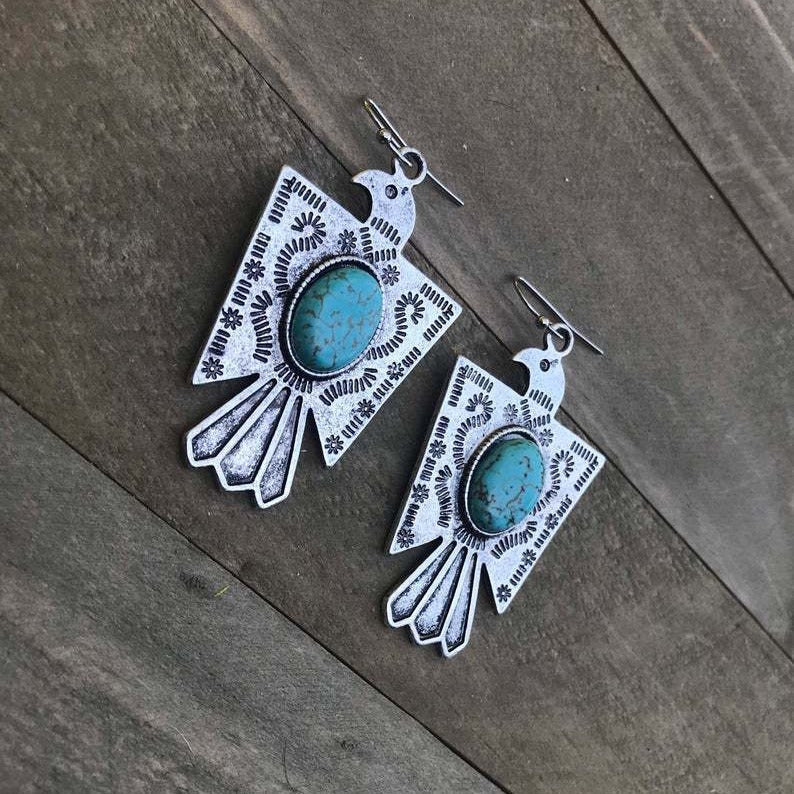
The Turquoise Western Statement Earrings are built to function as a visible focal point. Their sculptural outline, turquoise-style center accents, and vintage-inspired surface details suit the black-dress, concert, and tied-back-hair formulas. Review the current product images and options for the exact pair you are ordering; the product name describes its styling vocabulary and does not add material claims that are not stated on the page.
The Turquoise Western Stud Earring Set provides a different kind of versatility. Multiple floral, geometric, and turquoise-style stud shapes allow a wearer to change the motif while keeping the jewelry close to the ear. A set can work for daily outfits or gifting, but use the product photographs to confirm exactly what is included and check the current listing for product-specific details.
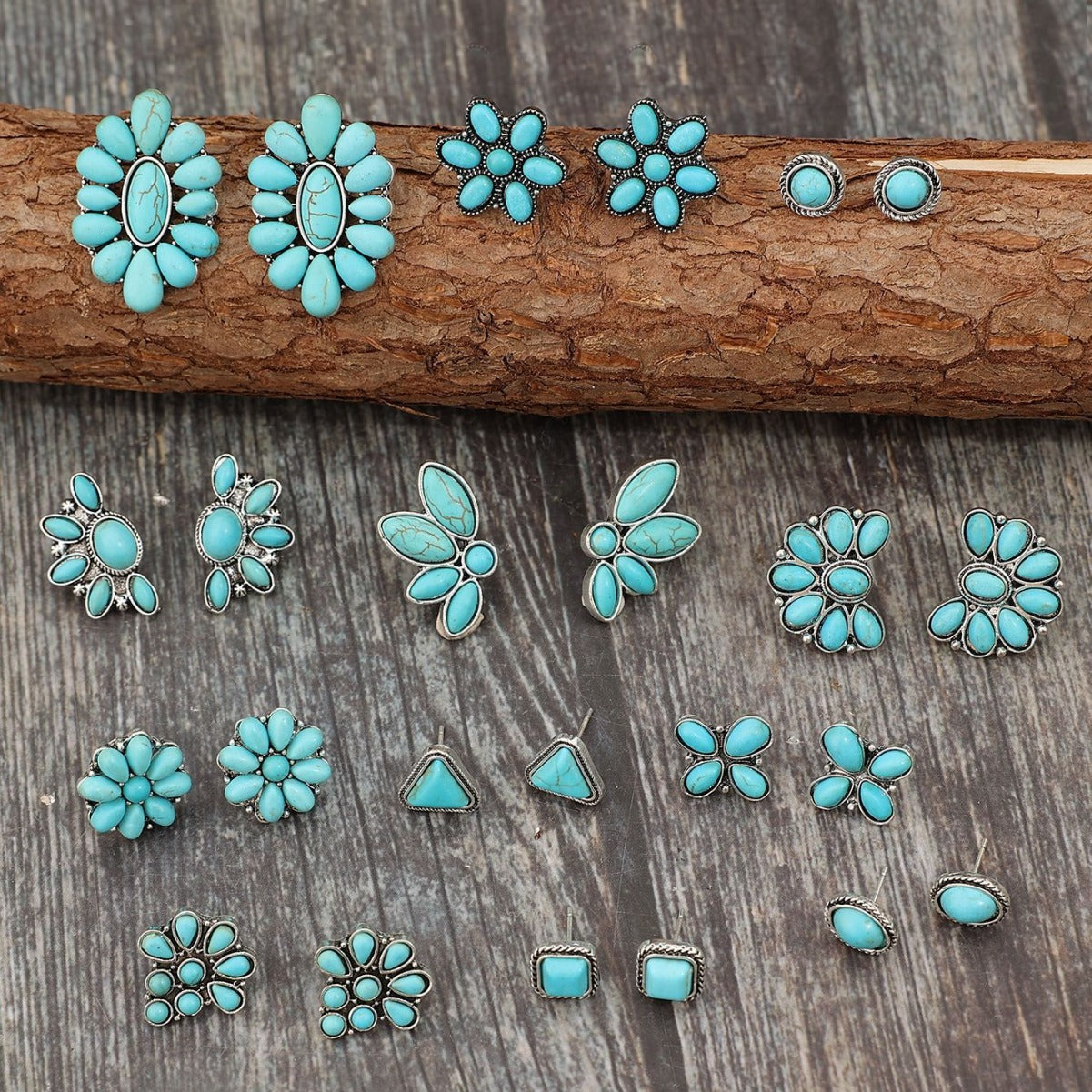
These examples demonstrate a decision framework, not a claim that one format is superior. Choose the statement pair when you want visible scale and one clear hero. Choose the stud set when you want multiple compact options. In both cases, dimensions, weight, closure, ear-contact materials, stock, price, and care should be checked on the live product page at the time of purchase.
How to Fact-Check a Western Earring Listing
- Confirm the unit: Is the listing for one earring, one pair, or a multi-pair set?
- Find measured dimensions: Record total length, maximum width, and hoop diameter or post length when relevant.
- Ask about weight: Determine whether the number is per earring or per pair. If no weight is shown and comfort matters, contact the seller.
- Identify the closure: Match the photograph and description to your piercing and preferred back.
- Separate every material: Base, finish, post or hook, back, stone or decorative accent, enamel, resin, leather, wood, and adhesive may differ.
- Read claims literally: “Vintage-inspired” is not proof of age; “turquoise color” is not proof of natural turquoise; “western” is not proof of maker or cultural origin.
- Look at several views: Front, side, back, scale, and on-person photographs answer different questions.
- Check the practical policy: Review current shipping and returns, especially for a gift or dated event.
A product title helps you find the look, but documented specifications support the purchase. When an important fact is absent, the correct conclusion is “not yet confirmed,” not an assumption based on appearance.
Care and Storage Without Guessing the Material
Use the care instructions supplied for the actual product materials. As a conservative routine, apply fragrance, hairspray, sunscreen, lotion, and makeup before putting earrings on, and allow those products to dry. Remove fashion earrings before swimming, showering, sleeping, or exercising unless the maker explicitly says the materials and construction are suitable.
After wear, wipe the pair gently with a soft, dry cloth. Store each pair separately so hooks do not tangle and raised surfaces do not scratch neighboring jewelry. Keep the backs with their original posts. Avoid liquid dips, abrasives, aggressive polishing, and ultrasonic cleaning unless the product instructions confirm compatibility with every component. A method that is appropriate for one metal may damage a coating, adhesive, patina, porous accent, wood, or leather.
Video: See Earring Proportion Around the Face
In this independent educational video, fashion designer Justine Leconte demonstrates how stud, drop, hoop, cuff, and other earring shapes interact with several face outlines. Watch for placement, direction, and proportion rather than treating any category as a restriction. The video is third-party styling education; it is not an Oroxen endorsement and it does not verify any Oroxen product material or fit.
Watch “How to choose earrings for your face shape” by Justine Leconte on YouTube.
Frequently Asked Questions
What size western earrings should I buy?
Start with a pair you already wear comfortably. Measure its total length and maximum width, then compare those numbers with the listing. Choose compact dimensions for a controlled daily accent or more width and length for a visible statement. There is no universal best size because hair, clothing, comfort, and personal style change the result.
How can I tell whether statement earrings will be too heavy?
Appearance alone cannot answer the question. Look for an earring weight, confirm whether it is per item or per pair, and compare it with a pair you know. Consider distribution, closure, duration, and piercing position. If weight is not listed, ask the seller. Test new earrings at home before an extended event.
Which earrings suit a round, square, heart, oval, or long face?
Use shape categories to test contrast and repetition, not to impose rules. A long narrow drop emphasizes a vertical line, a hoop repeats a curve, a fan adds width, and a geometric design echoes angles. Try the effect you want in the context of your hair and glasses. Any face can wear any earring that fits comfortably and expresses the wearer's taste.
Are hooks or studs more comfortable?
Neither closure is universally more comfortable. Stud support depends on post placement, backing, size, and weight distribution. Hooks change the movement and pressure point. Choose a closure compatible with your piercing, ask for materials that contact the ear, and compare the construction with jewelry you already tolerate well.
How do I stop western earrings from competing with a necklace?
Choose one face-and-neckline hero. With large earrings, use a fine chain, compact pendant, or no necklace. With studs, a larger western pendant has more space to lead. Coordination can come from one repeated color, metal tone, or texture rather than an exact matching set.
Does “turquoise western earring” guarantee natural turquoise?
No. The phrase may describe a color or style. The accent could be natural turquoise, another stone, stabilized or composite material, glass, resin, enamel, or something else. Rely on the product-specific material statement, not color or naming alone. The western turquoise jewelry guide explains how to separate visual vocabulary from documented composition.
What western earrings are easiest to give as a gift?
A familiar scale, a closure the recipient already wears, and a favorite color or motif usually reduce uncertainty. Confirm whether the ears are pierced, ask about sensitivities, check whether the item is a pair or set, and review the current return policy. A compact stud or moderate drop can be easier to repeat than an unfamiliar oversized or heavy-feeling design.
Your 60-Second Final Decision
- I know the total length and maximum width.
- I have a stated weight or have asked the seller, and I know whether it is per earring or pair.
- The closure works with my piercing and I know which material touches my ear.
- The lower edge clears my collar, fringe, scarf, glasses, and preferred hairstyle.
- I understand whether the design is fixed or articulated.
- I have separated style language from verified material, age, and origin claims.
- The shipping timing and return terms suit my occasion.
- I enjoy the silhouette on me, regardless of face-shape rules.
When those statements are true, the decision becomes personal in the best way. Browse western earrings for the silhouette that fits your wardrobe, follow the live product page for its current facts, or return to the Oroxen homepage to explore the full western jewelry shop. Choose measured compatibility first, then choose the story you want the earring to tell.
To compare earrings with neckline, wrist, and hand placements, continue to What Is Western Jewelry?. The broader guide maps motifs, style lanes, material language, and one-hero-zone outfit planning across all four categories.