A western necklace can be a quiet finishing detail or the piece that gives an entire outfit its direction. A small turquoise-colored teardrop can bring contrast to a white shirt. A cow skull, cross, horse, heart, floral medallion, or long leather-cord pendant can turn denim and boots into a recognizable western look. Yet online photographs make it difficult to answer the most important question: where will the necklace actually land when you wear it?
The answer is not contained in chain length alone. Pendant height, bail, adjuster, clasp, neck circumference, clothing, and the weight of the centerpiece can all change the final position. This guide introduces a landing-point method for comparing western necklaces. It also explains pendant scale, necklines, closures, cords, comfort, layering, motif hierarchy, product claims, gifts, and care. Keep the Oroxen western necklaces collection open while you use the measurement steps.
The Landing-Point Method
Retail guides often group necklaces into names such as collar, choker, princess, matinee, opera, or rope. These labels can help you visualize broad categories, but the ranges are not a substitute for actual measurements. Two necklaces advertised with the same chain length may finish at different places because one has a pendant, one has an extender, one sits tightly around a larger neck, and one uses a long bail that adds another visible section.
The landing-point method asks you to locate the bottom of the entire visible necklace. For a plain chain, that is the lowest curve. For a pendant necklace, it is usually the bottom of the pendant. For a multi-strand piece, it may be the lowest strand or hanging detail. That endpoint determines whether the necklace clears a collar, enters a V-neck opening, overlaps a shirt edge, disappears beneath a crew neck, or competes with another pendant.
- Measure a known necklace. Lay a necklace you already like flat and measure it end to end. Record where its lowest point sits when worn.
- Record the new chain or cord length. Note the shortest and longest settings if an extender is included.
- Add the pendant information. Find the pendant height, including the bail when the seller supplies it. Also record maximum width.
- Map the clothing. Put on the intended shirt or dress and mark its neckline edge in a mirror or photograph.
- Predict the endpoint. Use a ribbon or string adjusted to the listing length, then place a paper shape at the approximate pendant size.
This quick mock-up is more informative than guessing from a magnified product image. It also exposes a common layering mistake: separating chain lengths while forgetting that one pendant extends far below its chain.
A Decision Table for Western Necklace Shopping
| Styling goal | Critical listing facts | Home test | Good starting silhouette |
|---|---|---|---|
| Everyday focal point | Full length, pendant dimensions, closure | Compare with your most-worn pendant | Moderate teardrop, heart, cross, or geometric pendant |
| Open-shirt or V-neck look | Shortest/longest setting and final pendant drop | Check whether it stays inside the opening | Vertical, pointed, or compact centered pendant |
| Statement over a high neckline | Width, contrast, weight, chain or cord construction | Place a paper template over the garment | Long pendant, medallion, or bold motif |
| Two- or three-piece layer | Every chain length and every pendant height | Plot each final endpoint, not just chain lengths | One hero pendant plus quieter chains |
| Gift | Adjustability, closure, materials, returns | Compare with the recipient's familiar length | Recognizable motif in a repeatable scale |
Chain Length: Use Numbers, Not Category Names
Length categories vary among retailers and bodies. Always prioritize the stated unit. Confirm whether the measurement includes the clasp and whether an extender is part of the number. If the listing shows a range, determine whether that is the wearable adjustment range or a choice among separate sizes.
Measure a necklace you already own
Unclasp it, lay it on a flat surface without stretching, and measure from one end of the clasp assembly to the other. If it has a pendant, measure the chain and the visible pendant drop separately. Wear it with your typical tops and record the landing point. This becomes a personal reference that is more reliable than a generic diagram.
Use ribbon or string for a new length
Cut or mark a non-stretch ribbon to the advertised length and fasten it loosely enough to remove safely. Do not pull it tight around the neck. Add a paper pendant with the approximate listed height and width. The result is not a precision fit test, but it reveals whether the design will cross a collar, sit inside an opening, or occupy too much space near a buckle, embroidered yoke, or scarf.
Account for neck and body differences
The same chain will not sit identically on every wearer. Neck circumference, shoulder slope, chest, height, posture, clothing thickness, and pendant weight influence position. That variation is normal. When a product is adjustable, treat the range as styling flexibility rather than evidence that it will fit every person or neckline.
Do not assume a men's or women's standard
Gender labels describe merchandising, not a guaranteed fit. Select by actual measurement, pendant scale, clothing, and preference. A customer who wants a close necklace may need a longer number than a chart's choker category; another wearer may prefer the same pendant lower. Product data should lead the choice.
Pendant Size: Height, Width, Bail, and Visual Density
Pendant height answers only part of the scale question. A narrow cross and a wide cow skull can share a height yet create very different visual weight. A solid-looking center may appear stronger than an open outline. Bright turquoise-style color may make a smaller pendant read more clearly than a larger low-contrast shape.
Include the bail
The bail is the loop or connector that joins a pendant to a chain or cord. Sometimes a measurement includes it; sometimes it does not. A decorative or elongated bail adds both height and character. If the listing is unclear, ask for the full top-to-bottom dimension rather than assuming the pendant body is the complete drop.
Measure maximum width
Width predicts how much space a centerpiece occupies against skin or fabric. It is especially important for cow skulls, hearts, wings, flowers, disks, fans, and multi-part crosses. A wide pendant can overlap a shirt opening even when its chain length looks appropriate on a chart.
Judge visual density
An open wire outline lets clothing show through and can feel visually light. A filled disk, dense cluster, or dark leather backing creates a stronger block. Neither effect is better; they need different backgrounds. A dense motif often benefits from a solid-color top, while an open shape can remain readable over texture or denim.
Check whether the chain suits the centerpiece
A product sold as a complete necklace has already paired a chain or cord with a pendant, but the listing should still show the connection, clasp, and back. When buying components separately, confirm that the chain can pass through the bail and that the maker considers it appropriate for the pendant. Visual balance is not proof of mechanical compatibility.
Weight, Movement, and Everyday Comfort
A large western pendant can look lightweight in a photograph, and a compact piece can be unexpectedly dense. If weight matters to you, look for a stated number and confirm whether it refers to the entire necklace. Compare it with a necklace you already tolerate for the same number of hours. There is no universal gram limit that guarantees comfort for every wearer.
Distribution matters too. A central pendant may pull a fine chain forward. A wide multi-part necklace can spread weight across a larger area. Leather cords, beads, layered chains, and rigid collar forms place pressure differently. Clothing changes the experience: a long pendant resting on a sweater may feel different from the same pendant moving directly against skin.
Try a new necklace at home before using it for travel, work, a concert, or a full-day event. Move your head, sit, bend, put on a jacket, and test the bag strap you expect to carry. Remove any piece that pinches, catches, scratches, or causes irritation. For allergies, fresh piercings near the neckline, medical devices, skin conditions, or persistent reactions, obtain exact material information and appropriate professional advice rather than relying on broad terms such as “silver color.”
Match the Final Drop to the Neckline
Neckline advice works best when treated as a visibility plan, not a list of fashion laws. You may want the necklace to echo the garment, provide contrast, fill open space, or sit entirely over fabric. The most troublesome placement is often an accidental one: a pendant repeatedly crossing the fabric edge as you move.
V-neck or open button-down
A vertical or pointed pendant can echo the opening. Measure whether the final drop stays inside the V or falls completely below it. When a pendant lands directly on the border, normal movement can make it alternate between skin and fabric. For a button-down, decide how many buttons you will leave open before setting the chain length.
Scoop and round necklines
A compact pendant can sit inside the open area, while a longer pendant can cross the neckline and rest on the shirt. Rounded necklaces repeat the curve; pointed or geometric pendants introduce contrast. Make sure a wide pendant has room between the garment edges.
Square, strapless, and off-shoulder shapes
These necklines create open horizontal space. A shorter necklace can occupy that area without touching the garment. A long pendant can also work when the outfit needs a vertical line, but the contrast is stronger. Consider the earrings at the same time so the open space does not collect several competing focal points.
Crew neck, mock neck, and turtleneck
A necklace that ends just under the collar may disappear or catch. Either keep the piece clearly above the fabric edge or choose enough length for the pendant to sit visibly over the garment. Test contrast: turquoise-style color, warm metal, silver tone, leather, or a dark motif needs to remain distinct from the shirt.
Western yokes, embroidery, fringe, and scarves
Decorated western clothing already contains lines and texture near the necklace. Place the pendant in a quieter zone or choose one bold element to lead. A scarf may replace the necklace entirely. Fringe and long necklaces both move, so check for tangling before wearing the combination to an active event.
Western Motifs: Build a Hierarchy
Western necklaces may use turquoise-style color, crosses, cow skulls, longhorns, horses, boots, hats, rope-like borders, concho-inspired disks, flowers, hearts, stars, feathers, moons, leather-look cords, or distressed finishes. The more recognizable the symbol, the less supporting explanation the outfit needs.
Choose a hero, a supporting echo, and optional quiet details. If a cow skull and cross necklace is the hero, small earrings and one simple ring can support it. If ornate earrings already lead, use a compact pendant or no necklace. The western earrings size and comfort guide helps you compare the face and neckline zones, while the cowgirl jewelry style guide expands the system to bracelets, rings, hats, boots, and complete outfits.
Do not turn a style name into an unsupported product claim. “Turquoise-colored” is not proof of natural turquoise. “Silver tone” is not the same statement as sterling silver. “Vintage-inspired” describes an aesthetic, not verified age. A western or concho-inspired motif does not establish a maker or cultural origin. Check the live product description for the facts the seller actually documents.
How to Layer Western Necklaces Without Losing the Story
Successful layering gives every piece a job. One necklace supplies texture, one supplies the main pendant, and an optional third extends the line. Starting with three elaborate western pendants often creates tangling and visual competition before it creates depth.
Map endpoints rather than repeating a fixed gap
Many guides recommend the same numerical gap between chain lengths. Treat that only as a starting idea. A tall pendant can occupy the space intended for the next layer, while a plain chain has no added drop. Draw a vertical map: mark the bottom of each chain and the bottom of each pendant. Increase or decrease the adjustable lengths until the visible elements occupy separate zones.
Use one pendant as the anchor
Select the western motif you most want noticed. Place a shorter simple chain above it, or a longer quiet chain below it, rather than surrounding it with equal competitors. When two pendants are used, vary either scale, shape, color intensity, or visual density so the hierarchy remains clear.
Vary texture carefully
A fine chain, rope-like chain, beads, and leather-look cord create different surfaces. Contrast can help the layers separate visually, but incompatible weights and constructions may still tangle. Product photos cannot guarantee tangle-free wear. Movement, clothing, pendant weight, and clasps all affect the result.
Mixed metals can be intentional
Repeat each tone somewhere else instead of requiring an exact set. A silver-toned pendant, two-tone ring, and warm buckle can connect a mixed-metal outfit. If the necklaces already vary in color, keep the clothing base quieter. The goal is a repeated visual cue, not perfect sameness.
Test the back as well as the front
Several clasps can migrate, overlap, and pull one another. Fasten the layers, move normally, and check the nape after a few minutes. A compatible layering connector may help some combinations, but it is not a guarantee for every chain or clasp. Follow the hardware maker's instructions and avoid forcing incompatible components.
Closures, Extenders, Cords, and Adjustability
- Lobster clasp: a familiar spring-operated closure; check its size and whether you can operate it comfortably.
- Spring-ring clasp: compact and common on finer chains; the small lever may be difficult for some hands.
- Toggle: a bar passes through a ring; the design can be decorative, but secure use depends on construction and fit.
- Hook or S-hook: used on some chains and cords; examine how the opening is designed to remain secure.
- Adjustable slider or extender: changes the wearable length; verify the actual range rather than assuming unlimited adjustment.
- Tie cord: may offer flexible positioning; check material, knot method, end treatment, and care.
If dexterity matters, test a similar mechanism before buying. Long hair can catch in some chains or closures, and rough garment texture can interact with fine links. Put the necklace on after dressing to reduce snagging, and remove it before pulling a tight neckline over the head.
Two Oroxen Examples: Refined Teardrop Versus Theme-Forward Pendant
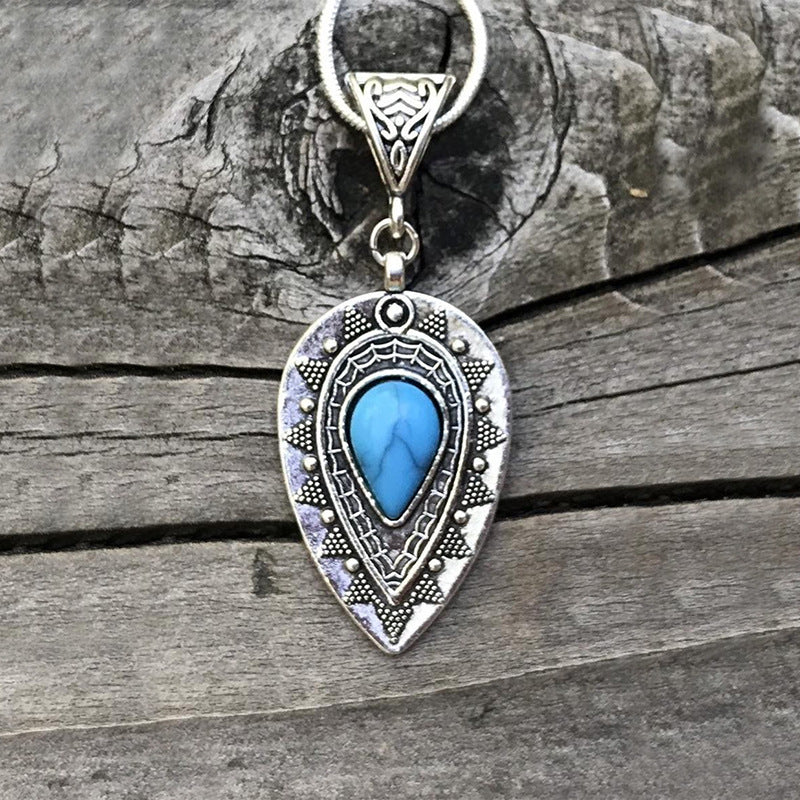
The Turquoise Western Teardrop Pendant Necklace uses a centered teardrop silhouette, turquoise-style color, and vintage-inspired surface detail. Its visual direction is clear without combining several literal motifs, which makes it a useful example for an everyday focal point, an open shirt, a simple dress, or a layered arrangement with one quieter chain.
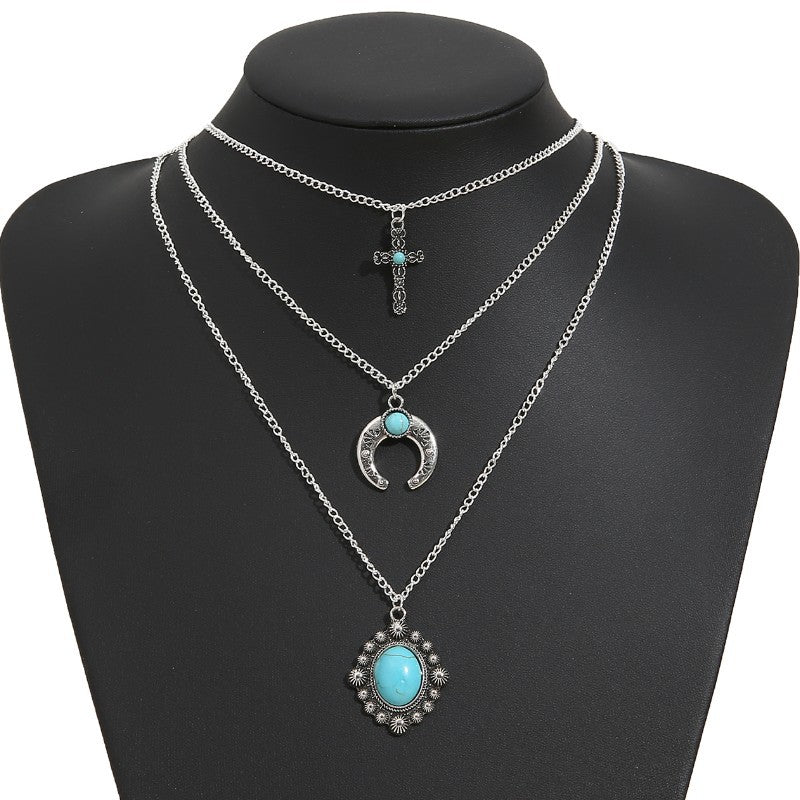
The Turquoise Cow Skull Moon Cross Necklace combines several recognizable elements and therefore reads as a more theme-forward statement. Give the motif clear space against a solid top, denim layer, or simple dress. Keep nearby earrings compact if you want the necklace to remain the headline.
These examples illustrate contrasting styling jobs; they do not establish unlisted materials, measurements, weight, age, or origin. Review the current product page, images, options, price, shipping, and return information before ordering.
Five Reliable Western Necklace Outfit Formulas
1. White shirt, denim, and a centered teardrop
Open the shirt to the point you normally wear it, then set the necklace so the pendant sits clearly inside the opening or clearly over the fabric. Add jeans and boots, and keep the earrings compact. This is an easy repeatable formula because the familiar clothing gives the pendant room to supply color and detail.
2. Black dress with a theme-forward pendant
A solid black dress creates contrast for turquoise-style accents, silver tones, leather cords, and western symbols. Choose one visible pendant and skip a competing statement earring. A ring or bracelet can repeat a small part of the color story farther from the neckline.
3. High-neck knit with a long necklace
Place the entire pendant visibly over the fabric rather than directly on the collar edge. Confirm that the chain, cord, and back of the pendant do not catch the knit. Use contrast so the silhouette remains readable. This formula can make a western necklace useful outside concert or rodeo settings.
4. Concert layers with controlled movement
Combine a simple top, denim, a light jacket, and one necklace that clears zippers, fringe, bag straps, and hair. Test the clasp and movement before leaving home. When the outfit already has a hatband, large buckle, and detailed boots, use a compact pendant rather than adding another large motif. For a full event sequence covering security, seating, dancing, weather, jacket changes, earrings, bracelets, and rings, use the country concert jewelry and movement guide.
5. Two-necklace everyday layer
Use one short texture-focused chain and one longer western pendant. Plot the bottom of both pieces so the pendant does not repeatedly strike the shorter chain. Keep the metal or color relationship intentional and stop at two pieces if the result already feels complete.
How to Read a Western Necklace Listing
- Identify the unit: Is this one necklace, a layered set, a detachable pendant, or a chain without the shown charm?
- Record the full wearable range: Include the extender and each available option.
- Find pendant height and width: Determine whether height includes the bail.
- Check the construction: Chain, cord, beads, multiple strands, fixed pendant, sliding pendant, and detachable parts behave differently.
- Confirm the closure: Match it to your dexterity, hair, and intended use.
- Separate material claims: Chain, finish, clasp, pendant body, decorative accent, coating, and cord may not share one material.
- Ask for weight when needed: Confirm that the number applies to the complete necklace.
- Review several photographs: Front, back, side, scale, and on-person images answer different questions.
- Read current policies: Shipping and returns are especially important for a dated event or gift.
The U.S. FTC Jewelry Guides provide a framework for truthful descriptions of jewelry materials. As a shopper, translate that principle into a simple habit: treat the exact product specification as evidence and treat styling words as visual navigation. Oroxen's western turquoise jewelry guide offers additional questions for blue-green accents and stone-related language.
Giving a Western Necklace as a Gift
A necklace avoids ring sizing and piercing questions, but fit still matters. Look at what the recipient already wears: short or long, fine or bold, plain chain or pendant, bright turquoise-style color or neutral metal, literal motifs or abstract geometry. Photograph or discreetly measure a favorite necklace when possible.
Confirm whether the recipient is comfortable with jewelry close to the neck, whether the clasp is manageable, and whether any material sensitivities are known. Choose an adjustable design when the documented range genuinely covers several landing points. Review the return policy and shipping date before treating adjustability as a substitute for all other information.
A recognizable horse, cross, cow skull, heart, boot, or birth-related motif may feel personal, but meaning should come from the recipient rather than a universal symbol claim. For broader gift coordination, pair a necklace with a compact piece from western earrings or use the western turquoise ring guide if you already know the recipient's ring preferences and fit.
Care and Storage
Follow the care directions for the necklace's documented materials. A conservative fashion-jewelry routine is to apply fragrance, hairspray, sunscreen, lotion, and makeup before putting the necklace on and allow those products to dry. Remove it before showering, swimming, sleeping, or exercise unless the maker confirms that every component is suitable for those conditions.
After wear, wipe accessible surfaces gently with a soft, dry cloth. Close the clasp and store the necklace flat or hanging in a way that does not strain the chain. Keep pendants and raised details from rubbing other pieces. Separate layered necklaces before storage unless the product was designed as a fixed set.
Do not use a dip, abrasive paste, polishing cloth with unknown treatment, ultrasonic cleaner, or steam cleaner unless the product instructions confirm compatibility with the chain, finish, accent, adhesive, patina, leather, resin, and every other component. A method suitable for one metal can damage a coating or porous decoration.
Video: Statement Necklace Shapes and Necklines
Fashion designer Justine Leconte demonstrates short, long, choker, pendant, mixed-material, and statement necklaces with different necklines in this independent educational video. Use the examples to observe landing points and visual hierarchy rather than treating them as mandatory rules. The video is not an Oroxen endorsement and does not verify any Oroxen product's materials, dimensions, or fit.
Watch “How to style (statement) necklaces” by Justine Leconte on YouTube.
Frequently Asked Questions
What is the best length for a western pendant necklace?
There is no universal best length. Choose the final landing point by measuring a necklace you own, then compare the new chain or cord length, extender, pendant height, neck circumference, and intended neckline. A useful result places the pendant clearly inside an opening or clearly over fabric instead of repeatedly crossing the edge.
Does pendant height count as part of necklace length?
A retailer may list chain length separately from pendant dimensions. The pendant still adds visible drop below the chain, so you need both numbers to predict the endpoint. Check whether the pendant height includes its bail.
Which necklace works with a V-neck?
A centered vertical, teardrop, cross, or pointed pendant can echo the V, while a rounded piece can create deliberate contrast. More important than the shape label is the landing point. Test whether the pendant stays inside the V or falls fully below it.
How do I layer western necklaces without tangling?
Give each piece a separate endpoint, use one main pendant, vary chain or cord texture carefully, and test the combination while moving. No spacing formula guarantees tangle-free wear because pendant height, clasp movement, clothing, chain construction, and activity all matter.
Can I wear a large western necklace with statement earrings?
You can, especially for a deliberately maximal outfit, but establish a hierarchy. Let either the face or neckline lead. A large pendant often reads more clearly with compact earrings; dramatic earrings may need a small pendant or no necklace.
Does a turquoise western necklace contain natural turquoise?
Not necessarily. The phrase may describe color or style. The accent could be natural turquoise, another stone, composite material, glass, resin, enamel, or a different decorative component. Use the live product specification rather than the title or photograph as proof.
What should I check before buying a necklace online?
Confirm the wearable length range, pendant height and width, whether the bail is included, closure, construction, stated materials, weight if important, the exact item included, several photographs, current shipping, and returns. Contact the seller when a purchase-critical fact is missing.
Your 60-Second Western Necklace Check
- I know the shortest and longest wearable settings.
- I know the pendant's full height and maximum width.
- I have plotted the final endpoint against my intended neckline.
- The closure and chain or cord construction suit how I will wear it.
- I have checked weight or asked for it when comfort matters.
- The motif has a clear role beside my earrings, hat, yoke, scarf, or buckle.
- I have separated style language from verified material, age, and origin claims.
- Any layered pendant has its own visible zone.
- The current shipping and return terms work for my occasion.
Once those checks are complete, choose the necklace that makes your existing clothes more expressive. Explore western necklaces by silhouette and motif, follow each product page for its current facts, or return to the Oroxen homepage for the full western jewelry shop. The strongest choice is not the longest chain or the largest pendant—it is the piece whose final landing point, comfort, and story fit the way you actually dress.
When a pendant is only one possible focal point, use the complete western jewelry guide to compare face, neckline, wrist, and hand placement while keeping visual style separate from unsupported composition or origin claims.