A western turquoise ring can add color, pattern, and a clear point of view to an outfit without requiring a complete wardrobe change. It may be a compact blue-green accent worn with denim, a large cross or floral statement on the index finger, or one piece in a mixed ring stack. The challenge is choosing a design that looks as good on your hand as it does in a close-up product photograph.
This guide focuses on the decisions that matter before you buy: silhouette, apparent scale, finger placement, fit, comfort, material descriptions, outfit coordination, and care. It also explains why “turquoise” in a product name may describe color or style rather than prove a particular stone. You can compare current styles in the Turquoise Rings collection, browse the broader Western Rings collection, or start with our complete western turquoise jewelry guide.
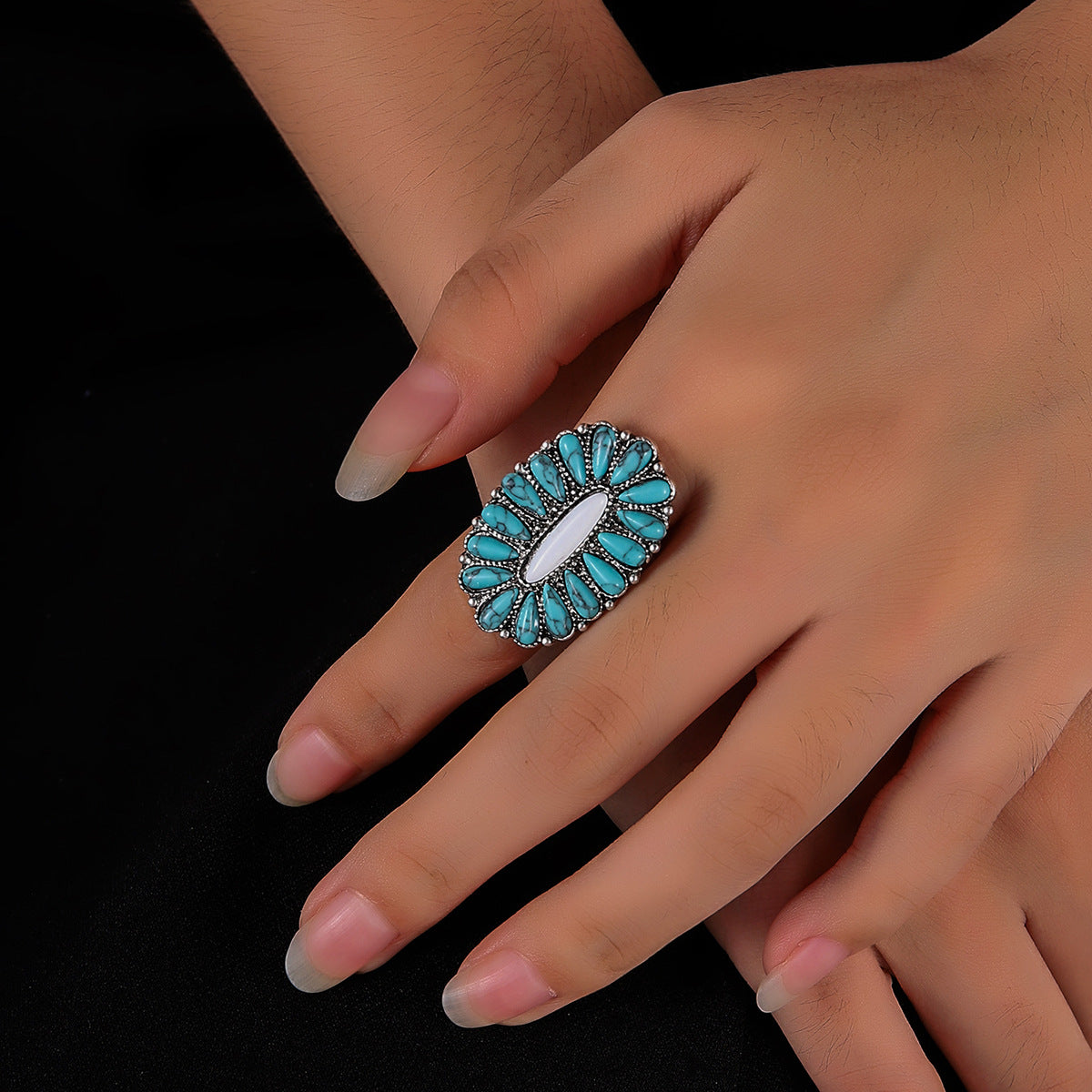
Start with the Meaning of “Turquoise Ring”
Online listings use “turquoise ring” in more than one way. Sometimes it refers to jewelry containing a material identified by the seller as turquoise. Sometimes it means turquoise-colored resin, glass, enamel, composite, another stone, or a decorative blue-green surface. It may also be part of a style phrase such as “western turquoise ring,” where the words describe the overall look.
Do not identify material from color alone. Natural turquoise, treated turquoise, composite material, imitation material, and other blue-green accents can look similar in photographs. If composition matters to you, look for an exact specification and supporting documentation. If the listing is silent, treat the material as unspecified rather than upgrading the claim in your mind.
The same rule applies to metal. “Silver tone” is a color description. It is not the same statement as sterling silver. “Vintage-inspired” describes appearance, not age. “Western” describes design language, not a named maker or cultural origin. These distinctions let you enjoy fashion jewelry for what it is while reserving stronger claims for pieces with evidence.
What Makes a Ring Look Western?
No single detail owns the western look. Designers build it from combinations of shape, color, texture, motif, and proportion. One ring might use an elongated oval center with an antiqued-looking border. Another may feature a cross, cactus, flower, rope edge, fan, feather, or geometric frame. A third may rely only on a blue-green centerpiece against a warm or darkened metal tone.
Decorative centers
A defined center gives the eye a focal point. Round centers feel compact and balanced. Ovals lengthen the design across or along the finger. Rectangular, diamond, and cross-shaped centers create stronger geometry. If the top of the ring extends far beyond the finger, check whether it will interfere with adjacent fingers.
Stamped and raised textures
Dots, scallops, radiating lines, floral borders, and rope-like edges catch light and create contrast. Deeper relief reads more clearly from a distance but may also catch on loosely woven fabric. Examine side and angled product images, not only the straight-on hero image.
Cross, cactus, floral, and geometric motifs
Literal motifs make the style more explicit. A cactus or cross ring will usually become the narrative center of a hand stack, while a simple oval can blend more easily into everyday outfits. Choose a motif because it suits the wearer, not because every western outfit must contain a symbol.
Choose the Silhouette Before the Color
Blue-green color attracts attention first, but silhouette determines how a ring occupies the hand. Product photography can hide that fact because every item is enlarged to fill the same screen. Look for top dimensions, band width, total height, and a hand photograph. When measurements are missing, ask the seller instead of estimating from the crop.
A compact ring is easier to combine with bracelets, watches, and other rings. A medium statement ring shows clearly without covering much of the neighboring fingers. An oversized design makes the hand a focal area and may work best as the only ring on that hand. Large does not automatically mean uncomfortable, but top weight, balance, edge shape, and band construction matter.
Think in terms of visual zones. A long oval placed vertically follows the finger. A wide cross or floral plate travels across it. A tall setting adds profile and may catch more easily. Choose the direction that complements your preferred finger and daily activities.
| Ring scale | Visual role | Best measurement check | Common tradeoff |
|---|---|---|---|
| Compact accent | Supports a watch, cuff, or larger earring | Band width and inner diameter | May look smaller than expected in outfit photos |
| Medium statement | Visible repeat-wear focal point | Top length, top width, and neighboring-finger clearance | Needs coordination with other hand jewelry |
| Oversized design | Makes the hand the hero zone | Top dimensions, height, edge shape, weight balance | More contact with gloves, pockets, fabric, and adjacent fingers |
How to Measure Ring Size More Reliably
A ring must pass over the knuckle and settle comfortably where it will be worn. The Gemological Institute of America’s sizing benchmark explains that professional gauges and the ring’s width affect sizing decisions. Wider rings can fit more snugly than narrow bands because more material contacts the finger.
The most reliable method is to have the intended finger measured by a jeweler with an appropriate gauge. If that is not possible, compare with a ring that already fits the same finger and measure its interior diameter. Do not use a ring from another finger as if the size were interchangeable. Fingers on opposite hands may also differ.
- Choose the exact finger and hand where the new ring will be worn.
- Measure more than once rather than relying on a single moment.
- Check that the ring can pass the knuckle without forcing.
- Compare the band width with the ring used as your reference.
- Use the product’s actual size chart because international systems differ.
Temperature, activity, and time of day can change how a finger feels. A string method can give a rough estimate, but stretch, tension, and marking errors can change the result. For a gift, borrowing a ring that fits the intended finger is usually more informative than guessing from general hand size.
Fixed Size, Adjustable, and One-Size Rings
A fixed-size band should list a defined size or measurable interior diameter. An adjustable ring has an opening or construction that allows some movement. “One size” may mean adjustable, but it does not tell you the full usable range or how many adjustments the structure can tolerate.
If a listing describes a ring as adjustable, look for minimum and maximum guidance. Ask whether the ring should be adjusted once or can be reshaped repeatedly. Frequent bending may stress some materials, finishes, joins, settings, or decorative elements. Adjust slowly and evenly, following product-specific instructions.
Wide decorative tops can hide an open band in photographs. That may help the design look continuous, but it does not eliminate fit questions. Confirm whether the opening touches neighboring fingers, whether the top rotates, and whether the product is intended for occasional fashion wear or regular use.
Match Ring Scale to Finger Placement
Index finger
The index finger gives a statement ring space and visibility. A cross, cactus, or broad floral design reads clearly here. Because this finger participates in many daily movements, check the side profile and neighboring-finger clearance.
Middle finger
The center of the hand creates symmetry and can support a large oval or geometric ring. Leave enough room on both sides. A slim thumb ring or small pinky ring can balance the look without crowding it.
Ring finger
A decorative fashion ring can be worn on the ring finger, but do not assume it is designed as a wedding or engagement ring. Jewelry intended for continuous symbolic wear may require documented materials, stone details, construction, service options, and durability information that a fashion listing does not provide.
Pinky or thumb
Small rings can create an intentional pinky accent. A thumb ring usually needs a comfortable inner shape and a size suited to the broader joint. These placements can make an asymmetric stack feel planned, but each finger should be measured separately.
Three Ways to Style a Western Turquoise Ring
1. Denim, white shirt, one statement ring
This formula puts nearly all the jewelry emphasis on the hand. Wear jeans, a white or chambray shirt, and a large turquoise-colored ring. Roll the sleeves to expose the wrist, then choose either a quiet bracelet or none. The simplicity of the clothing makes surface detail visible.
2. Black dress with controlled contrast
Black provides a clean background for blue-green accents and silver-toned texture. Add boots or a leather belt if you want a stronger western direction, but the ring can be the only obvious cue. Keep the earrings compact when the ring is oversized.
3. Neutral knitwear and a mixed stack
Cream, camel, soft gray, and muted green make a useful base for several smaller rings. Repeat one texture or metal tone, then use one turquoise-colored ring as the stack’s color anchor. Browse Cowgirl Jewelry when you want more literal western motifs, or Turquoise Jewelry when color is the main connection.
Should Rings Match Earrings and Necklaces?
Exact matching is optional. A better approach is to repeat one or two attributes: blue-green color, metal tone, stamped texture, a cross motif, or overall visual weight. If the ring and earrings are both oversized, the look can become crowded even when the colors match perfectly.
Choose a hero zone. When the hand leads, use small earrings and an open neckline. When a necklace leads, choose a compact ring that repeats one color. If a statement ring, watch, bracelet stack, and large bag hardware all occupy the same side, remove one element and compare again.
Mixed metals can look deliberate when repetition creates continuity. A silver-toned ring, two-tone belt buckle, and warm bracelet can work together if each metal is visible more than once. Explore the wider Western Jewelry collection for coordinating categories rather than forcing an identical set.
Two Oroxen Examples with Different Visual Jobs
Turquoise Vintage Statement Cross Ring
The Turquoise Vintage Statement Cross Ring combines turquoise color, a broad statement silhouette, vintage-inspired texture, and a cross motif. It works best when the hand is meant to be a focal point. Pair it with a simple neckline or compact earrings so the decorative top has space.
Turquoise Boho Vintage Ring
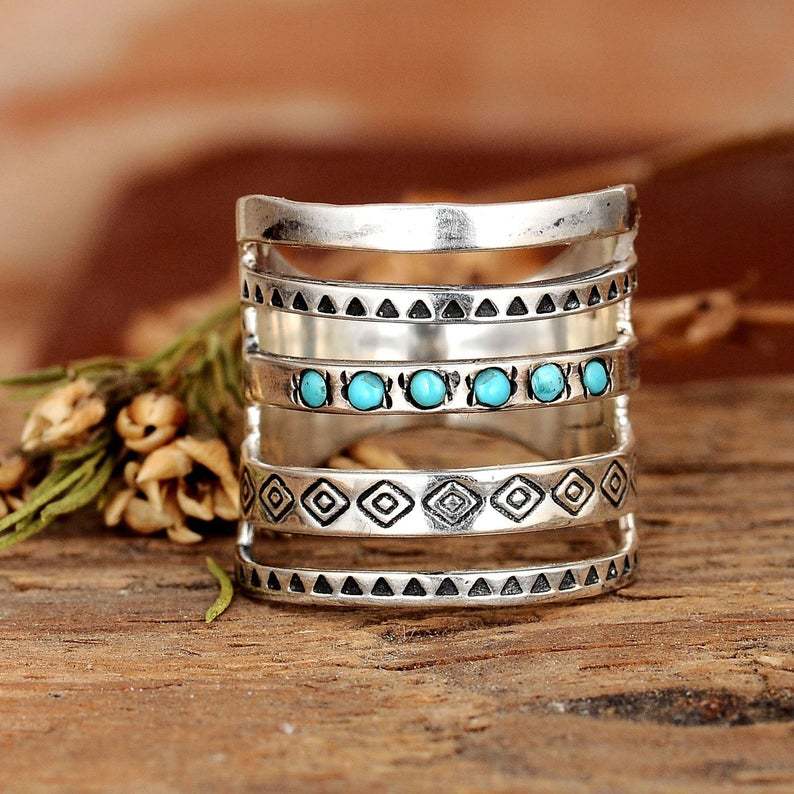
The Turquoise Boho Vintage Ring offers a different route into the look. Its boho and vintage-inspired vocabulary makes it useful with neutral knits, layered fabrics, and casual denim. Check the live product page for current variants, size information, price, and materials before ordering.
These names describe the designs as presented by Oroxen. They do not independently establish natural turquoise, sterling silver, antique age, or a specific cultural maker. Apply the same reading discipline to every product you compare.
How to Read a Ring Product Page
A helpful listing should let you answer practical questions before checkout. Product images are useful, but they are not a complete specification. Record the details rather than relying on an overall impression.
- Size: Is it fixed, adjustable, or one size, and what measurements define that?
- Top dimensions: How long and wide is the decorative face?
- Band: Is the band narrow, wide, open, or tapered?
- Materials: What are the base, finish, and blue-green component?
- Profile: Does the top sit close to the finger or rise above it?
- Variants: Do photographs and names correspond to the option selected?
- Policies: Are shipping timing and return terms suitable for a gift or event?
If a listing omits information that matters, ask a narrow question. “What is the inner diameter?” is more actionable than “Will it fit?” “What material is the blue-green component?” is clearer than asking whether the ring is “real.” Specific questions reduce misunderstanding.
Care for the Materials You Actually Have
Product-specific instructions should come first because coatings, adhesives, stones, resin, enamel, and metal components can respond differently. As a conservative routine, remove fashion rings before swimming, showering, exercising, cleaning, or applying chemicals. Put the ring on after lotion, sunscreen, perfume, and hairspray have dried.
Wipe the piece gently with a soft, dry cloth after wear. Store it separately so raised edges do not scratch other jewelry. Do not use a chemical dip, abrasive paste, ultrasonic machine, or aggressive polishing cloth unless the seller confirms compatibility with every component. A cleaner that is safe for one metal may harm a coating, adhesive, patina, or decorative center.
Adjustable rings deserve extra attention. Avoid opening and closing the band repeatedly unless the maker says that is intended. Hold the band rather than the decorative top when making a permitted adjustment, and stop if resistance changes or the setting moves.
When the accent is specifically documented as turquoise, the GIA turquoise care guide notes that heat, chemicals, cosmetics, oils, and perspiration can affect it and that steam and ultrasonic cleaning should be avoided. If the accent material is unspecified, follow the exact seller instructions and use the conservative dry-care routine above rather than applying natural-gemstone advice by assumption.
Watch: Measuring Ring Size at Home
This independent video from the verified MrYouWho channel demonstrates several home ring-sizing methods and discusses comparison charts and measuring tools. It is useful as a visual companion to the fit section above. The video is third-party educational content, not an Oroxen endorsement, and its charts should not replace the size information on the exact product page.
Watch “How to Measure Your Ring Size at Home” on YouTube.
A Practical Buying Checklist
- Choose the finger and decide whether the ring will be worn alone or in a stack.
- Measure that exact finger or a ring that already fits it.
- Compare the decorative top dimensions with the finger, not just the product photo.
- Confirm fixed, adjustable, or one-size construction.
- Read the stated base, finish, and accent materials.
- Separate style terms from claims about composition, origin, or age.
- Check the side profile and neighboring-finger clearance.
- Identify at least three outfits that can use the ring.
- Review current variants, shipping information, and return terms.
Frequently Asked Questions
Is every turquoise-colored ring made with natural turquoise?
No. The accent may be natural turquoise, treated or composite material, another stone, glass, resin, enamel, or a different decorative substance. Use the product specification rather than appearance alone.
Are western turquoise rings always sterling silver?
No. Western style and silver color do not establish metal content. A listing should make a specific sterling-silver claim if that is the material. Look for supporting details when composition matters.
Which finger is best for a western statement ring?
The index and middle fingers often give a broad design more visual space, but comfort and movement are more important than a styling rule. Measure the exact finger and confirm that the ring does not press against adjacent fingers.
Can a one-size ring fit everyone?
No. “One size” does not guarantee universal fit. It may indicate an adjustable design, but you still need its intended range and adjustment guidance.
Can I use a fashion turquoise ring as a wedding ring?
You can assign personal meaning to any jewelry, but a fashion ring should not be assumed to have the documented materials, construction, resizing options, or service support expected for continuous bridal wear. Review the exact specifications and intended use before deciding.
How should I style a large turquoise ring?
Let it lead the hand. Wear it with denim and a white shirt, a black dress, or neutral knitwear. Keep neighboring rings small and use compact earrings or a quiet necklace so several large pieces do not compete near the face and hands.
How do I keep a statement ring from spinning?
Spinning can result from fit, top weight, band shape, or changes in finger size. Confirm the correct size first. Do not add permanent sizing material or bend an adjustable band repeatedly without product-specific guidance.
Build a Ring Wardrobe That Converts Style into Repeat Wear
Complete the cluster: compare other jewelry categories in the western turquoise jewelry pillar guide, use the cowgirl jewelry guide for occasion-based outfit balance, and review concho earrings when the face-level accessory also makes a statement.
The best western turquoise ring is not necessarily the largest or most ornate. It is the one whose scale fits your hand, whose construction fits your routine, and whose documented details match your expectations. Start with the silhouette, verify the size, interpret material language carefully, and choose an outfit role before checkout.
Shop the focused Turquoise Rings collection, compare more silhouettes in Western Rings, browse all Oroxen collections, or return to the Oroxen home page. One well-chosen ring can become a repeat-wear signature rather than a product that only looked good in a close-up.
To compare this hand-level choice with earrings, necklaces, and cuffs, use the western jewelry motifs, styles, and materials guide. It adds an Evidence Ladder for separating appearance from documented material, maker, age, and provenance information.