A pendant can look simple in a product photograph while creating a surprisingly complex buying decision. The visible centerpiece is only one part of the necklace. Chain length, pendant dimensions, weight, bail clearance, connector strength, clasp operation, surface finish, color variation, and care restrictions all determine whether the piece works in real life. When those facts are missing, an attractive image is a starting point rather than a complete reason to order.
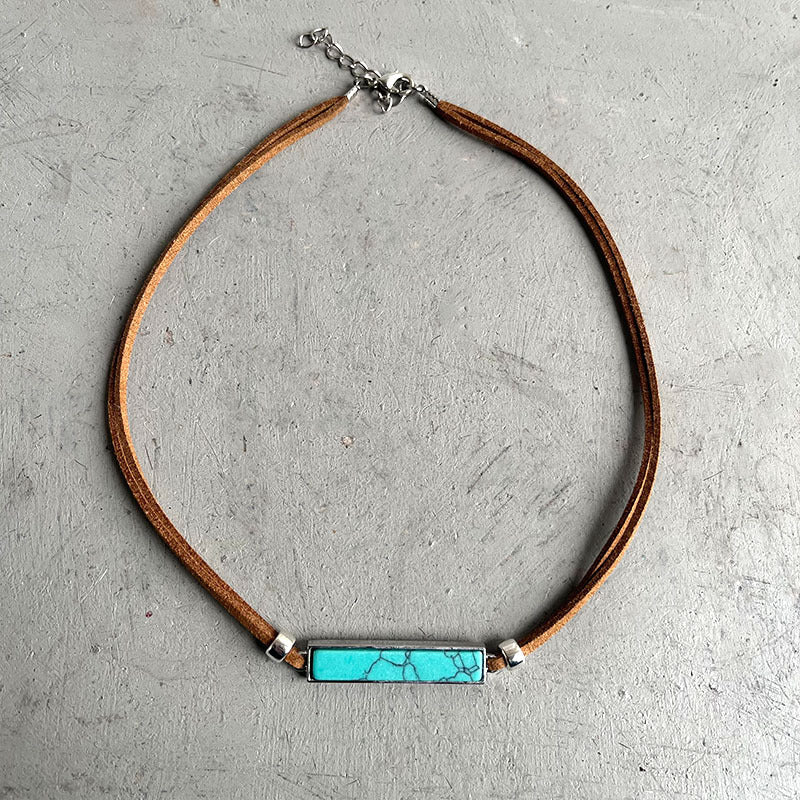
This guide compares two current Oroxen examples: the Western Turquoise Vintage Geometric Cross Necklace and the Turquoise Western Teardrop Pendant Necklace. The product names describe visible style language. They do not independently prove natural turquoise, vintage age, metal identity, origin, production method, or cultural affiliation. The practical goal is to turn what you can observe into a precise list of facts to verify.
Quick Answer: What to Know Before Buying
Choose a turquoise-colored pendant only after you can answer seven questions: Where should it sit? How large and heavy is it? What materials and finishes are documented? How is the pendant connected to the chain? Can the clasp and chain support the intended use? What care limits apply? What happens if the delivered piece differs from the listing or is uncomfortable?
If the product page does not answer a question, do not fill the gap with assumptions. Save the exact option, collect screenshots, and ask the seller in writing. A label such as “turquoise,” “antique silver,” “vintage,” or “Western” can be useful for style discovery without establishing composition, age, or value. Keep observation and verification separate.
For broader orientation before comparing pendants, use the public complete guide to choosing Western turquoise-style jewelry. It provides category context, while this article concentrates on necklace construction and pendant placement.
Build a One-Page Pendant Brief
Write a short buying brief before browsing. Start with the intended use: everyday wear, a particular outfit, a concert, an event, travel, or a gift. Add the preferred visual role—quiet accent, medium focal point, or dominant statement. Then list the necklines, outer layers, bag straps, seat belts, work equipment, and activities that the necklace must coexist with.
Set non-negotiables. These may include an exact placement zone, maximum weight, adjustable chain, easy clasp, smooth reverse, removable pendant, documented materials, or a return window. Do not create a false universal standard. A comfortable limit and usable clasp depend on the wearer, the necklace, and the situation.
Finally, create an “unknown” column. Missing measurements, unclear option names, unspecified metal, unconfirmed stone identity, undisclosed coating, or absent care guidance belong there. Unknown does not automatically mean unacceptable; it means the decision is incomplete until the uncertainty is resolved or consciously accepted under the seller’s current terms.
Separate Observation, Listing Evidence, and Inference
| Information type | Example | How to use it |
|---|---|---|
| Direct observation | The image shows a cross-shaped or teardrop silhouette | Use for styling and motif comparison |
| Listing evidence | The exact option name, disclosed measurement, or written care rule | Record with the date and selected option |
| Inference | Assuming a blue-green component is natural turquoise | Do not treat as a verified product fact |
| Open question | Chain length, weight, bail size, metal, coating, or treatment is not stated | Ask before purchase when it affects the decision |
This four-part distinction prevents a common mistake: converting visual resemblance into a material claim. It also improves comparison. Two pendants can be evaluated fairly even when their construction is not fully documented, because you can compare disclosed facts and note the remaining gaps instead of guessing.
Measure a Placement Window, Not Just a Chain
A chain-length number is useful only when connected to a body and an outfit. Put on the neckline you expect to wear most often. Use a soft measuring tape or a piece of non-stretch cord to mark the highest and lowest acceptable center positions. Record that vertical window and take a straight-on photograph. Repeat with an outer layer if jackets or shirts are part of the plan.
Now add the pendant’s height. A chain may place the bail correctly while the lower point crosses a neckline seam, button, zipper, or garment edge. Width matters around lapels and narrow V-necks. Profile matters near seat belts, bag straps, and layered necklaces. Exact pendant height, width, thickness, and total necklace length should therefore be considered together.
Ask whether the chain length includes the clasp, whether an extender is included, where the seller measures from, and whether the pendant is removable. If there are multiple option images, verify that the stated dimensions belong to the selected design rather than another variation.
Use the Western Necklaces Collection as a Shortlist
Browse Western Necklaces to compare silhouette families, motif scale, apparent color placement, chain style, and how much visual space each pendant occupies. Shortlist by role first. A narrow vertical pendant, a wide horizontal composition, and a multi-component statement necklace solve different wardrobe problems even when all use turquoise-colored details.
Open every candidate in a separate tab and create one row per exact option. Record the product title, URL, selected option, displayed images, dimensions, disclosed materials, closure, care guidance, availability, delivery estimate, and current return terms. Date the worksheet because commercial details can change.
Do not rank candidates by price or photograph alone. Mark each field as confirmed, missing, or incompatible with the brief. A modest-looking pendant with complete measurements may be a safer choice than a dramatic option whose placement, weight, or construction cannot be assessed.
Option One: Geometric Cross Necklace
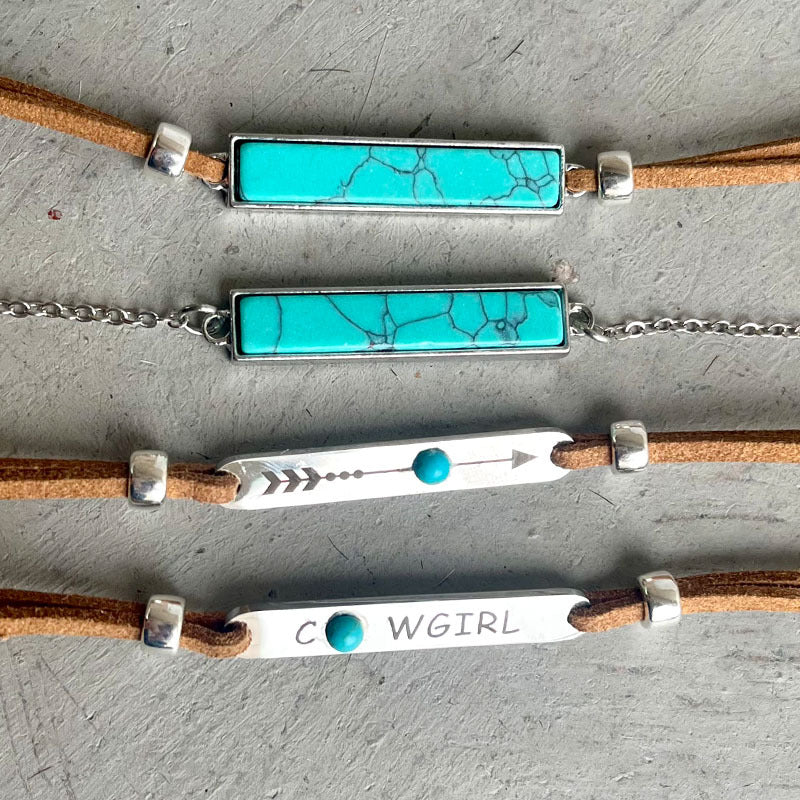
The current Western Turquoise Vintage Geometric Cross Necklace page presents a prominent Western-inspired cross composition with turquoise-colored details. Its selector is labeled “Size,” but the visible choices are “Design 1,” “Design 3,” and “Design 4.” Treat those as design labels unless the seller confirms that they also represent measurable sizes. Verify which photograph and specifications belong to each selection.
This option suits a buyer seeking a clear focal motif. Before ordering, request the overall necklace length, adjustment range, cross height and width, maximum profile, total weight, chain construction, clasp type, bail or connector dimensions, component materials, finish, care restrictions, and whether the pendant can be removed. Ask whether all visible decorative components are mechanically set or whether adhesives are used.
Test the idea against actual clothing. A cross with multiple arms and decorative edges may occupy more horizontal space than a narrow drop. Trace the stated dimensions on paper, cut out the shape, and tape it to the measured placement cord. Check it over a crew neck, open collar, and preferred jacket. This paper test cannot predict weight or texture, but it reveals proportion and neckline conflict.
Consider motif meaning as well as scale. A cross can carry personal or religious significance. The product title does not define what the symbol means to the wearer or recipient. For a gift, confirm that the motif is welcome rather than assuming that Western styling makes it universally appropriate.
Option Two: Teardrop Pendant Necklace
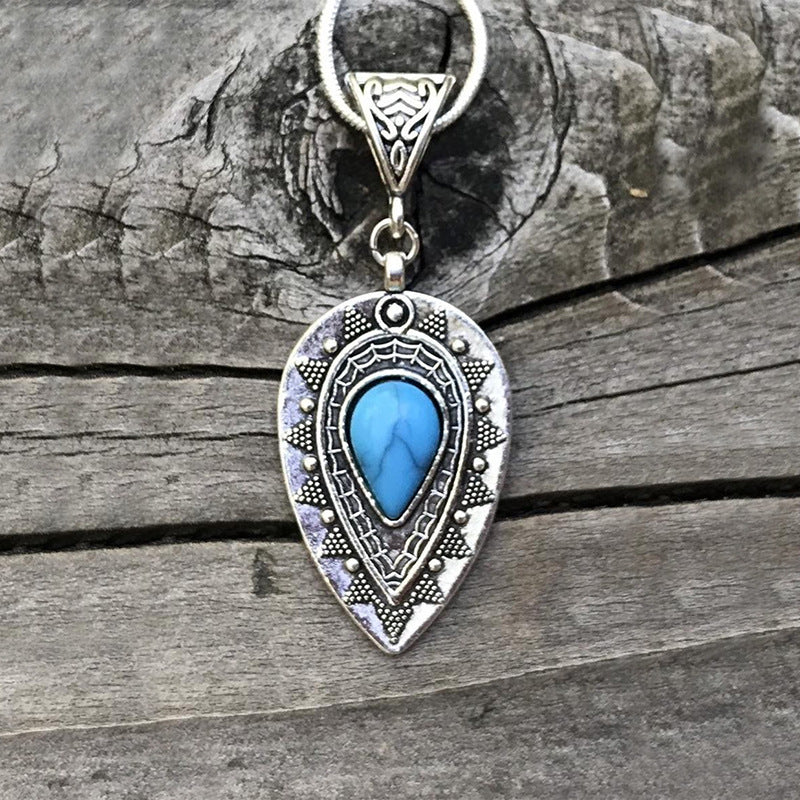
The current Teardrop Pendant Necklace page describes a Western pendant with a turquoise-style center, teardrop silhouette, antique-silver-colored appearance, and vintage-inspired detailing. Its visible option area shows one color selection and no clearly stated size choice. The page recommends denim, boots, shirts, dresses, solo wear, and layering, but these are styling suggestions rather than proof of fit.
The page’s care section advises keeping the jewelry dry, avoiding direct contact with perfume or lotion, and storing it in a soft pouch; it also notes that material details can vary by option. Apply that warning before purchasing. Ask for chain length, pendant dimensions, weight, clasp, bail clearance, every component material, finish system, stone or stone-like component description, and construction method for the exact option.
A teardrop creates a vertical line and may fit more easily inside a V-neck or open collar than a wide motif, but this is only a visual hypothesis until measurements are known. Make the same paper template and placement-cord test used for the cross. Then compare how the bottom point interacts with buttons, seams, and other necklaces.
Compare the Two Options With a Decision Matrix
Do not decide which pendant is “better” in the abstract. Score each one against the brief. Use zero for missing or incompatible information, one for a question that can be resolved, and two for a confirmed match. Weight critical fields—such as material disclosure, measurements, comfort, closure, and return readiness—more heavily than visual preferences.
| Decision field | Cross option | Teardrop option |
|---|---|---|
| Visual role | Broader, motif-led statement | Narrower vertical focal point |
| Visible selector | Design 1, Design 3, Design 4 under “Size” | One visible color option |
| Best question | Which image and specifications match each design? | What are the exact chain and pendant measurements? |
| Wardrobe test | Horizontal clearance around collar and lapels | Vertical clearance across neckline and buttons |
| Shared requirement | Verify materials, finish, weight, chain, clasp, connector, care, availability, and current return terms | |
If both candidates remain tied, choose the one with fewer important unknowns. Information quality is part of product suitability. A clear answer about size or construction can be more valuable than an additional styled photograph.
Match the Pendant to Real Movement
Visual placement is only the first test. List movements from the intended setting: walking, bending, driving, dancing, using a phone, lifting a bag, wearing a lanyard, or putting on a coat. Mark where the pendant, chain, and clasp might contact skin, fabric, hair, buttons, hardware, a seat belt, or another necklace.
For an everyday piece, prioritize repeatable comfort and low interference. For a short occasion, a larger motif may be acceptable if it remains secure and comfortable. For travel, consider storage, tangling, and the difficulty of replacing a lost backing or connector. For a concert, read the public country concert jewelry planning guide and adapt the contact-point checks to the venue.
Never rely on a model photograph to predict where a necklace will sit on another person. Neck circumference, torso proportions, clothing thickness, and exact chain adjustment all change placement.
Video Buying Lesson: Turn Claims Into Questions
The supplemental video is Watch This Before You Buy Turquoise — Know What You’re Buying by GomeowCreations. Its page was accessible during this review, but a transcript was not available. This article therefore does not quote the creator or use the video to authenticate either Oroxen necklace.
Watch the complete video and write down every material, treatment, origin, or identification claim you hear. For each one, ask what evidence supports it, what exceptions exist, and whether it applies to finished fashion jewelry. Then return to the exact product listing. A third-party educational video can improve your questions, but it cannot identify a component from an Oroxen photograph or certify a specific option.
Buying Mistakes and Red Flags
The first mistake is assuming that a product title is a laboratory report. The second is ordering without measurements. The third is treating every option image as interchangeable. The fourth is overlooking the reverse, chain, clasp, bail, and connectors because the decorative front receives most of the photography.
Pause when the selected option cannot be matched to its pictures, critical measurements conflict, materials are described inconsistently, the return window is too short for your delivery and testing plan, or the seller cannot explain an important care limitation. A missing fact is not proof of a defect, but it can still make the purchase unsuitable for a buyer who needs certainty.
Capture the listing, chosen option, expected contents, price, delivery estimate, and return terms immediately before checkout. Read exclusions and determine who pays return shipping, whether original packaging is required, and whether worn jewelry is returnable. Commercial policies can change, so use current checkout information rather than an old article or screenshot.
The public RIDER framework for buying Western jewelry for women offers another way to organize evidence, dimensions, daily contact, and return readiness.
Arrival Inspection Before the First Wear
Open the package over a clean tray and compare the contents with the order. Photograph the front, reverse, side, clasp, chain, connectors, bail, and option label. Measure the chain and pendant using the same method discussed with the seller. Record weight if it was an important decision field.
Inspect for sharp edges, open links, bent hardware, loose components, finish transfer, unexpected movement, or visible differences from the listing. Do not bend, polish, soak, or repair a questionable piece before contacting the seller, because alteration can complicate a return. Keep packaging until the inspection and wear test are complete.
Perform a short stationary test over soft clothing, followed by normal head and shoulder movement. Check clasp operation, chain twist, pendant rotation, neckline contact, and comfort. Stop if the piece catches, pinches, feels insecure, or causes irritation. Style decisions come after structural and comfort checks.
Gift-Buying Questions
A pendant gift requires more than knowing that someone likes blue-green color or Western fashion. Confirm preferred motif, religious-symbol comfort, usual necklace length, metal sensitivities, statement tolerance, closure needs, and whether the recipient layers necklaces. A discreet photo of necklaces they already wear can reveal scale and placement preferences without guessing.
Favor documented dimensions and flexible return terms when size information is limited. Include the product record and care instructions with the gift, but do not attach an unsupported story about natural turquoise, vintage age, or cultural origin. The public Western jewelry gift guide provides a recipient-and-occasion checklist for the broader decision.
Frequently Asked Questions
How should a beginner choose a turquoise-colored pendant?
Start with a placement window, maximum acceptable scale, intended use, and required documentation. Shortlist only pieces that can be compared through exact option information. Ask for missing dimensions, weight, materials, construction, closure, and care before ordering.
Which neckline works best?
There is no universal best neckline. Test pendant height and width against the actual garment. Keep the lower edge away from seams, buttons, and hardware, and check the necklace again with jackets or shirts added.
Can a product photograph confirm real turquoise?
No. Color and visible pattern alone cannot verify identity, treatment, or origin. Use written disclosure from an accountable source and obtain appropriate independent expertise when authenticity materially affects the purchase.
Is a cross pendant always more formal than a teardrop?
No. Formality depends on scale, finish, outfit, styling, setting, and the wearer’s interpretation. Compare each option as a complete necklace rather than assigning a fixed rule to the silhouette.
Should I plan to layer the pendant?
Layering requires verified lengths, compatible profiles, independent movement, and care compatibility. Begin by testing one necklace. Add another only when chains and pendants do not strike, tangle, or compete for the same neckline space.
How do I decide between statement and everyday use?
Compare visibility, wardrobe matches, contact points, movement, maintenance, and information quality across expected wears. The public statement-versus-everyday turquoise-style jewelry guide provides a structured wear grid.
Final Purchase Checklist
- Identify the exact option and match it to the correct images.
- Confirm total length, adjustment range, pendant height, width, thickness, and weight.
- Confirm component materials, stone or stone-like description, finish, treatment, and care.
- Inspect chain, clasp, connectors, bail, reverse, and decorative attachments.
- Test the dimensions against the intended neckline and movement.
- Save current availability, delivery, and return information before checkout.
- Keep the delivered piece unchanged until arrival inspection is complete.
Continue comparing visual families in Western Jewelry and Turquoise Jewelry, then return to Oroxen for current product and store information. The best pendant purchase is not the one supported by the most confident guess. It is the one whose verified facts, proportions, construction, care, and terms fit the wearer’s real plan.