Turquoise Bracelets Styling Mistakes to Avoid with a Wedding Guest Look
A turquoise-colored bracelet can give a wedding guest outfit a memorable point of color, but the wrist is a busier zone than it appears in a posed photograph. The bracelet may meet a sleeve, handbag handle, dinner table, coat cuff, watch, corsage, glass, or another guest during a hug. A successful choice therefore has to work through an entire event, not only in the mirror before leaving home.
This guide treats styling as an invitation-to-exit rehearsal. You will move from dress code and outfit architecture to wrist fit, camera balance, ceremony behavior, dinner comfort, dancing, travel, and storage. The goal is not to declare one design universally appropriate. It is to identify avoidable mistakes, test the exact selected product, and let one turquoise bracelet decision support the occasion instead of competing with it.
Quick Answer: Rehearse the Wrist, Not Just the Outfit
The most common mistake is choosing a turquoise jewelry bracelet because its color works with a dress, then skipping the mechanical questions. First confirm the invitation and venue. Next assign the bracelet one job: quiet color repeat, wrist focal, support for earrings, or contrast against a plain sleeve. Then verify the selected option, included quantity, dimensions, opening or closure, mass, materials, finishes, skin-contact parts, care, availability, delivery timing, and return terms.
Wear the complete outfit during a short rehearsal. Put on the coat, carry the bag, sit at a table, use a phone, lift a glass, hug, and move as you expect to move at the reception. Photograph the look from normal portrait distance. If the bracelet catches, rotates, clatters, presses, dominates every photograph, or requires constant correction, change the stack before the event.
For broader category navigation, begin at the Turquoise Jewelry Guides hub. For this specific occasion, keep the decision tied to the exact product page and your own rehearsal.
Mistake 1: Letting the Color Override the Invitation
Turquoise color is not a dress code. A daytime outdoor wedding, a formal evening reception, a courthouse ceremony, and a destination celebration can place very different demands on the same bracelet. Read the invitation, wedding website, venue information, and any cultural or religious guidance supplied by the couple. When the instructions are unclear, a simple question to the host is more reliable than an online list of universal wedding rules.
Translate the event into practical constraints. Will there be grass, sand, stairs, a coat check, plated dinner, buffet, long sleeves, dancing, or a flight? Is the outfit already patterned, embellished, metallic, or highly structured? The bracelet does not need to mimic the venue, but it should survive the schedule without turning into a maintenance task.
Do not use turquoise-colored styling language to imply a gemstone, metal, age, maker, region, tribe, nation, or cultural affiliation. Product wording such as turquoise-colored, Western-inspired, boho, vintage-inspired, statement, or cuff describes appearance or merchandising unless the current page provides stronger documentation. The published guide to Western jewelry motifs, styles, and materials can help separate a visible motif from an unsupported identity claim.
Mistake 2: Building a Matching Set Instead of a Visual Hierarchy
A bracelet, necklace, earrings, ring, belt buckle, bag hardware, shoe detail, and dress embellishment can all be attractive individually. Giving every piece equal volume creates competition. Decide which zone leads. If the wrist leads, reduce the size, shine, movement, or color repetition elsewhere. If earrings frame the face for photographs, let the bracelet act as a quieter echo rather than a second headline.
Use three distances during the mirror test. At arm's length, check whether the wrist supports the silhouette. From across the room, check whether the outfit still reads before the accessory. In a phone photograph, check whether reflective or high-contrast details pull attention away from the face. A close product photograph magnifies detail; wedding photographs usually show the bracelet as one part of a larger composition.
Matching every blue-green accent exactly is unnecessary. Controlled variation can look more intentional than a collection of near-matches. Coordinate through one shared property—color family, visual weight, line, finish temperature, or spacing—then allow the remaining elements to differ. The detailed Western jewelry styling guide for dresses and other wardrobe foundations offers additional ways to organize a focal piece without duplicating every motif.
Mistake 3: Counting Pieces Before Confirming the Selected Option
A listing photograph may show a stack, a range of alternatives, or multiple angles. It does not always define what the selected option includes. Before planning four cuffs or one statement bracelet, record the title, URL, selected radio, readable option label, displayed price, and included-contents statement. Save a current screenshot for your own reference, especially when timing matters.
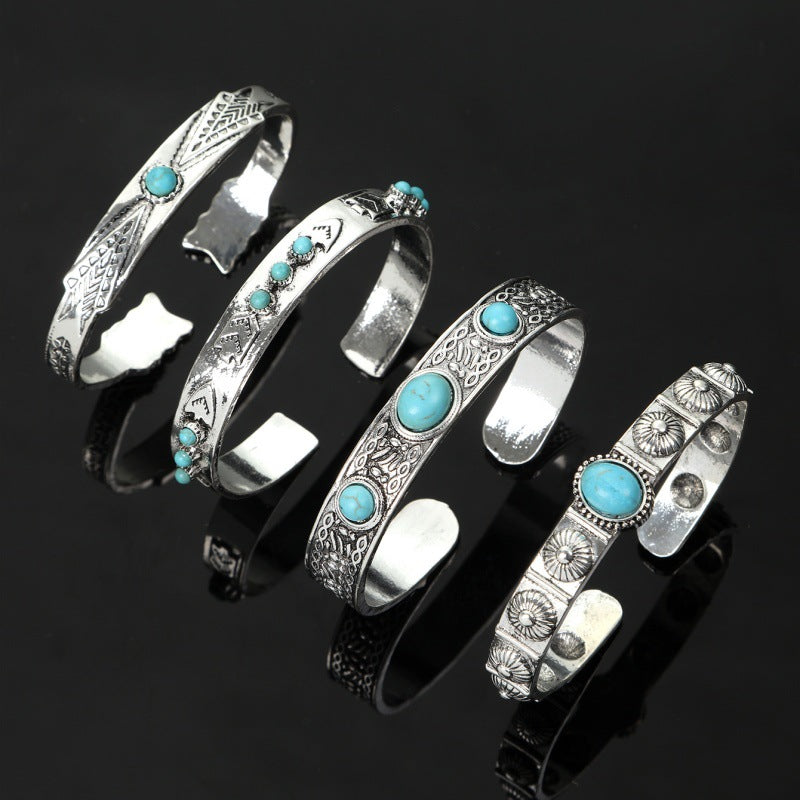
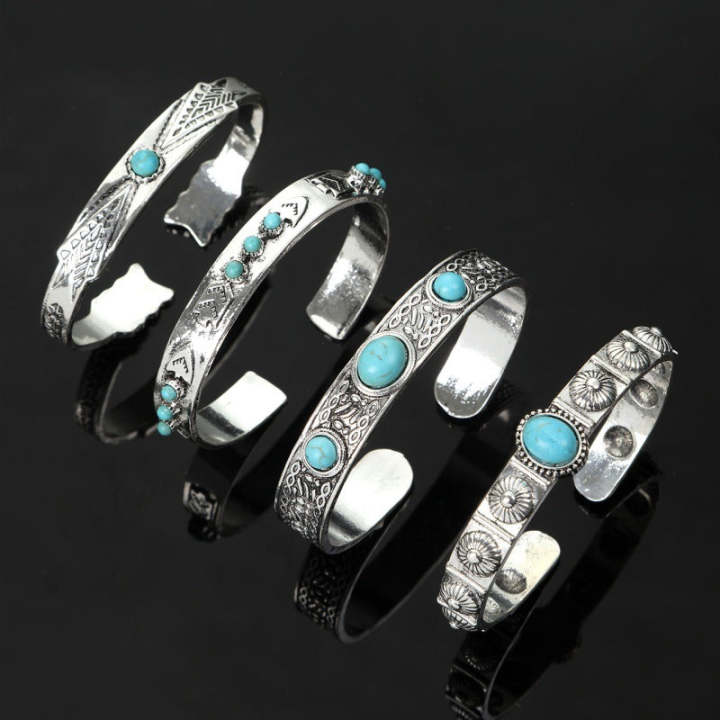
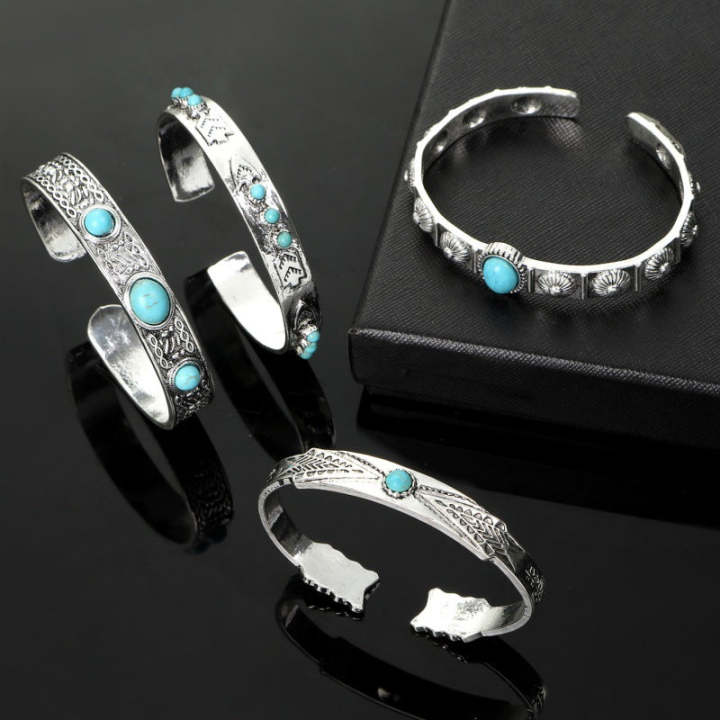
During the live review, the Turquoise Western Cuff Bracelet Set displayed at $34.99 USD with the option “4Set” selected. The page described a set of four open cuff bracelets with turquoise-colored accents and varied vintage-inspired motifs, wearable together or individually. It also asked shoppers to review product images and the selected option and noted that screen color may vary.
Those statements define more than a collage alone, but they do not answer every fit question. The inspected page did not state internal diameter, opening width, circumference, individual mass, exact materials, finish composition, skin-contact components, adjustment method, or item-specific care. Confirm any detail that could decide comfort, sensitivity, or compatibility before ordering. Current price and option availability can change, so recheck them at checkout.
Mistake 4: Treating an Open Cuff as Automatically Adjustable
An open shape can appear flexible without the page confirming how, whether, or how often it should be adjusted. Repeated bending may affect a finish, connection, setting, or structural part. Do not force a cuff smaller or wider based on appearance. Ask for the internal dimensions, opening measurement, intended wrist range, adjustment instructions, and whether reshaping is recommended.
Use a soft measuring tape around the intended wearing point without pulling it tight. Record the measurement and compare it with seller-provided dimensions for the exact option. Then test practical placement. A bracelet worn low near the hand interacts with glasses, plates, and bag handles differently from one placed higher on the forearm. A stack also changes behavior as pieces contact one another.
The wrist rehearsal should include thirty minutes of normal wear if the item is already owned and safe to test. Look for pressure marks, sliding, edge contact, noise, snagging, warmth, irritation, or the urge to reposition it. Remove the item if discomfort develops. Fit cannot be proven by a model photograph, “everyday” wording, or the fact that another shopper wears a similar style.
Mistake 5: Ignoring Sleeves, Bags, and Table Contact
Wedding guest styling advice often stops at color balance. Real wear continues through doors, cars, coats, seating, greetings, meals, and dancing. Test the bracelet against the exact sleeve. Lace, loose knits, tulle, embroidery, sequins, and fine threads may require more clearance than a smooth sleeveless fabric. If the bracelet repeatedly catches during the rehearsal, that is a styling failure even when the combination photographs well.
Carry the actual or similarly shaped handbag. Place the strap on the intended shoulder, open the bag, retrieve the phone, and hold the handle in the correct hand. A wrist focal may be hidden by a clutch or compete with metal hardware. Moving the bracelet to the non-bag hand can improve both visibility and comfort, but test that choice with dining and greeting movements.
Sit at a table and imitate the small motions of a meal. Rest the forearm lightly, use utensils, lift a glass, and reach within a normal place setting. A large stack that repeatedly hits the surface can become distracting. Reducing the number of pieces is not a loss of style; it is an edit that protects the guest's attention for the event.
Mistake 6: Assuming Every “Bracelet” Option Is One Interchangeable Design
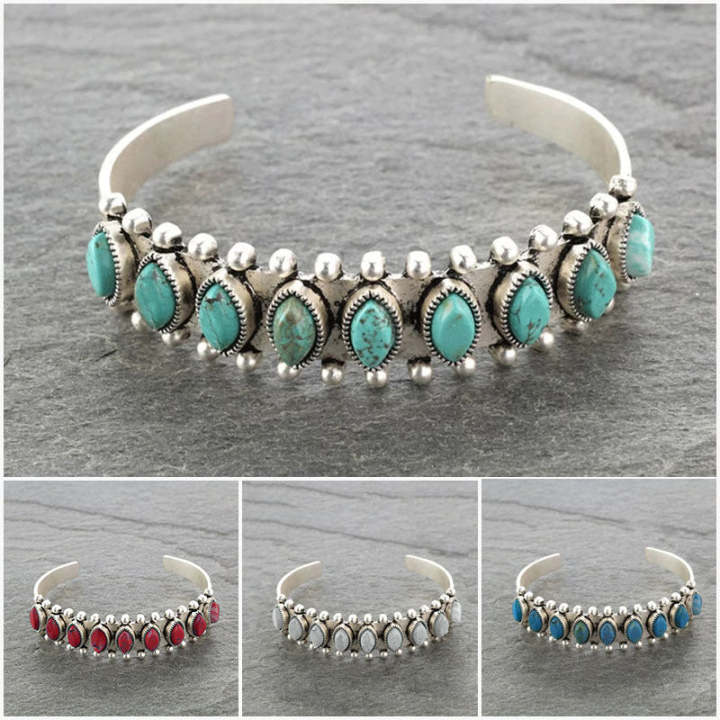
The second live example, the Turquoise Boho Vintage Bracelet for Women, displayed at $90.90 USD during review. Its selector showed seven choices labeled Bracelet 1 through Bracelet 7, with Bracelet 1 selected. The visible description characterized the design using turquoise, boho, and vintage styling language and suggested casual, Western-inspired, occasion, and gifting uses.
That does not make the seven choices mechanically equivalent. Each option may differ in shape, width, closure, surface, or relationship to a sleeve. The inspected text did not provide exact dimensions, mass, materials, finish, stone or decorative-component identity, closure, fit range, skin-contact components, exact care, or an explicit mapping of every selector label to a written specification. Select by the option label and current image together, then ask for missing facts that matter.
A useful comparison record has one row per option, not one row per product family. Include selected label, screenshot date, price, included quantity, wrist measurement, internal dimensions, opening or closure, mass, materials, care, delivery estimate, and return eligibility. Blank cells remain questions; they do not become answers because the design suits the dress.
Mistake 7: Buying for the Portrait and Forgetting the Timeline
Work through five scenes. In the arrival scene, the bracelet must cooperate with transport, coat, and bag. In the ceremony scene, it should remain quiet and secure during sitting and standing. In the portrait scene, it should support the face and outfit at normal camera distance. In the dinner scene, it should clear the table and sleeves. In the reception scene, it should tolerate the planned movement without slipping, catching, or demanding attention.
Score each scene as ready, needs a test, needs a seller answer, or no-go. A bracelet does not have to be perfect in every theoretical setting; it has to be suitable for this schedule. If the only unresolved question affects a scene that will not occur, it may be acceptable. If the unresolved question concerns fit, skin contact, structural security, or arrival before the wedding, it can block the purchase.
Country-concert jewelry and wedding-guest jewelry may share denim, boots, turquoise color, or Western-inspired shapes, but their movement and etiquette contexts differ. The existing country concert jewelry guide is useful as a contrast: reuse its method of assigning roles and testing movement, while recalibrating volume and behavior for the invitation.
Mistake 8: Treating a Related Video as Product Documentation
A relevant video can expand visual vocabulary, but it cannot supply missing specifications for an Oroxen product. The corresponding resource selected for this article is “Turquoise Necklaces” by John Hartman. Only the title, channel, URL, and topic relationship are used here. The video was not watched in full for this draft, and no scene, statement, demonstration, authentication claim, material claim, valuation, or care instruction from it is cited.
The subject is necklaces rather than bracelets, so use the link only as adjacent category context. Do not transfer a necklace material, maker, history, dimension, styling behavior, or care method to a cuff or bracelet option. Exact product-page information, seller clarification, item-specific documentation, and your own fit rehearsal remain the decision sources.
Mistake 9: Skipping the Exit Plan
A wedding outfit needs a fallback. Pack a small soft pouch or compartment so the bracelet can be removed without dropping it loose into a handbag. Keep it away from keys, liquids, cosmetics, perfume, sanitizer, and hard accessories. Do not promise that one storage method suits an undocumented material; the pouch is a temporary separation tool, not a universal preservation treatment.
Before purchase, check the current shipping threshold, delivery estimate, return window, return exclusions, condition requirements, and refund process. The reviewed product pages displayed free shipping on orders over $59 and 30-day returns, but banners and policies may change. Read the full current policy and checkout estimate rather than relying on an article snapshot. Allow time to receive, inspect, ask questions, rehearse, and make a lawful return if necessary.
Set a no-go rule before urgency appears. Examples include no documented dimensions for a fit-sensitive cuff, no confirmed materials for a known sensitivity, arrival after the event, an option label that cannot be matched to the intended image, or a stack that catches the garment. A fallback accessory already owned can be more valuable than an uncertain rush purchase.
A Wedding Guest Bracelet Rehearsal in Twelve Checks
- Read the invitation, venue notes, and host-provided guidance.
- Name the bracelet's single job within the outfit.
- Record the exact selected option and included contents.
- Measure the wrist and request product dimensions and mass.
- Confirm materials, finish, decorative components, and skin-contact parts.
- Verify the opening, closure, adjustment guidance, and care instructions.
- Reduce competing jewelry until one visual hierarchy is clear.
- Test sleeves, coat, handbag, phone, glasses, and table movements.
- Photograph the full look from realistic portrait distance.
- Rehearse ceremony, dinner, greeting, and dancing movements.
- Verify delivery and return details on the current pages.
- Pack a safe temporary removal option and choose a fallback accessory.
Browse the Western Bracelets collection with this checklist beside you, then compare the result with the wider Western Jewelry collection. The purpose of collection browsing is to create a short list, not to erase unanswered product questions.
Frequently Asked Questions
Can a turquoise bracelet work for a formal wedding?
It can work when the host's guidance permits it and the bracelet's scale, finish, movement, and styling role support the outfit. “Formal” does not identify one universal accessory. Test the complete look at normal viewing distance and make the couple's instructions authoritative.
Should a guest wear the full four-cuff set?
Only if the exact selected set fits, remains comfortable, behaves well through the event, and does not overload the outfit. Wearing one or several pieces may create better spacing. Confirm any adjustment guidance before separating or reshaping cuffs.
Which wrist is better?
There is no universal side. Test the hand used for the handbag, phone, utensils, greetings, mobility support, and other accessories. Choose the side that reduces interference and keeps the bracelet secure.
Can the product photographs prove size or material?
No. They can support visual comparison, especially when several views are consistent, but they do not replace stated dimensions, mass, materials, treatments, or fit guidance. Ask for written facts for the exact option.
What should be removed first if the outfit feels busy?
Remove the element that repeats the least important visual message or competes most strongly with the intended focal zone. Photograph each version. Often reducing one bracelet, necklace layer, large ring, or strong pair of earrings creates more clarity than changing the dress.
Where should a shopper continue?
Visit Oroxen, use the linked collections to form a short list, and resolve the first missing fact that could block fit, comfort, timing, or care. The complete Western turquoise jewelry buying guide provides additional verification questions before checkout.
Conclusion: Let the Bracelet Pass the Whole Event
The best turquoise bracelet for a wedding guest is not simply the closest color match. It is the exact option that respects the invitation, has acceptable documentation, fits the wearer's wrist, cooperates with sleeves and bags, supports the outfit hierarchy, and remains manageable through ceremony, photographs, dinner, and movement.
Run the invitation-to-exit rehearsal before the purchase deadline. Keep appearance words separate from material claims. Confirm what arrives, how it fits, what it touches, and how it should be handled. If a seller answer or physical test changes the plan, edit the stack early. The result should feel intentional in photographs and nearly forgettable in use—the bracelet contributes color and character while the guest stays present for the celebration.