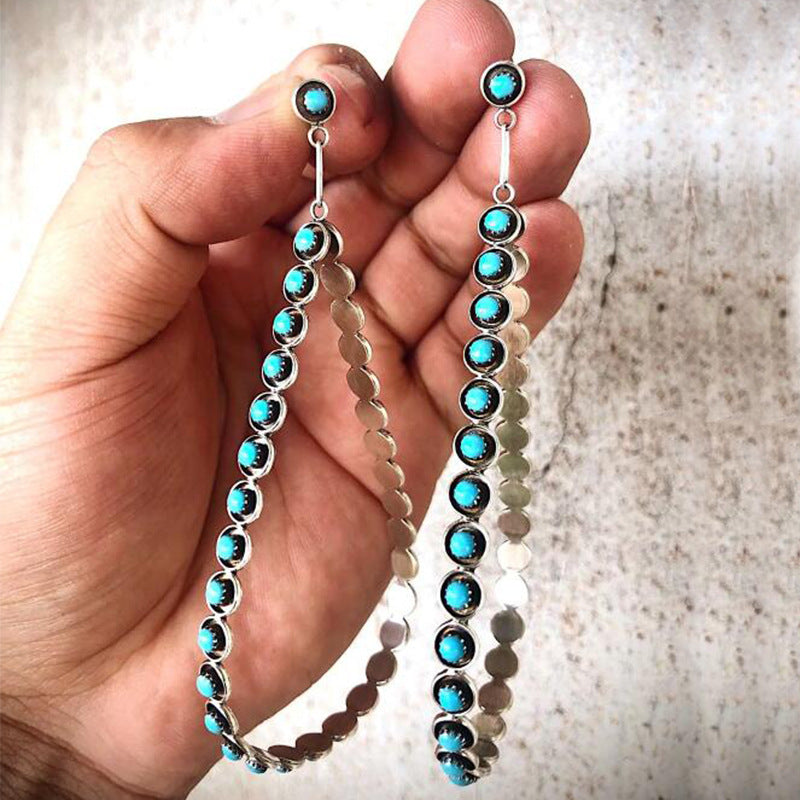
“Statement” and “everyday” are not opposing product categories. They are jobs that jewelry performs inside a particular wardrobe. The same turquoise-colored earring can be the loudest object in a quiet denim outfit and a supporting detail beside a patterned shirt, hat, belt buckle, and boots. That is why choosing men's turquoise jewelry by a gender label or a product photograph alone often produces the wrong answer.
This comparison builds two styling roles around current Oroxen examples: Turquoise Statement Cross Earrings and Turquoise Western Statement Earrings. The merchandising names describe an aesthetic direction; they do not certify stone identity, metal content, age, origin, cultural affiliation, treatment, or construction. The better decision begins with the visible design, then pauses for the missing physical facts.
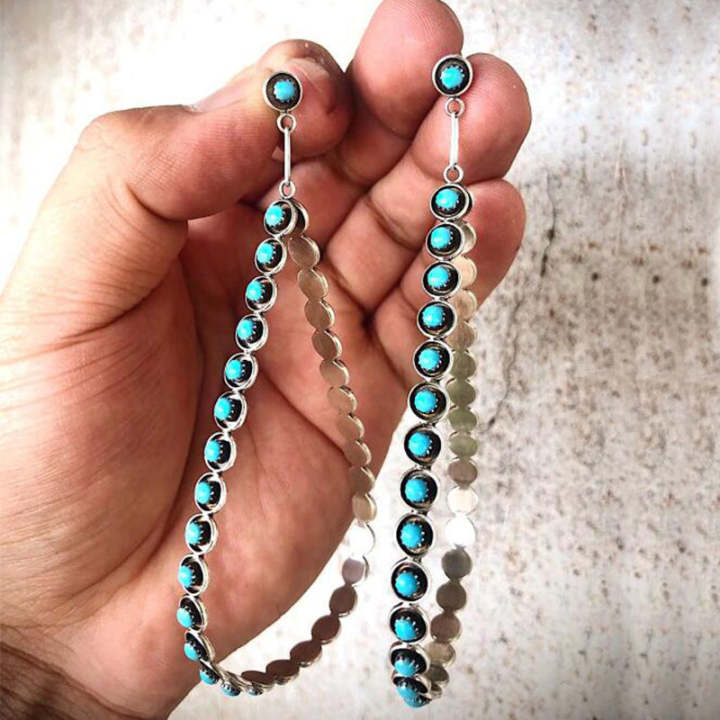
Quick Answer: Assign the Role Before Choosing the Piece
Choose statement styling when you want the earrings to lead the portrait area, direct attention to the face, and carry most of the outfit's motif. Choose everyday styling when you want a piece to survive a repeatable week of shirts, jackets, weather, travel, work, and ordinary movement without constant adjustment.
Neither role means “large” or “small” by definition. Statement impact depends on contrast, outline, motion, motif, and the visual competition around it. Everyday value depends on documented weight, closure, measurements, contact behavior, care, and compatibility with real routines. A dramatic silhouette can become a daily signature; a visually simple piece can fail daily use if it catches a collar or feels insecure.
For a broader comparison of visibility and repeatability, consult the public statement-versus-everyday turquoise-style jewelry guide. The framework applies to any wearer. Gendered catalog terms are useful for navigation, not rules about who may wear a design.
Build Two Role Contracts
A role contract is a short list of conditions a piece must meet before it enters the wardrobe. It prevents a vague word such as “versatile” from deciding the purchase. Write one contract for statement use and one for everyday use, then score each candidate against the same evidence.
Statement Role Contract
- The design remains recognizable at conversational and half-body distance.
- Its motif is appropriate for the wearer and intended setting.
- The outline is not buried by hair, collar, hat cord, eyewear, or patterned fabric.
- Other accessories can be reduced so one visual leader is clear.
- Verified weight, profile, drop, closure, and movement suit the event length.
Everyday Role Contract
- The piece works with at least five existing tops and two outer layers.
- It remains comfortable through a realistic wearing session.
- The closure can be operated reliably and stays clear of collars and equipment.
- Its disclosed materials and care requirements fit the wearer's habits.
- The outfit can be repeated without requiring a special supporting purchase.
Do not lower safety or information standards for a statement piece. Do not lower visual standards for an everyday piece. The contracts describe different uses, not different quality thresholds.
Compare Men's Turquoise Jewelry With One Evidence Grid
Browse the Turquoise Jewelry collection as a visual index, then create a grid for serious candidates. Use current product-page facts, direct observation, and questions sent before purchase. A blank field is not a negative fact; it is an unresolved decision input.
| Criterion | Statement question | Everyday question | Evidence needed |
|---|---|---|---|
| Visible scale | Does it lead from normal distance? | Does it fit common collars and hair? | Exact height, width, drop, and life-size test |
| Weight | Can it be worn for the planned event? | Can it be repeated through the week? | Per-earring weight and timed try-on |
| Closure | Is motion controlled? | Is fastening reliable during routine use? | Closure type, backing, and movement test |
| Surface | Does lighting preserve readable detail? | Does expected contact fit the care rules? | Component and finish disclosure |
| Motif | Is its meaning suitable for the occasion? | Will the wearer choose it often? | Wearer preference and context |
| Wardrobe reach | Can supporting details step back? | Can it complete many owned outfits? | Photographs with actual garments |
Score only what is supported. For example, a product title can establish that the seller calls a design “cross” or “Western,” but it cannot establish natural turquoise, sterling silver, artisan provenance, or historical age. Color on a screen also cannot guarantee an exact match to a shirt or stone already owned.
Option A: Turquoise Statement Cross Earrings
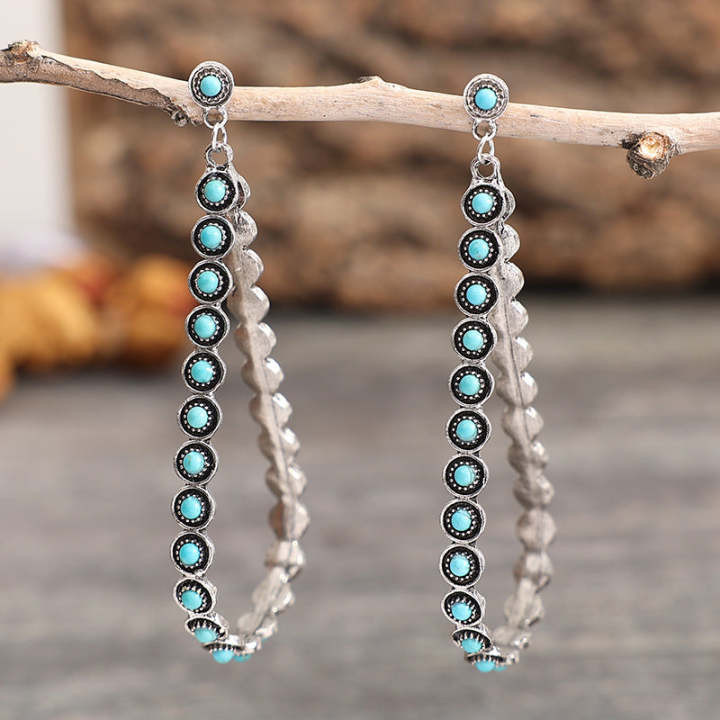
The current product page presents the name Turquoise Statement Cross Earrings and shows one visible color choice. Its copy describes turquoise, statement, and cross details and proposes casual, Western-inspired, occasion, and gift use. Those are styling cues. The visible page does not clearly state exact height, width, total drop, profile, per-earring weight, closure, backing, component materials, finish, construction, or care.
The cross motif has two kinds of impact. First, it produces a strong vertical-and-horizontal outline that can remain legible from farther away than a small irregular detail. Second, it may hold personal or religious meaning. Visual prominence therefore needs contextual consent: the wearer should actively want the motif, and a gift buyer should not assume that a striking shape is automatically appropriate.
For statement styling, begin with a quiet chest and neckline. Try a plain crew-neck shirt, unpatterned overshirt, or dark jacket with limited hardware. Photograph the arrangement from close range, conversational distance, and full-body distance. If the earrings vanish in the full-body image, they may be face-framing accents rather than the outfit's primary statement. That distinction is useful, not a failure.
For everyday styling, make a cardboard or paper outline from seller-confirmed dimensions. Place it beside glasses, beard line, hair, hat brim, collar points, headphones, and any required work equipment. The question is whether the cross can occupy a stable zone without repeated contact. Request the closure and per-earring weight before planning long wear.
Best-Fit Statement Scenario
Use the cross as the single recognizable motif with a solid shirt, uncomplicated jacket, and restrained necklace or no necklace. Let belt, ring, and watch repeat only color or apparent finish rather than introducing another large symbol. This keeps the portrait zone intentional.
Best-Fit Everyday Scenario
Build a five-shirt rotation around one verified earring position. Include the highest collar, the roughest outer layer, and the most active day. If the piece passes those tests and the wearer still chooses it by the fifth outfit, its everyday role is earned by evidence rather than by marketing language.
Option B: Turquoise Western Statement Earrings
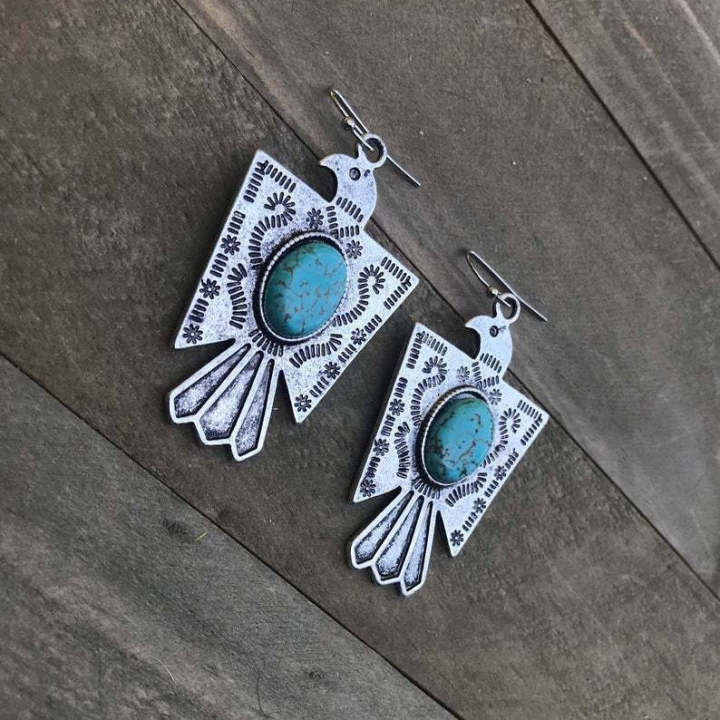
The current Turquoise Western Statement Earrings page describes a bold Western silhouette, turquoise-style center stones, vintage-inspired detailing, and pairings with denim, boots, dresses, or occasion looks. It shows one visible color option. Exact dimensions, total drop, profile, per-earring weight, closure, component materials, finish, construction, and specific care are not clearly supplied in the visible information.
This option reads less like one isolated symbol and more like a sculptural Western composition. That can create a broader field of detail around the face. For statement use, compare the outline against patterned shirts and textured jackets. A visually rich earring does not need a visually empty wardrobe, but competing detail should be separated by scale: fine shirt texture can support a broad earring, while multiple large motifs may fight for attention.
For everyday use, the unresolved profile and movement matter as much as the front view. Ask whether the photographed option corresponds to the current selection and request a side view, closure description, dimensions, and weight. Then test phone use, jacket removal, bag straps, car restraints, hair, and headwear. A stable everyday outfit should not require guarding the jewelry every time the wearer turns.
Use the public pre-purchase Western jewelry checklist for the missing-facts conversation. Its verification questions are not gender-specific and can be applied to either earring design.
Best-Fit Statement Scenario
Place the earrings above a dark denim shirt or clean neutral knit and remove large chest-level motifs. Boots can carry the Western direction at a separate visual level. Take a full outfit photograph to confirm that the face remains the intended focal point.
Best-Fit Everyday Scenario
Pair the design with a repeated uniform such as jeans, a solid tee, and an overshirt. Keep the formula constant for three trials while changing only the outer layer. Record comfort, contact, fastening, and whether the wearer reaches for the earrings without prompting.
The 30-Wear Simulation
Before calling either option versatile, simulate thirty uses on paper. Make six columns for work, casual errands, dinner, music or festival settings, travel, and gifting or celebration. Add five likely outfits beneath each. You do not need thirty unique looks; repetition is the point.
Mark each pairing green when all disclosed facts and wardrobe conditions support it, amber when information is missing, and red when a known conflict exists. An amber result might mean weight or closure is unknown. A red result could mean a required headset occupies the same space. Do not convert amber to green because the product looks attractive.
Now calculate role density. A statement candidate succeeds if it produces a few high-confidence, high-impact combinations that match real events. An everyday candidate succeeds if it produces many low-friction combinations across ordinary days. One piece may score well in both, but the evidence must support both independently.
Face-Frame Mapping for Earrings
Draw an oval for the face and mark the outer edges of hair, beard, glasses, hat, collar, and headphones. Add the verified earring outline at actual size. This simple map exposes collisions that a cropped product image hides.
Evaluate three viewing zones. The near zone concerns closure, skin contact, and comfort. The conversational zone concerns motif recognition and balance between both sides. The outfit zone concerns hierarchy among earrings, shirt, jacket, necklace, belt, and footwear. A design can succeed in one zone and need adjustment in another.
Asymmetry is an option when the wearer wants it, but never assume that a product sold as a pair must be worn symmetrically in every setting. Any alternate wearing plan still requires secure, appropriate components and should respect the wearer's preferences and workplace rules.
Video Perspective: Use Questions, Not Borrowed Conclusions
The supplemental video is Turquoise in Rings by Turquoise in America. A transcript was not available during review, and the video title focuses on rings rather than either Oroxen earring. Its useful role here is to prompt visual questions about scale, color variation, setting vocabulary, and the difference between what a camera shows and what a seller documents.
Watch the complete source before relying on it. Do not transfer any claim about a ring's material, origin, treatment, maker, age, or value to these earrings. Neither a video demonstration nor visual resemblance authenticates a different product. The product seller remains the source for option-specific specifications, while independent expertise may be needed for material verification.
Six Decision Scenarios
1. A First Turquoise-Colored Earring
Favor the option with the most complete measurements, weight, closure, component, and care disclosure. Information quality matters more than which silhouette appears simpler.
2. A Weekend Signature
Choose the motif the wearer would voluntarily repeat. Test it with Friday, Saturday, and Sunday clothing rather than imagining an abstract “Western wardrobe.”
3. A Concert or Festival
Prioritize secure closure, motion control, event rules, weather, travel storage, and contact with hats or hair. Visual impact cannot replace physical suitability.
4. A Workplace Rotation
Map uniforms, collars, protective equipment, headsets, and dress requirements. When a known conflict exists, reserve the piece for off-duty use.
5. A Gift
Confirm pierced-ear status, closure preference, motif meaning, weight tolerance, care habits, and return conditions. Do not present an unverified material story as part of the gift.
6. A Capsule Wardrobe
Use the public earrings-and-necklaces styling guide to divide visual roles. One face-frame leader, one quiet neck option, and a limited finish palette usually create more usable combinations than several competing statements.
Comparison Errors That Waste Money
- Equating “men's” with a fixed design language. Choose for the person, anatomy, wardrobe, and context rather than a merchandising boundary.
- Equating “statement” with uncomfortable. Impact is visual; comfort is physical and must be measured.
- Equating “everyday” with invisible. A repeated signature may be highly recognizable.
- Reading image scale as measurement. Request numbers for the selected option.
- Reading color as composition. A turquoise-colored area does not independently prove natural turquoise.
- Comparing prices without the same information. Current price can change, and value also depends on use, disclosure, comfort, and return terms.
- Buying supporting clothes to rescue the jewelry. Test against owned garments first.
Frequently Asked Questions About Men's Turquoise Jewelry
Can men wear statement earrings every day?
Yes, when the wearer wants the look and verified dimensions, weight, closure, contact behavior, care, and setting make repeated use practical. “Statement” describes visual emphasis, not a schedule.
Which of these two designs is more versatile?
The public pages do not provide enough physical information for a universal verdict. The cross offers a clearly recognizable motif; the Western statement design offers a sculptural, detailed silhouette. Apply the same owned-outfit and comfort tests to both.
Does turquoise-colored jewelry need to match other blue-green accessories?
No. Exact matching can look forced and is unreliable across screens and lighting. Coordinate through contrast, repeated visual weight, or one shared color family while confirming real products in person.
Should earrings and a necklace both be large?
They can be, but assign a leader. Photograph the combined face and chest zones, test movement, and remove any piece that competes, contacts another component, or makes the wearer uncomfortable.
What facts should be requested before ordering?
Ask for option-specific height, width, total drop, profile, per-earring weight, closure and backing, component materials, finish, construction, care, availability, and current return conditions. Keep the answer with the order record.
How should costume turquoise jewelry be described?
Describe what is documented. Use terms such as turquoise-colored or turquoise-style when stone identity is not verified, and avoid claims about natural origin, treatment, metal, age, artisan production, or cultural affiliation without evidence.
A Practical Final Decision
- Write separate statement and everyday role contracts.
- Collect the same option-specific physical facts for both products.
- Make life-size outlines and map the face, hair, collars, eyewear, hats, and equipment.
- Run the thirty-wear paper simulation.
- Choose one three-outfit trial for high impact and one five-outfit trial for repetition.
- After delivery, test only within the current return and care conditions.
Explore additional silhouettes in Western Jewelry, and use the public Western jewelry wardrobe guide to test shirts, denim, dresses, boots, and workwear as separate variables. Return to Oroxen for current store and product information.
The winning choice is not automatically the most dramatic or the quietest. It is the design whose documented facts, wearer preference, wardrobe evidence, and real-life trial agree on the job it should perform.