How to Style Chunky Turquoise Jewelry with a Rodeo Outfit
A rodeo outfit is experienced in sequence. The wearer travels to the venue, enters through a gate, finds a seat, handles a phone and bag, buys food or merchandise, watches the event, takes photographs, adds or removes a layer, and eventually returns home. Chunky turquoise-colored jewelry has to work through that sequence—not only in a mirror before departure.
This guide uses a six-stop spectator route to style a substantial wrist stack with a quieter ear. It is intended for spectators and social occasions, not for competition, ranch work, riding, animal handling, or any activity in which jewelry could create an equipment or snag hazard. Venue rules and the wearer's actual plans always come first.
Quick Answer: Put the Impact at One Zone and Test the Route
Build the outfit around one high-impact zone. If several cuffs create the main statement at the wrist, keep earrings compact, reduce other repeated blue-green areas, and give the sleeve enough clearance. If the ear needs to lead because the wrist will be busy with a bag, phone, camera, mobility aid, child care, or food, wear fewer bracelets and choose one clearly visible stud shape.
Then rehearse six stops: vehicle, gate, seat, concession, photo, and exit. At each stop, check both appearance and contact. A combination passes only when the jewelry remains visually intentional, does not interfere with the planned task, and is supported by product information about included quantity, dimensions, mass, attachment, contact materials, construction, and care. Unknown facts stay unknown.
Readers choosing a product category for the first time can begin with the published complete western turquoise jewelry guide. The published cowgirl jewelry style guide provides a broader map of how ear, neck, wrist, and hand accessories can share an outfit.
First Define “Chunky” Without Making a Material Claim
Chunky is a styling role. A bracelet arrangement may look chunky because several bands create cumulative width, repeated blue-green accents produce contrast, motifs create visual density, or the entire stack occupies a large part of the forearm. None of those visible qualities establishes physical weight, metal identity, stone identity, durability, or comfort. A photograph cannot reveal whether a component is solid, hollow, plated, coated, glued, cast, stamped, resin, glass, stone, composite, or something else.
Likewise, “turquoise” in a title or navigation category does not automatically prove natural turquoise. Use the wording supplied for the exact product. “Turquoise-colored” describes visible color; “turquoise-style” preserves appearance-oriented listing language; “natural turquoise” requires explicit, reliable documentation. Browse the Turquoise Jewelry collection to compare colors and silhouettes, but perform the material check on each exact page.
Design the Outfit in Two Lanes
The impact lane asks what the eye should notice first. The friction lane asks what the body and the day's objects will touch. A rodeo look succeeds when the impact lane is clear and the friction lane is quiet.
For a wrist-led outfit, the impact lane can include a cuff stack, simple denim, one belt shape, and a restrained ear. The friction lane includes sleeve edges, watch, wristband, ticket scanner, phone, bag handles, seat arms, table surfaces, cup, handwashing, and jacket changes. For an ear-led outfit, the friction lane moves to hair, hat, glasses, phone, collar, and any hearing protection. Styling is not complete until both lanes are mapped.
The Six-Stop Rodeo Spectator Route
Stop One: Vehicle and arrival
Put on the complete outfit and use the same transportation posture expected on the day. Buckle the seat belt, reach for a door handle, carry the planned bag, and add any jacket. A broad cuff arrangement may contact a console, watch, sleeve, or bag handle. Stud earrings may press against a phone or catch in hair while the wearer looks behind.
If contact occurs, change the number or placement of pieces before changing the entire outfit. Wearing one cuff on the hand that performs fewer tasks may solve more than adding another accessory elsewhere. Do not bend or reshape an open cuff unless the seller specifically says the construction permits it; repeated adjustment may affect unknown materials or finishes.
Stop Two: Gate and security
Check the venue's current bag, prohibited-item, re-entry, and screening rules. Jewelry acceptance can depend on the venue and event, so a fashion article cannot guarantee admission. Keep tickets and identification accessible without removing loose pieces. If the wearer expects a wristband, leave enough room for staff to apply and scan it without striking the stack.
The entry outfit should be understandable even when the phone, pass, and bag temporarily occupy the hand zone. If the jewelry vanishes into too many objects, move visual emphasis to one wrist and keep the other clear. If the cuff edges catch a bag opening during rehearsal, reduce the stack or choose a different verified item.
Stop Three: Seat or standing area
Sit in a chair similar to the venue seating, rest both forearms naturally, stand, turn, and applaud. Check whether the cuffs strike one another, the seat, a neighbor's space, or a hard surface. Sound may be part of the design for some jewelry, but it should not be assumed or imposed on nearby attendees. Physical width and movement require exact measurement.
For the ear, test the actual hat, eyewear, and hair arrangement. Compact studs can keep the face connected to the turquoise-colored theme while the wrist remains dominant, but “stud” does not prove small dimensions or low weight. Obtain the measurements, post type, back, per-item mass, and included count for the selected set.
Stop Four: Concession, restroom, and merchandise
Practice holding a cup, opening a wallet, tapping a payment device, carrying a tray, washing and drying hands, and lifting a merchandise bag. If jewelry would need to be removed for any task, bring a rigid or semi-rigid case with a reliable closure. Do not place loose earrings or cuffs in a pocket with keys, coins, or a phone.
Water, soap, sanitizer, sunscreen, perfume, sweat, and food can affect different materials and finishes differently. Because the exact construction and care may be unstated, do not promise that a product tolerates these contacts. Minimize unverified exposure and follow written care instructions supplied for the exact item.
Stop Five: Photographs and social moments
Take three photographs: a full outfit, a waist-up view, and a hand detail. The full view asks whether one zone leads. The waist-up view checks the relationship among hat, face, shirt, belt, and jewelry. The hand detail verifies that the wrist stack reads as one deliberate group instead of several unrelated objects.
Do not alter color so aggressively that blue-green elements look like a different material or shade. Product and event photographs are styling records, not authentication. Screen rendering, light, editing, and surrounding colors can change appearance.
Stop Six: Layer change and exit
Rodeo venues may change temperature from arrival to evening. Rehearse removing and carrying the jacket without dragging a sleeve over cuffs or studs. At the end of the event, fatigue and low light can make a complicated removal plan unreliable. Decide before leaving home whether jewelry stays on, goes into a case, or is reduced during the day.
After returning, inspect the pieces in good light. Record looseness, surface changes, bent-looking areas, missing components, or discomfort without attempting an improvised repair. Clean or adjust only according to verified instructions. A route test is valuable because it produces specific evidence for the next wear.
Build Three Rodeo Outfit Formulas
Formula One: Wrist headline, quiet ear
Use a solid tee or restrained pearl-snap shirt, straight or bootcut denim, functional boots, a simple belt, the cuff set as the main accessory, and one compact stud design. Keep the necklace absent or minimal. Push or roll the sleeve only if it remains secure and does not rub the jewelry.
Formula Two: One cuff, clearer earring
When the planned day makes a full wrist stack impractical, choose one verified cuff and a more visible pair of studs from the assortment. A dark solid shirt can increase the contrast around the face. Keep the buckle and hat band restrained so the ear and wrist still read as connected rather than competing headlines.
Formula Three: Dress and jacket
A simple dress with boots can carry western direction without several motifs. Add one or two cuffs on the less-busy hand, use a compact stud, and test the jacket sleeve over the exact arrangement. The published guide to styling western jewelry with denim, dresses, boots, and workwear offers more clothing relationships for these formulas.
Product Study One: Turquoise Western Cuff Bracelet Set
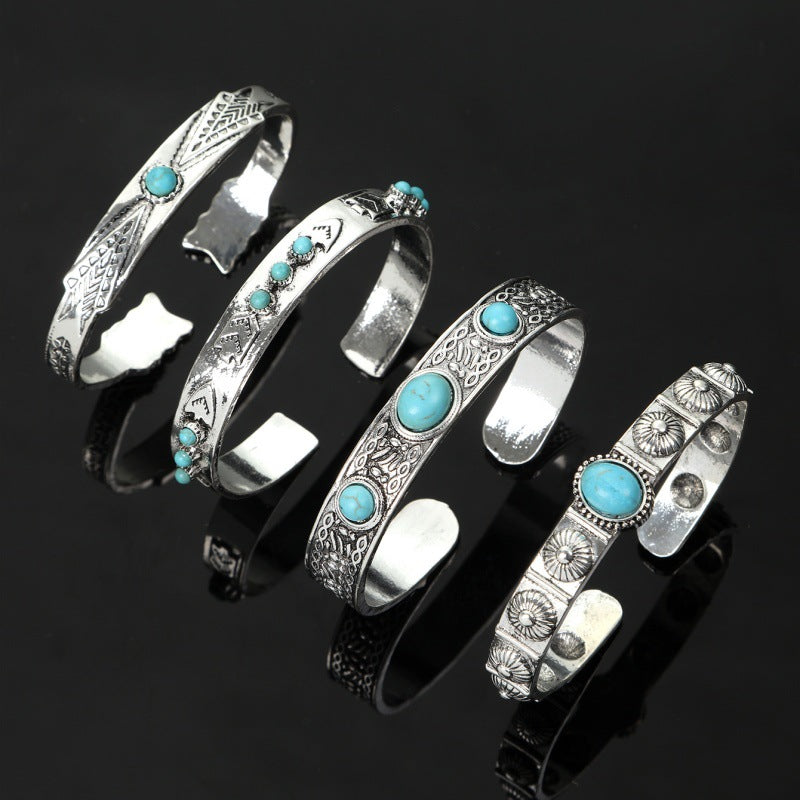
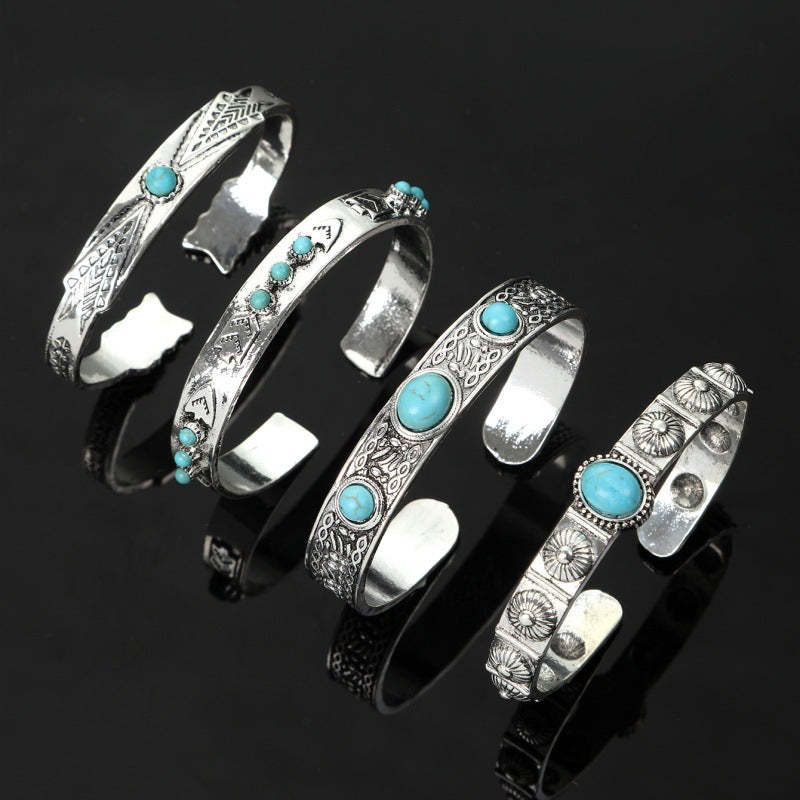
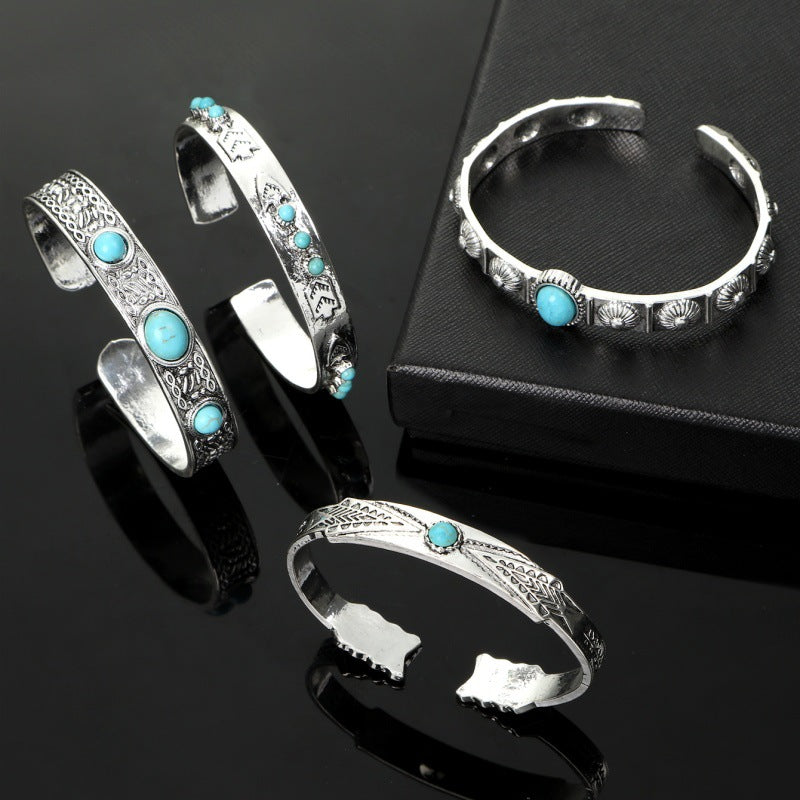
The Turquoise Western Cuff Bracelet Set page was reviewed on August 24, 2026. It displayed $34.99 USD, a visible Set choice labeled “4Set,” and a ten-image gallery. The current product copy explicitly describes a set of four open cuff bracelets with turquoise-colored accents and varied vintage-inspired motifs. It says they may be worn together or individually.
Those statements support the central route idea: the wearer can begin with a four-piece visual group and reduce the number when a planned task makes the full stack impractical. They do not prove that every wrist can wear the cuffs, that the cuffs should be bent for fit, or that the accents are natural turquoise.
Facts still needed before a route decision
The visible page reviewed did not state each cuff's inner circumference, width, opening, thickness, mass, complete components, material identity, finish, construction, flexibility, adjustment method, or care. Ask for those facts for all four pieces, not only a representative cuff. Also confirm whether the displayed set and selected “4Set” option correspond exactly to the four items expected in the order.
Use a paper strip to reproduce documented circumference and width only after measurements are supplied. Do not wrap it tightly or use it as a load test. The purpose is to see how much forearm space the arrangement may occupy beside a sleeve, watch, wristband, or bag handle.
Product Study Two: Turquoise Western Stud Earring Set
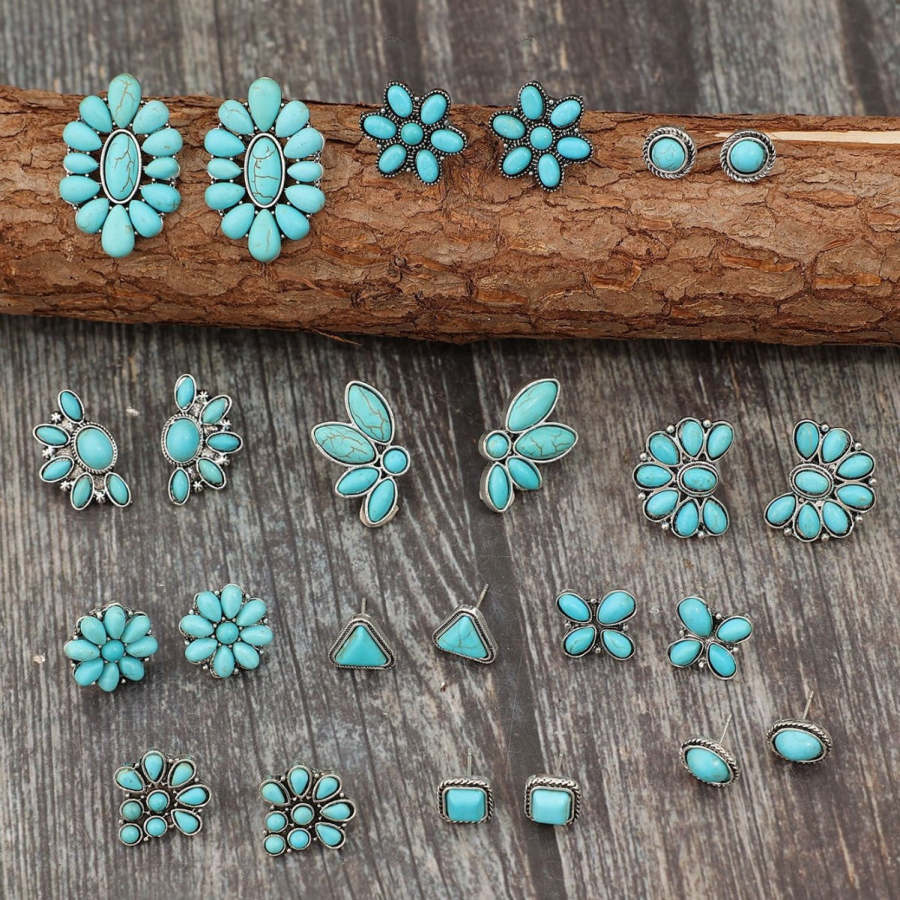
The Turquoise Western Stud Earring Set page was checked on August 24, 2026. It displayed $29.99 USD, one visible Color choice, and a nine-image gallery. The current description calls it a coordinated assortment that mixes floral, geometric, and classic turquoise-style studs for everyday styling and gifting.
The assortment language supports choosing a quieter or clearer ear shape for different wrist arrangements. “Turquoise-style” is the correct page wording and does not identify natural turquoise or any other exact decorative material. “Vintage-inspired” styling does not prove age. The product title uses “set,” but the visible copy reviewed did not state an exact included earring or pair count.
Facts still needed before mixing the assortment
Request the exact included quantity, which designs form matched pairs, individual dimensions, projection, total and per-earring mass, post and backing type, complete contact components, decorative materials, finish, construction, and care. Do not assume every pictured design is included or that all pieces have identical posts, backs, sizes, or materials.
If intentional mismatching is part of the outfit, record which two verified designs are being worn. Unequal visible size does not necessarily mean unequal mass, and equal-looking size does not guarantee equal projection. Test each ear separately with the hat, hair, glasses, phone, and any hearing protection.
A Practical Product Comparison
| Route question | Cuff set | Stud assortment |
|---|---|---|
| Confirmed listing structure | Four open cuffs; together or individual wear | Coordinated floral, geometric, and classic turquoise-style studs |
| Primary impact zone | Wrist and lower sleeve | Ear, hair, hat, and face |
| Common route contacts to test | Bag, phone, wristband, seat, cup, sleeve | Hair, hat, glasses, phone, collar, hearing protection |
| Material status | Natural turquoise not established | Turquoise-style; exact material not stated |
| Critical missing evidence | Fit measurements, mass, materials, finish, care | Included count, size, mass, backs, materials, care |
The two listings can work as a high-low visual system: more repetition at the wrist and less at the ear, or a reduced wrist with a clearer stud design. That is a styling option, not a fit recommendation. Exact measurements and contact facts determine whether either configuration is wearable for a particular person.
What the JTV Video Contributes
JTV's short public video “Wear It With Style: Turquoise Jewelry” presents turquoise jewelry as capable of making either a bold statement or a subtler addition. That bold-versus-subtle distinction fits the two-lane method: one zone can provide the impact while another supports it.
The video page calls turquoise a gemstone, but that general statement does not authenticate either Oroxen listing. It cannot establish the cuffs' accent material, the studs' decorative material, metals, treatments, dimensions, mass, fit, durability, or care. Use the video's styling contrast as inspiration; use the exact seller evidence for every product claim.
Rodeo Styling Errors the Route Test Reveals
- Building only for the photograph: add gate, seat, payment, restroom, layer, and exit tasks before approving the outfit.
- Loading both hands: keep one hand more functional when tickets, bags, cups, or mobility tasks require it.
- Ignoring the event wristband: reserve physical space and keep the scanning area accessible.
- Treating an open cuff as universally adjustable: obtain construction and adjustment guidance for the exact product.
- Assuming a set count from photographs: confirm exactly what is included in the selected option.
- Calling blue-green accents natural turquoise: preserve “turquoise-colored” or “turquoise-style” wording until documented.
- Wearing jewelry during a hazardous activity: this article addresses spectators; follow qualified activity rules and remove jewelry when required.
Fit, Care, and Documentation Card
Create one card per product. Record the URL, review date, selected option, displayed price, included quantity, each item's dimensions and mass, attachment, contact components, decorative materials, stated treatments, finish, construction, care, availability, delivery estimate, and return terms. Save a matching image. Write “not stated” instead of filling blanks from a similar listing.
Before checkout, revisit the current page because price, availability, policies, and copy may change. If the wearer has a known sensitivity or medical concern, product marketing is not a substitute for professional guidance. Terms such as hypoallergenic, nickel-free, lead-free, non-toxic, waterproof, or sweatproof require specific support.
The published guide What Is Western Jewelry? helps separate motifs, styling labels, and material evidence when a title combines several descriptive words.
Frequently Asked Questions
How many cuffs should be worn to a rodeo?
There is no universal number. Begin with the complete verified set only if it fits and passes the six stops. Reduce to one, two, or another documented arrangement when the route shows contact or task interference.
Can chunky bracelets be worn with a watch?
Only after checking total width, fit, movement, finish contact, and wearer preference. Place paper templates from verified measurements beside the exact watch, then test normal hand tasks. Do not assume rubbing is harmless to either surface.
Should the earrings match the bracelets exactly?
No. Coordinated color or one shared shape can be enough. A quieter ear often makes a broad wrist arrangement easier to understand. Exact color matching is unreliable across screens and lighting.
Are the cuffs and studs natural turquoise?
The visible pages reviewed did not establish natural turquoise. The bracelet page says turquoise-colored accents, and the earring page says turquoise-style studs. Ask for exact materials and supporting documentation.
Is the stud set suitable for sensitive ears?
The visible information reviewed did not provide a complete post, backing, or contact-material statement. Do not infer suitability. Request exact components and consult appropriate professional advice for personal sensitivity concerns.
Can these pieces be worn while riding or competing?
This guide makes no such recommendation. Jewelry can interact with equipment and movement. Follow the rules and qualified safety guidance for the exact activity, and remove jewelry whenever required or uncertain.
What should go in a small event kit?
Bring a protective case sized for the exact pieces, any verified product-specific care item, and the documentation needed for the day. Avoid loose storage, unverified cleaners, glue, tools, or improvised adjustments at the venue.
Final Six-Stop Checklist
- Vehicle: seat belt, door, bag, phone, and jacket do not create unresolved contact.
- Gate: current venue rules are checked and ticket, ID, and wristband remain accessible.
- Seat: sitting, standing, applauding, turning, and neighboring space have been rehearsed.
- Concession: payment, cup, bag, handwashing, and secure removal have a plan.
- Photo: one impact zone is clear in full, waist-up, and detail views.
- Exit: layer change, low light, storage, inspection, and verified care are covered.
Conclusion: Style the Whole Day, Not One Pose
Chunky turquoise-style jewelry can bring a clear western direction to a rodeo spectator outfit when the impact stays at one zone and every task has room. A four-cuff set can lead the wrist while a coordinated stud supports the face; the balance can reverse when the day's route demands a freer hand.
Compare more options in the Western Jewelry collection or return to the Oroxen homepage. Preserve the exact product language, verify physical facts, follow venue and activity rules, and let the six-stop route decide whether the outfit is genuinely ready.