Denim and turquoise-colored necklaces are often described as an effortless combination, but “denim” covers many different surfaces. A pale jacket, dark raw-looking shirt, black denim dress, faded jeans, and white denim overshirt do not create the same background. The neckline, wash, stitching, buttons, collar, and layering state determine whether a pendant is clearly framed or visually lost.
This guide uses two current Oroxen examples: the Western Turquoise Vintage Geometric Cross Necklace and the Turquoise Western Teardrop Pendant Necklace. Their names describe visual style. They do not independently verify natural turquoise, vintage age, metal composition, origin, maker, treatment, leather, or cultural affiliation. Verify every material, measurement, construction, and care fact for the exact selected option.
Quick Answer: Pair by Contrast, Clearance, and Direction
Choose a necklace by three relationships. Contrast asks whether the pendant is distinct from the denim wash. Clearance asks whether it avoids the collar, button placket, zipper, seam, and jacket edge. Direction asks whether the pendant’s geometry supports the garment’s vertical and horizontal lines.
Do not choose from a flat product photograph alone. Mark the intended chain position on the actual garment, request exact necklace and pendant measurements, and rehearse the outfit with the denim open, closed, worn, and carried. A necklace that works with an open jacket may collide with the top button when closed.
For a broad denim foundation, read the public turquoise-style jewelry and denim-jacket guide. This article concentrates on necklace geometry and denim construction.
Make a Denim Garment Map
Lay the denim garment flat and photograph the front. Mark the collar points, top usable button, placket, pockets, contrast stitching, yoke seams, zipper, snaps, and hem. Then put it on and repeat the photograph because fabric shifts on the body. Add any T-shirt, dress, or shirt worn underneath.
Measure a safe necklace window. The top boundary is where the chain can sit without being trapped by the collar. The bottom boundary is the first seam, pocket, closure, or garment edge that the pendant should not cross. Record the width between collar points as well as the vertical space.
Do this for every wearing state. An overshirt may be open over a top, buttoned as a shirt, tied at the waist, or removed and carried. A jacket may be open outdoors and closed in transit. The necklace must either function through those states or be assigned to one clearly defined version.
Understand Five Denim Color Conditions
| Denim condition | Likely visual effect | First necklace test |
|---|---|---|
| Light blue | Lower color contrast with blue-green details | Use clear outline, apparent finish, or motif |
| Medium blue | Familiar tonal relationship | Separate pendant from stitching and buttons |
| Dark indigo-looking | Higher brightness contrast | Check whether a statement becomes too dominant |
| Black denim | Strong color separation | Control accessory hierarchy |
| White denim | Bright field with softer color contrast | Check apparent finish and edge definition |
These are visual starting points, not fabric or dye claims. Actual lighting, fading, texture, and screen display change color. Evaluate the real garment and necklace together after delivery rather than chasing an exact online match.
Use the Western Necklaces Collection as a Shape Library
Browse Western Necklaces by silhouette. Separate narrow vertical drops, broad motifs, multi-component statements, short collar-level pieces, and longer pendants. The category helps identify possible roles; the exact product page must supply the physical facts.
Create one worksheet row per candidate. Record the selected option, total length, adjustment range, pendant height and width, profile, weight, clasp, connector, bail, component materials, finish, care, availability, and current return terms. Mark every field confirmed, unresolved, or incompatible with the garment map.
Reject the idea that more photographs automatically mean better information. An alternate view can clarify shape, but it cannot supply an undisclosed measurement or authenticate a component.
Cross Necklace With a Denim Jacket
The current geometric cross necklace page shows Design 1, Design 3, and Design 4 under a selector labeled “Size.” Those are visible design labels rather than disclosed measurements. The page does not visibly provide exact chain length, cross dimensions, profile, weight, clasp, materials, finish, construction, or care for each design.
A cross composition can occupy more horizontal space than a narrow pendant. With an open denim jacket, place a life-size paper outline between the lapels or collar edges. Check that the arms of the motif do not repeatedly touch buttons or stitching. If the jacket is buttoned, determine whether the pendant sits above the placket, within an open collar, or entirely outside the garment.
Ask which images and specifications correspond to each design. Confirm whether the pendant is removable, how it attaches, and whether the chain can support the stated weight. A cross can also carry personal or religious meaning; confirm that the motif is appropriate for the wearer, recipient, and setting.
Cross Necklace Outfit Formulas
Open Medium-Wash Jacket
Wear a simple top beneath the open jacket and place the necklace inside the lapel frame. Keep earrings and belt quiet so the cross remains the central motif. Check whether contrast stitching creates another large cross-like grid.
Dark Denim Shirt
Open only enough buttons to create a stable placement window. The pendant should not rest across a button or fall into the placket. If the verified necklace cannot occupy that window, wear it outside the shirt only after a fabric-contact test.
Black Denim Dress
Use the cross as the single color leader and reduce bag hardware. Photograph the full body because hand, waist, and footwear details can compete even when the neckline looks clean.
Teardrop Pendant With Denim
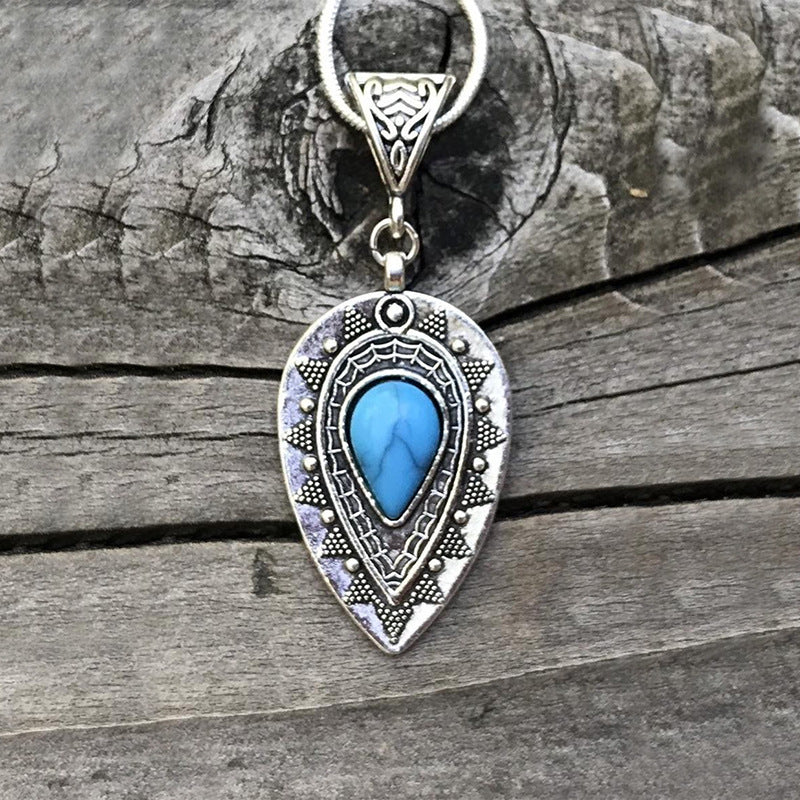
The current teardrop page describes a Western pendant, turquoise-style center, teardrop silhouette, antique-silver-colored appearance, and vintage-inspired detail. It shows one visible color choice and no clearly stated size option. Exact chain length, pendant dimensions, weight, closure, materials, and construction are not visibly supplied.
The page’s care section advises keeping the jewelry dry, avoiding direct perfume and lotion contact, and storing it in a soft pouch; material details may vary by option. Ask for exact disclosure before selecting a cleaning method or assuming the apparent finish identifies a metal.
A teardrop creates a vertical line that may fit between shirt buttons more easily than a broad cross, but only measurements can confirm this. Mark its complete height, including bail, on the garment map. The lower point should not repeatedly strike a button, zipper pull, or pocket edge.
Teardrop Outfit Formulas
Light Denim Overshirt
Wear the overshirt open over a neutral top and let the pendant occupy the center. Its blue-green area may be closer in color to pale denim, so rely on silhouette and apparent finish for definition rather than exact matching.
White Denim Jacket
Use the bright background to emphasize the pendant outline. Reduce other polished-looking hardware if the jacket already has prominent buttons. Test color in the intended light.
Denim Dress With a Belt
Keep the pendant above the belt and away from the top of any chest pocket. If the dress has a full button front, use a shorter verified setting or choose another neckline strategy rather than letting the pendant bounce across closures.
Can the Two Necklaces Be Layered?
Do not begin with layering. Verify and test each necklace alone. Layer only when the chains have different stable lengths, the pendants occupy separate zones, clasps remain accessible, and neither piece strikes the other during walking, sitting, or dressing.
The broad cross and vertical teardrop can create strong motif competition. Choose one leader and one clearly smaller support. Because exact dimensions are missing from the visible pages, obtain them before planning. Do not use image proportions as a substitute.
Check care compatibility. Two unknown finishes or components should not be allowed to rub repeatedly. If contact occurs, change lengths, remove one piece, or abandon the layer.
Use the Styling Video as Inspiration, Not Authentication
The supplemental video is Wear It With Style: Turquoise Jewelry by JTV. Its short auto-generated transcript was available during review. The video presents general styling ideas involving denim-like casual dressing, collared shirts, earth-colored clothing, layering, and larger statement looks.
Those ideas support experimentation, not product verification. The video is retailer-produced and does not identify either Oroxen necklace. Independently confirm materials, origin, treatment, maker, value, construction, and care. Watch the complete video before applying any visual suggestion.
Denim Contact and Transfer Risks
New or dark denim can sometimes transfer color, and raised jewelry can catch coarse seams. Do not assume either event will occur; inspect and test the real combination. Use a hidden fabric area for any garment test according to its care instructions, and keep the necklace unchanged during the product return window.
Check collar edges, metal buttons, zipper teeth, pocket rivets, and bag straps. Repeated hard contact can affect some finishes or components. A visually attractive arrangement that clicks, catches, or requires constant repositioning is not complete.
Run a Denim Hardware Audit
Count every visible hard element within the necklace zone: snaps, buttons, zipper pulls, rivets, pins, and decorative studs. Mark whether each one is centered, paired, or asymmetrical. The count reveals why a simple-looking denim garment may already feel busy around the chest.
Next, move the necklace through its expected arc while supporting it safely. Do not swing or strike the product. Observe whether the pendant can reach hardware during walking, bending, or dressing. If the likely paths overlap, shorten or lengthen the verified chain, change the garment state, or choose another necklace. Styling cannot eliminate a recurring physical collision.
Apparent hardware color can serve as a visual echo without proving metal compatibility. Coordinate what the eye sees, while keeping care and material decisions tied to documented facts.
Adapt the Pairing Across Seasons
Warm-weather denim may involve open shirts, sleeveless dresses, or lighter layers, leaving more skin around the chain. Cold-weather outfits introduce turtlenecks, scarves, coats, and thicker collars. Rebuild the placement window whenever a layer is added rather than assuming the summer necklace position will transfer.
With a scarf, decide which item leads and remove the necklace if the two repeatedly rub or tangle. With a coat, inspect the zipper and lapels. With a knit under a denim jacket, check whether the pendant profile catches loops or moves away from the body. Do not infer fabric composition from appearance.
Create one verified warm-season formula and one cold-season formula instead of forcing a necklace into every outfit. Repeatability matters more than theoretical universality.
Score the Final Photographs
Use six fields: outline clarity, denim relationship, hardware clearance, motion stability, accessory hierarchy, and wearer comfort. Score each from zero to two. Photograph at close, half-body, and full-body distances because each reveals a different failure.
A high close-up score cannot compensate for a crowded full silhouette. A visually balanced photograph cannot compensate for contact or discomfort. Keep the formula that performs consistently across views and normal movement, then save the garment, option, chain setting, and lighting notes for later reuse.
A Five-State Rehearsal
- Denim garment open, arms at rest.
- Garment closed in the intended way.
- Jacket or shirt removed and carried.
- Bag worn and phone used.
- Sitting, walking, turning, and fastening a seat belt.
Photograph every state from consistent distance. Score placement, visibility, contact, security, comfort, and repeatability. If a necklace fails only in one unavoidable state, choose another length or product rather than accepting repeated interference.
The public Western jewelry and denim styling guide provides additional outer-layer checks.
Frequently Asked Questions
Which denim wash is best with turquoise-colored necklaces?
No wash is universally best. Light denim may create a tonal relationship; dark or black denim can increase contrast; white denim emphasizes outline. Judge the real garment, necklace, and lighting.
Should the pendant sit inside or outside a denim shirt?
Choose the position with stable clearance from collar, buttons, seams, and movement. Use verified length and pendant dimensions. Do not force a necklace into an unstable opening.
Can I wear a large necklace with decorated denim?
Possibly, but embroidered, studded, patched, or heavily stitched denim already occupies visual space. Select one leader and compare the full silhouette.
How should a beginner verify the necklace?
Use the public Western turquoise-style buying guide, then request exact option mapping, measurements, weight, materials, construction, closure, and care.
Is a statement necklace practical for everyday denim?
It can be when the necklace passes comfort and contact tests across repeated outfits. Compare statement and everyday roles with the public 30-wear visibility grid.
Final Denim-and-Necklace Checklist
- Map collar, placket, buttons, pockets, stitching, and jacket edges.
- Measure a safe vertical and horizontal pendant window.
- Confirm the exact design, chain length, pendant dimensions, weight, materials, and care.
- Choose one leading necklace silhouette.
- Test open, closed, layered, carried, and moving states.
- Remove layers that strike, tangle, catch, or compete.
Explore current shapes in Western Jewelry and return to Oroxen for current product and store information. Denim becomes a useful necklace framework when its wash, construction, and movement are treated as real design variables rather than one generic blue background.