A white shirt and jeans can support turquoise Western jewelry without turning the outfit into a costume. The useful question is not whether turquoise “goes with” denim—it usually provides clear color contrast—but which jewelry zone should lead, how large that focal point should feel, and what evidence the product page actually supplies.
This guide builds a repeatable decision method around two current Oroxen examples: the Western Turquoise Boho Vintage Cow Skull Earrings and the Western Turquoise Vintage Cross Jewelry for Women. Their names communicate a Western, turquoise-colored, boho, vintage-inspired direction. Those words alone do not verify natural turquoise, exact components, age, maker, geographic origin, treatment, artisan production, or cultural affiliation.
Quick Answer: Choose One Lead Zone
Choose either the ears or the neckline as the lead zone. If the earrings carry a recognizable cow-skull form, leave the neckline open or very quiet. If a cross necklace leads, use restrained earrings or none. Then decide whether the outfit needs a second Western signal at all.
Use this order: confirm the exact product option, request missing measurements and component details, photograph the white shirt and jeans in natural light, make a life-size paper outline of the jewelry, and run a movement test. Only after those steps should color, boots, belt, bag, or another accessory enter the decision.
The longer complete Western turquoise-style jewelry guide explains how to separate visible design from documented facts. Here, that principle becomes a specific white-shirt-and-jeans buying system.
Why This Outfit Is a Useful Test Bench
A white shirt creates a relatively quiet field around the face and neckline. Denim supplies familiar texture and blue-family color without requiring the jewelry to match it exactly. Together they expose questions that a busier outfit can hide: Is the piece too close to the collar? Does the turquoise-colored area remain distinct from the denim? Does a symbol feel intentional? Is the jewelry still comfortable after a jacket, bag, phone, or seat belt is added?
“White shirt and jeans” is not one formula. A crisp poplin button-down, soft camp shirt, oversized Oxford, fitted ribbed top, Western yoke shirt, and linen blouse create different edges and contact paths. Dark straight jeans, pale relaxed denim, cropped jeans, and a denim skirt also change the balance. Record the exact garments instead of buying for an imaginary generic outfit.
Photograph the outfit before adding jewelry. If the shirt already has pearl-like snaps, embroidery, contrast stitching, a pointed yoke, large pockets, or a dramatic collar, it may already provide the main Western signal. The jewelry should support that information rather than compete with every detail.
Build a White-Shirt Map Before Shopping
Put on the shirt and mark five zones on a mirror photo: earlobe to collar, open neckline, button placket, chest pocket or yoke, and shoulder-to-bag path. Add the top edge of the jeans, belt hardware, jacket line, and seat-belt route. These are the areas where jewelry will either remain visible or collide with clothing and equipment.
| Outfit feature | Question to answer | Possible buying consequence |
|---|---|---|
| High or stiff collar | Does it touch an earring or necklace? | Prefer a shorter, quieter, or differently placed focal point. |
| Open neckline | How much uninterrupted space is visible? | A necklace may lead if its verified drop fits the space. |
| Long hair or hat | Will the ear zone remain visible and clear? | Test earring silhouette and fastening before prioritizing color. |
| Strong denim fading | Is the lower half already visually active? | Keep the jewelry plan cleaner and avoid extra matching signals. |
| Bag and outer layer | Where do straps, lapels, and zippers travel? | Reject a necklace placement that reaches hard or moving hardware. |
This map converts “I like the look” into product questions. It also protects against a common mistake: buying a dramatic piece for a cropped studio photograph that never shows the real collar, hair, coat, or bag.
Define the Jewelry Job in One Sentence
Write one sentence before opening a collection page. Examples include: “I want a face-level Western focal point for an unbuttoned Oxford,” “I want one vertical necklace line over a smooth white shirt,” or “I want an occasional symbol, not a complete themed set.” The sentence should name the zone, visual job, and frequency of wear.
A buying sentence prevents category drift. Without one, a shopper may compare stud sets, long necklaces, cuffs, rings, and belts as if they solve the same problem. They do not. Each category has different measurement, movement, fit, care, and return questions.
If the sentence includes a symbol, add a personal-consent clause: “I understand and want this motif.” Cow skulls and crosses are not neutral geometry. The wearer should decide whether the symbol fits personal meaning, workplace rules, event context, gifting circumstances, and the desired intensity of the outfit.
Use the Turquoise Jewelry Collection as a Shortlist
Browse the Turquoise Jewelry collection to identify types and silhouettes, not to assume identical materials across products. Open every candidate page and create a separate fact card. A category name or photograph cannot answer option-specific questions.
The fact card should contain the exact title and URL; selected option; numerical dimensions; weight; closure, post, backing, or clasp; component and finish disclosures; stone or imitation disclosure; construction; care; image-to-option mapping; current availability; shipping timing; and return terms. Record “not visibly stated” when a field is absent. Do not fill an empty field with a conclusion from color or styling photography.
When two products remain, compare them on the same fields. Do not compare one on symbolism and the other on price, or one on comfort and the other on color. Equal fields reveal which uncertainty matters and which seller question should come first.
Evaluate Product Option One: Cow Skull Earrings
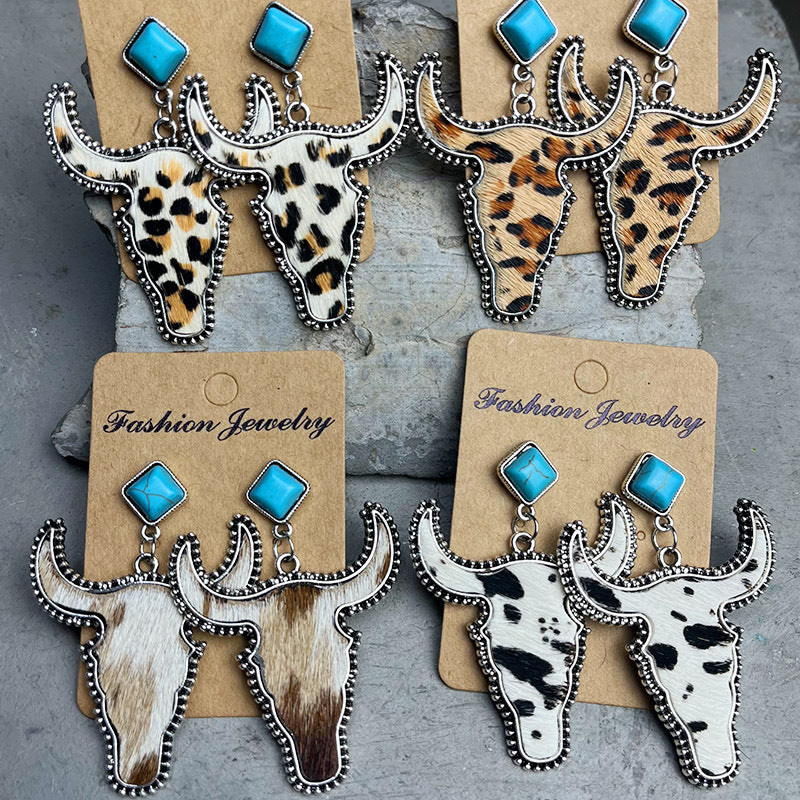
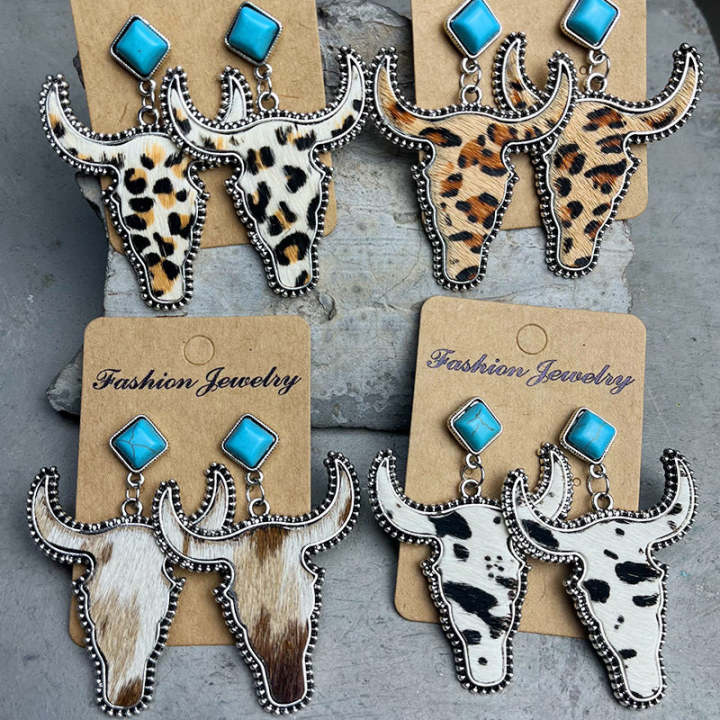
The current product page for the Western Turquoise Boho Vintage Cow Skull Earrings displayed a price of $141.40 USD during review and showed four design options labeled Design 1 through Design 4. Prices, stock, and interface defaults can change, so verify the live page and selected option before ordering.
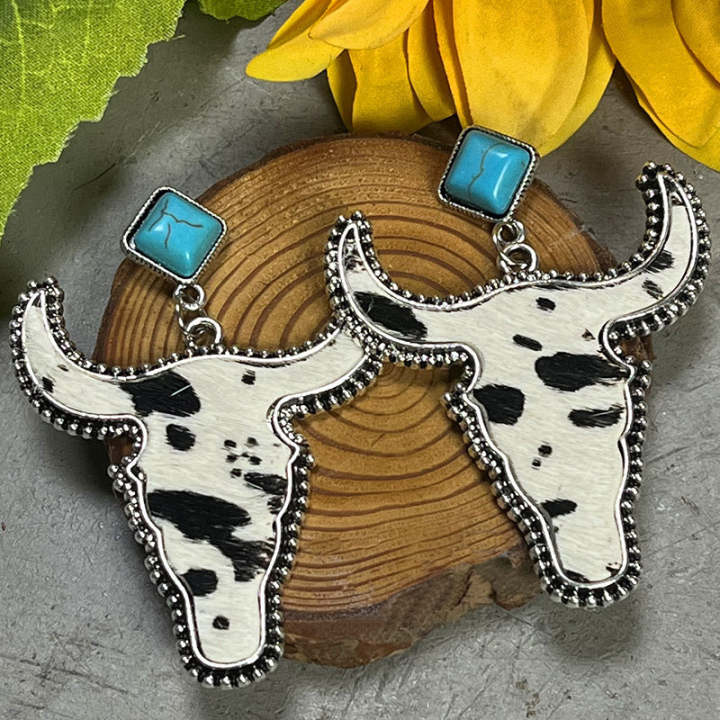
The visible description positions the earrings for casual, Western-inspired, occasion, and gifting use. It also asks shoppers to review product images and the selected option and notes that screen color may vary. The visible page did not clearly provide exact dimensions, weight, post and backing details, complete component materials, finish, construction, or option-specific care. Those gaps matter more than a flattering close-up.
Who May Prefer This Direction?
This earring direction may suit someone who wants the focal point near the face, prefers an open neckline, or does not want a necklace touching a placket, bag strap, or seat belt. A cow-skull silhouette can provide a clearer Western reference than color alone, so it may need fewer supporting accessories.
It may be a weaker fit when the shirt collar rises into the ear zone, hair repeatedly catches decorative edges, a headset or hat occupies the same space, or the wearer does not want the motif in a workplace or formal setting. Those are fit and context decisions, not judgments about the design.
Questions to Ask Before Buying
- Which photograph corresponds to each of the four design labels?
- What are the total height, widest point, thickness, and weight of one earring?
- What post, hook, backing, and connecting hardware does the selected design use?
- What are all components and finishes, including the turquoise-colored portion?
- What care method applies to this exact option?
After receiving answers, draw the silhouette at full scale, tape it beside—not onto—the ear in a mirror test, and check collar, hair, glasses, hat, phone, and head movement. Do not alter the product or perform exposure tests that conflict with care or return conditions.
Evaluate Product Option Two: Vintage-Inspired Cross Jewelry
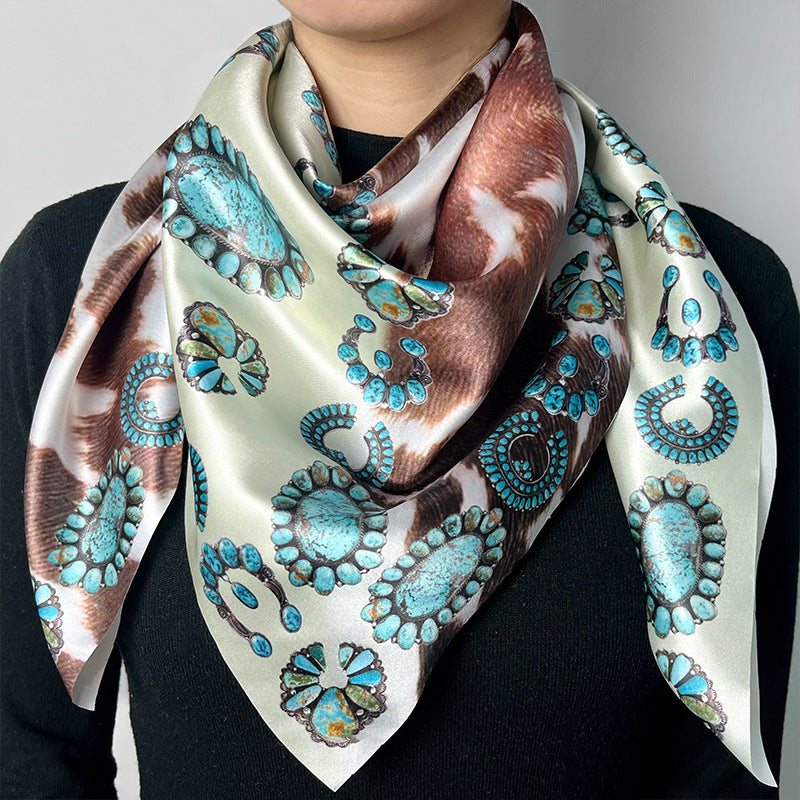
The current page for the Western Turquoise Vintage Cross Jewelry for Women displayed $112.11 USD during review and showed 90 cm and 52 cm size choices, with 52 cm selected in the visible interface. Confirm whether those labels represent total wearable length and how they map to the photographed product. Do not infer pendant drop, adjustment range, clasp, or fit from a length label alone.
The visible description emphasizes Western, turquoise, and vintage-inspired styling and notes that screen color may vary. It did not clearly state complete components, stone identity, pendant dimensions, chain width, total weight, clasp construction, finish, or option-specific care in the visible summary. “Vintage” in a product title can describe appearance; it is not evidence of age.
Who May Prefer This Direction?
This necklace direction may suit someone who wants the shirt front to carry the visual focus and who intentionally chooses a cross motif. It can work over a smooth closed shirt or inside an open collar only when the verified length and pendant dimensions fit that exact space.
It may be less practical when a placket, zipper, chest pocket, badge, lanyard, scarf, bag, or seat belt crosses the same path. A 90 cm option, if that number is confirmed as wearable length, may enter more contact zones than a shorter one. Longer is not automatically more versatile.
Questions to Ask Before Buying
- Does 52 cm or 90 cm describe the complete wearable circumference, and is any extender included?
- What are the cross pendant's height, width, depth, and total drop?
- What are the necklace weight, clasp type, chain width, components, and finish?
- What exactly is the turquoise-colored element, and is treatment or imitation status disclosed?
- Which cleaning, storage, moisture, perfume, and lotion instructions apply?
Make a string mock-up using seller-confirmed wearable length and attach a paper pendant with confirmed dimensions. Wear it with the actual shirt, jeans, coat, and bag. The goal is to detect hard contact and poor placement, not to imitate the product's weight or fastening.
Choose Between Earrings and Necklace with a Six-Run Test
Instead of asking which product is “better,” run six imagined outfit conditions. Score each candidate from zero to two for verified fit, freedom from contact, intended symbolism, visibility, care compatibility, and repeatability. Leave a field blank when evidence is missing; do not award points for optimism.
- Desk day: include phone calls, headset, keyboard posture, and repeated sitting.
- Walking day: include a crossbody or shoulder bag and changing outer layers.
- Driving or transit: include seat belt, coat, earbuds, and head turns.
- Meal or social event: include leaning, hugging, photos, and table height.
- Work setting: include dress rules, equipment, lanyards, and symbol suitability.
- Repeat day: ask whether the same combination still feels appealing after three wears.
The earrings win only if the ear zone is actually safer and more useful. The necklace wins only if its verified drop occupies a clear corridor. If both contain unresolved fields, postpone the comparison and request facts.
Coordinate Turquoise Color Without Forced Matching
Do not require the jewelry color to match denim exactly. A little separation often improves clarity. Examine the outfit in daylight, indoor light, and a phone photograph. Screen color can differ from the physical product, so treat online images as a planning reference, not a color guarantee.
With dark indigo jeans, a turquoise-colored detail may read as a bright interruption. With pale or heavily faded jeans, it may sit closer to the lower-half palette. The white shirt provides breathing room in either case. Keep other blue-green accessories limited during the first test so the jewelry's role remains visible.
Metal-colored finishes can influence the overall temperature, but do not name a metal without disclosure. Use “silver-colored,” “gold-colored,” or “antique-silver-colored appearance” only when that visual description is accurate. The practical statement-versus-everyday turquoise styling guide offers a separate method for choosing intensity.
Create Four White-Shirt-and-Jeans Formulas
Formula One: Face-Level Statement
Wear the cow-skull earrings with an open collar, tucked or half-tucked shirt, dark straight jeans, and simple shoes. Leave the neck bare. Keep belt hardware and bag ornament quiet. This formula lets motif and face-level color lead.
Formula Two: Central Vertical Line
Wear the cross necklace at a verified length over a smooth shirt front or inside an open collar. Use small, neutral earrings or none. Avoid a competing lanyard, scarf, or large buckle. This formula gives the neckline one clearly defined path.
Formula Three: Layered Denim Transition
Use the white shirt beneath a denim or neutral jacket and keep only one jewelry leader. Put the whole outfit on before approving it. Lapels and collars can change a safe jewelry position. The denim-jacket turquoise styling guide provides a dedicated layer-by-layer check.
Formula Four: Low-Intensity Work Version
Choose the least obstructive verified option, use clean jeans only where dress rules allow, and remove additional motifs. Confirm symbol suitability and equipment clearance. A Western-inspired outfit can stay low intensity; adding more recognizable elements is not a requirement.
Video Buying Lesson: Turn a Claim into a Question
The supplemental video is Watch This Before You Buy Turquoise - Know What You're Buying by GomeowCreations. At review, YouTube showed an approximately 30-second video, no closed captions, and a description about distinguishing different kinds of turquoise and avoiding fake material.
A short video description is not enough to classify either Oroxen product, and the video does not document these listings. Its useful lesson is procedural: when material identity affects the purchase, ask for option-specific disclosure and preserve the seller's answer. Do not use a home scratch, heat, solvent, or destructive test; such methods can damage jewelry, create safety risks, and violate care or return terms.
If natural turquoise, treatment, mine origin, age, or value is important, request documentation and consider an appropriately qualified independent professional. If the purchase is mainly about appearance, say so plainly and evaluate design, fit, comfort, care, and price without inventing gemstone claims.
Buying Mistakes to Avoid
- Matching color before checking fit. A perfect palette cannot fix collar contact or an unsafe fastening.
- Treating a product title as a laboratory report. Ask what the turquoise-colored portion and every other component are.
- Comparing different jobs. Decide whether ears or neckline should lead before comparing products.
- Estimating size from a cropped image. Request numerical dimensions and create a full-scale outline.
- Ignoring the selected variant. Confirm that the image, price, and specifications belong to the exact design or length.
- Adding too many Western signals. Give one motif or jewelry zone room to work.
- Forgetting real equipment. Test bag, coat, seat belt, phone, headset, glasses, and workplace gear.
- Using unsupported cultural language. Do not claim Native American, Indigenous, tribal, sacred, regional, or artisan provenance without reliable evidence and appropriate context.
Set Up a Twenty-Four-Hour Decision Pause
After choosing a favorite, wait one day before ordering. During the pause, complete three tasks: ask the unanswered seller questions, repeat the paper or string mock-up, and build three outfits from clothes already owned. If the candidate only works with future purchases, it is not yet a versatile choice for this wardrobe.
Save the live product page, selected option, answers, screenshots, price, date, shipping estimate, return deadline, and care instructions in one folder. Time-sensitive values should be recorded as dated observations, not permanent article facts.
Finally, write a rejection reason for the runner-up. “Necklace reaches the zipper” or “earring dimensions are not supplied” is more useful than “did not love it.” Specific rejection notes reduce repeated shopping mistakes.
Frequently Asked Questions
Does turquoise Western jewelry work with every white shirt?
No single placement works with every collar, fabric, placket, pocket, yoke, and fit. Map the specific shirt and test the jewelry at life size.
Should earrings match the blue of the jeans?
No. Exact matching is unnecessary and may be impossible because screens, lighting, washes, and physical finishes vary. Aim for a clear relationship and one visual leader.
Can the cow-skull earrings and cross necklace be worn together?
They can be considered together only after option, size, weight, fastening, symbolism, and contact are verified. For a first outfit, letting one motif lead is usually easier to evaluate.
Does “turquoise” prove that the jewelry contains natural turquoise?
No. A color, category, product title, photograph, or short external video does not prove material identity. Request option-specific disclosure.
Which necklace length is best with a button-down shirt?
The answer depends on the wearer's dimensions, collar opening, placket, pendant size, outer layers, and equipment. Confirm what the listed length measures and test it with string before choosing.
What if the product page lacks measurements or materials?
Record the fields as unresolved and ask the seller. Do not translate visual confidence into factual certainty. The public guide to what to know before buying Western jewelry for women supplies a broader pre-purchase checklist.
Final White-Shirt-and-Jeans Checklist
- Photograph the exact shirt and jeans without jewelry.
- Choose ears or neckline as the lead zone.
- Confirm that the wearer wants the cow-skull or cross symbolism.
- Record the exact product option and image mapping.
- Request dimensions, weight, fastening, complete components, finish, construction, and care.
- Make a life-size paper or string mock-up.
- Check collar, hair, bag, coat, phone, seat belt, and work equipment.
- Use turquoise-colored and vintage-inspired language unless stronger claims are documented.
- Review current shipping, returns, price, and availability before ordering.
- Repeat the winning outfit three times before adding another Western signal.
Browse the current Western Jewelry collection after defining the jewelry job, or return to Oroxen for current store and product information. The best choice is not the item with the most keywords or motifs. It is the documented option that fits the exact white shirt, jeans, movement, symbolism, and routine the wearer already has.