How to Choose Turquoise Necklaces for a Wedding Guest Look
A necklace can look perfect in a product crop and land in exactly the wrong place on a wedding guest outfit. It may cross a neckline seam, disappear under a lapel, strike a button, compete with embroidery, or enter the path of a bag strap. Choosing turquoise jewelry necklaces for a wedding therefore begins with the garment's usable space, not with a favorite pendant photograph.
This guide builds a neckline routing worksheet. The worksheet maps the area from collarbone to waist, records every object that crosses it, and gives the necklace a verified landing zone. It also separates turquoise color and Western-inspired styling from unproved material, age, maker, origin, or cultural claims. The result is a purchase decision that can survive the real ceremony, reception, travel, weather, and outerwear plan.
Quick Answer: Choose the Landing Zone Before the Necklace
Put on the exact dress, jumpsuit, shirt, or separates. Add the underlayer, outer layer, bag, hairstyle, and any event-required accessory. Mark the clear vertical space between the neckline and the first seam, button, print, ruffle, belt, or bag strap. That is the candidate landing zone. A necklace belongs there only when its documented wearing length and pendant dimensions place it inside the clear field.
Next, choose one neck-zone role: quiet color accent, defined pendant focal, layered arrangement, or no necklace. Compare exact product options for length, extension range, pendant size, mass, closure, components, care, included quantity, delivery, and return conditions. If those details are missing, use a temporary ribbon or paper template for visual planning but do not treat the placement as confirmed.
The Turquoise Jewelry Guides hub provides broader education. The method below focuses on the geometry and logistics of a wedding guest neckline.
Start with the Invitation, Then Draw the Garment Map
Record only the dress code and guidance that the invitation or host actually provides. Add the ceremony and reception settings, start time, expected weather, travel, seating or standing periods, and any religious or cultural directions. Do not assume that a word such as formal, cocktail, festive, rustic, or Western has one universal jewelry rule. Context decides whether a visible pendant, symbol, or stacked necklace looks appropriate.
Lay the garment flat and draw a simple front-view outline. Mark:
- the neckline edge and collar points;
- buttons, plackets, lapels, ties, bows, ruffles, and embroidery;
- printed or beaded areas that already lead visually;
- corsage, name-tag, or ceremonial placement if applicable;
- the outerwear opening when closed and open;
- the bag strap path;
- the top edge of a belt or high waist;
- all zones that move or fold when seated.
The blank area that remains is the necklace field. It can be wide, narrow, shallow, deep, split by a seam, or absent. “No necklace field” is a valid finding. In that case, earrings, a bracelet, or no jewelry may serve the outfit better.
The published guide to Western jewelry with denim, dresses, boots, and workwear offers garment examples. Translate them through the wedding invitation rather than copying a casual outfit unchanged.
Measure Three Neckline Coordinates
Coordinate A: available drop
Measure from the expected chain path near the neck to the beginning of the first visual obstacle. Do not measure only against bare skin. A collar, lining, bra edge, jacket, or fabric fold can change the usable drop. Record the smallest available space across ceremony and reception versions.
Coordinate B: pendant width
A pendant needs lateral room. Its edges should not overlap lapels, straps, trim, or strong print boundaries unless that overlap is intentional and tested. Product photographs do not provide wearer scale unless reliable dimensions are stated.
Coordinate C: movement corridor
Draw the path the pendant takes when the wearer sits, bends, dances, hugs, lifts a bag, or puts on a coat. A pendant can begin in a clear field and swing into a button or hard bag fitting. The movement corridor matters as much as the resting point.
Use a soft ribbon, paper shape, or another harmless temporary marker to simulate the documented dimensions. Never use the template to invent a missing necklace length. It is a comparison aid: “this field could accept a pendant approximately this size if the real specifications match.”
Build a Necklace Evidence Card
Every shortlisted necklace receives its own card. Include the live URL, date reviewed, exact option label, current price, availability, included quantity, full wearing length, extension range, pendant height and width, mass, chain or cord description, closure, documented materials, treatments, skin-contact components, finish, care, shipping expectation, and return information.
Divide the card into five labels:
- Documented: stated for the exact current option.
- Observed: visible color, line, silhouette, or motif.
- Fit test: a result obtained with the wearer and full outfit.
- Current policy: time-sensitive delivery, return, or venue information.
- Unknown: anything the page and appropriate evidence do not establish.
A product title can support how the store names a style. It cannot by itself prove natural turquoise, metal composition, vintage age, handwork, maker, origin, or cultural affiliation. The published Western jewelry terminology overview helps keep those categories separate.
Use Collections to Compare Silhouettes, Not to Fill Missing Facts
Browse the Western Necklaces collection to see how pendants, strands, chains, cords, motifs, and visual weights differ. Create a shortlist based on the garment map: shallow field, long central field, open collar field, or no usable field. Then open each product page and build the exact evidence card.
The Western Jewelry collection is useful when the neck field fails. Compare earrings, bracelets, or rings for another visual zone rather than forcing a pendant into crowded clothing. A collection is navigation, not a source of specifications for every item within it.
Limit the shortlist to three distinct jobs. Candidate A should be the quietest viable accent. Candidate B should be the intended focal. Candidate C should be the fallback category or no-necklace solution. Three genuinely different jobs are easier to evaluate than ten near-duplicate pictures.
Live Option One: Western Turquoise Vintage Geometric Cross Necklace
The live Western Turquoise Vintage Geometric Cross Necklace page was reviewed on August 24, 2026. It displayed $126.25 USD. Three visible Size radios were labeled Design 1, Design 3, and Design 4, with Design 1 selected. The visible sequence did not include a Design 2 radio. Product-image numbering extended through eight.
The current copy supports Western, turquoise-colored, vintage-inspired, and cross styling language. It proposes everyday, Western-inspired, occasion, and gifting contexts. Those statements make the selected Design a possible focal candidate, but the invitation and wearer still decide whether the symbol and intensity suit the wedding.
The page did not establish natural turquoise, geometric component material, metal composition, age, maker, origin, handwork, cultural affiliation, chain or cord material, wearing length, extension range, pendant dimensions, mass, closure, skin-contact components, treatments, or care. Gallery views do not guarantee that every pictured design is included. Save the selected Design and request the missing specifications before relying on a precise landing point.
For a provisional rehearsal, create a paper outline based only on documented measurements when available. Place it in the garment map and test the cross-shaped visual area against the neckline, buttons, and bag. If the outfit already contains a cross, floral embroidery, large buckle, decorated hat, or prominent print, remove competing details before deciding that the necklace is too quiet or too strong.
Live Option Two: Turquoise Western Teardrop Pendant Necklace
The live Turquoise Western Teardrop Pendant Necklace page was reviewed on the same date. It displayed $39.99 USD. One visible Color radio was selected but did not expose a readable text label in the inspected page state.
The page describes a Western-inspired pendant necklace with a teardrop silhouette, turquoise-style center stone, antique-silver color, and vintage-inspired detailing. It suggests wearing the necklace alone, layering it with simpler necklaces, and pairing it with denim, boots, shirts, or dresses. “Turquoise-style” and “antique-silver color” are appearance language, not natural-stone or metal-content claims.
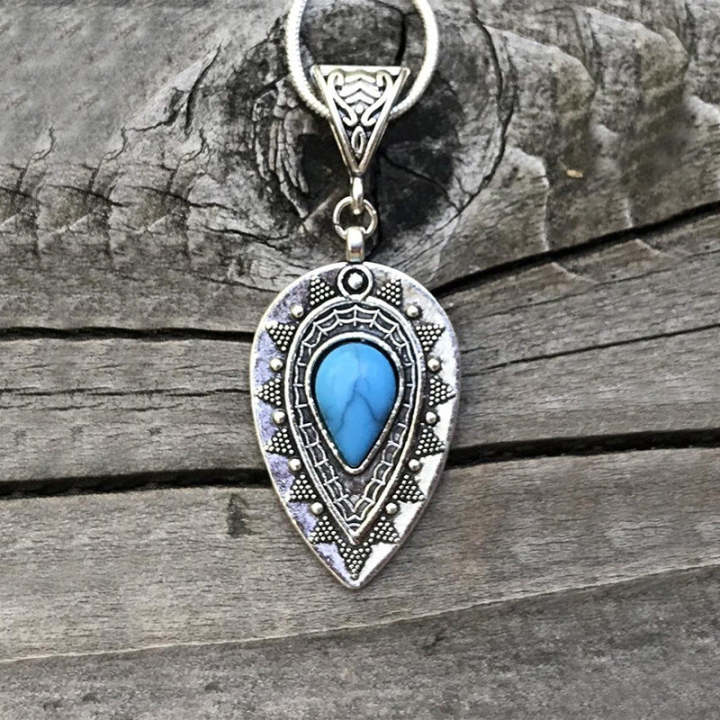
The Materials & Care panel states that material details can vary by product option. It advises keeping jewelry dry, avoiding direct contact with perfume or lotions, storing it in a soft pouch when not worn, and reviewing the product images for the exact finish and design. This is usable general care tied to the page, but it is not a complete component list.
The visible page did not establish natural turquoise, exact center-stone material, metal composition, wearing length, extension range, pendant dimensions, mass, closure, skin-contact components, treatment, maker, origin, age, handwork, or cultural attribution. The teardrop outline may be easier to place in a narrow vertical field than a wider geometric form, but only verified dimensions and an outfit test can confirm that impression.
Compare the Cross and Teardrop as Routes
Do not ask which necklace is “better.” Ask which route fits the map.
Route Cross: choose this route when the event context, personal preference, garment field, and verified measurements support a recognizable geometric focal. The nearby earrings, belt, bag, and hat should not repeat multiple strong symbols without a deliberate reason.
Route Teardrop: choose this route when a central vertical silhouette suits the open field and the turquoise-style, antique-silver-colored appearance supports the outfit. Follow the documented dry-storage and perfume-or-lotion avoidance guidance. Do not layer until each necklace length, closure, mass, component, and collision path is known.
Route Empty: choose no necklace when either option lacks essential fit information, conflicts with the invitation, reaches a busy garment area, or collides during movement. An empty neck can make earrings, face, garment construction, or a bracelet easier to read.
The published Western turquoise jewelry buying guide provides more questions for the evidence card. It cannot supply missing specifications for these two options.
A Fifteen-Minute Landing-Zone Rehearsal
Minutes 0–3: Dress completely and mark the neckline obstacles. Add the hairstyle, outer layer, bag, and any planned earrings. Photograph the front and side without a necklace.
Minutes 3–6: Use a harmless temporary marker that corresponds to documented necklace dimensions. Check the resting point while standing and seated. If dimensions are unavailable, treat the result as a field-size experiment, not a product-fit confirmation.
Minutes 6–9: Walk, bend, turn, hug, dance, lift the bag, and close the jacket. Watch the movement corridor. Reject any route that repeatedly strikes a button, buckle, zipper, bag fitting, or another necklace.
Minutes 9–12: Compare the intended focal with the quiet and empty routes. Take full-body photographs at likely daylight and evening lighting. Decide what receives attention first, second, and third.
Minutes 12–15: Confirm the exact option, live price, availability, delivery margin, return conditions, specifications, and care. Choose the fallback immediately if an essential fact remains unresolved near the event date.
Corresponding YouTube Buying Reference
The corresponding video is Buying Turquoise from Turquoise in America. The YouTube page lists a duration of 11 minutes 46 seconds and describes the video as Mike explaining different ways to buy turquoise.
Use the link as general educational media and a prompt for better questions. It does not authenticate, value, date, or identify the two Oroxen necklaces. The video page's title, channel, duration, and description establish the reference's topic; item-specific product facts in this guide come only from the current product pages. Any material, origin, maker, cultural, or valuation idea must be independently verified for the exact necklace.
Wedding Buying Red Flags and Corrections
Red flag: a precise outfit plan built on an unknown length
Correction: request the full wearing length, extension range, and pendant dimensions. Keep the no-necklace route ready until the product can be placed accurately.
Red flag: treating turquoise color as natural turquoise
Correction: preserve the page's own wording. Turquoise-colored or turquoise-style can describe appearance without establishing composition.
Red flag: choosing from a close crop alone
Correction: use full-body distance, the complete garment, and a movement corridor. A pendant that dominates a product image may be subtle on the wearer, or the reverse.
Red flag: buying close to the wedding date
Correction: allow time for delivery, inspection, fit testing, clarification, and a return if current policy permits. Do not let urgency turn unknowns into assumptions.
Red flag: forcing a Western theme
Correction: follow the invitation and host guidance. A Western-inspired necklace can express personal style without turning the wedding into a costume or claiming a cultural identity.
The movement and current-rule checks in the published country-concert jewelry guide can improve the rehearsal, even though a wedding requires a separate occasion brief.
Frequently Asked Questions
How should a beginner choose turquoise jewelry necklaces for a wedding?
Map the exact garment first, then select a quiet, focal, layered, or empty neck route. Compare exact options for documented length, pendant dimensions, mass, closure, components, care, delivery, and returns. Test the full outfit under ceremony and reception conditions.
Which neckline works best?
No neckline is universally best. The useful neckline is the one that provides a clear field at the necklace's verified endpoint without competing seams, trim, print, lapels, straps, or movement paths.
Can faux turquoise jewelry work for a wedding guest look?
A turquoise-colored or documented imitation component can work visually if the invitation, garment, product specifications, comfort, and personal preferences support it. Describe the material only as the evidence allows. “Faux” is not a substitute for an exact component statement.
Can men use the same worksheet?
Yes. The routing method applies to shirts, suits, jackets, vests, dresses, jumpsuits, and other garments. Tie, lapel, pocket, boutonniere, collar, and jacket openings become additional map obstacles. Fit and style are individual, not determined by gender labels.
Can the teardrop necklace be layered?
The page suggests layering with simpler necklaces. Before doing so, confirm the lengths, extensions, closures, masses, components, care, and movement paths of every piece. Remove a layer if the necklaces tangle, strike, or compete.
Where should the shopping path continue?
Return to Oroxen, compare the Western Necklaces and Western Jewelry collections, then resolve the largest unknown on the preferred product card. A verified landing zone is more useful than adding another visually similar candidate.
Conclusion: Let the Garment Approve the Necklace
A wedding guest necklace should not be chosen in isolation. The invitation sets the context, the garment supplies the field, verified measurements determine the route, and movement testing decides whether the route remains usable. Turquoise color, geometric cross, teardrop form, vintage-inspired detail, and Western styling can guide appearance without proving material or origin.
Build the map, compare the three routes, preserve every unknown, and keep the empty-neck fallback complete. When the necklace has a documented landing zone and a quiet movement corridor, it can support the wedding guest rather than becoming an object that must be watched, adjusted, or explained throughout the day.