How to Choose Men's Turquoise Jewelry for a Rodeo Outfit
Choosing men's turquoise jewelry for a rodeo outfit is not a matter of finding the product with the strongest western name. It is a purchase decision involving a particular wearer, a particular event, a particular outfit, and a particular set of product facts. Marketing labels such as “men's,” “women's,” “cowgirl,” or “unisex” can help people navigate a store, but they do not determine who is allowed to wear an earring, necklace, ring, cuff, or symbol.
This guide builds a four-page Rodeo Buyer's Dossier. Page one defines the wearer. Page two defines the outfit and spectator context. Page three records product evidence. Page four creates a checkout, return, and backup plan. The dossier keeps style preference active while preventing photographs, price, gendered titles, and turquoise-colored details from turning into unsupported claims.
Quick Answer: Choose for the Wearer, Then Prove the Product
Start with the person, not the category label. Record the jewelry type they actually wear, preferred symbolism, visible scale, attachment, contact materials, sensitivities, comfort limits, and whether the item needs to work with a hat, glasses, facial hair, hairstyle, collar, bag, or hearing protection. Then identify the day's role: spectator, social guest, performer, worker, rider, competitor, or another activity. This article addresses spectator and social styling only; activity-specific safety rules take priority.
Next, request exact dimensions, mass, included quantity, selected option, attachment or clasp, complete components, decorative materials, stated treatments, finish, construction, care, delivery timing, and return terms. If the documentation does not identify natural turquoise, do not claim natural turquoise. If the product title says “vintage,” do not claim historical age without provenance.
For broader buying distinctions, begin with the published complete guide to choosing western turquoise jewelry. The published What Is Western Jewelry? guide helps separate motifs, style language, and material facts.
Page One: Write the Wearer Brief
The wearer brief should be short enough to use while shopping. Begin with the jewelry category. A person who never wears pierced earrings should not receive earrings because a search result labels them western. A person who regularly wears symbolic necklaces may prefer a cross, but the buyer must know whether that symbol is welcome. A person who likes a cattle-skull silhouette may want it at the ear, buckle, shirt, or nowhere at all.
Add physical preferences without turning them into body rules. Record maximum verified earring drop, per-earring mass, necklace length range, pendant area, acceptable movement, and preferred fastening. If those limits are not known, measure existing comfortable jewelry rather than guessing from height, age, gender, or clothing size. Measurements of a favorite item provide a comparison, not a guarantee.
Finally, record contact questions: known sensitivities, post or hook preference, backing, chain or cord contact, beard or hair interaction, glasses, hat, hearing protection, and collar. Terms such as hypoallergenic, nickel-free, lead-free, waterproof, lightweight, and safe for sensitive skin need reliable support for the exact product.
Page Two: Define the Rodeo Outfit and Role
Spectator in denim and a plain shirt
A low-pattern shirt and denim create space for a recognizable earring or pendant. Decide whether the focal point belongs near the face or at the chest. If earrings carry a cow-skull motif, use a quieter necklace and belt. If a cross necklace leads, keep earrings simple or absent.
Spectator in a pearl-snap shirt
Repeated snaps create their own visual rhythm. A necklace may intersect the snap line, while earrings share space with the collar, hat, glasses, and hair. Photograph the outfit with the exact jewelry dimensions reproduced before adding another large motif.
Social night or rodeo-adjacent event
A dark solid shirt, clean jacket, boots, and one focal jewelry category can feel western without repeating every symbol. Test jacket removal, phone use, sitting, and bag or coat contact. The published guide to styling western jewelry with denim, dresses, boots, and workwear offers additional clothing relationships.
Rider, competitor, worker, or animal handler
Do not transfer spectator advice into a hazardous activity. Jewelry can interact with equipment, animals, machinery, clothing, and falls. Follow current event rules, workplace requirements, coaches, qualified instructors, and other appropriate safety guidance. Remove jewelry whenever the activity requires it or the risk is uncertain.
Create a Visual Job Description
Use one sentence: “The item should add one blue-green detail near the face,” “The necklace should carry the only large symbol,” or “The jewelry should make a plain dark shirt feel western while leaving the hands free.” This sentence becomes the first filter.
Then list existing competition. Hat band, buckle, boot stitching, shirt embroidery, scarf, facial hair, glasses, jacket hardware, watch, and event wristband all occupy visual or physical space. A strong jewelry product does not need an equally strong object at every zone. Remove one competing element before buying a larger piece.
Browse the Turquoise Jewelry collection to compare categories and blue-green styling. Treat the collection as a shortlist, not a certificate that every product contains natural turquoise. The exact listing must support the exact claim.
Page Three: Build the Product Evidence Packet
An evidence packet begins with the product URL, date reviewed, selected option, current price, and image that matches the option. Add a line for every physical fact: included quantity, overall dimensions, drop, projection, total and per-item mass, wearable length, extension, pendant dimensions, post, hook, backing, clasp, chain, cord, connectors, and adjustable parts.
Add material and construction fields: decorative material, natural or manufactured status when stated, treatment, metal or nonmetal components, plating or coating, adhesive, finish, assembly, maker or origin only when documented, and exact care. “Not stated” is a valid entry. It prevents a similar product, search result, video, or photograph from filling a blank.
Save current delivery and return information immediately before ordering. A general banner is not a substitute for the exact conditions that apply to the destination, product, sale status, or order. Record who pays return shipping, return window start, condition requirements, exclusions, exchange process, and refund method where available.
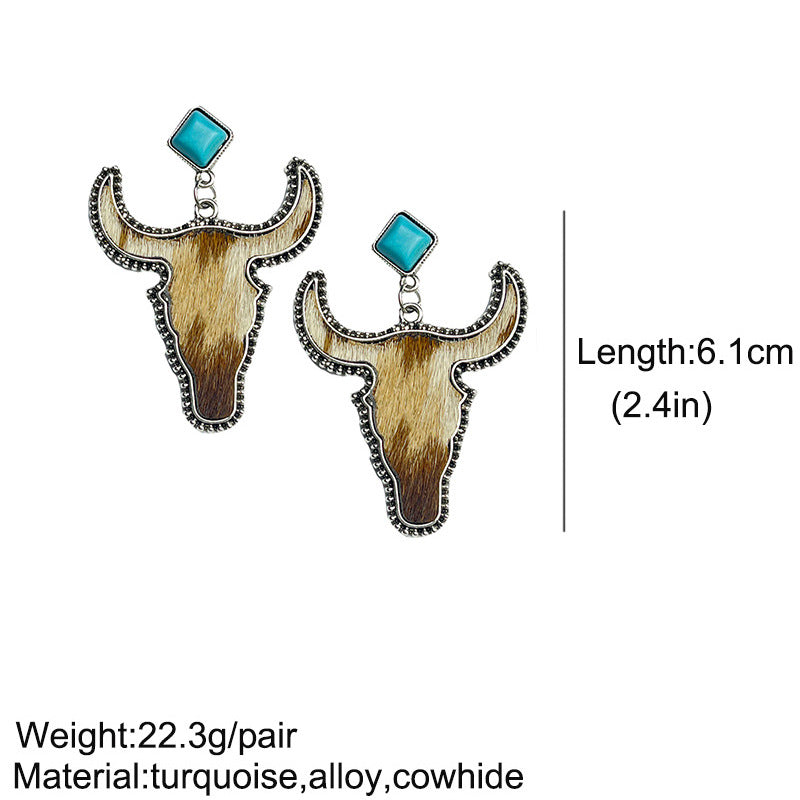
Product Option One: Western Turquoise Boho Vintage Cow Skull Earrings
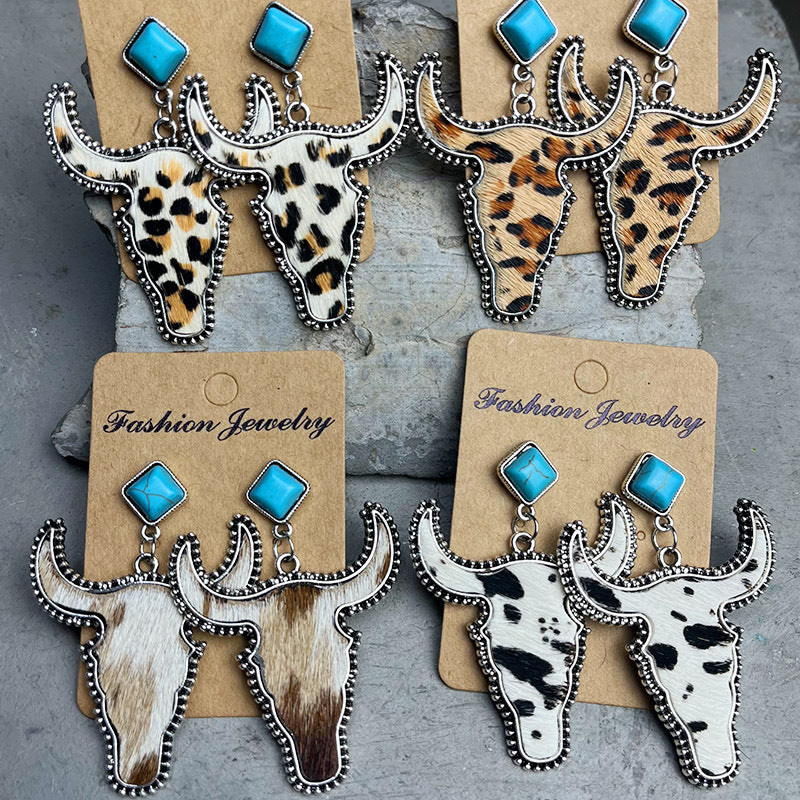
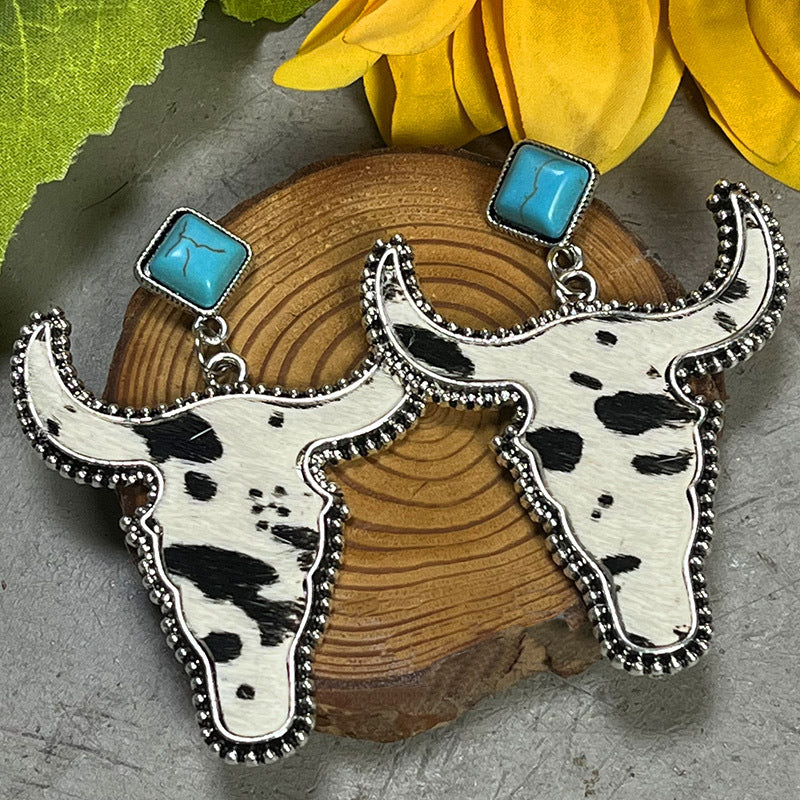
The Western Turquoise Boho Vintage Cow Skull Earrings page was reviewed on August 24, 2026. It displayed $141.40 USD, four visible Size choices labeled Design 1 through Design 4, and a sixteen-image gallery. Current copy describes a western, turquoise, and boho design for everyday, western-inspired, occasion, and gifting contexts.
The title supplies cow-skull and vintage styling language, but the visible information reviewed did not establish natural turquoise, historical age, cultural origin, maker, exact materials, dimensions, drop, mass, attachment, backing, included quantity, finish, construction, or care. The buyer must match every requested fact to Design 1, 2, 3, or 4 rather than borrowing data across the gallery.
Who might choose this option?
A wearer who likes a cattle-skull silhouette near the face and wants it to be the main western motif may consider the listing. That preference is not restricted by gender. The wearer should decide what the skull represents to them; a product title does not establish ranch experience, community affiliation, cultural meaning, or authenticity.
Style one exact design with a solid shirt, restrained hat band, and no competing large pendant. Test the profile with hair, beard, glasses, phone, collar, hat, and hearing protection. Do not call the earrings lightweight or secure until dimensions, per-earring mass, attachment, backing, and included count are documented.
Questions to send before checkout
- Which images correspond to the selected Design?
- Does the order contain a matched pair or another quantity?
- What are the height, width, projection, drop, and mass of each earring?
- What attachment and backing does this Design use?
- What are all contact and decorative materials, treatments, finishes, and assembly methods?
- What care guidance and return conditions apply to this exact option?
Product Option Two: Western Turquoise Vintage Cross Jewelry for Women
The Western Turquoise Vintage Cross Jewelry for Women page was checked on August 24, 2026. It displayed $112.11 USD, two visible Size choices labeled 90cm and 52cm, and a thirteen-image gallery. The visible copy describes a western, turquoise, and vintage design for casual, western-inspired, occasion, and gifting contexts.
The “for Women” title is store categorization, not a rule that prevents a man or any other person from wearing it. Suitability depends on the wearer's interest in the cross, the exact selected length, pendant shape, fit, components, movement, and care. The cross can have religious, personal, cultural, memorial, aesthetic, or no appropriate meaning; the wearer decides.
What the visible length labels do and do not tell us
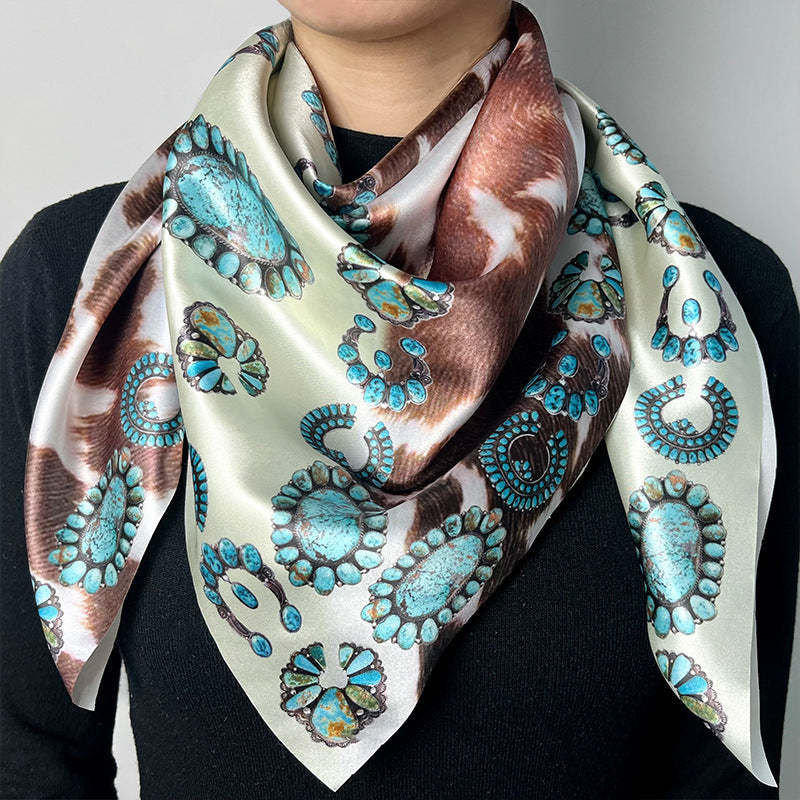
The page shows 90cm and 52cm as Size choices. Do not assume where the seller measured them, whether they include an extension, how the pendant contributes to total drop, or whether every image matches both choices. Ask for the measurement method, wearable length, extension, clasp, pendant dimensions, and mass for the selected option.
The visible page reviewed did not establish natural turquoise, documented age, materials, treatment, metal identity, finish, construction, clasp, care, or pendant measurements. A longer label does not prove a heavier necklace, and the higher or lower price relative to another product does not prove authenticity or quality.
How to place the cross in a men's rodeo outfit
Use a smooth shirt or restrained snap pattern as the background. Let the cross be the only large symbolic element. Reproduce the verified length and pendant area, then check whether it meets the collar, belt line, buckle, seat belt, bag strap, and jacket. A 90cm label may create a very different interaction from 52cm, but only the seller's exact measurement method can define the difference.
Compare the Options Without Gender Stereotypes
| Buyer question | Cow-skull earrings | Cross jewelry listing |
|---|---|---|
| Primary visual zone | Ear, face, hat, hair | Neckline, shirt, jacket, chest |
| Visible choices | Design 1–4 | 90cm and 52cm |
| Symbol decision | Does the wearer want a cattle-skull motif? | Does the wearer want a cross, and what does it mean? |
| Gender label | Not a fit specification | “For Women” does not restrict the wearer |
| Critical missing facts | Per-design size, mass, attachment, materials, care | Measurement method, pendant size, mass, clasp, materials, care |
The products do different jobs, so price alone cannot rank them. Earrings demand ear-contact and included-quantity evidence. A necklace demands length, pendant, clasp, and torso-contact evidence. The best option is the one the intended wearer wants and can verify for the planned context.
Use the Buying Video as a Question Generator
GomeowCreations' video “Watch This Before You Buy Turquoise — Know What You're Buying” says in its public description that the creator shows different kinds of turquoise and discusses avoiding fake material in jewelry-making work. That framing is useful: “turquoise” can refer to different disclosed materials, conditions, and treatments, and a buyer should ask what a seller means.
The video cannot authenticate either Oroxen listing, identify their blue-green components, verify metal, determine age, assign origin, or prove value. Do not use color, matrix-like markings, price, temperature, weight, scratching, solvents, heat, or another informal test as definitive proof. Destructive tests can damage jewelry. Request a precise written disclosure; use a qualified independent professional when financial, cultural, historical, or resale stakes justify it.
Turn the video's buying warning into five questions: What is the exact decorative material? Is it natural, manufactured, composite, reconstructed, dyed, stabilized, treated, or unspecified? What documentation supports the statement? What other materials touch the skin? What care follows from the construction? Do not supply answers that the product page does not provide.
Page Four: Checkout, Return, and Backup Plan
Before checkout, capture the selected option, current image, current price, availability, product facts, delivery estimate, and return conditions. Revisit the page immediately before payment because these details can change. If a rodeo date matters, allow time for delivery, inspection, fit testing, questions, and a return within the applicable terms.
Create a backup outfit that does not depend on the new item. Use clothing and jewelry already verified for comfort. This prevents a late delivery, inaccurate fit, missing pair, damaged component, or unanswered material question from forcing the buyer to accept an unsuitable product.
When the order arrives, compare the item with the saved option and included quantity before removing tags or altering packaging in a way that could affect a return. Inspect it in good light. Do not bend, polish, clean, repair, or modify the item until its construction, care, and return implications are understood.
Rodeo Spectator Fit Test
- Put on the exact shirt, jacket, hat, glasses, belt, boots, and bag.
- Add one focal jewelry category, not both products automatically.
- Check front, profile, seated, standing, jacket-on, and jacket-off views.
- Use the phone, fasten a seat belt, lift the bag, sit, stand, turn, and applaud.
- Add hearing protection and event wristband space where relevant.
- Stop if jewelry causes pain, unsafe contact, equipment interference, or a concerning reaction.
The published country concert jewelry guide is useful for additional spectator logistics such as seating, outerwear, bags, hearing protection, and secure removal. Rodeo rules remain event-specific and must be checked directly.
Buying Mistakes and Better Replacements
- Mistake: buying by gender label. Replacement: buy for wearer preference, verified fit, symbolism, contact, and context.
- Mistake: treating “turquoise” as proof of a mineral. Replacement: obtain exact material and treatment disclosure.
- Mistake: treating “vintage” as age. Replacement: request provenance when historical age matters.
- Mistake: assuming every Design shares specifications. Replacement: match facts and images to the selected option.
- Mistake: accepting 90cm or 52cm without a method. Replacement: ask how wearable length, extension, and pendant drop are measured.
- Mistake: ordering just before the event. Replacement: leave an inspection, test, question, and return window.
- Mistake: using spectator styling for hazardous activity. Replacement: follow qualified activity-specific rules and remove jewelry when required.
Frequently Asked Questions
Can men wear earrings marketed with boho or cowgirl styling?
Yes, if the wearer wants them and the exact product fits their needs. Marketing categories do not determine gender permission. Verify piercing compatibility, attachment, backing, dimensions, mass, materials, and comfort.
Can a man wear a necklace titled “for Women”?
Yes. The practical questions are whether the person wants the symbol and design, and whether the selected length, pendant, clasp, materials, movement, and care work for them.
Are the cow-skull earrings or cross necklace natural turquoise?
The visible information reviewed did not establish that. Request exact decorative materials, treatments, and supporting documentation. Do not infer mineral identity from blue-green appearance.
Which option is better with a cowboy hat?
A necklace usually avoids direct brim contact, while earrings may share space with the hat, hair, glasses, and hearing protection. That does not make the necklace automatically better. Test the exact dimensions, movement, outfit, and wearer preference.
How should a cross or cow skull be chosen as a gift?
Confirm that the recipient welcomes the symbol and the jewelry category. Obtain fit, attachment, contact-material, care, delivery, and return information. Do not assign religious, ranch, cultural, or personal meaning on the recipient's behalf.
Does a higher price mean genuine turquoise?
No. Price can reflect many factors and does not authenticate material, metal, age, maker, origin, construction, or value. Use written disclosure and appropriate independent expertise when needed.
What if product facts are still missing before the rodeo?
Use the backup outfit and do not force the purchase. Missing facts are a reason to ask, delay, choose a better-documented option, or skip the item—not a reason to invent an answer.
Final Rodeo Buyer's Dossier
- Wearer page: jewelry category, symbolism, fit comparison, attachment, contact, sensitivities, and preferences.
- Outfit page: role, hat, shirt, jacket, glasses, hair, bag, buckle, hearing protection, and activity restrictions.
- Evidence page: selected option, images, price, dimensions, mass, included count, materials, treatment, construction, care, and terms.
- Plan page: delivery margin, inspection, fit rehearsal, return route, secure event storage, and backup outfit.
Conclusion: Buy for a Person, Not a Label
Men's turquoise jewelry for a rodeo outfit should begin with the actual wearer and finish with exact evidence. A cow-skull earring can be the face-level focal point; a cross necklace can be the symbolic chest-level focal point. Neither is defined by a gendered label, gallery mood, or price alone.
Compare more silhouettes in the Western Jewelry collection or return to the Oroxen homepage. Complete all four dossier pages, preserve unknowns, respect wearer meaning and activity rules, and order only when the product proof and the rodeo plan agree.