Good jewelry care begins with a pause, not a bottle of cleaner. A turquoise-colored Western earring or pendant can combine several components, finishes, adhesives, coatings, stones, and findings, yet a product photograph cannot identify all of them. Treating the entire piece as if it were one known material can turn a small maintenance task into permanent surface damage.
This guide builds a conservative routine around two current Oroxen examples: the Turquoise Western Stud Earring Set and the Turquoise Western Teardrop Pendant Necklace. Their names describe appearance and style direction. They do not independently establish natural turquoise, metal composition, age, origin, treatment, plating, or construction. Request those facts for the exact option before selecting any liquid, polish, or cleaning method.
The Quick Answer: Preserve First, Clean Second
If the materials and finish are undocumented, use four low-risk actions: handle the jewelry with clean dry hands, isolate it from harder objects, keep it dry and away from cosmetics, and store it in a soft separate pouch. Do not improvise a chemical treatment. A cleaner that is acceptable for one metal or durable stone may be unsuitable for a coating, adhesive, porous component, or intentionally darkened detail.
When dirt is more than loose surface dust, stop and ask the seller for option-specific care instructions. When a component is loose, a post is bent, a chain link is opening, a finish is lifting, or a stone-like element moves, choose repair assessment rather than cleaning. Removing soil is not worth accelerating a structural failure.
Step 1: Create an Identity and Condition Record
Before touching the surface, give each piece a simple record. Note the product name, option, purchase date, seller, color, visible finish, and every disclosed material. Save screenshots or documents that came with the purchase. Add four photographs: front, back, side profile, and the closure or post area. Use neutral daylight and the same background each time.
For a multi-piece earring set, assign short labels such as E1, E2, and E3 rather than relying on motif descriptions. Record which backing belongs to which post. For a necklace, label the clasp, chain, connecting rings, bail, pendant frame, and center. This map makes later comparisons much more reliable than memory.
Inspect without bending or pulling. Look for changes in color, surface texture, gaps, residue, bent hardware, rough edges, missing parts, and movement between components. Note the location and size of anything unusual. A quarterly photograph from the same distance can show whether a mark is stable or expanding.
Step 2: Classify What You Know—and What You Do Not
Make two columns. The first contains facts supplied for the exact product option. The second contains open questions. Useful facts include component materials, coating or plating, stone identity, treatments, adhesives, dimensions, closure type, and explicit care limitations. “Turquoise,” “silver,” “vintage,” “boho,” and “Western” in a style name are not enough to fill those fields.
Unknowns should narrow the routine. If stone identity is unknown, do not assume the component tolerates soaking, heat, steam, ultrasonic vibration, acids, alkalis, or abrasives. If the metal and finish are unknown, do not select a metal polish. If the construction is unknown, do not assume every decorative element is mechanically set. Conservative handling remains useful while documentation is incomplete.
Readers comparing broader style families can review Oroxen’s Turquoise Jewelry collection and Western Jewelry collection, then use the public guide to Western jewelry motifs, styles, materials, and selection to separate design vocabulary from verified product facts.
A Low-Risk Care Kit
Build a preservation kit rather than a universal cleaning kit. Include small soft pouches, individual dividers, plain acid-free labels, a pencil, a ruler, a phone camera, and a clean tray with raised edges. Keep any cloth separate until the seller confirms that gentle dry wiping is appropriate for the exact finish. Previously used polishing cloths can carry abrasive or chemical residue and should not be treated as neutral.
Use the tray over a stable table so a loose backing or connector cannot roll away. Place a fresh white sheet beneath the piece to make tiny parts visible. Remove bracelets and rings from your own hands before handling. Avoid sinks, open drains, carpet, food-preparation surfaces, and direct sun. The goal is controlled observation with minimal contact.
Do not add toothpaste, baking soda, vinegar, alcohol, perfume, hairspray, household detergent, essential oils, metal polish, or an ultrasonic machine to the default kit. Some products may tolerate a seller-approved method involving one of these categories, but that permission must come from reliable material and construction information—not from a similar-looking item online.
Care Workflow for the Turquoise Western Stud Earring Set
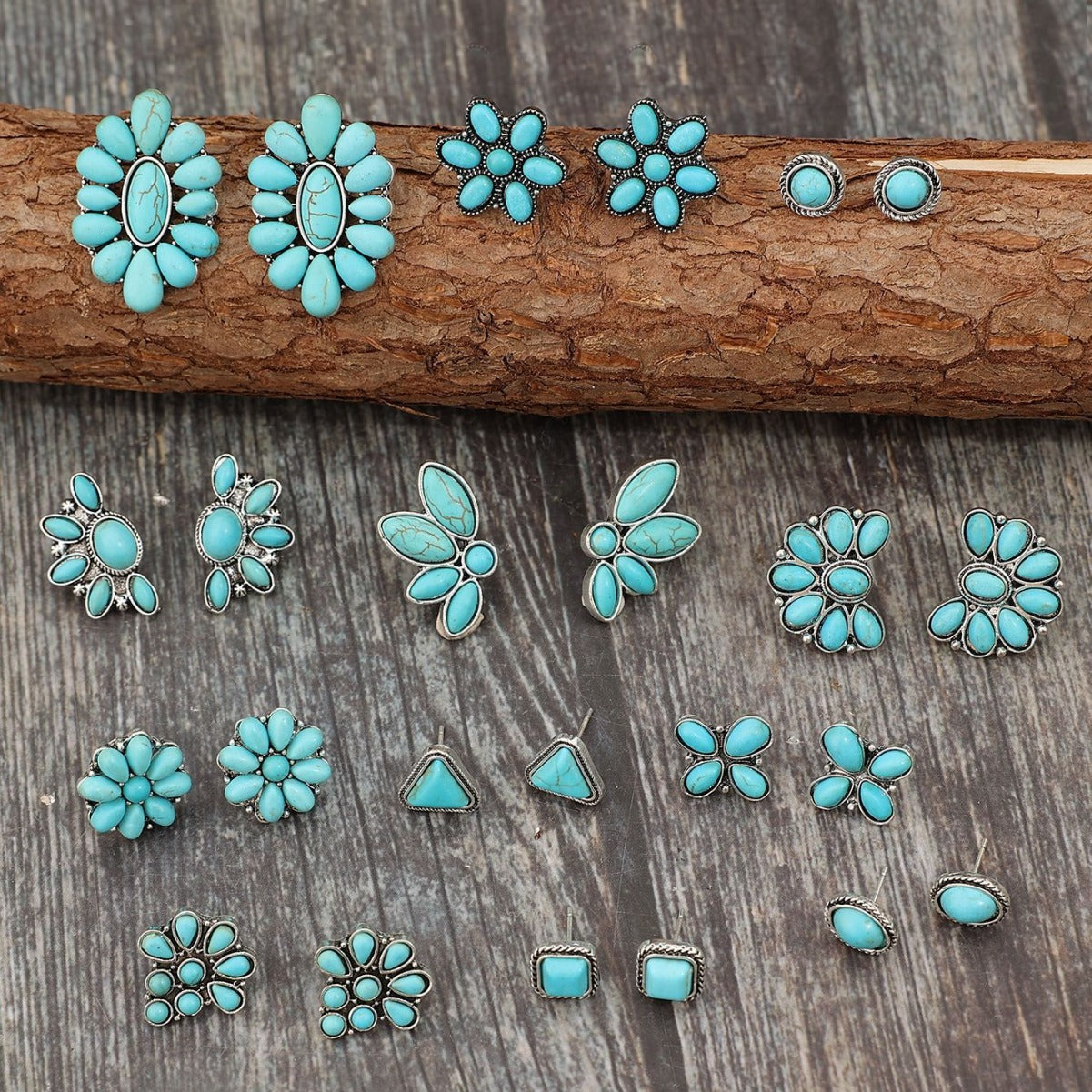
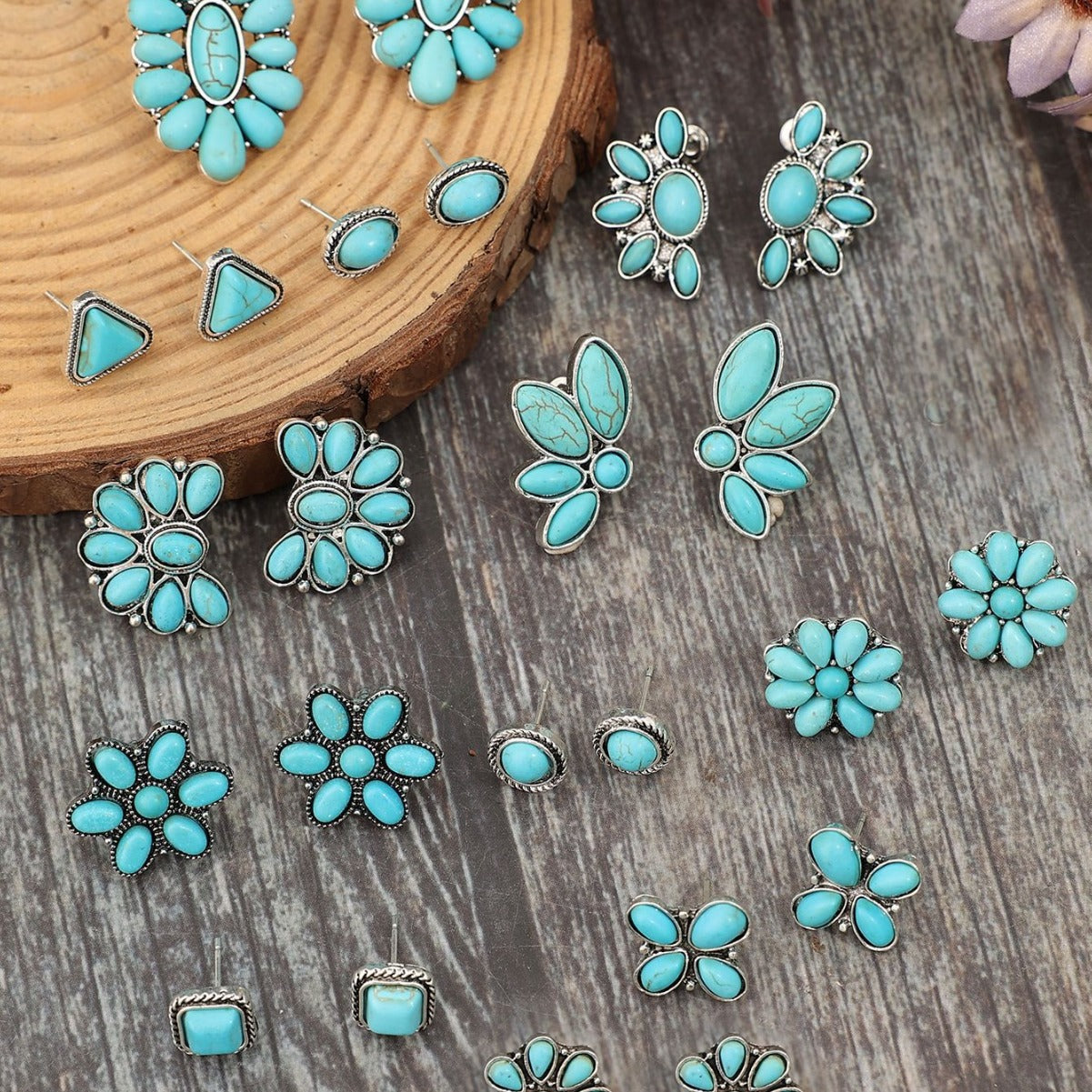
The earring product page presents a coordinated assortment of floral, geometric, and classic turquoise-style studs. The captured page did not state the exact included count, dimensions, per-earring weight, post or backing materials, decorative component materials, or finish system. Confirm those details before treatment.
Begin with inventory. Lay each earring beside its backing and compare the set with the order record. Photograph the front and reverse of every unit. Inspect the post where it meets the decorative face, because a change in angle or a widening gap can indicate stress. Do not repeatedly straighten a questionable post; cyclic bending may worsen weakness.
Keep earring hygiene separate from finish care. A product that is safe for a detached backing is not automatically safe for the decorative front, an adhesive joint, or a coated post. Follow the seller’s instructions for the complete construction. Do not share earrings, and do not wear a post that is rough, damaged, contaminated, or associated with irritation. Personal discomfort or a skin reaction calls for removal and appropriate professional advice, not experimentation with stronger cleaners.
After wear, place each unit in its assigned compartment. Avoid tossing the entire set into one pouch, where posts can scratch decorative faces and backings can disappear. If the seller confirms that a dry untreated cloth is appropriate, use a separate clean section for each piece and almost no pressure. Stop if color transfers to the cloth, the surface changes, or a component moves.
Care Workflow for the Teardrop Pendant Necklace
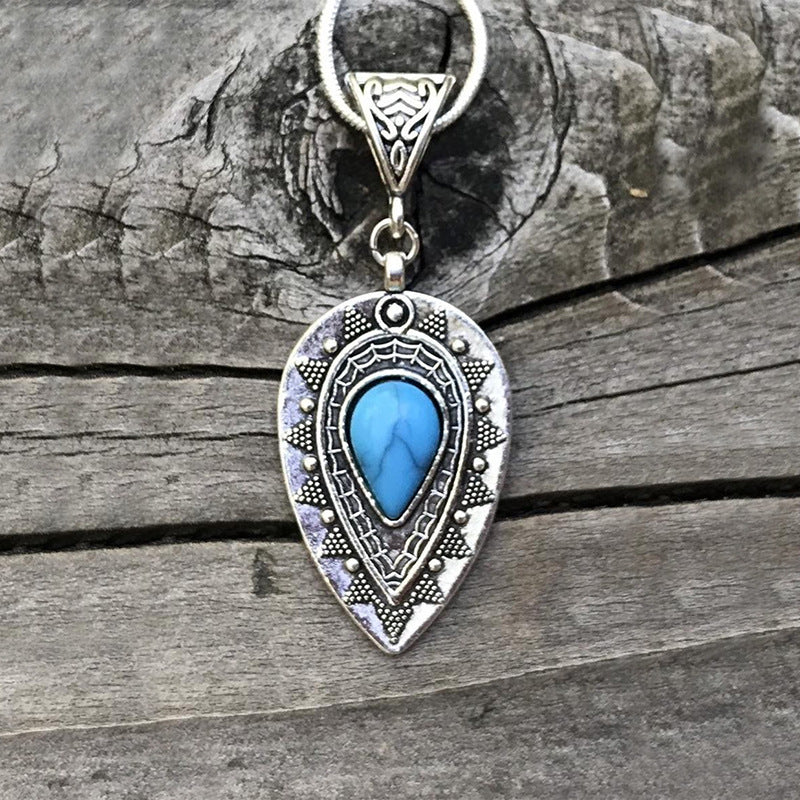
The necklace page shows a Western-inspired teardrop silhouette, a turquoise-style center, an antique-silver-colored appearance, and vintage-inspired detail. Its visible option area did not provide exact chain length, pendant dimensions, weight, closure specification, or component materials. The page’s care section advises keeping the jewelry dry, avoiding direct contact with perfume or lotions, and storing it in a soft pouch; it also notes that material details may vary by option.
Translate that guidance into order of operations. Apply fragrance, hair products, lotion, and cosmetics first, away from the necklace. Allow them to dry before dressing. Put the necklace on last and remove it first. Do not wear it for bathing, swimming, strenuous exercise, household cleaning, or other situations involving water, chemicals, heavy perspiration, impact, or repeated friction.
Inspect the necklace as a chain of load points. Start at the clasp, follow every visible link, examine connecting rings, then check the bail and the junction between pendant components. Support the pendant in one hand while moving the chain; do not let its weight pull on a questionable connector. A gap, sharp edge, kink, lifting surface, or moving center is a stop condition.
Store the chain extended or loosely curved so it cannot knot. Keep the pendant in its own soft compartment and prevent the clasp from resting against the decorative face. Do not hang a necklace for long-term storage unless the maker confirms the construction can tolerate constant tension. A flat, protected arrangement reduces both load and accidental swinging.
Use an Exposure Log Instead of Guessing
When a change appears, write down recent exposures before attempting a remedy. Record water, sweat, cosmetics, fragrance, cleaning products, humidity, strong light, temperature swings, impact, compression, and rubbing against fabric or other jewelry. Include the date, duration, and affected area. This can reveal patterns and gives the seller or repair professional useful context.
Do not assume that every color change is removable dirt. It could involve residue, surface wear, intentional oxidation, a coating change, or another process that requires identification. Aggressive polishing may remove the very finish you are trying to preserve. A clear exposure history is more valuable than a sequence of undocumented home treatments.
A Four-Level Decision Tree
| Observation | Lowest-risk response | Avoid |
|---|---|---|
| No visible soil or damage | Photograph, isolate, and store dry | Cleaning merely because time has passed |
| Loose dust on a documented stable finish | Follow the seller’s exact dry-care direction | Pressure, scrubbing, or improvised liquids |
| Unknown residue or color change | Pause and request product-specific guidance | Diagnosing the material from appearance |
| Loose, bent, cracked, sharp, or lifting component | Stop wearing and seek repair assessment | Cleaning, bending, gluing, or testing solvents |
This decision tree is intentionally cautious. It does not promise zero risk, and it cannot replace instructions for the purchased option. Its purpose is to prevent an unknown construction from receiving an irreversible treatment.
Storage by Microclimate
A jewelry box is not automatically a safe environment. Inspect its lining, dividers, closure, location, and humidity. Keep pieces away from bathroom steam, kitchen vapors, window heat, direct sunlight, and areas where temperature changes rapidly. Do not use a storage insert with an unknown chemical odor or visible transfer.
Give each earring and necklace a defined space. Soft pouches should be clean, dry, and large enough to avoid compression. Place labels outside rather than in direct contact with the jewelry. If anti-tarnish or desiccant products are being considered, ask whether they are compatible with all documented components, and replace or monitor them according to their own instructions.
Once each quarter, compare the current piece with its baseline photographs. Check the same points in the same order. A one-minute structured review catches change earlier than a dramatic annual cleaning and produces evidence for a useful seller conversation.
Travel Without Creating a Repair Job
Pack jewelry only after completing a condition check. Use a rigid outer case with soft individual compartments. Secure studs so posts cannot pierce adjacent pouches. Close the necklace clasp, lay the chain in a loose curve, and immobilize the pendant without pressing its raised details. Keep the case in hand luggage when practical and never place heavy items on it.
Photograph the packed arrangement, then repeat the inventory at the destination. Dress over a clear surface and return every removed component to its assigned place. Do not use a hotel bathroom counter or sink. A small tray and printed inventory card prevent more loss than an emergency cleaning kit.
How to Use the Care Video Responsibly
The supplementary video is Episode 9: Turquoise Care and Cleaning Guide by Amitis Art. The video page was accessible during drafting, but a transcript was not available for review. This article therefore does not quote the presenter or treat the video as verification for either Oroxen product.
Watch the complete video and convert any proposed procedure into questions: What material is being handled? Is it treated or coated? Is the method intended for a loose stone, finished jewelry, or a particular setting? Are adhesives present? What exclusions does the presenter state? Then compare those answers with documentation for your exact option. A general demonstration cannot authenticate a component or authorize a technique for a different construction.
When to Contact the Seller or a Repair Professional
Contact the seller when material disclosure, option details, approved routine, or restrictions are missing. Send the product URL, option, order information, and close photographs. Ask one specific question at a time: “Is an untreated dry cloth approved for every surface on this option?” is more actionable than “How do I clean jewelry?” Keep the written reply with the condition record.
Seek an appropriate jewelry repair professional when a post bends, a link opens, a clasp fails, a bail deforms, a component loosens, an edge becomes sharp, or a finish visibly separates. Explain that composition may be unknown and provide the exposure log. Do not conceal previous treatments; they can affect diagnosis and repair choices.
Frequently Asked Questions
Can I soak turquoise-colored Western jewelry?
Do not assume soaking is safe. The color and style name cannot identify every component, treatment, adhesive, or finish. Use only a method explicitly approved for the exact product option.
Can I use silver polish on the antique-silver-colored necklace?
An apparent color is not a material disclosure. Polish can alter some coatings and intentional dark details. Confirm the metal and finish system, then follow product-specific instructions.
Should I clean earrings after every wear?
Inspect after every wear, isolate each piece, and follow documented hygiene and finish-care instructions. Repeated unnecessary treatment can create wear. Stop using any item that is damaged or causes discomfort.
What if a soft cloth turns dark?
Stop. Transfer may be soil, residue, finish material, or another change that cannot be diagnosed from the cloth alone. Photograph both surfaces and ask the seller or a qualified professional before continuing.
Can all pieces in the same set share one care routine?
Not necessarily. Decorative faces, posts, backs, coatings, stones, adhesives, and findings may differ. Confirm whether the seller’s directions apply to every component.
Where can I learn more about choosing and wearing these styles?
Use the public complete Western turquoise-style jewelry selection guide, the cowgirl earrings and necklaces style guide, and the guide to styling Western jewelry with denim, dresses, boots, and workwear. Browse Western Earrings and Western Necklaces only after separating visual preference from material and care verification.
A Repeatable Five-Minute Routine
- Remove jewelry over a clean raised-edge tray.
- Compare the closure, connectors, posts, backs, and decorative surfaces with the baseline.
- Record unusual exposure or visible change without diagnosing it.
- Perform only the exact low-risk care approved for the documented construction.
- Return each component to its separate soft compartment.
This routine favors consistency over dramatic restoration. It is easy to repeat, creates a useful history, and makes a stop decision clear. When uncertainty remains, doing less is an active preservation choice.
Final Checklist
- Confirm materials, finishes, treatments, adhesives, and care for the exact option.
- Photograph the piece before the first wear and at regular intervals.
- Keep jewelry dry and separate from perfume, lotion, chemicals, friction, and impact.
- Inspect each earring, backing, chain link, clasp, connector, bail, and decorative component.
- Store every piece separately in a clean soft compartment.
- Stop when color transfers, hardware moves, a gap appears, or a surface lifts.
- Use seller guidance or professional assessment before any irreversible procedure.
For current products and store policies, return to Oroxen. A careful owner does not need to know the answer to every material question immediately. They need a reliable record, a conservative default, and the discipline to pause before an uncertain treatment becomes permanent.