Costume Turquoise Jewelry for Country-Music Fans: A Practical Guide
Costume turquoise jewelry can be a useful styling category for a country-music fan, but the word “costume” should begin a decision process rather than end one. It does not automatically mean poor quality, natural turquoise, imitation turquoise, a particular metal, a particular price, or a specific level of durability. A product still has to be evaluated as the exact item and option shown on its current page.
This beginner guide uses an evidence ladder. The first rung is what can be seen. The second is what the seller documents. The third is what the wearer can test. The fourth is what only a qualified expert or appropriate testing could establish. Keeping those rungs separate helps shoppers enjoy turquoise-colored and Western-inspired design without turning a photograph, title, or styling impression into an unsupported material or value claim.
Quick Answer: Buy the Documented Object, Style the Visible Design
Begin with the exact product option rather than the category name. Record its current title, selected choice, price, included quantity, dimensions, mass, closure, materials, skin-contact components, finish, treatments, care, shipping expectation, and return conditions. If a field is missing, mark it unknown. Do not replace the blank with a guess from color, motif, price, or another listing.
For styling, choose one visual job: face-framing earrings, a wrist stack, a necklace focal, or a small color accent. Test the piece with the actual shirt, denim layer, dress, boots, hat, bag, and hair. For buying, set a total-use budget that includes not only price but also information risk, fit, comfort, care, delivery margin, and how often the item can realistically be worn.
The Turquoise Jewelry Guides hub provides a wider path through turquoise-colored categories. This article stays focused on how a beginner can classify evidence and make a practical country-music wardrobe decision.
What “Costume Turquoise Jewelry” Can and Cannot Tell You
Costume jewelry is commonly used as a retail or collecting category for pieces selected primarily for decorative design rather than for a guaranteed investment in precious materials. Real listings do not always use the term consistently. Some products disclose every component; others emphasize a look. Some turquoise-colored elements may be stone, composite, glass, resin, another material, or an unspecified decorative component. The category alone cannot identify them.
Use “costume turquoise jewelry” here as a search and wardrobe label. It can help gather earrings, bracelets, necklaces, and rings that share blue-green color, Western-inspired line, cross, floral, geometric, cow-skull, or other visible motifs. It cannot prove any of the following:
- that a blue-green component is natural turquoise;
- that a metal-colored component contains a named metal;
- that vintage means a documented age;
- that Western appearance establishes maker, region, tribe, nation, or cultural affiliation;
- that a low or high price establishes authenticity, quality, rarity, or resale value;
- that two similarly colored pieces require the same care.
The published Western jewelry motifs, styles, and materials overview is useful for separating visual vocabulary from material and origin claims. That separation is especially important when a shopper is new to turquoise-colored jewelry.
The Four-Rung Evidence Ladder
Rung 1: Visible observation
Observation covers color, outline, number of clearly pictured components, visible motif, apparent placement, and the relationship between shapes. Use restrained language: turquoise-colored accent, cross shape, open-cuff silhouette, repeated decorative units, or vintage-inspired appearance. Observation cannot identify chemistry, treatment, internal construction, mass, dimensions, or age.
Rung 2: Seller documentation
Documentation is tied to the exact option and current page. It may include a written materials list, measurements, closure, included contents, care, and policy information. Save the URL, date, selected option, and a reference image. Product pages can change, so reopen the listing immediately before ordering.
Rung 3: Wearer testing
The wearer can test comfort, balance, interference, styling versatility, and ordinary movement. Put on the full outfit and try sitting, turning the head, using a phone, lifting a bag, putting on a jacket, clapping, dancing, and reaching. A wear test can reveal that an earring catches a collar or that cuffs collide with a watch. It still cannot prove material identity.
Rung 4: Specialist conclusion
Authentication, treatment identification, valuation, dating, and cultural attribution may require provenance, close physical examination, appropriate instruments, comparison references, and a qualified professional. A general video, photograph, or product title is not a substitute. The beginner's best decision is often to leave a question unresolved unless the answer is essential to the purchase.
The complete Western turquoise jewelry selection guide supplies a broader set of questions that can be placed on rung two instead of answered by assumption.
Build a Country-Music Wear Budget
A useful budget has five columns. Purchase cost is the current item price plus any applicable order costs. Evidence cost is the uncertainty that remains about composition, fit, or care. Use count is the number of outfits and settings in which the exact piece has a distinct job. Handling cost covers storage, cleaning, repair risk, and the effort required to prevent tangling or collision. Fallback cost is what happens if the product does not arrive, fit, or feel comfortable before a planned event.
This model does not assign a monetary value to uncertainty. It forces the shopper to see it. A lower-priced item with clear contents, useful dimensions, and a repeatable wardrobe role may be easier to plan than a higher-priced item with missing specifications. Conversely, a visually appealing piece may still be worthwhile when the buyer is comfortable with the unknowns and the return conditions are suitable.
Count outfit roles rather than vague possibilities. For a country-music wardrobe, roles might include quiet denim-shirt accent, concert ear focal, dress neckline focal, layered-jacket wrist stack, or gift option with documented contents. If two candidates perform the same narrow job, compare them directly instead of buying both because their turquoise color differs slightly.
Choose a Visual Zone Before Choosing Quantity
Divide the outfit into ears, neck, hands, wrists, and lower accessories. Give one zone first attention. A cross-shaped earring can lead near the face, while a set of four cuffs can lead at the wrist. Wearing both at full intensity may be appropriate for some personal styles, but it should be a tested choice rather than an automatic matching rule.
Country-music styling often combines denim, boots, belts, bags, hats, stitching, fringe, prints, or metal-colored hardware. Those elements already occupy attention. A turquoise-colored piece becomes easier to see when surrounding motifs are reduced. Exact matching across earrings, necklace, bracelet, ring, buckle, boots, and bag can make the outfit look less deliberate, not more.
Use the Turquoise Jewelry collection to compare different zones and silhouettes. Use the Western Jewelry collection to compare the broader vocabulary. A collection page is a discovery tool; the exact product page is the evidence source.
Live Example One: Turquoise Statement Cross Earrings
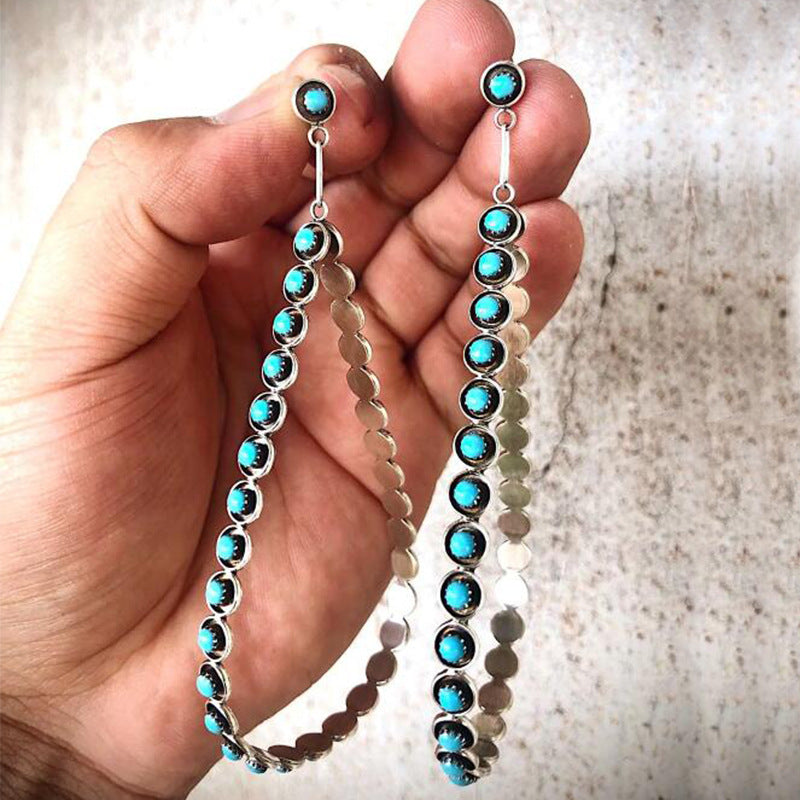
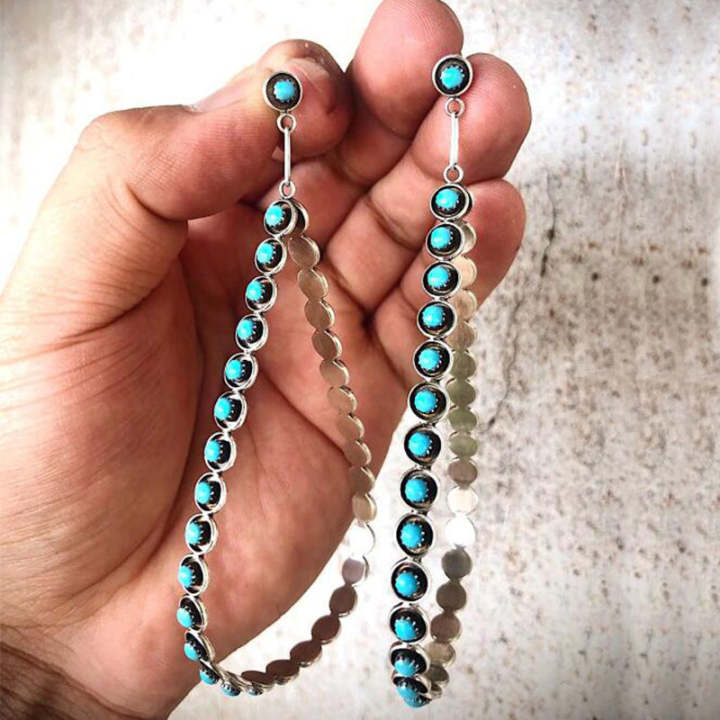
The live Turquoise Statement Cross Earrings page was reviewed on August 24, 2026. It displayed $127.26 USD. One visible Color radio was selected but did not show a readable text label in the inspected page state. The current copy describes turquoise, statement, and cross visual details and proposes everyday, Western-inspired, occasion, and gifting contexts.
Place those facts on rung two. The photographs can place turquoise-colored elements and a cross motif on rung one. The visible page did not establish natural turquoise, exact decorative material, metal composition, dimensions, mass, closure, skin-contact components, treatments, care, maker, origin, age, handwork, or cultural affiliation. It also did not turn the page's six numbered product-image views into a specification or included-contents statement.
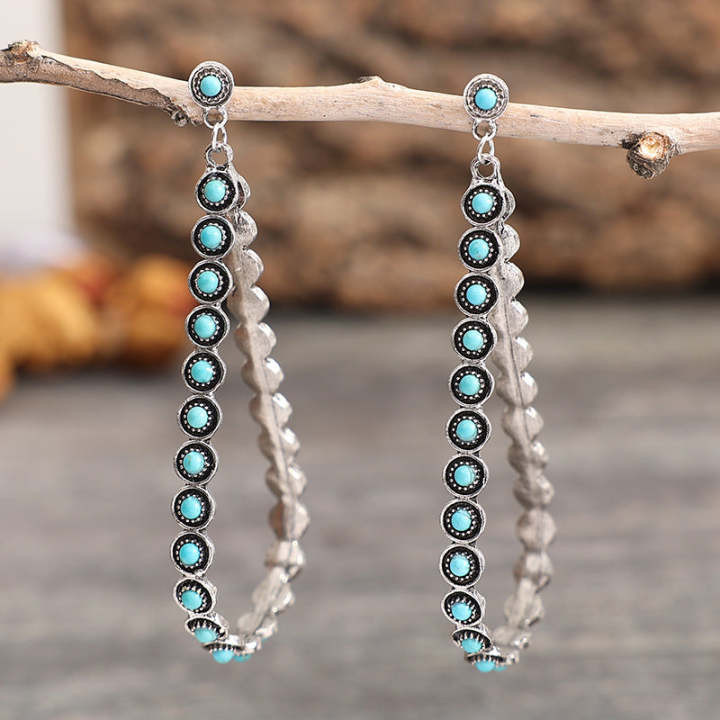
A beginner can test these as an ear-zone lead. Start with a quiet shirt, knit, or dress neckline and either no necklace or a low-information neck area. Compare hair down and hair back. Check the earring path against hat brims, collars, scarves, headphones, and phone use. Do not schedule event-length wear until the missing dimensions, mass, closure, and component information are resolved to your satisfaction.
The motif is a personal and contextual choice. Consider the setting, host expectations, workplace or venue context, and your own relationship to the symbol. The product title alone does not provide a universal occasion rule.
Live Example Two: Turquoise Western Cuff Bracelet Set
The live Turquoise Western Cuff Bracelet Set page was reviewed on the same date. It displayed $34.99 USD. The visible Set choice was labeled 4Set and selected. The current product text states that the selection contains four open cuff bracelets with turquoise-colored accents and varied vintage-inspired motifs, and that they can be worn together or individually.
That written information gives the set a clearer quantity and wearing concept than the earrings page. It does not establish natural turquoise, decorative-component material, metal composition, internal dimensions, opening width, mass, treatments, adjustability limits, care, maker, age, origin, handwork, or cultural affiliation. “Open cuff” describes a form; it does not prove that the bracelet should be bent repeatedly or adjusted beyond documented instructions.
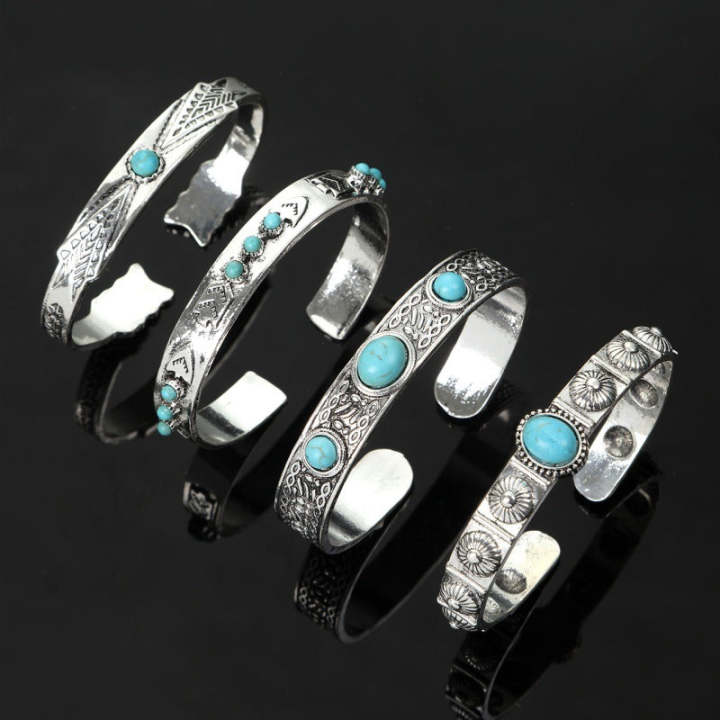
Use four index cards, one for each pictured cuff after confirming that the image corresponds to the selected 4Set. Give each card a visual description and a proposed role. Card A may be the quiet single cuff. Card B may coordinate with a denim jacket. Card C may join one other cuff for a concert stack. Card D may remain unused when a watch or detailed sleeve already fills the wrist zone.
This approach creates more outfits than treating the four pieces as one permanent stack. Test each cuff alone, two at a time, and then all four. Check collision, sound, pressure, sleeve contact, watch contact, desk use, bag handles, and dancing. Stop if the set pinches, shifts, catches, scratches another surface, or requires repeated correction.
Compare the Two Products Without Declaring a Winner
The earrings and cuffs solve different wardrobe problems. The earrings operate close to the face and interact with hair, collars, phones, and headwear. The cuff set occupies the wrist and interacts with sleeves, watches, bags, tables, and hand movement. Price alone cannot compare those jobs.
Use a twelve-cell comparison sheet:
- Exact selected option and readable label.
- Current displayed price and review date.
- Written included quantity.
- Dimensions and wearing range.
- Mass or component-level mass.
- Closure, opening, or wearing mechanism.
- Documented materials and treatments.
- Skin-contact components.
- Documented care.
- Number of distinct outfit roles.
- Movement and collision test result.
- Current delivery and return information.
The cuffs currently have clearer written quantity information. The earrings may provide a stronger face-framing focal for some outfits. Those are different observations, not a universal ranking. Leave every missing cell blank until evidence appears.
How to Use the Corresponding Video Responsibly
The corresponding YouTube reference is the 31-minute-51-second Dr. Lori program How to Value Turquoise Jewelry, Glass, Blue & White Chinese Bowls, Wedgwood, Lists. The page title and description identify an appraisal-format program that includes a turquoise jewelry example among several unrelated objects.
Use the video as a prompt to ask better questions, not as transferable authentication. The necklace shown in the program is not either Oroxen product. Its appearance, history, materials, construction, and appraisal do not prove anything about the earrings or four-cuff set. No value statement from the program should be applied to a current retail listing without item-specific evidence and an appropriate evaluation.
For this guide, the video is linked as relevant educational media rather than used as the source of product facts. The live Oroxen pages remain the source for the limited product statements above. This boundary lets a beginner explore appraisal thinking without confusing entertainment or general education with a certificate.
Four Country-Music Outfit Formulas
Quiet denim with an ear focal
Use a low-detail denim shirt or jacket field, selected earrings, and a quiet neck. Keep the buckle and bag restrained. Test the collar against the earring path. The published denim, dresses, boots, and workwear guide offers more garment-specific ideas.
Solid dress with one or two cuffs
Choose a sleeve length that leaves a clear wrist field. Begin with one cuff, then add a second only if they do not collide or crowd the hand. Quiet the earrings and neckline so the wrist is a deliberate accent.
Concert look with a tested stack
Confirm current venue rules, bag requirements, weather, outerwear, travel, and expected movement. Test the cuff stack while clapping, dancing, using a phone, and carrying the permitted bag. The country-concert jewelry guide expands this real-condition rehearsal.
Patterned Western-inspired layer with one color echo
If the garment already contains embroidery, fringe, floral or geometric pattern, or strong hardware, choose either the earrings or one cuff. Let turquoise color echo a minor garment detail without matching every accessory. Empty visual zones are part of the outfit.
Care When the Materials Are Unknown
Do not invent a universal turquoise-jewelry cleaning method. A routine appropriate for one stone, coating, adhesive, finish, or metal can damage another. Request care instructions tied to the exact option and components. Until that information exists, reduce exposure to moisture, cosmetics, fragrance, cleaners, abrasion, impact, heat, and prolonged friction.
Store earrings so their posts, hooks, decorative faces, and connecting parts do not press against harder objects. Store cuffs separately enough to prevent scratching or tangling. Do not repeatedly bend an open cuff unless the seller documents how and within what range it may be adjusted. Remove an item when it causes irritation, pain, discoloration, a loose component, damaged finish, or closure failure.
Unknown does not mean fragile, unsafe, or unsuitable. It means the guide cannot give a material-specific instruction. Responsible care begins by obtaining the missing information.
Beginner Mistakes and Better Replacements
Mistake: equating turquoise color with turquoise identity
Replacement: describe color on rung one and require documentation or appropriate evaluation before naming a material.
Mistake: treating costume as an insult
Replacement: use costume as a shopping category, then judge the documented object, visual role, comfort, and care requirements. Decorative value and personal use are not the same as material or resale value.
Mistake: using price as proof
Replacement: compare price with contents, specifications, fit, use count, policies, and unresolved questions. Price is one current listing fact, not authentication.
Mistake: stacking every matching piece
Replacement: select one visual leader and add support only after a full-outfit and movement test.
Mistake: copying facts from a video or adjacent listing
Replacement: keep one evidence card per exact product and option. General education can improve the questions, but it cannot fill another object's blank fields.
Frequently Asked Questions
How should a beginner choose costume turquoise jewelry?
Choose an outfit role first, then inspect the exact option. Record contents, dimensions, mass, wearing mechanism, materials, skin-contact components, care, price, delivery, and returns. Mark missing information unknown and decide whether the remaining uncertainty fits your use budget.
Does costume turquoise jewelry contain fake turquoise?
The category word alone cannot answer that question. A turquoise-colored component may have many possible identities. Use the exact product's documentation or an appropriate item-specific evaluation. Do not infer composition from color, price, or a costume label.
Can the four cuffs be worn separately?
The current product copy says the four open cuff bracelets can be worn together or individually. Confirm that the selected 4Set and current images correspond, obtain fit and care information, and test each combination for pressure and collision.
Are the cross earrings suitable for a country concert?
The current page proposes casual, Western-inspired, and occasion styling, but a concert decision still needs dimensions, mass, closure, components, comfort testing, and current venue conditions. Test the exact choice with hair, hat, collar, phone, and outerwear.
Can a YouTube appraisal establish the value of these products?
No. The linked program concerns different objects. A value conclusion depends on the item, its materials, construction, condition, provenance, market, and the evaluator's method. The video is a question prompt, not an Oroxen appraisal.
Where should a beginner explore next?
Return to Oroxen, compare the two linked collections, and resolve the largest blank on the evidence card before adding another item. A better-documented decision is more useful than a larger pile of similar turquoise-colored pieces.
Conclusion: Keep Style Flexible and Evidence Exact
Costume turquoise jewelry can add a clear ear or wrist role to a country-music wardrobe without needing to make an authenticity or investment claim. Observe the design, record the documented facts, test the wearing experience, and reserve specialist conclusions for qualified item-specific work.
The Turquoise Statement Cross Earrings and Turquoise Western Cuff Bracelet Set illustrate why exact listings matter. One offers a face-framing motif with limited visible specifications; the other documents a four-piece open-cuff concept but still leaves important material, fit, and care questions. Neither should borrow facts from the other or from a video. When the evidence ladder remains intact, a beginner can enjoy the look, control the risk, and build more usable outfits from fewer, better-understood choices.