Common Questions About Turquoise Necklaces for Country-Music Fans
Questions about turquoise necklaces often sound simple: “Will this work with my concert outfit?” “Is the turquoise real?” “What length should I buy?” “Does a cross make it Western?” The trouble is that each question belongs to a different decision owner. A stylist can discuss visual proportion. A tape measure can establish placement. A product page or seller can document materials. The wearer decides personal meaning. The venue decides what is allowed.
This guide uses a question triage desk. Every question receives six labels: lane, answer owner, required evidence, expiry, reversible test, and stop condition. Routing the question correctly prevents a good styling observation from being mistaken for a gemstone, fit, cultural, or safety fact.
Quick Answer: Route the Question Before Answering It
Send appearance and outfit questions to the Style lane. Send necklace length, pendant dimensions, mass, closure, and garment placement to Fit. Send stone, treatment, metal, coating, construction, and care to Material. Send cross imagery, regional language, personal identity, and symbolism to Meaning. Send crowd, weather, dancing, seating, security, and movement to Event. Send option, price, availability, shipping, returns, and included contents to Purchase.
A single answer may require more than one lane. “Is this a good country-concert necklace?” needs Style, Fit, Event, Material, and Purchase evidence. The necklace can look right and still have an unknown length, unsuitable closure, unverified skin-contact components, or an arrival date that misses the show.
Keep the wording proportional to the evidence. Turquoise-colored appearance does not prove natural turquoise. Vintage language does not prove age. Western styling does not prove geographic origin. A cross does not assign meaning to the wearer. Product and seller documentation must support factual claims for the exact selected option.
How to Fill Out a Question Ticket
Write the shopper’s exact question at the top rather than rewriting it into the answer you expect. Under it, complete six short fields.
- Lane: Style, Fit, Material, Meaning, Event, or Purchase.
- Answer owner: observer, wearer, maker, seller, documented measurement, venue, or current policy.
- Required evidence: photograph, exact option, dimension, component disclosure, written attribution, movement test, or policy page.
- Expiry: stable personal preference, event date, or time-sensitive price, option, stock, shipping, and return information.
- Reversible test: garment mock-up, temporary styling, selected-option screenshot, or seller question.
- Stop condition: the missing fact that prevents a responsible yes.
The public guide to Western jewelry motifs, styles, materials, and selection provides useful vocabulary for the lanes. It can clarify what a motif looks like without authenticating the material, maker, or origin of an individual product.
Style Lane: What Should the Necklace Do in the Outfit?
Question: Should the necklace be the focal point?
Answer owner: the wearer’s visual goal. First list the hat, earrings, shirt, jacket, buckle, belt, boots, and bag. If the necklace leads, give it an uninterrupted shirt panel and reduce high-contrast objects near the neckline. If the hat or buckle leads, use a quieter necklace or leave the neck unoccupied.
Required evidence: a full-outfit photograph at conversation distance and a seated version. A close product crop cannot establish hierarchy. Ask another viewer to name the first three things noticed without being told what to find.
Question: Can I wear turquoise color with denim and boots?
Answer owner: visual observation and wearer preference. Turquoise color can contrast clearly with blue denim, brown footwear, cream, black, rust, or white, but the exact intensity depends on the selected piece, lighting, garment wash, and surrounding details. Coordinate through one repeated line or restrained color relationship rather than matching every object.
Question: Can two necklaces be layered?
This begins in Style but immediately moves to Fit and Material. Verify both wearing lengths, adjustment ranges, endpoints, pendant dimensions, masses, closures, projections, and surfaces. The pieces need visible vertical separation and a movement path that prevents striking and tangling. “Wear it with a simple necklace” is an idea, not a proof that two undocumented constructions are compatible.
The public guide to styling Western jewelry with denim, dresses, boots, and workwear can help connect the Style ticket to real garment architecture.
Fit Lane: Where Will the Necklace Actually Land?
Question: Which necklace length should I choose?
Answer owner: verified measurements plus the wearer’s body and garments. Obtain the wearable chain or cord length, adjustment, pendant height, connector length, and total front endpoint for the exact option. Measure a cord to the documented length and place it over the intended shirt, jacket, or dress. Do not estimate from a model, flat lay, or isolated gallery image.
Stop condition: any missing measurement that prevents the endpoint from being plotted. A label such as Design 1 is not a length. Even a centimeter label needs a defined measurement path: total component length, circumference, or another quantity.
Question: How large should the pendant be?
Measure height, width, projection, and mass. Then outline that footprint on paper and hold it at the intended endpoint. Check the outline against neckline, shirt placket, embroidery, pockets, jacket edges, and buckle. The photograph can show a silhouette; it cannot establish exact scale without a reliable reference.
Question: Does weight matter for a concert?
Yes, but no universal mass threshold fits every wearer. Record total mass and how it is distributed. Test the actual piece for the planned duration only after material, closure, and return conditions make that appropriate. Stop if the necklace pulls, shifts, causes discomfort, or requires repeated adjustment.
Material Lane: What Can the Listing Really Prove?
Question: Is the blue-green center natural turquoise?
Answer owner: product-specific documentation from the seller or maker, supported by any appropriate testing or disclosure. A title, color, matrix-like pattern, price, or video about other turquoise pieces cannot answer the question. Ask whether the material is natural, treated, stabilized, dyed, reconstructed, composite, simulated, or simply described by color—and request that the answer be attached to the exact option.
Question: What metal is the necklace?
Silver color, antique-silver color, or a reflective photograph does not identify silver, sterling silver, alloy, steel, plating, coating, or the composition of every connector. Request the chain, pendant, bail, clasp, extender, setting, solder, coating, and all skin-contact components separately. This is especially important for known sensitivities.
Question: Does “vintage” describe age?
Not by itself. Treat vintage wording as a visual style unless age and provenance are documented for the individual item. The same rule applies to handmade, artisan, tribal, Native American, Southwestern, mine, and regional claims: do not infer them from motifs or appearance.
The published complete Western turquoise jewelry guide expands the Material lane without supplying facts for the two examples below.
Meaning Lane: Who Decides What the Motif Says?
Question: Is a cross necklace right for every country-music fan?
No. Music preference does not grant permission to assign religious, memorial, fashion-only, cultural, or personal meaning. The wearer or recipient owns that decision. A cross may be welcomed, interpreted differently, or avoided. Ask directly or rely on repeated choices the person has already made.
Question: Does Western styling say anything about the wearer’s identity?
Not automatically. A wearer can enjoy a line, color, or motif without claiming ranch work, region, ethnicity, maker tradition, or spiritual significance. Product copy can name a style direction; it cannot define the wearer’s biography.
Question: Can a necklace be a thoughtful gift?
Yes, when meaning, fit, materials, deadline, and exchange options are handled respectfully. Record the recipient’s usual necklace lengths, welcomed motifs, sensitivities, closures, and wardrobe. Present exchange as part of the gift rather than a rejection of it.
Event Lane: Will It Work at the Actual Show?
Question: What should I check before a country concert?
Review current venue rules, entry procedures, crowd density, seating, standing time, dancing, weather, temperature, bag limits, travel, storage, and any activity before or after the show. Rehearse walking, sitting, turning, using a phone, handling a bag, opening a jacket, and removing the hat.
The published country-concert jewelry guide provides a full event checklist. Its role is to organize the rehearsal, not to override the selected product’s care or construction limits.
Question: What if the necklace keeps touching the buckle?
Change the endpoint, garment, buckle, or necklace. Repeated hard contact can affect comfort and may affect an undocumented finish or component. Styling should remove the collision rather than promise that the jewelry can tolerate it.
Question: Should I wear it during every activity?
No. Venue, sport, animal-handling, work, equipment, water, chemical, and safety rules may require removal. Build a secure storage branch before the event. The best accessory plan includes a simple way to stop wearing the piece.
Purchase Lane: Is the Exact Option Ready for Checkout?
Create a dated purchase card with title, URL, selected label, main image, current displayed price, included contents, measurements, mass, closure, components, treatment, finish, care, availability, shipping range, return window, and exchange process. Reopen the live page immediately before checkout because option, price, availability, and policies can change.
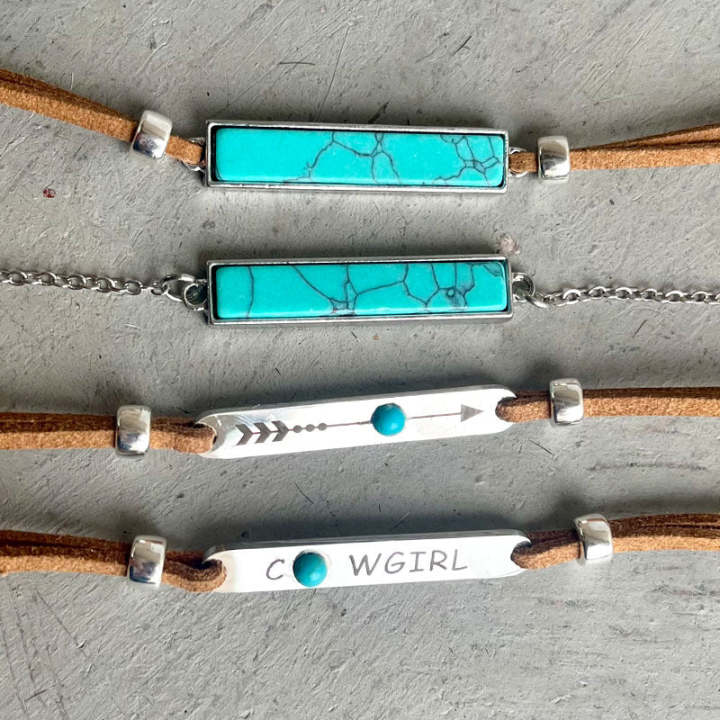
Question: Does a large gallery prove that every design is included?
No. Gallery positions show page media, not automatically package quantity. Match the selected radio or button label to the current main image and request an included-contents statement. Repeated or missing image numbers do not create product facts.
Question: What if critical information is missing?
Pause the decision. Ask the seller, choose a better-documented option, or keep the gift or outfit selection collaborative. A reversible next step is better than filling the card with guesses.
Live Example One: Western Turquoise Vintage Geometric Cross Necklace
The Western Turquoise Vintage Geometric Cross Necklace page was reviewed on August 24, 2026. It displayed $126.25 USD and three visible Size choices labeled Design 1, Design 3, and Design 4, with Design 1 selected. Product-image numbering extended through fifteen.
The current title and copy support Western, turquoise-colored, vintage-inspired, geometric, and cross-led visual language. The page suggests everyday, Western-inspired, occasion, and gifting contexts. Those are Style and Meaning inputs; they do not verify natural turquoise, metal, age, maker, origin, handmade production, cultural affiliation, dimensions, mass, closure, or care.
The missing Design 2 label in the visible sequence should not be interpreted. Record only the current selectable labels. For each Design, request the full Fit and Material record and confirm that the selected label matches the gallery view. The cross must also pass the wearer’s Meaning ticket.
Live Example Two: Turquoise Western Teardrop Pendant Necklace
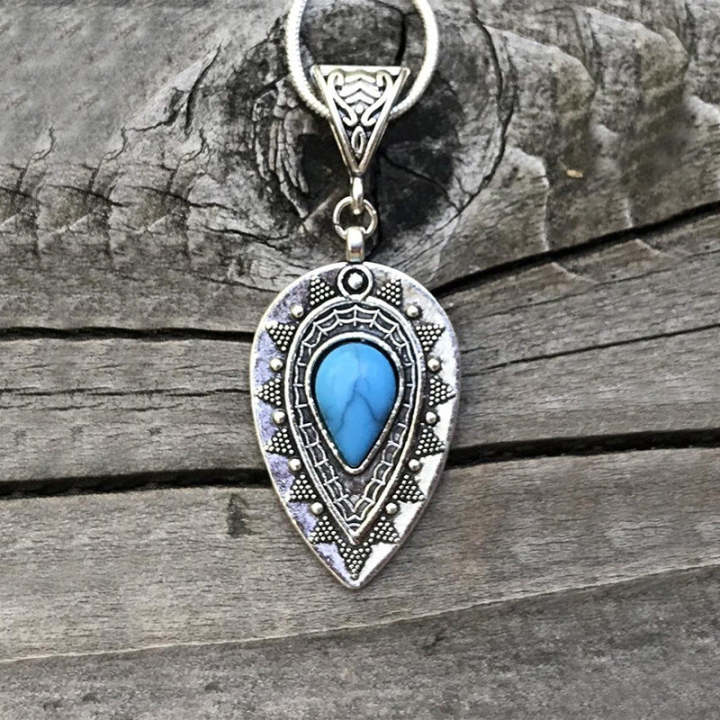
The Turquoise Western Teardrop Pendant Necklace page was reviewed on the same date. It displayed $39.99 USD, one visible Color radio, and product-image numbering through eleven. The page describes a Western pendant, vintage-inspired statement design, teardrop silhouette, turquoise-style center stone, and antique-silver color.
Those phrases give the Style ticket a teardrop center and vintage-inspired direction. They do not identify natural turquoise, silver, age, or exact construction. The visible page did not state wearable length, adjustment, pendant dimensions, mass, closure, or a complete option-specific component disclosure.
The Materials & Care panel says material details can vary by product option. It instructs shoppers to keep the jewelry dry, avoid direct contact with perfume or lotions, store it in a soft pouch when not worn, and review product images for the exact finish and design. Keep those instructions with this product page; do not turn them into a universal turquoise-care rule.
How to Use the Corresponding Video
The long-form video Turquoise Jewelry Guide | Everything You Need to Know About Turquoise comes from Turquoise Skies (T.Skies) Jewelry Gallery and was originally streamed. It is a category-education source, not evidence for either Oroxen necklace.
Route every video takeaway through the same triage desk. A general explanation can help you formulate a Material question. A demonstration can suggest what to inspect. A presenter’s attributed product can carry facts about that product. None of those automatically answers the Oroxen Fit, Material, Meaning, Event, or Purchase ticket. The description also links the presenter’s own commercial collections and cooperative, so keep its examples and commercial context visibly separate.
Twenty Rapid Questions, Routed Correctly
- Will it match my boots? Style; compare the full outfit.
- Where will it land? Fit; obtain exact measurements.
- Is it natural turquoise? Material; require product-specific disclosure.
- Is the metal silver? Material; document every component.
- Is it genuinely vintage? Material/provenance; require age evidence.
- Does the cross fit my beliefs? Meaning; the wearer decides.
- Is it culturally attributed? Meaning/material; require maker and origin documentation.
- Can I dance in it? Event plus Fit; run a safe movement test.
- Can it get wet? Material; follow exact care guidance.
- Can perfume touch it? Material; the teardrop page says avoid direct contact.
- Can I layer it? Style, Fit, and Material; map both pieces.
- Is the pendant heavy? Fit; request mass.
- What closure does it use? Fit/Material; request the exact mechanism and components.
- Which Design arrives? Purchase; select and document the option.
- Are all gallery pieces included? Purchase; require an included-contents statement.
- Will it arrive before the show? Purchase; verify the current destination-specific schedule.
- Can I return it? Purchase; read the current terms and deadline.
- Is it safe for my sensitivity? Material; require a complete skin-contact disclosure.
- Should it lead the outfit? Style; rank focal points at full-body distance.
- Should I remove it? Event; stop when rules, safety, comfort, or evidence require it.
When One Ticket Changes Another
The lanes are separate, but their answers must be handed off. Suppose the Style ticket chooses a low pendant over a plain concert shirt. The Fit ticket then discovers that the wearing length is unknown, so the desired endpoint is not established. That blank creates a Purchase stop condition: request the measurement before ordering. If the seller supplies a length, return it to Style and test a measured cord over the real garment.
A Material answer can also change Event. If documented care requires the piece to remain dry and the venue forecast includes rain, the Event response may be secure storage or a different necklace. A Meaning answer can change the shortlist before price is considered. A venue restriction can end the entire route even when the necklace passes every appearance test.
Write each handoff as a short sentence: “Fit cannot proceed until Purchase supplies length,” or “Event requires Material care guidance.” This prevents a later reader from seeing several completed fields and overlooking the one unresolved fact that controls the decision. The goal is not to fill every box for its own sake; it is to know which answer makes the next safe and reversible action possible.
Where to Explore Next
Use the Western Necklaces collection to discover current necklace silhouettes and the Western Jewelry collection to compare the necklace with earrings, bracelets, rings, and other categories. Collections belong to the Style lane. Every shortlisted item still needs its own Fit, Material, Meaning, Event, and Purchase tickets.
Final Answer from the Triage Desk
A turquoise necklace is ready for a country-music fan only when the right people and evidence have answered the right questions. The observer can describe shape and color. Measurements can establish placement. The seller or maker can document components and treatment. The wearer decides symbolism. The venue governs the event. The live page governs current option and purchase details.
Return to the Oroxen homepage for current navigation, open the exact listing, and keep unresolved questions visible. A careful “not established yet” is more useful than a confident answer from the wrong lane.