Boho Turquoise Jewelry in a Capsule Wardrobe for Country-Music Fans
A capsule wardrobe is often described as a small group of clothes that mix easily. That definition is incomplete when jewelry matters. An earring, ring, necklace, bracelet, or coordinated set can change the hierarchy of the same shirt and jeans more decisively than another neutral top. For a country-music fan, boho turquoise-colored jewelry can provide that change, but only if every piece has a defined job instead of appearing in every outfit by default.
This guide builds a capsule rotation matrix. The matrix assigns garments to repeatable wardrobe roles, jewelry to visual zones, and each outfit to a specific intensity level. It also keeps product evidence separate from styling observation. Words such as turquoise, boho, Western, vintage, floral, geometric, or cow skull can describe an appearance; they do not by themselves prove gemstone identity, metal composition, age, maker, origin, cultural attribution, or construction.
Quick Answer: Give Every Piece One Repeatable Job
Start with four garment roles: a quiet base, a denim layer, a textured Western-inspired layer, and an event layer. Add two footwear roles, one bag role, and one optional hat role. Then create four jewelry zones: ears, neck, hands, and wrists. In most outfits, assign only one zone as the leader. Supporting zones should be quieter, absent, or deliberately separated so the look does not become a catalog of unrelated motifs.
The capsule succeeds when a piece can be named by function: “focal earrings for a quiet neckline,” “coordinated set used as separately verified components,” or “single hand accent for a concert outfit.” It fails when the explanation is only “it matches turquoise.” Repetition is useful when it reinforces a role. Repetition becomes clutter when the earrings, necklace, rings, buckle, bag, and boots all demand first attention.
Use the Turquoise Jewelry Guides hub for broader education. The method here is specifically about obtaining more outfit combinations from fewer, clearly assigned objects.
Build a Twelve-Slot Country-Music Capsule
A practical starting board contains twelve slots. These are roles rather than mandatory purchases, and a single garment can sometimes serve two roles.
- Light quiet base: a cream, white, or another low-detail top that leaves room near the face and neckline.
- Dark quiet base: a black, charcoal, or deep neutral top that changes the contrast behind turquoise color.
- Denim layer: a jacket, shirt, or vest with known collar and seam behavior.
- Texture layer: suede-like, leather-like, knit, fringe, embroidered, or patterned clothing used selectively.
- One-piece option: a simple dress or jumpsuit that creates a continuous field for jewelry.
- Country-music event option: the outfit tested for seating, standing, crowd movement, weather, and current venue rules.
- Everyday footwear: comfortable shoes or boots that do not need to repeat every jewelry detail.
- Event footwear: selected for the real surface, duration, and activity.
- Working bag: chosen with its strap path in mind so it does not interfere with earrings or necklaces.
- Optional hat: included only after brim, band, hair, earrings, and face-framing details have been considered together.
- Jewelry focal A: one earring-led direction.
- Jewelry focal B: one coordinated or multi-component direction whose exact contents are documented.
The goal is not to own exactly twelve objects. It is to prevent duplicate purchases that perform the same narrow job while leaving another useful role empty. The published guide to Western jewelry with denim, dresses, boots, and workwear offers additional garment-specific ideas for these slots.
Create Three Intensity Columns
Draw three columns beside the wardrobe board: Quiet, Accent, and Focal. Quiet outfits emphasize clothing function and use little or no jewelry. Accent outfits add a controlled color or shape without dominating the face or torso. Focal outfits deliberately give one jewelry zone the first visual claim.
Place each item in a column only after viewing it with the real outfit at full-body distance. Product photographs are valuable for appearance but cannot determine the final hierarchy because the wearer’s face, hair, body, garments, hat, buckle, lighting, and movement are absent. A large earring may read as an Accent under long hair and as Focal with hair pulled back. A three-piece selection may fill multiple zones and therefore requires more restraint elsewhere.
Keep a fourth label outside the columns: Unassigned. Use it when a piece lacks necessary dimensions, mass, closure, component, care, option, or included-contents information. Unassigned does not mean rejected. It means the capsule should not rely on an assumption.
Use a Four-Zone Jewelry Map
Ear zone
Earrings shape the space around the face and can interact with hair, hat brims, collars, scarves, and phone use. Record length, width, projection, mass, closure, pair quantity, and every skin-contact component. Test turning the head, putting on outerwear, and using a phone. Remove or change the piece if it catches, pulls, or needs repeated adjustment.
Neck zone
A necklace occupies the garment field between neckline and torso. It must have a verified wearing length, endpoint, pendant dimensions, and a clear relationship with buttons, embroidery, lapels, pockets, bag straps, and buckles. When earrings lead, the neck is often most useful as a quiet zone.
Hand zone
Rings share attention with sleeves, bracelets, bags, phones, instruments, and ordinary hand movement. The short video reviewed later shows how varied turquoise ring silhouettes can be within one display. The capsule lesson is visual, not factual: one hand can hold several competing shapes very quickly. Choose the hand’s role before adding quantity.
Wrist zone
Bracelets must work with cuffs, jacket sleeves, watches, bag handles, and the wearer’s activities. Verify circumference or internal dimensions, opening or closure, width, projection, mass, components, and care. A wrist accent should not be added merely because the ear or neck piece has a similar color.
The published Western jewelry motifs and materials overview can help identify visual vocabulary across these zones. Product identity, provenance, and cultural attribution still require exact evidence.
Rotation One: Quiet Base Plus Focal Earrings
This is the simplest use of an earring-led capsule. Choose a low-detail shirt, controlled neckline, and either no necklace or a very quiet neck zone. Decide whether the hat and buckle are supporting objects or whether one must be removed. The earrings should frame the face without fighting collar points, hair, or a busy yoke.
Use two full-outfit photographs: one without the earrings and one with them. Compare what the eye notices first, second, and third. If the earrings disappear, changing the hair or garment field may be more effective than adding more turquoise-colored pieces. If they dominate too strongly, reduce other face-framing details or move the earrings to the event column instead of the everyday column.
This rotation works across light and dark bases, which creates two outfits from one jewelry role. Add the denim layer for a third version only after checking the collar and seam relationship. The item earns its capsule place by producing genuinely different, usable combinations rather than by appearing in every photograph.
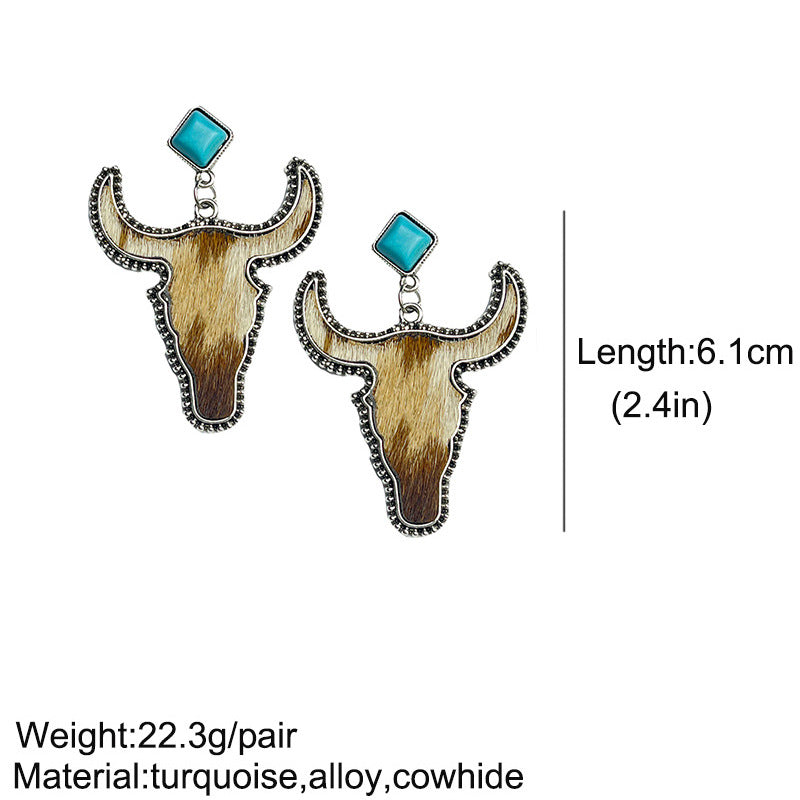
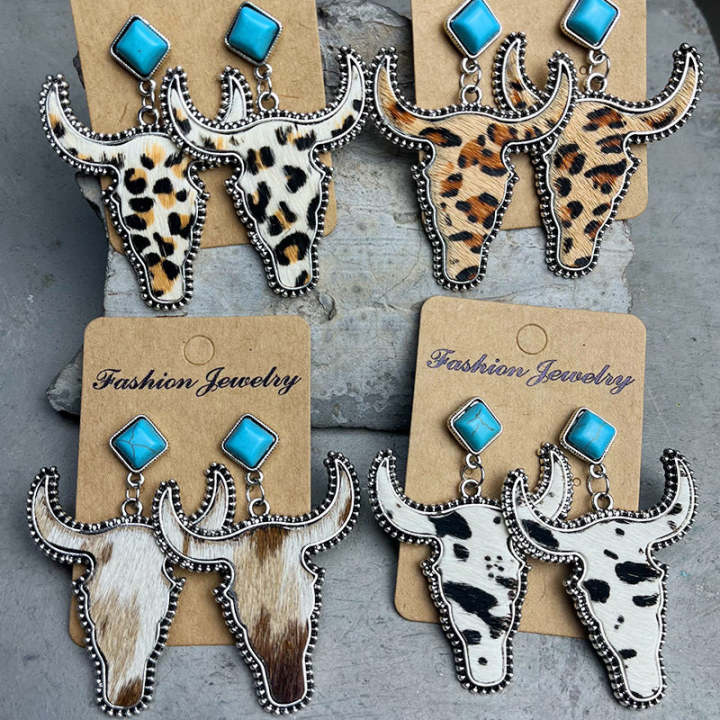
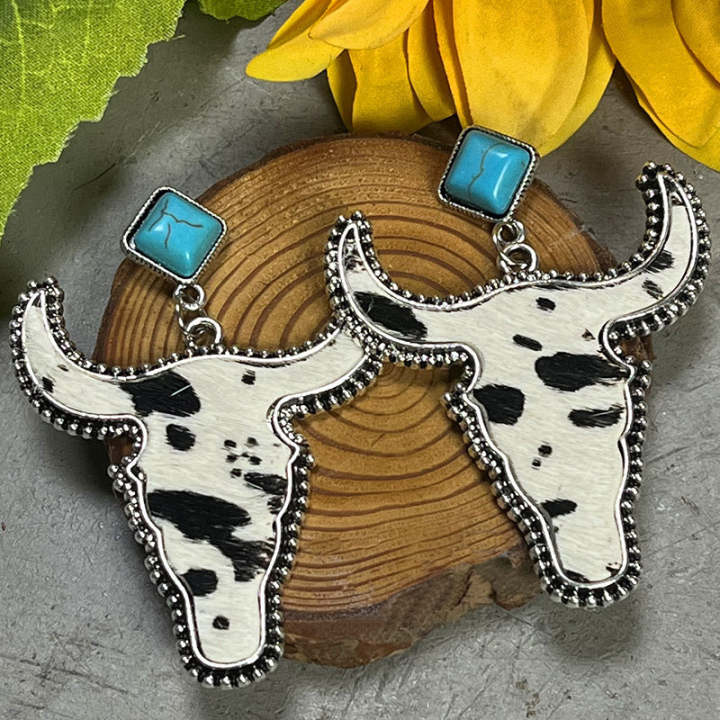
Live Example A: Western Turquoise Boho Vintage Cow Skull Earrings
The live Western Turquoise Boho Vintage Cow Skull Earrings page was reviewed on August 24, 2026. It displayed $141.40 USD. Four visible Size choices were labeled Design 1, Design 2, Design 3, and Design 4, with Design 1 selected. The gallery numbering extended through sixteen, with one number absent from the visible sequence.
The title and current copy support Western, turquoise-colored, boho, vintage-inspired, and cow-skull visual language. The page presents the earrings for everyday, Western-inspired, occasion, and gifting contexts. Those statements can place a selected Design provisionally in the ear-zone Accent or Focal column.
The visible page did not establish natural turquoise, metal composition, age, maker, origin, handmade production, cultural affiliation, earring dimensions, mass, closure, skin-contact components, or care. It also did not turn the sequence of gallery images into a promise that every pictured Design arrives. Record the selected Design, request the missing fit and component information, and confirm included quantity before relying on the pair for an event or gift.
Rotation Two: Multi-Component Direction Without Wearing Everything
A coordinated set can expand a capsule only when its components are documented and can be assigned separately. Do not assume that a product called a jewelry set contains a necklace, earrings, bracelet, ring, or any specific combination. Record the exact selected option and obtain an included-contents statement, component-level dimensions, closures, materials, care, and images.
Once the contents are confirmed, build three possible rotations rather than one overloaded look. Rotation A uses the strongest component alone. Rotation B uses two components separated across visual zones, provided they pass movement and comfort tests. Rotation C uses a quieter component with a patterned garment while leaving the other zones empty. The same purchase may therefore create several outfits without requiring every component to be worn simultaneously.
The capsule rule is simple: coordination is permission to compare, not an instruction to stack. A floral or geometric rhythm may repeat across components, but the wearer still decides how much repetition belongs in one outfit.
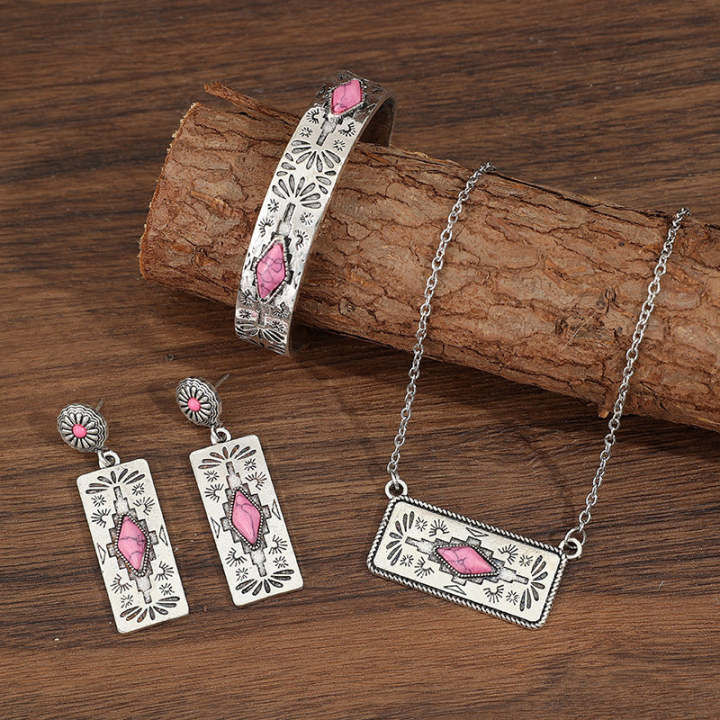
Live Example B: Turquoise Boho Vintage Geometric Floral Jewelry Set
The live Turquoise Boho Vintage Geometric Floral Jewelry Set page was reviewed on the same date. It displayed $116.15 USD. One visible Set radio was labeled Three-Piece Suit and was selected. Product-image numbering extended through ten.
The listing supports turquoise-colored, boho, vintage-inspired, geometric, and floral appearance language. It proposes casual, Western-inspired, occasion, and gifting use. The visible page did not state the exact three included components in text, their individual dimensions or masses, closures, materials, skin-contact components, care, treatment, maker, origin, or cultural attribution. A name such as Three-Piece Suit is an option label, not a full contents specification.
Keep this selection in the Unassigned column until the three components are identified for the exact option. Then give each component its own ear, neck, hand, or wrist record. The product can become a useful capsule multiplier only after the shopper knows what arrives and which pieces can be worn separately, comfortably, and consistently with their documented care.
A Nine-Outfit Rotation Matrix
Use three clothing rows and three jewelry columns. The clothing rows are Quiet Base, Denim Layer, and Event Layer. The jewelry columns are No Leader, Ear Leader, and Verified Set Component. That produces nine planning cells:
- Quiet Base with no jewelry leader.
- Quiet Base with the selected cow-skull earring Design.
- Quiet Base with one verified component from the set.
- Denim Layer with no jewelry leader.
- Denim Layer with the earrings after a collar and hair test.
- Denim Layer with a set component that has a clear garment field.
- Event Layer with no jewelry leader as the fallback.
- Event Layer with earrings after venue, duration, and movement review.
- Event Layer with one or two documented set components after collision and comfort testing.
The matrix exposes false variety. If six cells look nearly identical, the clothing roles may be too similar or the jewelry roles may not be distinct. It also exposes missing fallbacks. Every event row should include a simpler option in case weather, venue rules, comfort, or the final garment changes.
Use the Video as a Hand-Zone Lesson
The 10-minute-57-second video Turquoise in Rings comes from Turquoise in America. The presenter, Mike, displays a group of rings with varied stone arrangements, silhouettes, bands, and visual weight. The video’s description attributes the shown pieces within its own American Indian jewelry context.
The capsule takeaway is that a category label does not make objects visually interchangeable. A long oval, compact oval, clustered layout, wide band, rectangular face, and inlay-like arrangement occupy the hand differently. Assign the hand one job before adding quantity. The video does not verify anything about the two Oroxen products, and none of its statements about turquoise, metal, handwork, maker, culture, region, or origin transfer to the earrings or set.
Evidence Cards for Every Capsule Candidate
Create one card per selected option with the product title, current URL, option label, date reviewed, reference image, current displayed price, exact included contents, dimensions, mass, closure, materials, treatments, finish, care, maker and origin claims, availability, shipping expectation, and return information. Mark each entry as documented, observed, wearer preference, current policy, or unknown.
“Observed” can responsibly describe color, outline, and visible motif. It cannot identify a stone or metal. “Wearer preference” can decide whether cow-skull, floral, geometric, or another motif belongs in the person’s wardrobe. “Current policy” covers venue and time-sensitive purchase information. “Unknown” protects the capsule from being built on an unsupported fact.
The published Western turquoise jewelry selection guide provides a broader question bank. Use it to improve the card, not to fill blanks for another product.
Country-Music Event Rotation
Convert one everyday cell into an event cell by adding real conditions. Verify current venue rules, entry procedures, seating or standing time, crowd density, weather, outerwear, travel, bag limits, storage, and any activity before or after the show. Rehearse walking, sitting, turning the head, using a phone, lifting the bag, and putting on the jacket.
If earrings lead, check hair, hat brim, collar, scarf, and phone contact. If a set component occupies the neck or wrist, check its path against the jacket, bag, buckle, watch, and cuffs. Stop if an item catches, pulls, pinches, irritates, strikes another hard object, or requires repeated correction. The published country-concert jewelry guide expands this practical rehearsal.
Five Capsule Mistakes That Create More Clothes, Not More Outfits
Buying duplicate visual jobs
Two pieces can look different in a close crop yet perform the same focal role with every garment. Test the candidate against the matrix before purchasing. A useful addition should open a missing cell or perform an existing job more comfortably, clearly, or appropriately.
Making turquoise color the only connection
Color is one relationship. Scale, silhouette, texture, line, motif, finish, garment architecture, and visual distance also matter. Exact color matching across many items can make the capsule less flexible.
Treating a set as one permanent outfit
A set can become three role cards only when its contents and specifications are known. Wearing every component at once may reduce, not increase, outfit variety.
Ignoring empty zones
Negative space is an active capsule tool. An empty neck can make earrings readable. An empty hand can give a bracelet or bag hardware room. “No jewelry leader” is a valid matrix column.
Using future plans as current evidence
A product title, queue outline, article idea, or old screenshot cannot replace the live selected option. Reopen the page before purchase or publication because price, availability, choices, shipping, and return information can change.
Capsule Questions Worth Answering
How many turquoise-colored pieces belong in the capsule?
There is no universal number. Count distinct jobs rather than objects. One ear-zone focal, one neck or set-component accent, and one hand-zone option may create more variety than six pieces competing for the same role.
Can the cow-skull earrings be everyday jewelry?
The page proposes everyday use, but the selected Design still needs dimensions, mass, closure, component, comfort, and care information. The wearer must also decide whether the motif fits their daily settings and preferences.
Does Three-Piece Suit mean the pictured three items are included?
The option label alone does not identify each component. Request a written included-contents statement tied to the exact selected option, then compare it with the current gallery.
Should jewelry match the hat band or buckle?
It may relate through one color, line, or motif, but matching is not required. First establish the outfit leader and check physical interaction. A coordinated pendant and buckle can still collide; earrings can still compete with a detailed hat.
What makes a capsule purchase responsible?
The item fills a defined role, the exact option is documented, essential fit and component questions are answered, the wearer accepts its meaning, the piece passes a gentle outfit rehearsal, and the current purchase terms suit the plan.
Explore Without Losing the Matrix
Browse the Turquoise Jewelry collection to compare current turquoise-colored categories and the Western Jewelry collection to evaluate a wider mix of motifs and forms. Keep every candidate in Unassigned until its exact option and role are clear. Collections support discovery; they do not supply product-specific evidence.
Final Capsule Rule
Boho turquoise-colored jewelry earns a place in a country-music capsule when it opens useful outfit cells, has a named visual zone, works with the actual garments, and carries product evidence strong enough for the wearer’s decision. The capsule becomes smaller and more expressive when pieces rotate by role rather than accumulate by color.
Return to the Oroxen homepage for current navigation and live listings. Keep the matrix close: one leader, deliberate quiet zones, verified options, and a practical fallback can turn a limited wardrobe into a broad set of distinct looks.