dA white shirt and blue jeans make an unusually useful testing ground for turquoise-colored bracelets. The clothing is familiar, the color story is restrained, and the wrist sits far enough from the face to carry detail without automatically dominating the wearer. Yet a “simple” outfit can still go wrong when a bracelet catches a cuff, rotates constantly, competes with a watch, or is assumed to contain materials that the seller has not documented.
This checklist turns the outfit into a practical fitting session. It compares the Turquoise Western Cuff Bracelet Set with the Turquoise Boho Vintage Bracelet for Women. Product names and photographs describe visible style; they do not by themselves verify natural turquoise, metal identity, treatment, age, maker, origin, handmade status, or cultural affiliation.
Quick Answer: Use a Three-Pass Bracelet Check
Build the look in three passes. First, establish function: choose a sleeve position, decide whether a watch stays, and test the bracelet through ordinary hand movements. Second, establish hierarchy: select one lead wrist element and keep every other accessory quieter. Third, establish evidence: verify the exact selected option, dimensions, opening or closure, components, care guidance, and return terms before buying.
The short version is simple: roll or place the shirt cuff deliberately, add one bracelet arrangement, photograph it from standing distance, and live with it for at least twenty minutes. If you keep adjusting it, if it collides with a desk or watch, or if the cuff hides the feature you wanted to show, revise the arrangement. The broader Turquoise Jewelry Guides hub can support later decisions without turning this first outfit into a full jewelry overhaul.
Checklist 1: Establish the Outfit Before the Bracelet
Put on the actual white shirt and jeans you intend to wear. “White shirt” can mean a crisp poplin button-down, a soft linen blouse, an Oxford shirt, a fitted tee, or an oversized cotton layer. Each sleeve behaves differently. A narrow, structured cuff creates a firm boundary near the wrist. A loose sleeve may drift over a bracelet. A rolled sleeve exposes more forearm and gives a broad cuff or stack more visual room.
- Check whether the shirt is bright white, cream, or weathered white.
- Note whether the denim is pale, mid-wash, dark, distressed, or nearly black.
- Choose tucked, half-tucked, belted, or untucked before judging jewelry.
- Decide whether sleeves remain down, fold once, or roll above the forearm.
- Place the usual watch, fitness tracker, or medical device before adding decoration.
This order prevents an attractive bracelet photograph from becoming an impractical real outfit. It also gives the turquoise-colored accent a job: bridge the cool denim and clean shirt, create a deliberate Western note, or supply the only strong color.
Checklist 2: Choose a Lead Wrist and a Lead Shape
Bracelet styling becomes clearer when one wrist leads. The lead wrist can carry the most visible cuff, the densest stack, or the strongest color. The other wrist can stay bare, hold a watch, or carry one restrained piece. Symmetry is optional. In fact, a white shirt and jeans often looks more relaxed when the wrists are related but not mirrored.
Use the product silhouette—not an imagined category—to make the decision. An open cuff may create a broad horizontal band. A narrower bracelet may contribute rhythm or texture. Multiple pieces may act like one composed unit when their spacing is controlled. For a deeper discussion of visual mass, see the proportion and balance guide for turquoise bracelets.
| Outfit condition | Useful first test | What to watch |
|---|---|---|
| Sleeve fully down | One piece below the cuff | Snagging, overlap, hidden details |
| Sleeve rolled once | One focal cuff or two-piece stack | Gap between fabric and jewelry |
| Sleeve above forearm | Broader stack with breathing room | Rotation and overall visual weight |
| Watch required | Bracelet on opposite wrist | Collision, scratches, device comfort |
Checklist 3: Browse a Collection with a Specific Assignment
Do not browse every bracelet as if every item serves the same purpose. Open the Western Bracelets collection with a written assignment such as “one wrist focal point for dark jeans and rolled sleeves” or “a quieter turquoise-colored accent for an office outfit.” Compare visible outline, color distribution, number of components, and the likely relationship to your sleeve.
A collection thumbnail is a discovery aid, not a specification sheet. Open the exact product page and check the selected option. If numerical dimensions, mass, base components, surface finish, opening size, adjustability, construction, or care instructions are absent, ask before ordering when those details affect comfort, allergies, durability, or price. Do not infer stone identity or metal content from color.
Checklist 4: Test the Turquoise Western Cuff Bracelet Set
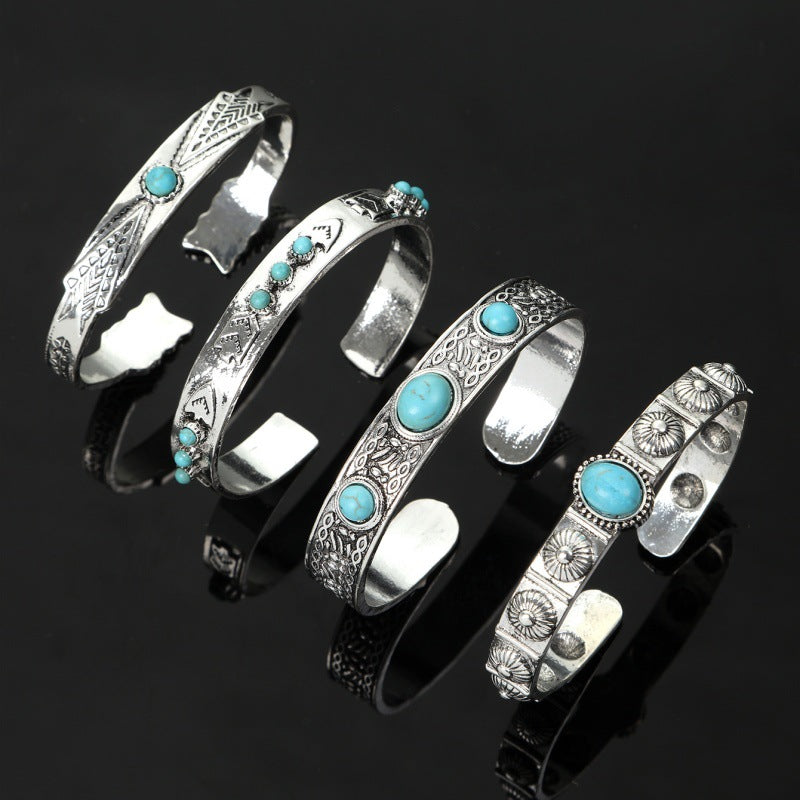
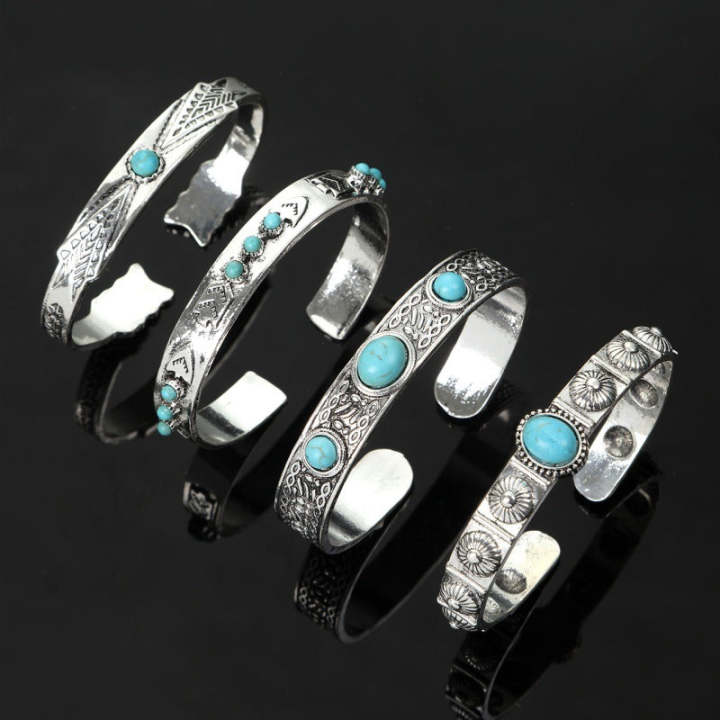
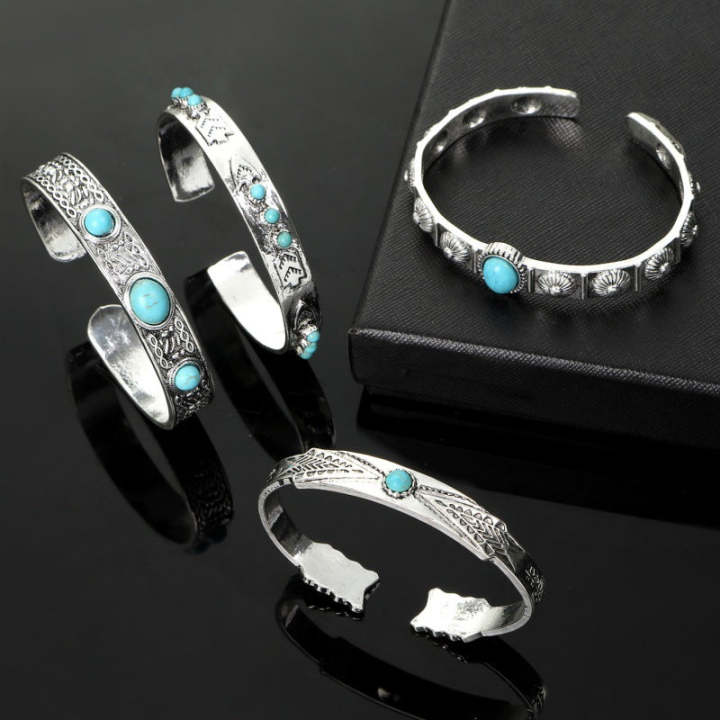
During the latest page review, the Turquoise Western Cuff Bracelet Set displayed a price of $34.99 USD and a checked “4Set” option. The visible description called it a set of four open cuff bracelets with turquoise-colored accents and varied vintage-inspired motifs, intended to be worn together or individually. Price and availability can change, so treat the live product page and selected option as authoritative at checkout.
The page did not visibly provide exact inside dimensions, opening width, individual or total mass, complete component disclosure, finish, construction method, adjustability range, or detailed care. An open-cuff description should not be converted into a promise that every wrist can bend or resize it safely. Ask how the item is intended to be fitted and whether repeated flexing is permitted.
Run four separate outfit tests rather than immediately wearing all four pieces:
- Wear one cuff with sleeves down and record whether the fabric catches.
- Roll the sleeve once and place two cuffs with a narrow visible gap.
- Try the complete set on one wrist while keeping the other wrist quiet.
- Split the arrangement only if the individual pieces remain comfortable and visually intentional.
Photograph each version with arms relaxed. A wrist held close to the camera exaggerates jewelry scale; a full-outfit photograph reveals whether the stack supports the white-shirt-and-jeans column or looks disconnected from it.
Checklist 5: Build a Casual Formula
For a casual formula, start with a soft white shirt, mid-wash straight jeans, and brown or neutral footwear. Roll the sleeve enough to leave a deliberate band of skin between fabric and bracelet. Try one turquoise-colored cuff or a compact two-piece arrangement on the lead wrist. Add either small earrings or a quiet ring—not both by default—and reassess.
The bracelet should be visible during normal movement without requiring a theatrical pose. If the hand already carries a large ring, decorated belt, prominent bag hardware, and a watch, remove one element before adding more. Repetition works best when it is selective: a small echo of blue-green or aged-looking texture is enough. Exact color matching can make the outfit feel packaged rather than personal.
Checklist 6: Compare the Seven Visible Bracelet Options
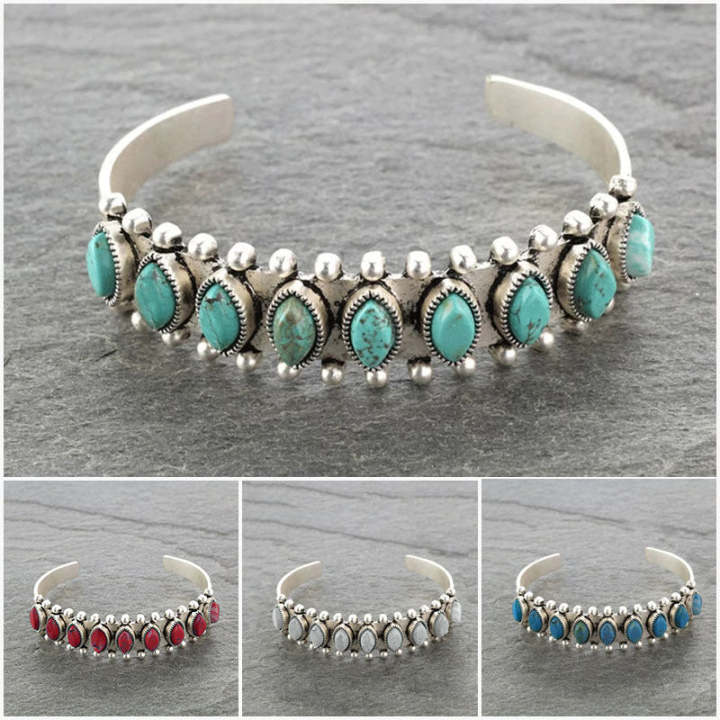
The Turquoise Boho Vintage Bracelet for Women page displayed $90.90 USD and seven visible selections labeled Bracelet 1 through Bracelet 7 during review. Its description emphasized turquoise, boho, and vintage styling for casual, Western-inspired, occasion, and gift contexts. The option labels indicate choices, not seven interchangeable sizes, and the selected option must be rechecked before purchase.
The visible page did not clearly state each option's exact dimensions, mass, closure or opening, fit range, full components, finish, construction, or care. Because the gallery contains many images, map the selected label to the correct image before comparing. Do not assume that facts visible for one option apply to all seven.
Use a two-column note: “what I can observe” and “what I must verify.” You may observe relative width, turquoise-colored areas, visible motif density, and how a photographed piece sits on the wrist. You must verify numerical fit, skin-contact components, treatment or composition claims, and any care limitation that matters to your use.
Checklist 7: Make a Dressier White-Shirt Formula
For a dressier version, use a crisp white shirt, dark straight or wide-leg jeans, a clean belt, and polished boots or loafers. Keep the shirt front and neckline quiet. Choose one bracelet with the clearest outline, roll the sleeve precisely, and leave the opposite wrist bare or limited to a slim watch. This turns the wrist into a controlled accent rather than one element in a costume.
If the bracelet is visually broad, reduce necklace scale. If the bracelet is narrow and rhythmic, a modest pendant may coexist with it. The decision is made from the full silhouette, not from a flat lay. A phone photograph at conversation distance is more useful than a close-up because it includes the cuff, hand, belt, and neckline in one frame.
Checklist 8: Use a Video for Technique, Not Product Claims
Glamour's short YouTube video “Jennifer Fisher Shows Her Stacking Bracelets Secrets” introduces the visual idea of layering cuffs, bangles, and other bracelet shapes and mixing metal colors. That general styling demonstration is useful here because it shows that a stack can gain interest from variation rather than from identical pieces.
The transferable lesson is to compose the wrist deliberately. Change one variable at a time—width, spacing, texture, or color—while keeping a lead element. The video does not identify, fit, or test Oroxen products, and it should not be used as evidence for their materials, durability, adjustability, or care. Those facts must come from the exact product listing or direct seller confirmation.
Checklist 9: Run a Twenty-Minute Movement Test
A bracelet can look balanced while the wearer stands still and become irritating during ordinary tasks. Wear the planned arrangement for twenty minutes at home. Type, hold a phone, fasten a bag, put on a jacket, wash hands without immersing the jewelry, and rest the wrist on a table. Notice impact, rotation, pinching, pressure, sound, snagging, and the urge to adjust it.
Remove the piece if it causes pain, numbness, swelling, broken skin, or a suspected reaction. A fashion guide cannot diagnose a medical problem or guarantee skin compatibility. If a watch or device must remain on the same wrist, prevent metal-on-metal collision and follow the device manufacturer's clearance and safety guidance.
Checklist 10: Correct the Five Most Common Styling Errors
Error 1: Treating Every Piece as the Focal Point
A large belt buckle, decorated boots, strong earrings, a necklace, rings, and a bracelet stack can each be attractive, but they do not all need maximum contrast at once. Choose the wrist as the lead zone, then reduce at least two competing zones.
Error 2: Hiding the Bracelet Under an Accidental Sleeve
If a soft cuff repeatedly falls over the jewelry, either roll it securely or select a slimmer arrangement. Do not spend an event pulling the sleeve back for the sake of the original styling plan.
Error 3: Assuming “Turquoise” Proves Composition
Color, a title, or a patterned component cannot establish natural stone identity. Avoid scratch, heat, solvent, acetone, or other destructive home tests. Request current option-specific disclosure and suitable documentation when composition affects the decision.
Error 4: Flexing an Open Cuff Repeatedly
Do not assume an opening authorizes repeated bending. Confirm the intended fitting method. Excess force can deform or damage an unidentified construction.
Error 5: Building the Stack Only in a Close-Up
A wrist close-up hides the rest of the outfit. Check a full-length photograph, a waist-up image, and a functional movement test. The same approach used in the costume turquoise jewelry and denim guide helps separate an attractive detail from a coherent total look.
Checklist 11: Verify Before Purchase, Wear, or Care
- Reopen the exact product page and confirm the selected option, displayed price, and availability.
- Request inside dimensions, opening or closure details, mass, and intended fit method.
- Request complete skin-contact and decorative components, finish, and construction facts.
- Ask whether “turquoise” describes color, style, or a documented material.
- Obtain option-specific care instructions; do not improvise with chemicals or abrasion.
- Review current shipping, return, and exchange terms before ordering.
- Save the seller's written answers with the order record.
If gifting, do not guess wrist size, sensitivities, symbolic preferences, or whether the recipient wears open cuffs. A shared shortlist or return-friendly plan is usually more considerate than a surprise based solely on a photograph.
Frequently Asked Questions
How should a beginner choose turquoise jewelry bracelets?
Begin with the wearer's actual sleeve, wrist routine, device use, and desired visual role. Compare one focal option with one quieter option, then verify fit and components. A category label is a search aid, not a substitute for specifications.
Can a man use the same white-shirt-and-jeans checklist?
Yes. The method is based on proportion, movement, comfort, preference, and verified product facts rather than gender. Adjust sleeve, wrist scale, watch placement, and accessory hierarchy for the individual.
Which occasions suit this outfit?
The combination can move from casual errands to a social dinner by changing shirt structure, denim wash, footwear, belt, and bracelet density. Workplaces, riding, food service, childcare, machinery, sport, and uniforms may impose safety or dress requirements that take priority.
How can two options be compared without unsupported claims?
Compare visible silhouette and documented listing facts in separate columns. Mark missing dimensions, mass, components, finish, construction, fit, and care as unknown instead of filling gaps from photographs or general jewelry knowledge.
What should readers explore next?
Use the seasonal white-shirt-and-jeans jewelry guide to adapt the base outfit, then browse the Western Jewelry collection only after assigning each accessory a role.
Final Check: One Outfit, One Wrist Plan, One Evidence Trail
The most dependable white-shirt-and-jeans bracelet look is not the one with the greatest number of pieces. It is the one that survives the sleeve test, the full-outfit photograph, ordinary movement, and a fact check. Establish the clothing first, choose a lead wrist, compare one piece with a controlled stack, and reduce anything that competes.
Begin at Oroxen, keep the exact option visible as you compare, and save unanswered questions before checkout. The result should feel easy on the wearer and honest about what is known: a turquoise-colored Western accent selected through observation, comfort, proportion, and verified information.