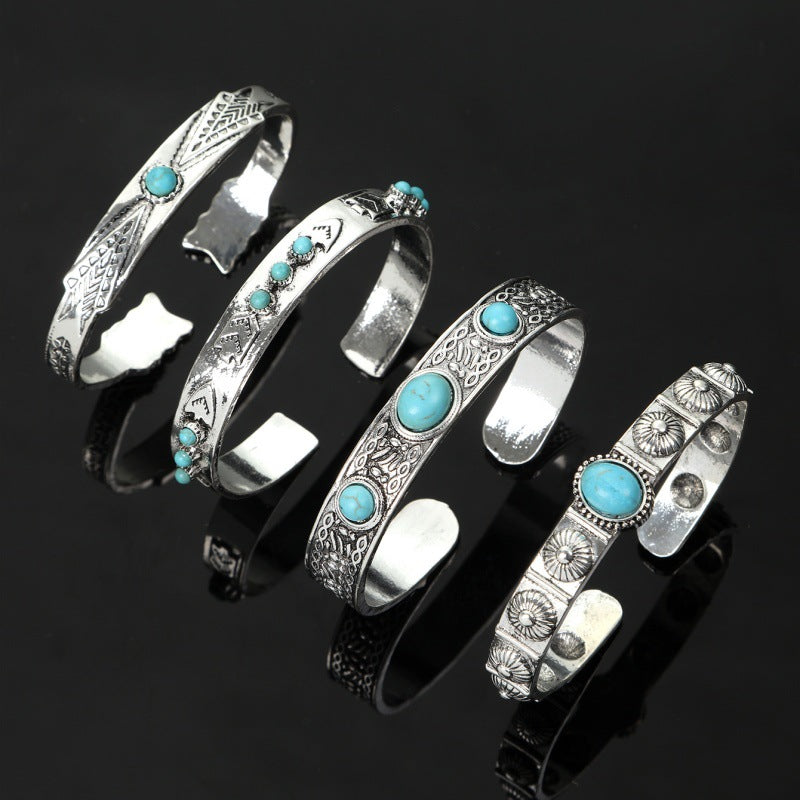
A turquoise-colored bracelet changes a white-shirt-and-jeans outfit at the point where the body is most active: the wrist. That position moves through pockets, buttons, cuffs, bags, desks, doors, phones, and gestures. Good proportion therefore cannot be judged from a motionless close-up. It has to survive the complete path of the hand.
This guide compares the Turquoise Western Cuff Bracelet Set and the Turquoise Boho Vintage Crystal Bracelet. Their titles and photographs indicate a turquoise-colored, Western, boho, vintage-inspired, or crystal-themed appearance. Those words do not independently establish a natural stone, crystal composition, metal, age, treatment, maker, geographic source, construction, or cultural connection.
Quick Answer: Design a Sleeve Window Around the Wrist
The sleeve window is the visible interval between the shirt cuff and the bracelet. A narrow interval creates a dense, connected wrist line. A wider interval separates clothing from jewelry and makes the bracelet easier to read. Neither is universally correct. The useful window is the one that preserves movement, prevents rubbing, and supports the intended visual weight.
- Choose the exact shirt and jeans first.
- Mark where the sleeve ends with the arm relaxed.
- Confirm the bracelet's verified wearable dimensions and profile.
- Test one bracelet on a bare wrist before building a stack.
- Photograph the hand at the side, in a pocket, at a table, and holding a bag.
- Adjust the sleeve, not an unverified rigid cuff.
Proportion succeeds when the wrist looks intentional in every common position and the jewelry remains comfortable.
Map the Wrist as Three Moving Tracks
Divide the visible wrist area into three tracks. Track One sits closest to the hand and encounters the most bending. Track Two is the central visual area. Track Three approaches the sleeve and is most likely to contact fabric. The boundaries change as the wrist flexes, so the map is a practical observation tool rather than a fixed anatomical measurement.
A single bracelet can occupy one track. Multiple cuffs can occupy adjacent tracks only after their edges, movement, fit, and permitted contact are understood. A watch creates its own track and should not be treated as invisible. If two items strike, overlap, pinch, or transfer finish, separate them or move one to the other wrist.
The public Western bracelet fit and stacking guide gives a broader process for wrist measurement and comfort checks.
Measure Visual Width Without Pretending It Is Physical Fit
Visual width is the amount of attention the bracelet occupies in a photograph. Physical fit is the relationship between the product's verified interior measurements and the wearer. A broad-looking design can be physically light; a narrow-looking design can still be heavy or rigid. Never substitute an image impression for internal dimensions, opening, closure, adjustment method, thickness, profile, or mass.
For a styling mock-up, cut a strip of plain paper to the apparent width shown by a confirmed scale reference only. Label it “visual estimate—not fit.” Place it at the wrist to compare sleeve spacing and overall outfit balance. Do not use the mock-up to order a size or force an actual cuff.
Balance the White Shirt Above the Wrist
Buttoned cuff
A closed cuff makes a crisp border. The bracelet can sit below it when verified fit and movement allow, but test whether the shirt button or seam strikes the jewelry. A broad cuff plus a broad bracelet creates a compact block; quieter denim and accessories may be needed elsewhere.
Single roll
One even roll exposes the wrist while preserving shirt structure. Keep the roll width consistent on both arms unless deliberate asymmetry is part of the outfit. Check that the folded fabric does not slide into an open cuff during use.
Soft push-up
A pushed sleeve can create relaxed proportion, but it changes position throughout the day. Test after reaching overhead and bending the elbow. If fabric repeatedly drops onto the bracelet, choose another sleeve treatment rather than assuming the jewelry will stay isolated.
For a separate jacket-based system, see the public guide to turquoise jewelry with a denim jacket.
Let the Jeans Supply a Stable Counterweight
The bracelet sits far from the jeans while the arms are raised, but it overlaps the denim field when the hands rest beside the body or enter pockets. This makes pocket stitching, distressing, rivets, belt hardware, and wash contrast part of the wrist composition.
If the bracelet is visually broad or multi-piece, use cleaner denim to keep the lower overlap readable. If the bracelet is compact, moderate denim texture may provide balance. Check the actual full-body photograph; do not apply a universal rule based only on product category.
A belt can act as a horizontal competitor. Large buckles and bright hardware may share the same visual height as the hands. When that happens, decide whether the wrist or waist leads. Two equal accents can work, but they should look intentional from normal viewing distance.
Product Path One: Four Cuffs, Five Starting Widths
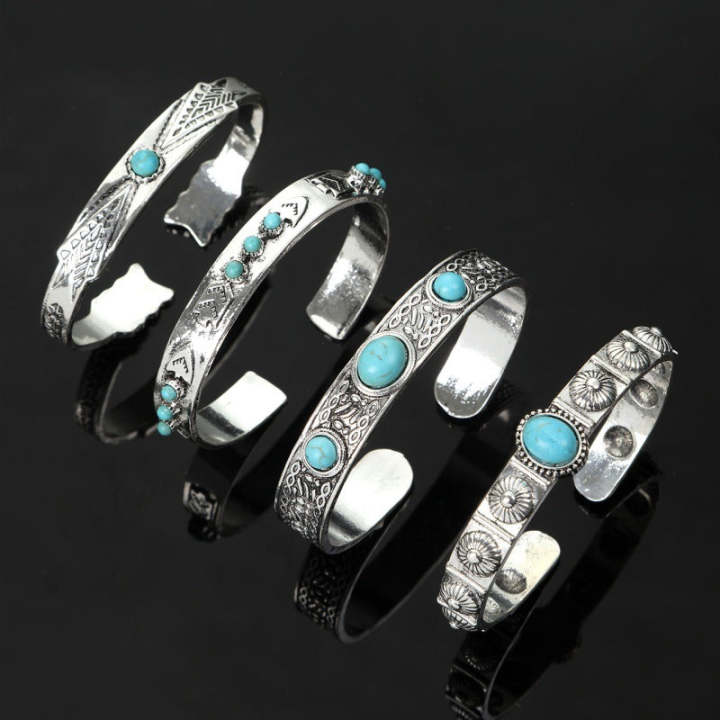
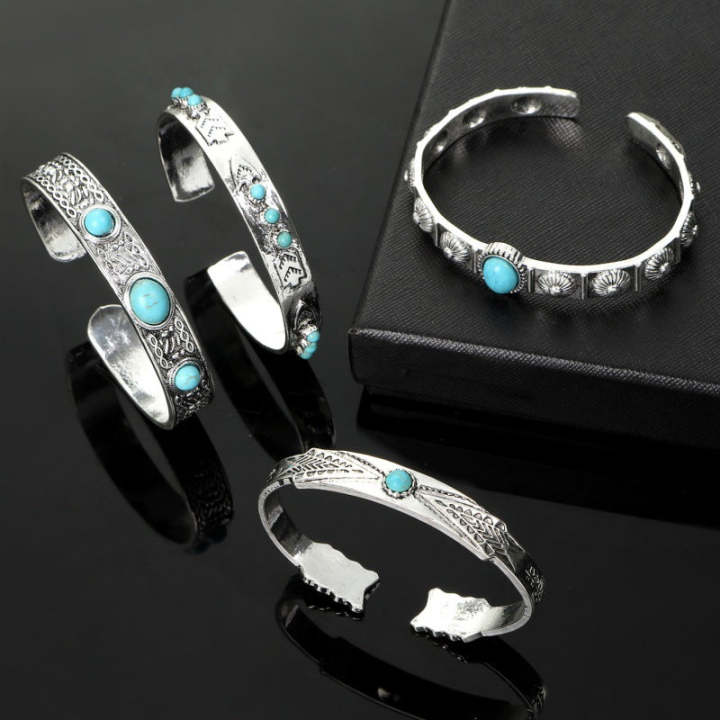
The current cuff-set page identifies a 4Set and describes four open cuffs with turquoise-colored accents and varied vintage-inspired motifs. It says the pieces may be worn individually or together. That provides five obvious starting widths: each of the four cuffs alone, plus the full set as a visual category. Many two- and three-piece combinations are also imaginable, but more combinations do not automatically create better outfits.
The visible page information did not clearly state individual internal dimensions, opening width, permitted adjustment, band width, thickness, profile, mass, components, surface finish, assembly, or care. A set label is not a fit specification. Ask for a component-by-component record and confirm whether adjacent wear is suitable.
Begin with the quietest single cuff as judged from the exact mapped image. Assign it to Track Two and photograph four hand positions. Then repeat with the next cuff. Only after individual tests pass should two cuffs be considered together. Leave a visible interval if their edges or motifs need separation, and stop any pairing that knocks or traps the shirt cuff.
Build a Combination Ladder Instead of Wearing All Four
Create a six-step ladder: one quiet cuff, one stronger cuff, two separated cuffs, two adjacent cuffs if approved, three cuffs, and the complete set. Photograph each step with the same sleeve and arm position. Score clarity, comfort, collision, shirt contact, and repetition.
The right stopping point is the first step that delivers the intended wrist presence without introducing an equal or greater problem. A two-cuff result can be more balanced than the full set. Modularity is valuable because it permits editing, not because it obligates maximum use.
Product Path Two: One Bracelet as a Fixed Wrist Sentence
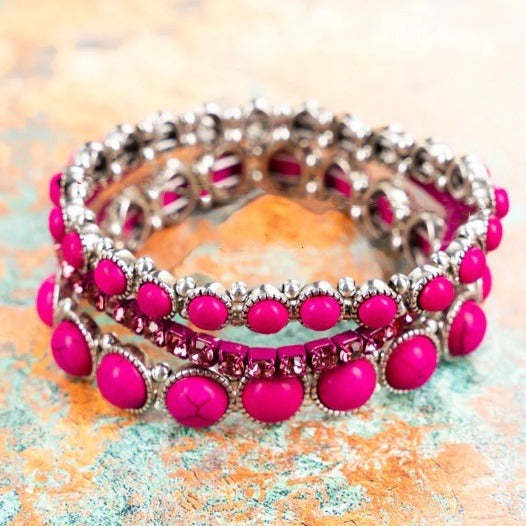
The current crystal-bracelet page shows a visible color selection and uses turquoise, boho, vintage, and crystal terminology. The visible summary did not clearly disclose wrist fit, length or internal measurement, adjustment, fastening, width, depth, weight, full composition, crystal identity, finish, construction, or care.
Do not assume that crystal identifies mineral crystal, glass, resin, or another substance. Do not infer natural turquoise from the color or title. Request a description of every decorative and skin-contact component and the correct maintenance limits for the exact selection.
A single bracelet simplifies visual proportion because it occupies one continuous zone. It can sit as the only wrist accent on the hand that appears most often in gestures, or on the opposite hand from a watch. Test both options. Dominant-hand placement may increase visibility and contact; non-dominant placement may reduce some actions but increase watch conflict.
Run an Eight-Object Contact Circuit
Wrist jewelry interacts with ordinary objects more often than earrings or a pendant. Use a controlled circuit with the objects the wearer actually handles:
- shirt button and cuff seam;
- jeans pocket edge and rivet;
- phone and charging cable;
- keyboard, mouse, or writing surface;
- bag handle and zipper;
- door handle or cabinet pull;
- seat belt and coat sleeve;
- storage pouch or compartment.
Observe without deliberately striking or stressing the piece. Record catches, taps, rotation, pressure, abrasion, noise, or transfer. If the product's construction or care is unknown, keep the circuit conservative and request guidance before extended wear.
Use a Balance Grid for the Whole Outfit
Divide a full-body photograph into four zones: face and neckline, torso, waist and hips, hands and footwear. Mark the strongest accent in each zone. The bracelet can lead the hands zone without leading the entire outfit. Decide whether that is the goal.
If the wrist should be the primary focal point, reduce high-contrast earrings, necklaces, belts, bags, and shoes. If the bracelet is a supporting accent, allow one upper-body leader and keep the wrist compact. Balance is not identical weight in every zone; it is a readable order.
The public article on styling Western jewelry with denim, dresses, boots, and workwear can help define that full-outfit order.
Video Reference: A Brief Style Prompt, Not a Bracelet Specification
Wear It With Style: Turquoise Jewelry by JTV was available during review as a 43-second video without captions. Its visible description presents turquoise as suitable for bold statements or subtle style.
Use the clip to ask whether the wrist should be bold or quiet in this exact outfit. It does not verify the size, weight, materials, construction, natural-stone identity, crystal composition, or care of either bracelet discussed here. No transcript is copied or reconstructed.
Photograph the Bracelet Through a Gesture Sequence
Take six images using the same lighting and camera distance: arms at sides, one hand in a pocket, hands folded, hand holding a bag, hand near the face, and hand resting on a table. The sequence reveals whether the bracelet changes from support to leader as it moves.
Choose the sleeve treatment and number of cuffs that remain coherent in at least five images. A formula that works only with the wrist held in a display pose is not ready for ordinary wear.
Protect the Shirt and Jewelry During Care
Put the bracelet on only after products on the hands and wrists have settled when compatible with documented instructions. White fabric can reveal residue or transfer quickly, so inspect the inner cuff and shirt contact zone before leaving. Remove jewelry before laundering or treating the shirt.
Never use generic dips, polish, vinegar, toothpaste, abrasives, heat, ultrasonic equipment, or scratch tests on unknown mixed components. Store cuffs so edges and decorative parts do not grind together. Keep a single bracelet supported according to its verified construction.
Common Proportion Errors
- Estimating fit from a product photograph. Obtain interior measurements and fastening facts.
- Forcing an open cuff to create space. Follow the seller's permitted adjustment guidance.
- Stacking before testing each component. Establish individual comfort first.
- Ignoring the watch. Treat it as a separate wrist track.
- Rolling sleeves differently by accident. Use deliberate asymmetry or consistent structure.
- Checking only a close-up. Add full-body and gesture photographs.
- Calling color a material. Request exact composition.
- Letting bracelet and belt compete without a plan. Choose a primary zone.
Frequently Asked Questions
How many cuffs should be worn with a white shirt?
Start with one. Add another only after fit, contact, movement, and visual hierarchy remain successful. The right number depends on the verified products and the complete outfit.
Should the bracelet sit over the shirt cuff?
Only when the product design, documented fit, fabric, movement, and care permit it. Many formulas work better with a visible sleeve window.
Which wrist should carry the bracelet?
Test dominant and non-dominant sides against watches, work, phone use, bags, and comfort. There is no universal side.
Does crystal in a title identify the material?
No. Request option-specific component disclosure and appropriate documentation before making a material or care conclusion.
Can turquoise bracelets be worn with a large belt buckle?
Yes, when the full-body photograph shows a deliberate order. If both accents compete at the same visual height, quiet one of them.
How should unknown bracelet materials be cleaned?
Do not guess. Obtain the complete component and finish information and follow the selected product's instructions.
Final Proportion and Balance Checklist
- Confirm the exact product option and component mapping.
- Obtain internal dimensions, opening or closure, adjustment, width, profile, weight, components, construction, and care.
- Choose a sleeve window and map the three wrist tracks.
- Test one cuff before any combination.
- Include the watch, belt, bag, and footwear in the balance grid.
- Complete the eight-object contact circuit conservatively.
- Review six gesture photographs, not only one close-up.
- Stop any formula that rubs, catches, compresses, or transfers.
Compare current silhouettes in Western Bracelets, explore the wider Western Jewelry collection, or return to Oroxen. Balanced wrist styling begins with verified fit and ends with a full movement path that still looks deliberate.