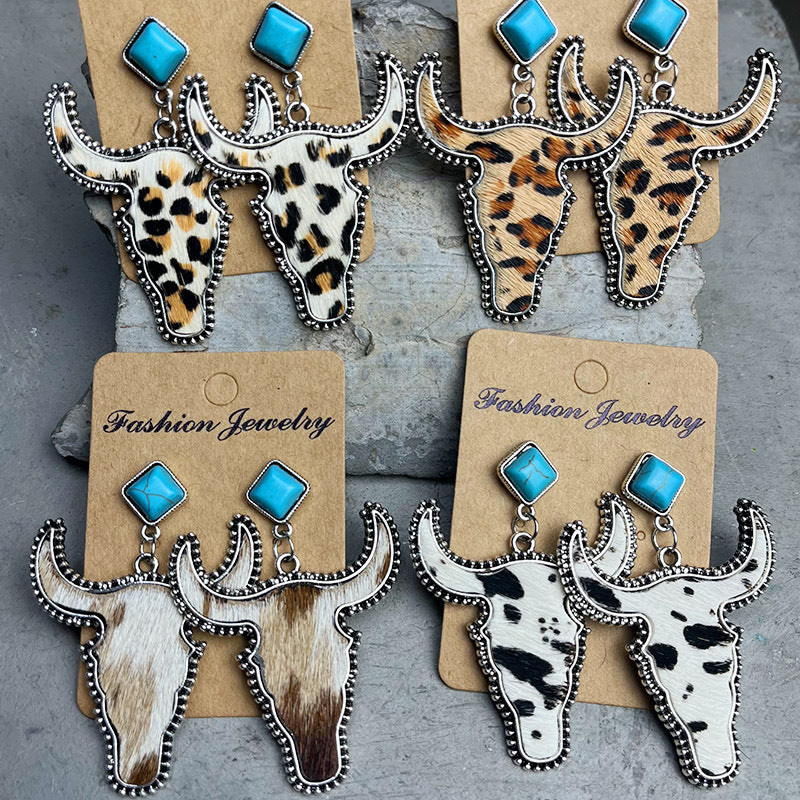
Pairing costume turquoise jewelry with denim is easiest when “costume” is treated as a purchasing category, not a shortcut for guessing materials. Fashion-led jewelry can use many components, coatings, imitation elements, stones, beads, adhesives, or mixed constructions. The styling plan begins only after the exact option, scale, fastening, components, finish, construction, and care are documented.
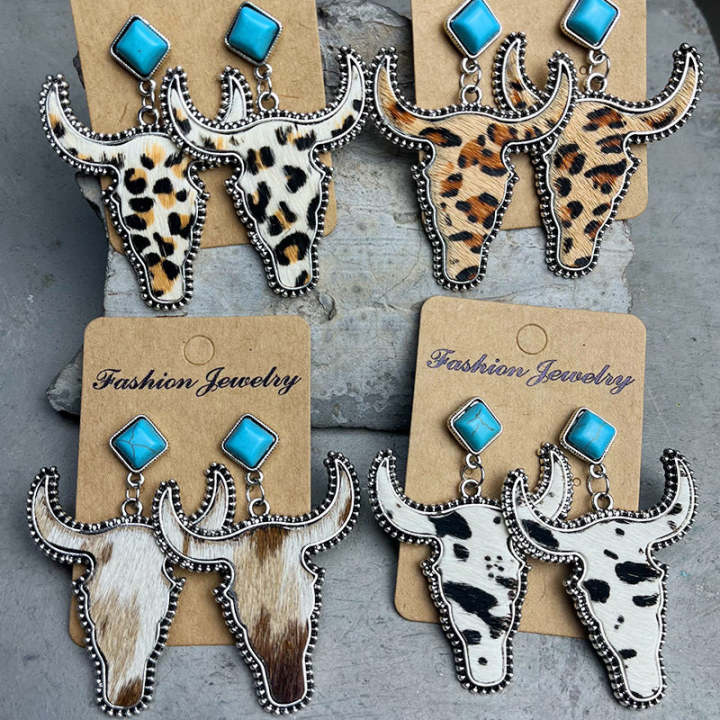
This guide uses the Western Turquoise Boho Vintage Cow Skull Earrings and the Western Turquoise Vintage Cross Jewelry for Women as current denim-pairing examples. Their pages do not clearly label them costume jewelry. Their titles communicate Western, turquoise-colored, boho, vintage-inspired, cow-skull, or cross styling; they do not prove specific materials, natural turquoise, age, treatment, maker, origin, artisan production, or cultural affiliation.
Quick Answer: Use a Denim Contrast Ladder
Place the denim garment on a five-step ladder: quiet dark rinse, clean medium wash, soft pale wash, visible fading or distressing, and highly detailed Western denim. As denim texture and hardware increase, reduce the jewelry's competing signals.
For dark clean jeans, either earrings or a cross necklace can become the main focal point. For a faded jacket with seams, pockets, and metal buttons, choose one jewelry zone and leave more visual space. For embroidered or yoke-detailed denim, the jewelry may need to be smaller, simpler, or absent.
The ladder is visual, not material evidence. Before purchasing, request dimensions, weight, fastening, components, finish, construction, care, exact option mapping, and current return terms. The turquoise jewelry with a denim jacket guide provides a detailed layer-contact check.
Define Costume Jewelry Without Assuming the Product
Costume jewelry commonly refers to fashion-focused pieces not represented as fine jewelry, but the term does not specify one material, quality, durability, or care method. A product should not be assigned to the category only because of price, color, style, or an SEO keyword.
Use a two-line product record:
- Seller-stated category and facts: copy the exact product title, option, components, measurements, finish, construction, and care.
- Your visual observation: describe color, silhouette, motif, scale, and denim relationship without converting appearance into composition.
Keep unknowns visible. “Turquoise-colored center; material not visibly stated” is more useful than “turquoise stone” when planning care, price comparison, or a gift.
Build a Denim Inventory Before Shopping
List the denim already owned: jeans, jacket, shirt, skirt, dress, vest, bag, or other garment. Record wash, fading, distressing, contrast stitching, embroidery, yoke, pockets, rivets, buttons, zippers, and fit. Cross out items that do not suit the intended activity.
Photograph the remaining garments without jewelry in daylight and indoor light. Mark the ear-to-collar zone, neckline, placket, pockets, belt, bag strap, and seat-belt path. These become the operating spaces for earrings and necklaces.
Do not buy new denim to make an uncertain jewelry product usable. First prove that one exact option fits a garment and routine already trusted.
Choose One of Three Denim Jobs
Job One: Background
Dark or clean denim stays quiet while turquoise color or a symbol leads. This works when the jewelry is the main message.
Job Two: Texture Partner
Visible grain, fading, and seams provide a second texture, but the outfit uses only one recognizable jewelry motif. Color and denim texture cooperate without exact matching.
Job Three: Western Signal
A yoke, snaps, embroidery, or pronounced stitching already carries a Western direction. Jewelry becomes a smaller supporting accent. Adding every expected motif usually weakens hierarchy.
The public cowgirl jewelry guide to earrings and necklaces helps keep separate zones from doing the same job.
Use the Turquoise Jewelry Collection as a Zone Map
Browse the Turquoise Jewelry collection by placement rather than color alone. Sort candidates into ears, neckline, wrist, and hand. Choose one lead zone for the first denim formula.
Open every candidate page and create an option-specific evidence card. A collection photograph may help discover shapes, but it cannot confirm that visible items are included, that two designs share components, or that one care method fits the entire category.
Compare candidates on identical fields: intended job, exact size, weight, fastening, components, finish, construction, care, symbolism, denim contact, current price, shipping, and returns.
Formula One: Cow Skull Earrings with Dark Denim
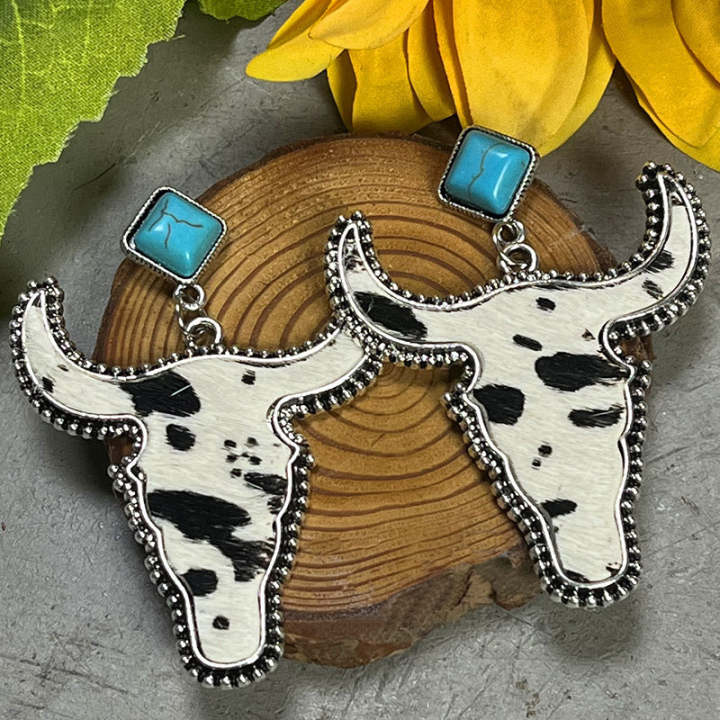
The current cow-skull earring page displayed $141.40 USD and four choices labeled Design 1 through Design 4 during review. Its visible summary describes Western, turquoise, and boho styling and asks shoppers to review product images and the selected option because screen color may vary.
The visible page did not clearly state text mapping for all designs, numerical dimensions, weight per earring, fastening, backing, complete components, finish, construction, or option-specific care. Those gaps prevent a reliable fit and care conclusion.
What May Work
Use a white or neutral shirt, dark clean jeans, simple shoes, no necklace, and minimal belt hardware. Let the cow-skull motif carry the Western signal and the turquoise-colored area carry the color signal.
What May Fail
A high denim collar, long hair, hat, headset, phone, or jacket can cross the ear zone. Embroidered denim, a large buckle, fringe, and several animal motifs may compete. Confirm that the wearer wants the cow-skull symbol in the intended setting.
Questions Before Purchase
- Which image corresponds to each design label?
- What are the height, width, profile, and weight of one earring?
- What fastening and backing are included?
- What components, finish, construction, and care apply?
Formula Two: Cross Necklace with a Denim Shirt
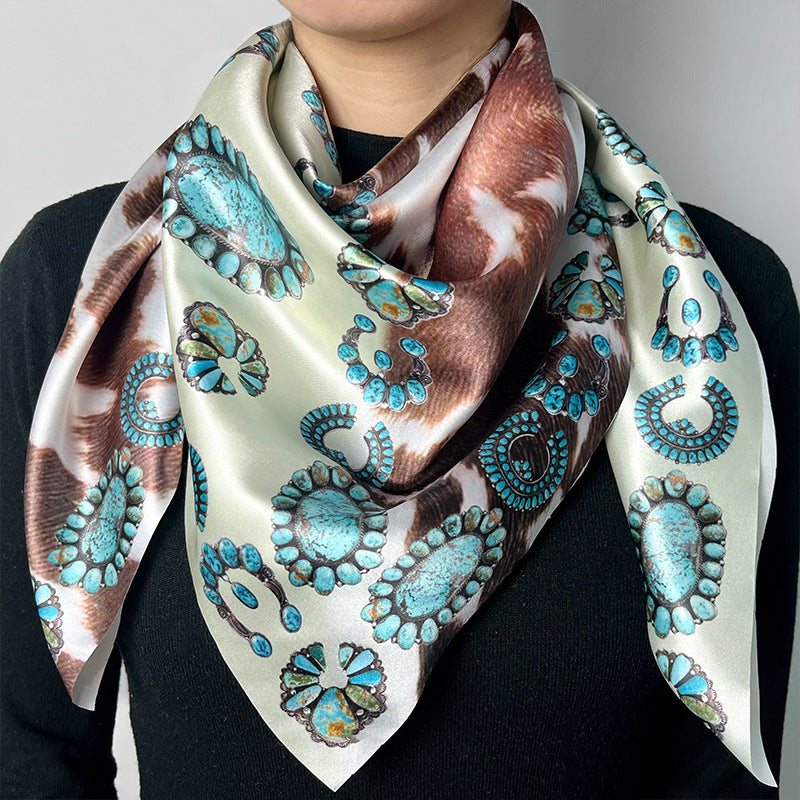
The current Western Turquoise Vintage Cross Jewelry for Women page displayed $112.11 USD and 90 cm and 52 cm choices during review. A visible default does not establish which length is best, what the labels measure, or the complete pendant drop.
The visible summary did not clearly state cross dimensions, adjustment range, total weight, clasp, chain width, complete components, finish, construction, or option-specific care. Vintage in the title can describe appearance rather than age.
What May Work
Use an uncomplicated denim shirt with a clear open collar or smooth buttoned front, simple trousers or contrasting jeans, restrained earrings, and no competing cross. Place a full-scale mock-up using seller-confirmed length and pendant dimensions.
What May Fail
A necklace that reaches snaps, pockets, zipper, belt buckle, bag strap, lanyard, or seat belt does not have a clean operating path. A 90 cm choice may cross more hardware than a 52 cm choice, but both require exact mapping and body-specific testing.
Questions Before Purchase
- Do 52 cm and 90 cm describe total wearable length?
- Is adjustment included, and what are the full cross dimensions?
- What clasp, chain, components, finish, construction, and care apply?
- What exactly is the turquoise-colored portion?
Pair Denim Wash with Jewelry Intensity
| Denim level | Earring direction | Necklace direction | Reduce first |
|---|---|---|---|
| Quiet dark rinse | Statement motif can lead | Cross can anchor clean shirt | Unnecessary matching accessories |
| Clean medium wash | One verified design | One clear pendant lane | Large buckle or second motif |
| Pale faded wash | Check color separation | Check full-body hierarchy | Repeated blue-green accents |
| Distressed or detailed | Smaller or quieter may work | Simpler corridor needed | Fringe, stacks, layered pendants |
| Western yoke/embroidery | Supporting accent only | Often unnecessary or very quiet | Duplicate symbols |
The table offers starting hypotheses. Confirm them with the exact garment, product, body, movement, and setting.
Run a Four-Distance Camera Test
- Detail distance: check the selected option and visible construction.
- Portrait distance: evaluate earrings, hair, collar, and neckline hierarchy.
- Conversational distance: decide whether motif and color still read clearly.
- Full-body distance: compare jewelry with wash, pockets, belt, shoes, and bag.
An outfit should not depend on the detail photograph. If the focal point disappears at conversational distance, improve contrast or placement before buying more jewelry.
Video Lesson: Bold or Subtle Is a Useful Dial
The supplemental video is Wear It With Style: Turquoise Jewelry by JTV. At review, YouTube showed a 43-second video with no closed captions. Its visible description presents turquoise as suitable for a bold statement or a subtler jewelry role.
Use bold-versus-subtle as a styling dial: dark simple denim may support a higher setting, while heavily detailed denim may need a lower one. The video does not document either Oroxen product and cannot verify their components, material identity, measurements, origin, construction, or care.
No captions or transcript were available, so this article does not quote or reconstruct spoken content. Inspect the original source directly.
Protect Fashion Finishes Around Denim
Denim can create abrasion through collars, cuffs, pockets, rivets, zippers, buttons, and seams. Map contact before wear. Do not assume a fashion finish, turquoise-colored element, chain, or earring body tolerates repeated rubbing.
Put jewelry on after cosmetics have settled when that matches the exact care guidance. Remove it before activities involving water, chemicals, impact, sports, tools, sleep, or other exposures when required. Do not use generic dips, polish, toothpaste, vinegar, heat, ultrasonic devices, or home scratch tests on unknown mixed materials.
Store pieces separately in a clean protected compartment compatible with documented components. Photograph condition before cleaning or repair.
Common Denim Pairing Mistakes
- Calling the product costume jewelry without evidence. Use the seller's documented category.
- Matching every blue-green accent. Choose one color leader.
- Repeating cow-skull or cross motifs. Let one symbol lead.
- Ignoring denim hardware. Map snaps, rivets, zippers, pockets, and belt.
- Comparing products on different fields. Use equal dimensions, fit, care, and context.
- Judging only a close-up. Run the four-distance test.
- Assuming vintage means old. Use vintage-inspired unless age is documented.
- Using cultural labels from appearance. Require reliable provenance and appropriate context.
The public Western jewelry introduction offers a broader vocabulary check before styling.
Separate Jewelry from Denim Care Day
Do not leave earrings, necklaces, rings, or bracelets attached to a denim garment when it is stored, spot-treated, brushed, washed, dried, steamed, pressed, repaired, or altered. Laundry products, stain removers, heat, moisture, friction, dye transfer, metal hardware, and garment tools can affect undocumented jewelry components or finishes.
Create two clearly separate stations. The jewelry station is a clean, dry, protected tray away from the sink and laundry area. The garment station contains only the denim and the care supplies approved for that garment. Count the jewelry pieces before moving the denim, place each in its designated storage, and verify that pockets, cuffs, collars, buttons, and belt loops are empty.
After denim care, allow the garment to reach its normal dry condition before rebuilding the outfit. Recheck its shape, color, collar, cuff, and hardware because laundering or pressing can change the contact map. Do not put jewelry onto damp fabric or use the jewelry to test whether dye still transfers.
Run a Three-Wear Denim Ledger
Use the same product and denim garment for three controlled wears within current care and return conditions. On the first wear, keep every supporting accessory quiet. On the second, add the intended jacket or bag. On the third, test the actual occasion or routine.
Record observable results under six headings: position, hard contact, fabric contact, security, visual hierarchy, and voluntary repeat. Include front, side, and full-body photographs taken in comparable light. Note whether the earring meets the collar or hair, whether the necklace crosses a snap or pocket, and whether denim color competes with the turquoise-colored area.
A successful formula should require fewer corrections by the third wear. If the wearer repeatedly removes the jewelry, repositions it, protects it from hardware, or simplifies the outfit, preserve that evidence. The appropriate decision may be a different product, different denim garment, or no jewelry for that activity.
Frequently Asked Questions
Is costume jewelry always inexpensive?
No single price defines the category, and price does not identify components or quality. Use option-specific facts and value the design, fit, care, and seller terms.
Can turquoise-colored jewelry be worn with every denim wash?
Many combinations are possible, but contrast, detail, hardware, body placement, and physical color vary. Test the exact garment and product.
Should earrings and necklace be worn together?
Start with one zone. Combine them only when scale, spacing, symbolism, components, care, and contact paths support both.
Does turquoise color prove turquoise material?
No. Request option-specific disclosure; do not infer identity from title, photo, category, price, or video.
How should fashion jewelry be cleaned?
Identify every component and finish and follow the selected product's instructions. Mixed materials can require different limits.
Can cow-skull or cross jewelry be gifts?
Yes, when the recipient wants the symbol and the fit, fastening, components, care, setting, delivery, and return conditions are suitable.
Final Denim Pairing Checklist
- Use costume only when the category is supported.
- Inventory the exact denim garment and hardware.
- Choose one jewelry zone and one primary signal.
- Confirm option mapping, dimensions, weight, fastening, components, finish, construction, and care.
- Match intensity to denim detail, not color swatches alone.
- Run movement, contact, and four-distance tests.
- Keep material and cultural claims evidence-based.
Explore current options in Western Jewelry or return to Oroxen for current product and store information. The strongest denim pairing uses one verified product, one denim job, and one clear hierarchy—without asking style keywords to prove what the jewelry is made from.