A first bracelet purchase can fail even when the photographs look perfect. The wrist is a moving joint, the hand is usually wider than the wearing position, sleeves and desks create contact, and the words “cuff,” “bangle,” “set,” or “bracelet” do not automatically tell you how an item goes on. Color is only one part of the decision.
This beginner’s guide turns the purchase into a wrist lab. You will make a paper measurement record, define a comfort envelope, separate visible style from documented product facts, compare a four-piece open-cuff set with a multi-option bracelet listing, test stacking contact, and prepare a first-hour inspection routine. “Turquoise” is used as product and color language unless the exact listing explicitly documents material identity. Never use an image, title, price, or video thumbnail as proof of stone, treatment, metal, coating, origin, or age.
Quick Answer: Buy for Entry, Wearing Position, and Motion
A bracelet must solve three different fit problems. Entry is how it passes over the hand or opens around the wrist. Wearing position is where it rests without excessive pressure or unwanted sliding. Motion is what happens when you type, drive, carry, reach, or bend the wrist.
Before shopping, measure the wrist at the intended position and record how much movement you prefer. For a closed bangle, hand circumference or diameter may matter more than wrist circumference. For an open cuff, inner dimensions, opening width, shape, and whether adjustment is explicitly allowed may matter. For a chain or linked bracelet, total length, wearable length, closure, and extension range may matter. Do not force one measurement method onto every construction.
Use the Turquoise Jewelry Guides as the topic hub. For terminology, motifs, and responsible product-language reading, the published guide What Is Western Jewelry? provides broader context.
Start a Wrist Lab Note
Take one sheet of paper and write the date, measuring tool, wrist, and intended use. Measure against skin without pulling a flexible tape painfully tight. Record the number exactly as measured instead of immediately adding a generic allowance. The correct allowance depends on construction, scale, weight, shape, and your comfort preference.
If you do not have a flexible tape, use a non-stretch strip of paper or cord, mark the overlap, and compare it with a ruler. Repeat twice. Measure both wrists if you may switch sides. Then photograph the tape position so you can reproduce it when comparing seller measurements.
Record four personal boundaries
- Minimum comfort: the bracelet should not press, pinch, or restrict normal movement.
- Maximum travel: decide how far toward the hand or forearm you will tolerate sliding.
- Contact sensitivity: note whether desk edges, keyboard use, or neighboring bracelets bother you.
- Daily obstacles: list sleeves, watch bands, gloves, bags, sports, water, or work requirements.
These boundaries form your comfort envelope. A seller’s measurements can be compared with that envelope, but a number alone cannot guarantee fit. Wrist shape, bracelet profile, opening orientation, and movement all contribute.
Learn the Construction Words Without Assuming Too Much
Open cuff
An open cuff has a gap and is generally placed around the wrist rather than passed over the widest part of the hand. That description does not tell you whether a specific cuff should be bent. Repeated bending may change shape or stress construction. Follow item-specific instructions and ask whether adjustment is permitted.
Closed bangle
A closed bangle normally passes over the hand. Hand width and circumference can be decisive even when the wearing wrist is small. Product pages should provide an inner measurement and explain how it was taken.
Hinged bracelet
A hinge creates an opening mechanism. Check the hinge, closure, wearable inner size, and how the fastener is secured. A photographed seam does not prove how the mechanism performs.
Chain, link, or cord bracelet
These may rely on a clasp, knot, slide, elastic component, or extension. Confirm wearable length, closure type, and whether decorative ends are included in the total measurement.
Bracelet set
A set should state the included quantity and whether the items are separate or connected. The current Oroxen example below explicitly describes four separate open cuff bracelets that may be stacked or worn individually. Do not assume every “set” follows the same arrangement.
Use the Western Bracelets Collection as a Shortlist, Not a Specification Sheet
Browse the Western Bracelets collection by construction first. Make separate groups for open cuffs, closed shapes, linked or flexible designs, single pieces, and sets. Then eliminate items whose entry method conflicts with your needs.
Next, shortlist by role. Do you want a single daily accent, a stack that can be edited, a motif-led statement, a quiet color echo, or a gift? The same object can perform several roles, but naming the primary one prevents comparison from becoming a contest of photographs.
Finally, open every exact listing. Verify selected option, associated images, piece count, dimensions, materials, closure or opening, weight when relevant, care guidance, stock, shipping estimate, and return terms. If information is missing, move the item to a “questions” column rather than filling the gap with an assumption.
Example One: Turquoise Western Cuff Bracelet Set
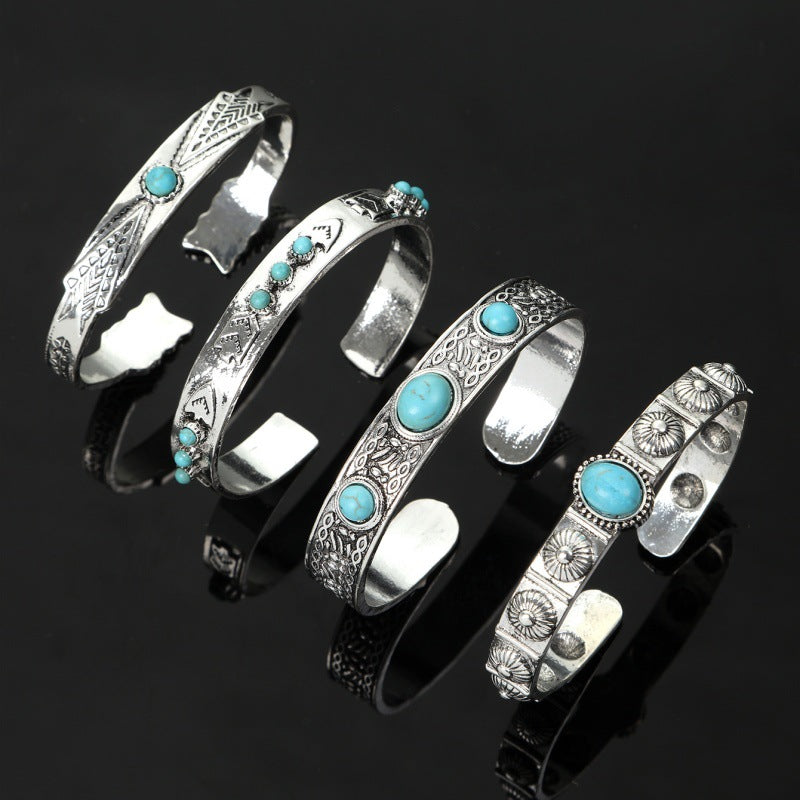
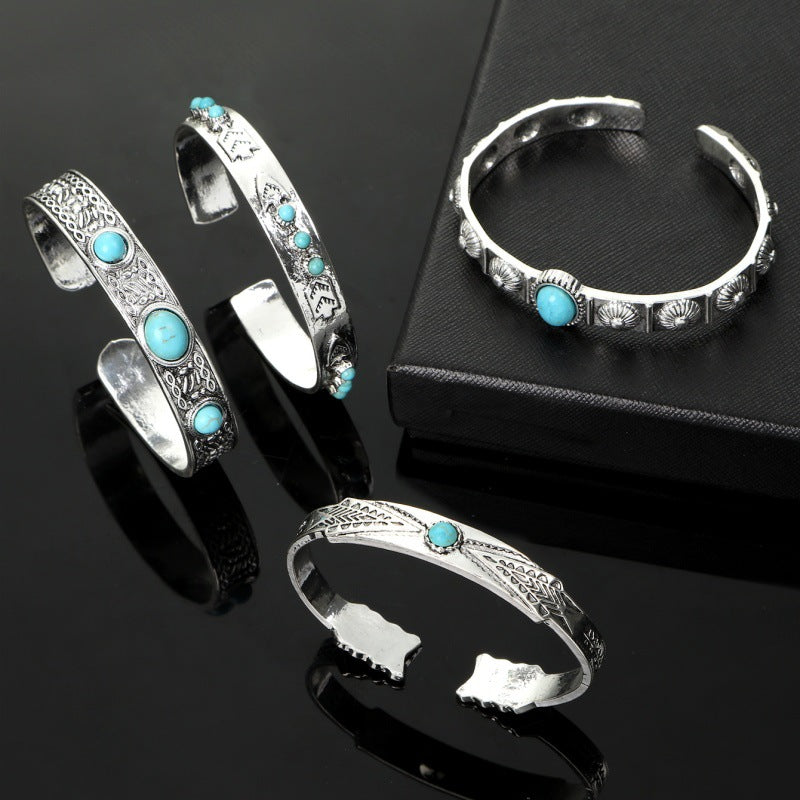
The current Turquoise Western Cuff Bracelet Set page provides several useful facts for a beginner. It identifies a set of four open cuff bracelets, shows turquoise-colored accents with varied vintage-inspired motifs, and says the pieces may be worn together or individually. The selector currently reads “4Set.” Those are listing facts that can support a stacking plan.
Beginner observation
The photographs can help you compare motif variety, relative visual width, and how the four pieces look together. They cannot provide a reliable wrist scale without documented measurements. They also cannot establish the exact materials, surface treatments, permissible adjustment, or long-term resistance to wear.
Questions to ask
- What are the inner width, inner height, opening width, band width, and weight of each cuff?
- Are all four cuffs the same inner size?
- What materials and finishes are explicitly documented?
- Should the openings remain fixed, or is any adjustment permitted?
- What care instructions apply when pieces are stacked and touch one another?
Three first outfits
For a restrained look, wear one cuff with a plain tee, denim jacket, and small earrings. For a medium look, choose two cuffs with different visual widths and leave space between them if contact is uncomfortable. For a full set look, wear all four only after testing edge contact, wrist movement, sleeve friction, and sound. The set makes variety possible; it does not require all four every time.
The Five-Minute Stack Test
Place the widest or most rigid-looking piece on the wrist by itself. Bend and straighten the wrist ten times. Add a second piece and repeat. Continue one piece at a time while noting which edges touch and which bracelet moves over another.
Then type for one minute, rest the wrist on a table, carry a bag, button a jacket, and put on a long sleeve. Listen as well as look. Repeated striking can be distracting and may affect surfaces depending on construction. Product images do not show this interaction.
If the full stack fails, do not declare the set unusable. Try one or two pieces, reverse their order, wear them on the opposite wrist from a watch, or save the complete stack for a shorter, lower-contact occasion. A set is a small system with multiple valid configurations.
Example Two: Turquoise Boho Vintage Bracelet for Women
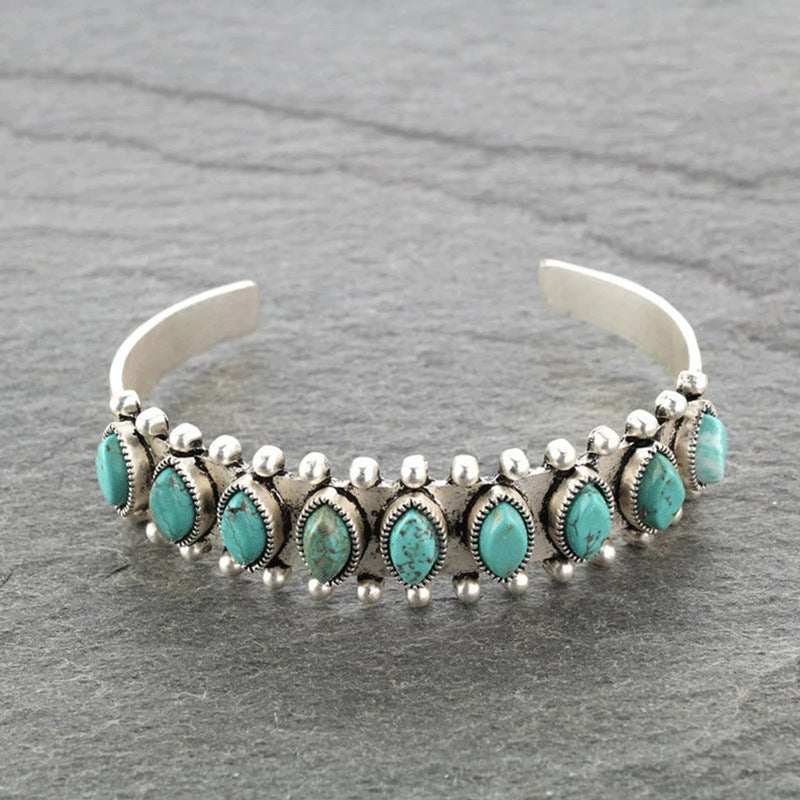
The Turquoise Boho Vintage Bracelet for Women page takes a different approach. It currently offers seven selectors labeled Bracelet 1 through Bracelet 7 and an extended gallery. Because “Bracelet 1” is not a measurement, a beginner must connect the exact selector to the exact photographs and request missing specifications for that option.
Beginner observation
The gallery can establish visible differences in shape, motif, color placement, and apparent construction. It cannot guarantee that specifications are shared across all seven choices. Bind every measurement or material statement to the selected bracelet rather than to the listing family as a whole.
Questions to ask
- Which image numbers correspond to Bracelet 1, Bracelet 2, and the remaining choices?
- What is the construction and entry method for each option?
- What dimensions, weight, materials, and finish apply to the selected option?
- Does the selected design include a closure, opening, elastic component, or adjustable part?
- What care and return terms apply if the option fits differently than expected?
This listing is best approached as seven possible products sharing one page. Choose one, create a short evidence record, and compare it with your wrist-lab boundaries. Do not blend photographs and facts from different options into an imaginary eighth bracelet.
How to Interpret “Real or Fake” Identification Videos
The paired video is “HOW TO IDENTIFY TURQUOISE JEWELRY – IS IT REAL OR FAKE?” by globalvoodoo. Watch the complete video before citing any technique or conclusion. Identification is a specialized subject, and a general online demonstration cannot authenticate the exact bracelets on a store page.
A responsible note separates three categories. Educational clue: a concept worth learning more about. Product-page fact: a statement explicitly tied to the selected Oroxen option. Authentication conclusion: a determination requiring appropriate evidence or qualified examination. Do not move an observation from the first category to the third because a color or pattern looks similar on screen.
Never copy a transcript, perform potentially damaging “tests,” or present a video as a certificate. If material identity affects value, care, allergies, or buying intent, request clear seller documentation and consider professional evaluation appropriate to the decision.
Care Begins with Construction Knowledge
A universal “turquoise bracelet cleaning method” is unsafe because products sold under similar style language can use different stones, composites, imitations, base materials, coatings, adhesives, cords, or closures. Water, chemicals, polishing, abrasion, heat, and ultrasonic cleaning may affect those constructions differently.
Until the item-specific instructions are known, use a conservative handling routine: keep the bracelet away from unknown cleaners, remove it before activities involving chemicals or impact, store pieces so they do not scrape one another, and use only methods approved for the documented construction. The published Western Turquoise Jewelry Guide explains why style language and material claims should be separated.
First-Hour Inspection After Delivery
- Preserve packaging and record the parcel condition.
- Compare the received item count and selected option with the order confirmation.
- Inspect each surface, edge, setting, connection, opening, and closure under good light.
- Measure using the same method promised by the seller.
- Try the entry method gently; do not force or bend a component without permission.
- Wear the bracelet briefly over a soft surface and run the motion test.
- Stop if there is pinching, sharp contact, unexpected looseness, instability, or a mismatch.
- Contact the seller within the applicable return window and keep written records.
Inspection protects both fit and evidence. Wearing a questionable item extensively, altering it, or performing an unauthorized test may complicate a return and can damage the product.
Beginner Mistakes and Better Questions
- Mistake: “My wrist is average.” Better: “My wrist measures X at this position using this method.”
- Mistake: “Open cuffs are adjustable.” Better: “Does the seller permit adjustment of this exact cuff?”
- Mistake: “The model photo proves fit.” Better: “What are the inner dimensions and opening width?”
- Mistake: “A set should be worn all together.” Better: “Which combination meets my comfort and contact limits?”
- Mistake: “Turquoise in the title proves the stone.” Better: “What material statement is explicitly documented?”
- Mistake: “All seven options share the same specifications.” Better: “Which facts apply to the exact selected bracelet?”
Frequently Asked Questions
How tight should a bracelet be?
There is no universal allowance. Construction, width, weight, wrist shape, and comfort preference matter. Record your measurements, ask for exact product dimensions, and avoid pressure, pinching, or uncontrolled sliding.
Can I bend an open cuff to make it fit?
Only if the seller’s instructions explicitly permit adjustment. Repeated or excessive bending may change shape or stress materials and connections.
What hand measurement is needed for a closed bangle?
Because it passes over the hand, a hand circumference or diameter measurement may be necessary. Follow the seller’s measurement method and compare it with the documented inner dimension.
Does “turquoise bracelet” mean natural turquoise?
No. The phrase can be a style, color, or product name. Seek an explicit material disclosure when identity matters.
Should a first-time buyer choose a set or a single bracelet?
A set offers more combinations; a single piece simplifies fit and contact evaluation. Choose based on the intended role, documented specifications, and whether you genuinely want to experiment with stacking.
How can I buy a bracelet as a gift?
Obtain a reliable measurement when possible, prefer clear construction and sizing information, and verify return terms. The published Western Jewelry Gifts for Her Guide provides a recipient, occasion, size, and giftability checklist.
Where should I browse next?
Compare current products in Western Bracelets, explore the wider Western Jewelry collection, or return to the Oroxen home page.
Final Beginner Checklist
Before checkout, you should be able to name the bracelet’s entry method, exact selected option, documented measurements, piece count, materials, finish, closure or opening, care instructions, current shipping estimate, and return path. You should also know your wrist-lab measurements, desired movement, contact limits, and the real activity where the bracelet will be worn.
A strong first purchase is not the one that wins the closest photograph. It is the one whose evidence record matches your body and routine. Measure first, distinguish observation from proof, test each stack one piece at a time, and preserve the return path. That process leaves room for style while giving comfort and product facts equal authority.