A Beginner's Guide to Turquoise Bracelets for Country-Music Fans
A turquoise-colored bracelet can connect easily with denim, boots, a concert tee, a simple dress, or a Western-inspired jacket. For a first-time buyer, however, the visual connection is the easy part. The harder questions concern what the selected option includes, whether it fits, what its components actually are, how it behaves during a long event, and what care the exact item requires. A product photograph can suggest an outfit; it cannot finish that investigation.
This beginner's guide uses a four-track soundcheck. Track one confirms identity and contents. Track two checks wrist mechanics. Track three assigns an outfit role. Track four rehearses the country-music event. You do not move to the cart because every track is perfect. You move when the unresolved questions are visible and none of them can change your decision about fit, comfort, timing, care, or meaning.
Quick Answer: Learn the Product Before You Learn the Stack
Begin with one exact bracelet option and one intended use. Record the page title, URL, date, selected label, displayed price, and included quantity. Request internal dimensions or wearable circumference, opening or closure, adjustment guidance, total mass, materials, finish, decorative-component identity, skin-contact parts, and care. Then measure the wrist and rehearse the item with the actual sleeve, watch, bag, phone, and movement.
Use turquoise, boho, vintage, Western, crystal, statement, cuff, stack, or set only at the level supported by the product page. Those words do not automatically prove natural turquoise, crystal composition, metal, age, maker, handwork, region, tribe, nation, cultural affiliation, spiritual property, or health effect. Appearance and evidence belong in separate notes.
Browse the Turquoise Jewelry Guides hub for category orientation. Return to the four tracks before checkout so inspiration does not erase the practical record.
Track One: Identity and Contents
Write the selected option exactly
A page may contain several radio buttons, designs, sets, or images. Write only the label that is visibly selected. If a label is absent, record “selected radio; label not readable.” Do not name an option blue, silver, turquoise, one-size, four-piece, or another convenient phrase unless the current page states it.
Pair the label with a dated screenshot and product URL. This protects the beginner from a common error: remembering the collage while ordering a different selection. If the text and image disagree, preserve the conflict and ask the seller which description controls.
Define what arrives
Bracelet, set, and stack are not interchangeable quantity statements. Write a sentence: “The selected option includes ___.” Fill the blank only from explicit current text or a written seller answer. Confirm whether decorative pieces, connectors, charms, replacement parts, closures, storage items, or packaging are included. A gift buyer should know what the recipient will open.
The Western jewelry motifs, styles, and materials overview can help name visible forms, but it cannot supply the contents or composition of another product.
Track Two: Wrist Mechanics
Measure the wearer, then the item
Wrap a soft measuring tape around the intended wearing point without compressing the skin. Record the measurement. Ask the seller for the exact option's internal diameter, circumference or wearable range, opening width if applicable, maximum external width, thickness, and total mass. A scale photograph is useful only when its reference and measurements are reliable.
Fit language should identify the mechanism. A rigid cuff, hinged bracelet, clasped chain, elastic strand, wrap, or adjustable cord behaves differently. An open shape is not proof that repeated bending is safe. Ask whether adjustment is intended, how it should be performed, and whether the finish or structure has limits.
Test the collision map
A country-music event can involve driving, rideshare, ticket scanning, a coat, stairs, seating, food, drinks, a phone, photographs, and dancing. Map every object that shares the wrist zone: watch, sleeve, bag handle, wristband, mobility aid, table, and another bracelet. A beautiful stack becomes a poor choice when it catches, presses, strikes surfaces, or needs constant correction.
If an item is already owned and safe to wear, perform a short home rehearsal. Bend the elbow, rotate the wrist, hold a phone, open a bag, sit, stand, clap gently, and move at the expected intensity. Remove the item if it causes pain, irritation, pinching, pulling, or instability.
Live Example One: A Documented Four-Cuff Set with Missing Fit Data
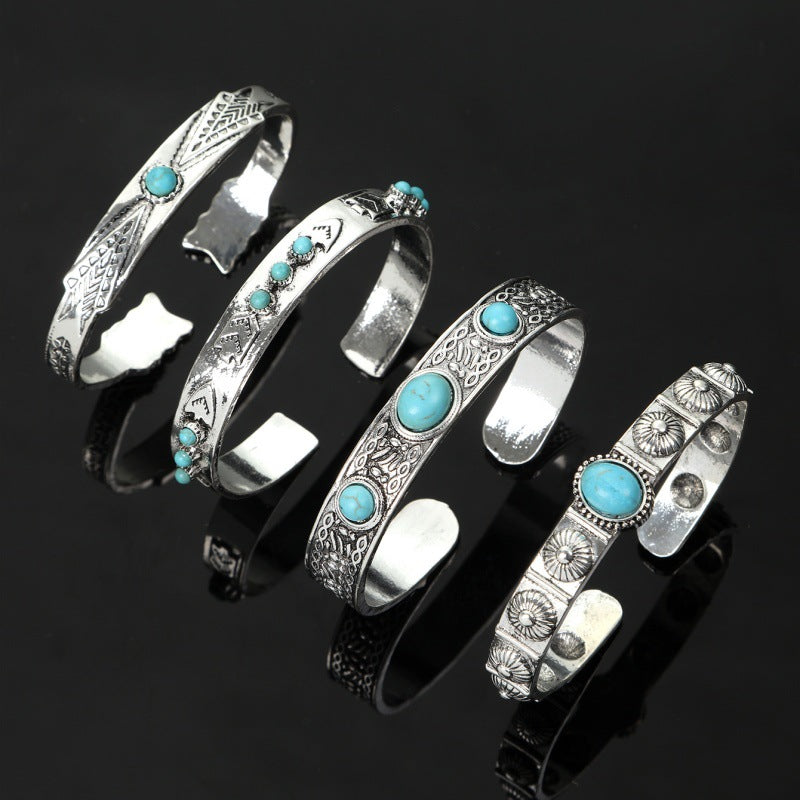
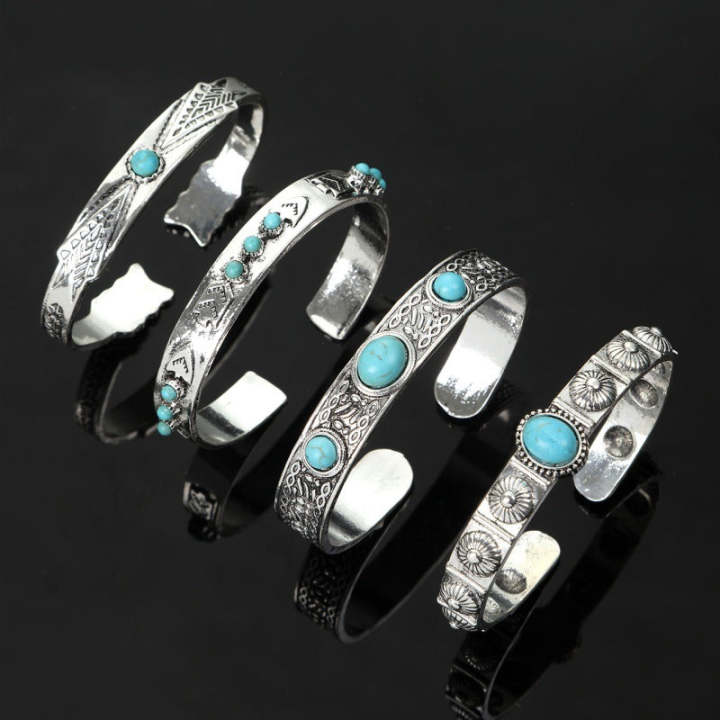
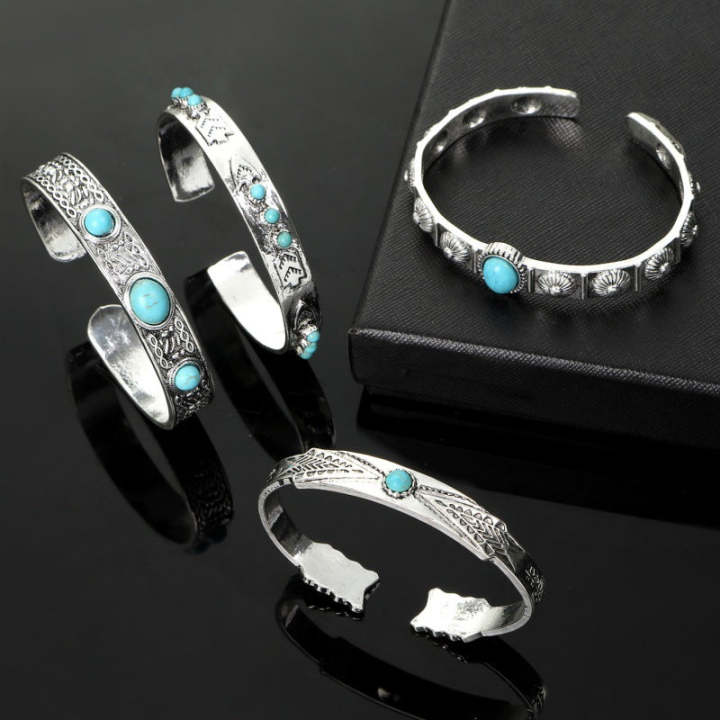
The live Turquoise Western Cuff Bracelet Set page displayed at $34.99 USD during review. It showed “4Set” selected. The page explicitly described a set of four open cuff bracelets with turquoise-colored accents and varied vintage-inspired motifs, wearable together or individually. It also advised shoppers to review the selected option and images and noted that screen color may vary.
For a beginner, that is useful identity and quantity evidence. It supports four open cuffs and a choice between stacking or wearing them individually. It does not answer fit. The inspected page did not provide internal diameter, opening width, circumference, individual mass, exact materials, finish composition, decorative-component identity, skin-contact parts, adjustment instructions, or item-specific care.
Create four lines in the soundcheck even if the page sells one set. A set can contain pieces with different widths, pressure points, and visual weight. Ask whether each cuff shares the same material and adjustment guidance. Do not repeatedly bend the pieces to create a fit until the seller confirms that such adjustment is intended.
A useful first outfit is one or two cuffs with a plain sleeve, leaving the remaining pieces for another look. This is a styling suggestion, not a claim that every piece fits every wrist. The wearer's measurement and the seller's exact dimensions decide the mechanical question.
Track Three: Give the Bracelet One Outfit Job
Color lead
Let the blue-green accent be the strongest color in a neutral outfit. Denim, black, brown, cream, gray, or a simple concert tee can provide a quiet field. Avoid repeating the color in every accessory. One small echo may connect the outfit; five near-matches can make the look feel assembled from a keyword.
Texture bridge
Use the bracelet to connect a smooth shirt to textured boots, a leather-like belt appearance, fringe, stitching, or denim grain. Coordinate one property rather than every motif. If the jacket, buckle, boots, bag, and jewelry are all highly detailed, reduce the wrist stack.
Movement accent
A bracelet can become visible when the hand moves, even if it is quiet in a still photograph. This can support a performance-oriented outfit, but movement also creates noise and collision. Test clapping, holding a drink, using the phone, and resting the arm. Do not assume more movement is automatically better for a concert.
The published Western jewelry styling guide offers additional outfit structures. Apply its proportion ideas to the exact bracelet instead of copying a complete look without a fit check.
Live Example Two: Two Unnamed Color Choices
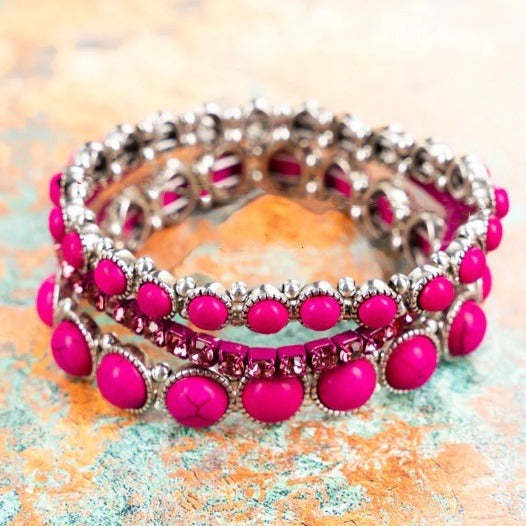
The live Turquoise Boho Vintage Crystal Bracelet page displayed at $112.11 USD during review. Under Color, it showed two radio choices; the first was selected, and neither label was readable in the inspected state. The copy used turquoise, boho, vintage, and crystal language and suggested casual, Western-inspired, occasion, and gifting use.
Record the state without inventing names: two Color radios, first selected, labels not readable. Ask the seller to map each option to its correct image and to confirm included quantity, wearable size, closure or adjustment method, total mass, materials, the basis for the word crystal, turquoise-looking component identity, finish, skin-contact parts, and care.
The inspected text did not document natural turquoise, crystal type, metal composition, dimensions, mass, closure, maker, age, origin, or cultural affiliation. A product name can remain the product name while the article avoids turning its words into scientific, historical, or spiritual proof.
For a beginner, the two-option page is a good reason to slow down. Choose the option only after the label-image mapping is clear. If the bracelet will be worn near a watch or event wristband, request enough dimension information to plan separation.
Track Four: Rehearse the Country-Music Event
Break the outing into arrival, waiting, performance, break, and departure. Arrival tests coat, ticket, phone, transport, and bag. Waiting tests standing, seating, and table contact. Performance tests movement, clapping, heat, and crowd proximity. Break tests food, drink, restroom, and storage. Departure tests fatigue and safe removal.
Mark every stage green, yellow, or red. Green means the exact item has acceptable evidence and behavior. Yellow means one seller answer or home test remains. Red means an issue can affect safety, comfort, timing, or care. A red item does not move to the cart because the outfit photograph looks complete.
Venue policy can change. Check the current bag, security, prohibited-item, accessibility, and entry rules directly with the venue. Jewelry pages do not determine what security staff will allow. Choose a fallback already owned so a late delivery or failed fit test does not disrupt the outing.
The published country concert jewelry guide extends the event-planning questions across earrings, necklaces, bracelets, and rings. Use it after the bracelet soundcheck, not instead of it.
Video Boundary: Personal Meaning Is Not Product Evidence
The corresponding content-map video is “Turquoise: Spiritual Meaning, Powers And Uses” by Crystal Meanings. For this draft, only the title, channel, URL, and broad turquoise-topic relationship are used. The video was not watched in full, and this article does not cite any statement, demonstration, spiritual claim, historical claim, material identification, authentication, valuation, care method, or health-related assertion from it.
Spiritual or symbolic meanings may be personal beliefs or traditions; they do not verify an Oroxen product's composition and should not be presented as medical advice or guaranteed effects. Never replace professional medical care with a jewelry or crystal claim. Item identity requires product documentation and, when warranted, appropriate professional evaluation.
A First-Buyer Worksheet
- Identity: title, URL, date, exact selected label, image, displayed price.
- Contents: number of bracelets and every included part.
- Fit: wrist measurement, internal dimensions, opening or closure, adjustment guidance.
- Weight: total mass and, for a set, mass of each piece.
- Components: materials, finish, decorative elements, treatments, skin-contact parts.
- Care: seller instructions for the exact option.
- Outfit job: color lead, texture bridge, or movement accent.
- Collision map: sleeve, watch, bag, phone, wristband, table, and other jewelry.
- Event: venue rules, weather, transport, activity, safe storage, fallback.
- Timing: current availability, delivery estimate, return window, and exclusions.
Use the Western Bracelets collection to compare silhouettes and the broader Western Jewelry collection to check whether the wrist should remain the focal point. A collection is a comparison tool; it does not fill blank worksheet cells.
Common Beginner Mistakes
Buying a collage: the shopper remembers multiple images but not the selected option. Save the label and image together.
Using color as identification: a blue-green component is called natural turquoise. Preserve the seller's documented certainty.
Bending before asking: an open cuff is repeatedly reshaped without adjustment guidance. Confirm the mechanism first.
Stacking before fitting: four pieces are treated as one size and weight. Evaluate each piece and the combined stack.
Copying a stage look: a performer, video, or promotional photograph becomes the fit model for another person and venue. Use it as inspiration only.
Using universal care: water, chemicals, polishing, ultrasonic cleaning, or another method is applied without documented components. Follow item-specific instructions.
Ordering against the clock: delivery and return timing leave no room for inspection. Set a decision deadline and keep a fallback.
For a more general evidence framework, consult the complete Western turquoise jewelry buying guide.
Frequently Asked Questions
Should a beginner start with one bracelet or a set?
Start with the option whose contents, dimensions, mechanism, and care you can understand. A set can offer styling flexibility, but it also creates more fit and interaction questions. Quantity alone does not make it better value.
Can turquoise bracelets be worn with a watch?
Yes, when the exact pieces fit, do not damage or obstruct one another, and remain comfortable. Test spacing, edge contact, sound, device controls, and normal wrist movement. Manufacturer guidance for the watch also matters.
How tight should a cuff be?
The correct fit depends on the exact design and seller guidance. It should not cause pain, numbness, pinching, skin injury, or instability. Request the intended size range and seek appropriate help for fit concerns.
Does “crystal” prove what the decorative component is?
No. Ask for a component list and documentation. The word in a title or design description should not be converted into a specific mineral, glass, treatment, or composition without evidence.
How should bracelets be stored after a concert?
Keep them separated from hard objects, liquids, cosmetics, and loose bag contents during travel. Follow the seller's item-specific cleaning and storage guidance. Do not assume one method suits every undocumented material.
Where should a beginner continue?
Return to Oroxen, compare the linked collections, and complete one soundcheck worksheet before adding a second candidate. One clear seller answer is often more useful than another hour of image browsing.
Conclusion: Finish the Soundcheck Before the Show
A country-music fan does not need expert terminology to choose a turquoise-colored bracelet responsibly. The beginner needs a repeatable order: identify the exact option, define what arrives, measure wrist mechanics, assign one outfit job, and rehearse the real event. Product words stay at their documented level, and unresolved facts remain visible.
When all four tracks are clear enough, the bracelet can support denim, boots, a concert tee, a dress, or another personal look without becoming a source of distraction. When a blocking question remains, use the fallback and keep learning. The best first purchase is not the one with the most pieces or strongest story; it is the one the wearer can describe, fit, use, and care for with confidence.