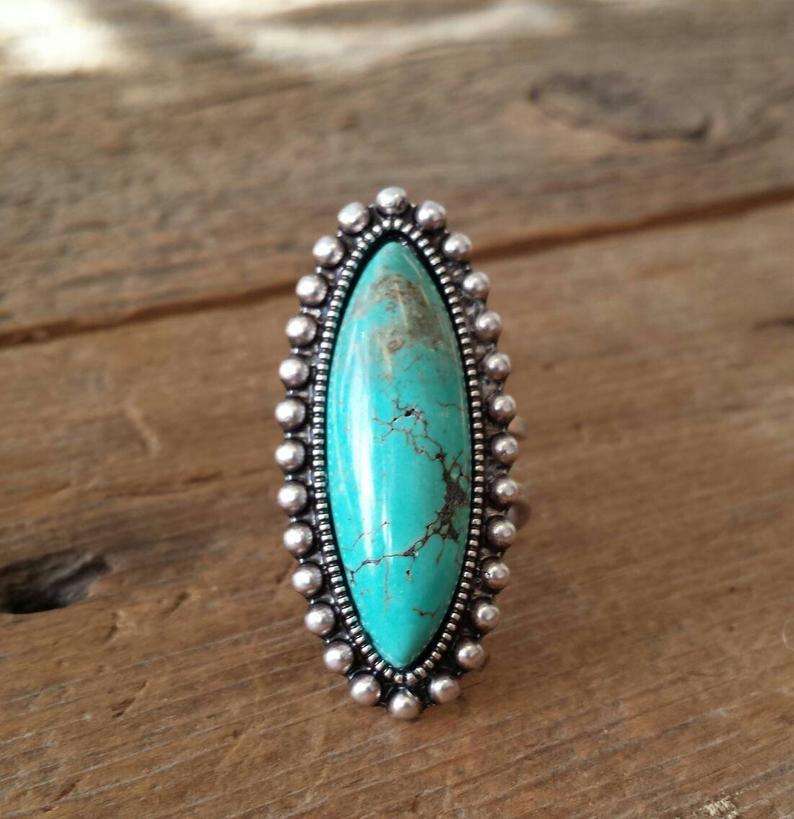
A turquoise Western ring can give a country-concert outfit a clear focal point, but the most common styling mistakes happen when appearance is planned without movement, fit, or evidence. A ring that looks balanced in a still photograph may turn, press neighboring fingers, catch a knit, strike a phone, or compete with every other accessory once the wearer starts moving through a real venue.
This practical guide uses the Turquoise Vintage Statement Cross Ring and the Turquoise Boho Vintage Statement Floral Ring as two styling candidates. Their titles and product photographs support discussion of visible design and outfit placement. They do not independently verify natural turquoise, a particular metal, age, maker, origin, construction, handmade status, or cultural affiliation.
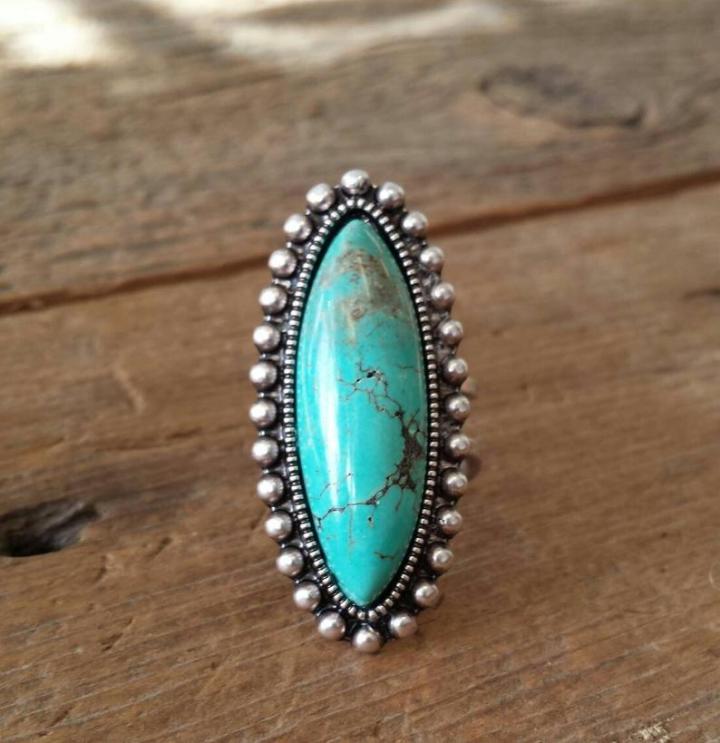
Quick Answer: Treat the Ring as Equipment as Well as Decoration
Avoid choosing a concert ring from color and mood alone. Confirm the exact option, intended finger, supported fit range, face dimensions, projection, mass, construction, skin-contact components, finish, adjustment method, care, and return conditions. Then rehearse the complete outfit while using a phone, opening a bag, handling a jacket, and washing and drying hands.
For visual balance, select one primary hand-level focal point. Repeat turquoise color once elsewhere only if the repetition supports the outfit rather than creating noise. The Western Rings collection is useful for building a shortlist, while the broader Western Jewelry collection helps compare a ring with alternatives at the ears, neck, or wrist.
Mistake 1: Assuming “Adjustable” Means Universally Comfortable
Both reviewed product pages showed one visible color option and an “Adjustable” size selection during the latest observation. That label is not a numerical fit specification. It does not tell a shopper the supported inside range, where pressure should be applied, how many fitting cycles are safe, whether a jeweler should perform the adjustment, or how the decorative face affects finger clearance.
Do not repeatedly bend an adjustable ring to move it among fingers or wearers unless the seller confirms that use. Repeated deformation can stress an unknown construction. Ask for the supported size range and exact fitting instructions, choose one intended finger, and minimize changes. If the ring cannot be fitted without pinching, gapping, rotation, or discomfort, it is not a suitable concert choice.
Mistake 2: Choosing the Largest-Looking Design Without Measuring Clearance
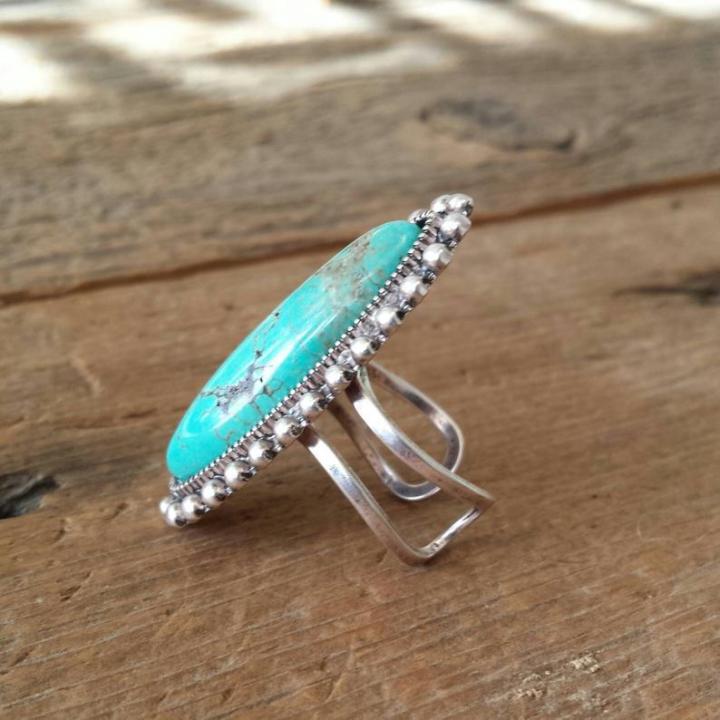
A statement face can cross beyond the width of its finger. That can be visually effective, but it changes how the hand closes around a phone, railing, cup, bag handle, or steering wheel. Gallery images can suggest scale; they cannot replace numerical face width, length, projection, and mass.
Request measurements for the exact option. Make a paper rectangle with the stated face dimensions, place it over the intended finger without fastening it, and slowly rehearse common hand positions. This is only a proportion test, not a wear test, but it can reveal obvious interference before purchase. Leave enough space between the ring and neighboring fingers to avoid pressure during hours of movement.
Mistake 3: Letting Every Accessory Compete
A country-concert look does not become more coherent simply because every belt, buckle, boot, earring, necklace, bracelet, and ring is visually strong. When all pieces demand attention, none establishes hierarchy. Start with the ring as primary, secondary, or quiet support. A statement cross or floral composition usually reads most clearly when the surrounding hand and wrist provide breathing room.
Use a three-distance test. From arm's length, the outfit should have one dominant focal area. From conversational distance, the hand-level detail should look intentional. Close up, the selected ring should not appear to have been stacked accidentally against unrelated shapes. Photograph the outfit from the front, side, seated position, and natural walking posture rather than judging only a close-up of the hand.
Mistake 4: Matching Every Color Too Literally
Exact turquoise repetition across a ring, necklace, earrings, bag, boots, and shirt can make an outfit look assembled from a color checklist. Instead, decide whether turquoise is the accent, a repeated rhythm, or the main color story. One hand-level piece can stand against denim, black, cream, brown, rust, or another quiet field without requiring an identical blue-green item everywhere.
When repeating the color, separate the accents vertically. For example, a ring and a small neckline detail create space between focal points. A ring, bracelet, and cuff in the same tight zone may merge into visual clutter. Judge repetition under outdoor light and indoor light because cameras, screens, and venue lighting can shift apparent color.
Mistake 5: Treating a Product Title as a Materials Report
Words such as turquoise, Western, vintage, boho, floral, and statement help describe a shopping style. They do not, by themselves, establish gemstone identity, age, metal composition, finish, treatment, maker, source, or cultural history. “Vintage” should be read as vintage-inspired unless age and provenance are documented.
If material identity affects price, sensitivity, care, or meaning, request an option-specific written description. Ask which components touch skin, which components are decorative, what finishes or coatings are used, how elements are joined, what the turquoise disclosure means, and what care limitations apply. Do not perform scratch, heat, solvent, bend, or other destructive tests on a finished product.
Mistake 6: Skipping a Dominant-Hand Test
A ring worn on the dominant hand interacts with more tasks: scanning a ticket, holding a phone, carrying a bag, using a restroom latch, adjusting a hat, and managing a jacket. A non-dominant placement may reduce some contact, but it can introduce other interactions with a watch, wristband, or bag strap.
Run a left-versus-right rehearsal. Wear a similarly sized inexpensive test object only if it fits safely, or use the paper proportion template without attaching it. Move slowly through the complete task list. Select the hand and finger that produce the least interference while still giving the desired visual effect. Never let styling override circulation, grip, or venue safety.
Mistake 7: Building a Ring Stack Before Choosing the Hero
A stack should be designed around the exact hero ring, not added from habit. Neighboring rings can change clearance, create hard contact, trap moisture, or push an adjustable band off its intended position. Start with the statement ring alone. If it passes the full rehearsal, add at most one supporting ring at a time and repeat every movement test.
Look for a stable visual interval rather than automatic symmetry. An empty finger can be useful negative space. A simple band on the opposite hand can balance a large face more effectively than several nearby rings. Remove any combination that causes clicking, rubbing, pressure, rotation, or difficulty drying the skin.
Candidate A: Turquoise Vintage Statement Cross Ring
During the latest review, the product page displayed $74.74 USD, one visible color choice, and the size label “Adjustable.” The title and photographs presented turquoise, vintage, cross, and statement styling. The visible page did not clearly provide the supported inside range, ring-face dimensions, projection, mass, full component list, finish, construction, adjustment instructions, or care protocol.
The cross-shaped visual geometry can act as a clear focal form. Before using it for a concert, ask whether the exact edges extend beyond the intended finger, how high the face sits, and whether any parts can catch open-knit fabric, fringe, embroidery, gloves, hair, or a bag lining. Confirm the intended orientation and whether the face remains stable when the hand changes angle.
Candidate B: Turquoise Boho Vintage Statement Floral Ring
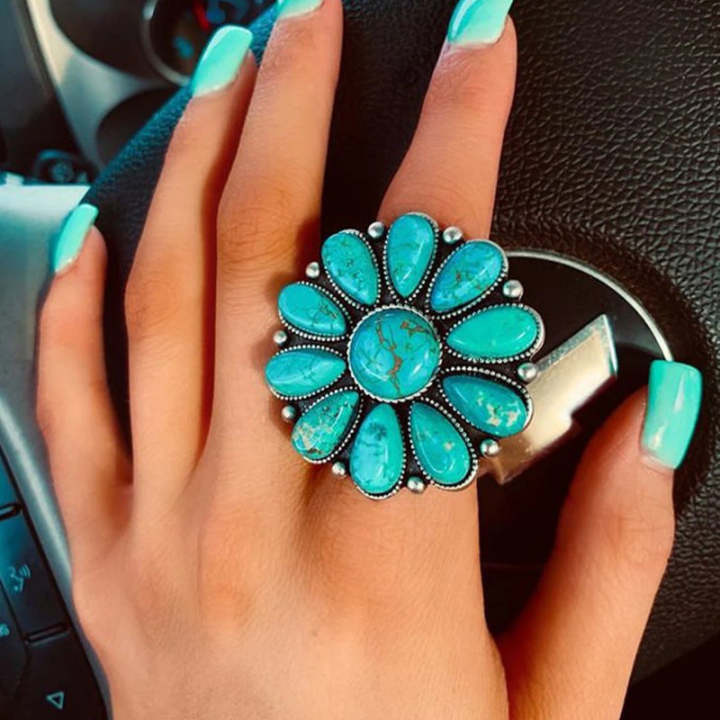
The second product page displayed $75.75 USD, one visible color option, and “Adjustable” as the checked size during review. Its title and photographs presented turquoise, boho, vintage, floral, and statement styling. The visible listing did not clearly state the supported size range, face dimensions, projection, mass, components, finish, construction, adjustment method, or care requirements.
A floral composition may distribute visual detail differently from a cross shape, but photographs alone cannot show how it feels between neighboring fingers or whether the decorative area rotates. Ask the same specification questions for both candidates. Do not transfer an answer from one product to the other simply because their price, color, or adjustable label looks similar.
Mistake 8: Ignoring Fabric, Fringe, and Bag Hardware
Western-inspired outfits often include textured denim, lace, open knits, embroidery, fringe, leather-like surfaces, snaps, zippers, and prominent bag hardware. Each feature creates a contact or snag scenario. The ring should be tested with the exact sleeve, jacket pocket, bag opening, and strap planned for the event.
Move slowly during the rehearsal. Place the ring hand into every pocket, open and close the bag, lift the strap, and put on and remove the jacket. Stop if a decorative edge catches. Do not attempt to “smooth” an unknown finish with abrasive tools. Choose a different placement, remove the conflicting garment, or select a lower-interference accessory.
Mistake 9: Forgetting Phones, Wristbands, and Cashless Venues
A concert outfit is also an interface with the venue. The wearer may use a phone for tickets, maps, photographs, rides, payments, and messages. Entry staff may apply a wristband. Security may ask the wearer to open a bag. A ring that changes grip or blocks a comfortable wristband position can create unnecessary friction.
Rehearse one-handed and two-handed phone use without dropping the device. Check whether the ring contacts the phone case, camera area, screen, or charging accessory. Leave space for a venue wristband and do not cover it with jewelry if staff need to see it. Use a secure bag that can be operated without forcing the ring against metal hardware.
Mistake 10: Wearing the Ring During Incompatible Tasks
A style plan should include a removal plan. Crowded transport, loading equipment, riding, animal handling, mechanical work, sports, heavy lifting, emergency tasks, or any activity where a ring can catch or affect grip may be incompatible. Follow venue instructions and professional safety guidance.
Do not remove the ring casually over a sink, open bag, or crowded floor. Carry a small dedicated case with a positive closure, place it in a consistent secure compartment, and wash and dry hands before storage if the product's care instructions permit. Never put a loose ring in a pocket with keys, coins, or abrasive objects.
Mistake 11: Cleaning an Unknown Construction by Guesswork
Without a complete component and finish disclosure, aggressive cleaning is an experiment. Water, detergent, alcohol, perfume, sunscreen, cosmetics, ultrasonic equipment, steam, polishing cloths, dips, and abrasives may affect different materials or joints in different ways. “Turquoise jewelry care” is not one universal procedure.
Ask the seller for product-specific care instructions before the event. Apply personal-care products and let them dry before putting on jewelry when compatible with those instructions. After wear, inspect the ring in good light, follow the documented cleaning method, dry it as directed, and store it separately. If an element becomes loose, stop wearing the ring and seek qualified assessment.
Mistake 12: Using a Video as Product Authentication
The YouTube video “What is a Statement Ring? Everything You Need to Know About Bold Jewelry Trends” by BriteCo Insurance provides useful general context on the idea of statement rings and how bold jewelry can express personal style. Use that context to think about focal role, scale, and deliberate outfit choices.
The video does not inspect, measure, authenticate, test, price, or endorse either Oroxen product discussed here. It cannot establish turquoise identity, metal, finish, construction, fit, care, origin, or safety for a specific wearer. General education should generate better questions, not replace option-specific evidence.
A 20-Minute Country-Concert Ring Rehearsal
- Minutes 0–3: fit. Confirm the intended finger, check circulation and neighboring-finger clearance, and note any rotation or pressure.
- Minutes 3–6: grip. Hold the phone, bag handle, water container, and any mobility aid or other permitted object normally used.
- Minutes 6–9: clothing. Put on and remove the jacket, use every pocket, adjust the hat, and handle the planned sleeve or glove.
- Minutes 9–12: venue actions. Simulate presenting a ticket, opening the bag for security, paying, using a latch, and reading a map.
- Minutes 12–15: movement. Walk, sit, stand, clap gently, and move the hands through natural conversation gestures.
- Minutes 15–18: removal. Practice moving the ring directly into its dedicated case without placing it on an exposed surface.
- Minutes 18–20: inspection. Check skin, fit, ring stability, fabric contact, and the stored product under good light.
A rehearsal cannot guarantee safety or durability. Its purpose is to expose predictable conflicts in a controlled setting. Any pain, numbness, swelling, skin reaction, insecure fit, catching, or impaired grip is a stop signal rather than a challenge to tolerate.
Build a One-Page Decision Record
| Field | Cross option | Floral option |
|---|---|---|
| Exact selected option | Record label and image | Record label and image |
| Supported size range | Request in writing | Request in writing |
| Face dimensions and projection | Request exact measurements | Request exact measurements |
| Mass and stability | Request and rehearse | Request and rehearse |
| Components and finish | Request full disclosure | Request full disclosure |
| Adjustment method | Request instructions | Request instructions |
| Care and storage | Request exact limits | Request exact limits |
| Return conditions | Review before fitting | Review before fitting |
Record the observation date because price, availability, option labels, and policies can change. Save seller answers with the order. A decision record prevents the excitement of the concert theme from erasing the questions that determine long-wear comfort and purchase risk.
Three Outfit Formulas That Preserve Hierarchy
Formula 1: Ring-Led Denim
Use a plain denim or chambray field, a statement ring, and restrained earrings. Keep the wrist nearest the ring relatively quiet. Let boots or a belt provide texture without repeating the ring's exact shape. Test buttons, cuffs, and pockets for contact.
Formula 2: Dark Base with One Turquoise Repeat
Use a black or deep neutral outfit, the ring as the hand focal point, and one smaller turquoise-colored accent at the neckline or ears. Separate the two accents so the eye travels rather than stopping at a crowded cluster. Confirm each product independently instead of assuming shared materials.
Formula 3: Warm Western Neutrals
Combine cream, tan, rust, or brown with the selected ring and simple hardware. The blue-green color can provide contrast without requiring a matching bag or boot. Evaluate the outfit under the likely venue lighting and keep a secure ring case in the bag.
Use Internal Guides as Different Decision Tools
For a broader wearer-first buying method, read How to Choose Turquoise Jewelry for Men with a Country Concert Look. Its fit-and-preference framework applies regardless of gender. For wrist-level spacing and movement, use 7 Ways to Wear Turquoise Bracelets for a Country Concert Look.
Before treating any Western search label as a specification, consult What to Know Before Buying Turquoise Cowboy Jewelry. The observation discipline in the Southwestern jewelry beginner guide also helps separate what is visible from what still requires evidence.
Final Checklist Before Leaving for the Venue
- The exact ring and option match the saved order record.
- The intended finger fits without pain, numbness, swelling, pressure, or unstable rotation.
- The ring passed phone, bag, jacket, pocket, wristband, grip, and removal rehearsals.
- No unsupported material, age, origin, maker, or cultural claim is being treated as fact.
- The wearer knows the product-specific care limits and has a dedicated storage case.
- The outfit has one clear focal hierarchy rather than several competing statement zones.
- Any task incompatible with ring wear has a safe removal plan.
- Current venue rules, weather, transport, and accessibility needs have been checked.
Conclusion: Avoiding Mistakes Creates a Stronger Look
The best turquoise Western ring styling is not the outfit with the most symbols or the greatest visual volume. It is the outfit in which one exact product has a defined role, a verified fit, enough hand clearance, compatible care, and a tested relationship with everything the wearer will actually do.
Compare the cross and floral candidates with the same evidence standard. Ask for missing specifications, rehearse the complete event routine, and stop when fit or safety fails. Explore more options and practical guides from the Oroxen homepage, but treat every listing as its own purchase decision. Deliberate restraint, honest uncertainty, and a reliable removal plan do more for a confident country-concert look than automatic matching ever can.