Turquoise Necklaces for Country-Music Fans: A Practical Guide
A country-music fan may want a necklace that feels connected to denim, boots, live shows, favorite artists, road trips, dancing, or everyday western-inspired clothing. The mistake is to let the mood answer questions that only product evidence can answer. A blue-green pendant can support a country look without proving natural turquoise, sterling silver, vintage age, handmade construction, a particular origin, or all-day comfort.
This practical guide turns necklace selection into a five-track setlist. The first track verifies facts. The second tests the necklace alone. The third tests layering. The fourth rehearses the actual listening or event context. The fifth plans removal, storage, and care. A candidate earns an encore only after it completes the entire set.
Quick Answer: Build the Setlist Before Buying the Headliner
Choose one intended role: everyday signature, concert focal point, layered accent, gift, or symbolic pendant. Then obtain the exact necklace length, extension range, pendant dimensions, total and pendant mass, clasp, chain or cord components, decorative materials, finish, construction, care, and included pieces. Reproduce documented measurements against the intended neckline and test the complete outfit in motion.
If the necklace leads, keep earrings and hat decoration quieter. If layers are desired, give every chain a different verified length and a separate visual job. If product details remain missing, styling can stay provisional but gemstone, metal, age, origin, treatment, comfort, and care claims must remain unconfirmed.
The published complete western turquoise jewelry guide provides category-level buying context. For a wider view of motif and accessory relationships, use the published cowgirl jewelry style guide.
Write the Necklace's Job in One Line
A country-music connection is personal. One wearer may associate a teardrop with a favorite ballad, another may see only a useful geometric outline, and another may prefer a cross because it carries religious or personal meaning. The product title cannot decide that meaning. Write a single job sentence before opening several listings.
Examples include “sit clearly over a dark concert tee,” “add one blue-green point to a denim shirt,” “layer below a small existing chain,” or “serve as a gift only after the recipient's symbolism, fit, and materials are known.” A precise job prevents the gallery from turning every visible detail into a requirement.
Track One: Soundcheck the Product Facts
A soundcheck finds problems before the audience arrives. The necklace version begins with a blank evidence card. Record the current URL, review date, selected option, current price, and matching image. Add fields for full wearable length, extension, pendant height and width, total mass, pendant mass, chain or cord construction, clasp, all contact components, decorative material, stated treatment, finish, assembly, care, availability, delivery estimate, and return terms.
Write “not stated” in every empty field. Do not estimate scale from a hand, model, guitar, shirt button, coin, or uncited ruler graphic. Do not transfer measurements from another design in the same gallery. If several options share one page, save the exact Design label and its corresponding images before asking questions.
“Turquoise-style,” “turquoise-colored,” and “antique-silver color” describe appearance. They do not prove a natural mineral, silver content, historical age, oxidation process, plating, or construction. “Vintage-inspired” is a design direction, not a date. The published guide to western jewelry motifs, styles, and materials explains why these categories should stay separate.
Track Two: Let One Necklace Play Solo
Put the exact base outfit on without jewelry. Identify its strongest existing elements: graphic on a concert tee, pearl-like snaps, embroidery, yoke, fringe, scarf, hat band, belt buckle, jacket hardware, or patterned dress. Add only the necklace. The pendant should have a stable background and enough open area for its outline to be understood.
Test at three distances. A close view reveals visible details. Conversation distance shows whether the pendant has a clear role near the neckline. A full-body photograph shows whether it connects to the outfit without becoming the only thing visible. A large crop on a product page cannot answer these three questions.
Use the real hairstyle, glasses, hat, outer layer, and bag. Sit, turn the head, look down, reach across the body, use a phone, zip the jacket, and remove it. Note chain migration, pendant flipping, clasp movement, hair contact, collar collision, and bag-strap overlap. These are test observations, not predictions from appearance.
Track Three: Arrange a Duet Without Tangling the Parts
Layer only after the solo works. Assign one necklace the lead and the other a supporting rhythm. The lead may have the recognizable teardrop or cross form; the support should be simpler, visibly separated, and less demanding. Exact length difference matters, so obtain measurements instead of relying on product photos.
Build a paper or cord neckline mockup from documented lengths. Mark the clasp and pendant positions, then place the mockup over the actual shirt or dress. This previews vertical spacing, not mass, movement, surface interaction, or tangling. Never fasten cord tightly around the neck, and do not use a mockup as proof that the real materials will be comfortable.
During the movement test, record whether the chains cross, pendants strike, surfaces rub, or one object covers the other. Mixed materials and finishes may react differently to friction and care. If exact construction is unknown, the honest solution may be to wear one necklace at a time.
Track Four: Rehearse the Real Listening Context
Everyday playlist and errands
Test a seat belt, jacket, tote or crossbody strap, phone, desk edge, and normal walking. An everyday signature should survive ordinary motion without constant repositioning. “Everyday” in copy is a styling suggestion, not a durability or comfort guarantee.
At-home listening or watch party
A controlled environment still includes reclining, headphones, hair, blankets, food, and children or pets. Decide whether wearing jewelry adds to the occasion or introduces needless contact. Store it safely when the activity changes.
Dance venue or social night
Check the current venue rules, then rehearse turning, raising the arms, sitting, and interacting at normal social distance. A pendant that swings freely may contact the body or another necklace. Choose verified length and mass appropriate to the wearer's preference, and remove jewelry if it interferes.
Country concert
Include hearing protection, weather layers, hat, bag, event wristband, security screening, seat, phone, and storage. The published country concert jewelry guide expands this rehearsal across necklaces, earrings, bracelets, and rings. No article can guarantee that a specific venue permits an item; verify current rules directly.
Track Five: Plan the Encore, Removal, and Care
Decide when the necklace comes off before the event begins. Bring a rigid or semi-rigid case with a dependable closure if removal may be needed. Keep the pendant and chain from tangling with keys, coins, earphones, or other jewelry. Do not put an unknown finish loose in a pocket or bag.
Exact care follows exact materials and construction. Do not apply silver polish because the surface looks silver-colored. Do not use stone cleaner because the center looks blue-green. Do not assume water, sweat, perfume, sunscreen, hairspray, heat, sanitizer, or ultrasonic cleaning is safe. Request written instructions for the selected item and preserve them with the evidence card.
After wearing, inspect the clasp, chain or cord, connector, pendant attachment, and visible surfaces in good light. Record changes without improvising glue, bending, polishing, or solvent use. A repair method suitable for one construction can damage another.
Explore Silhouettes Without Turning a Collection into Proof
The Western Necklaces collection is useful for comparing pendant shapes, visual scale, color placement, repeated motifs, and the difference between compact and extended silhouettes. It is not a material certificate. Every candidate still needs exact facts from its own page and, where necessary, direct seller documentation.
Make a shortlist of no more than three jobs, not three looks. For each candidate, write what it can do that the others cannot. If two products have the same job, compare evidence completeness, verified fit, wearer meaning, movement, care burden, and current terms. Price and gallery count are observations, not quality scores.
Product Study One: Turquoise Western Teardrop Pendant Necklace
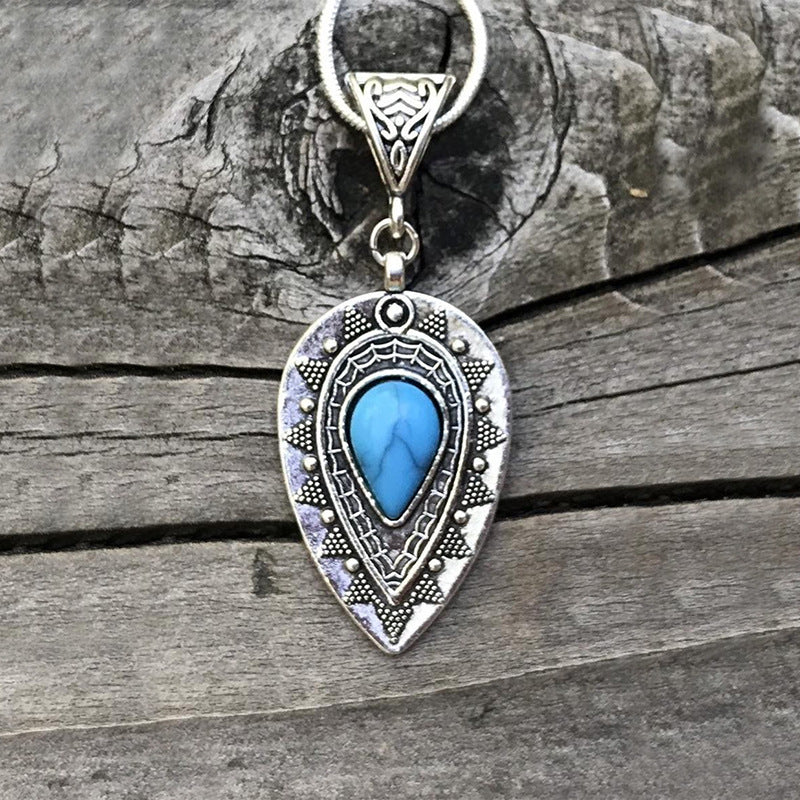
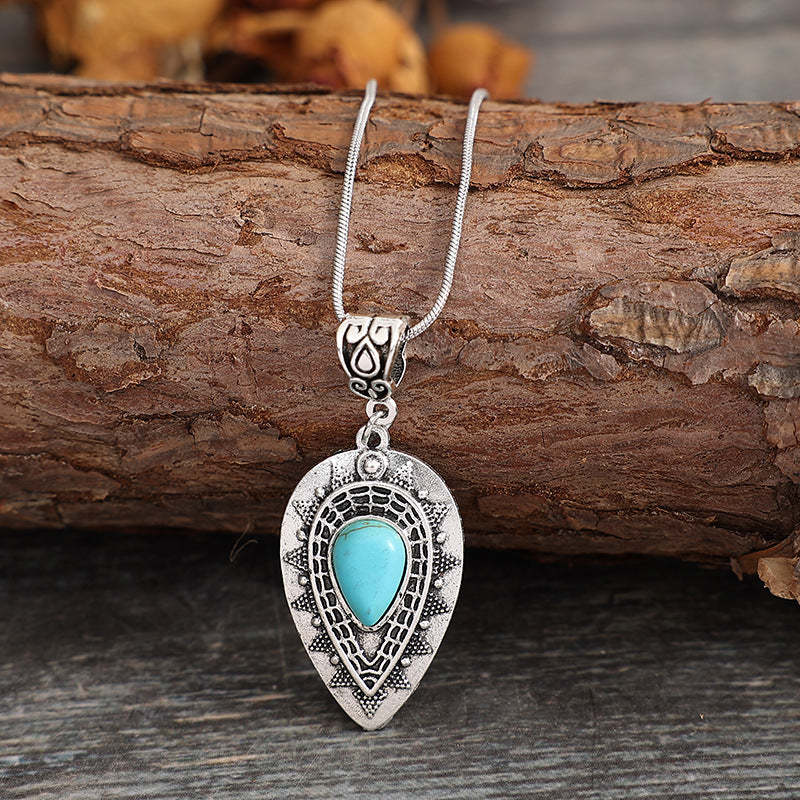
The Turquoise Western Teardrop Pendant Necklace page was reviewed on August 24, 2026. It displayed $39.99 USD, one visible Color choice, and an eleven-image gallery. Current copy describes a western pendant necklace with a vintage-inspired statement design. It specifically identifies a turquoise-style center stone, teardrop silhouette, vintage-inspired detailing, and antique-silver color.
The page suggests wearing the necklace alone as a focal point or layering it with simpler necklaces. That supports testing solo and duet roles. It does not establish natural turquoise, silver content, vintage age, exact wearable length, extension range, pendant dimensions, total or pendant mass, clasp type, chain components, finish process, construction, or care.
How a beginner can audition the teardrop
Give the teardrop a plain background first: a dark concert tee with a quiet graphic zone, light chambray, a simple dress, or an open denim jacket over a solid base. Avoid another large teardrop at the ear or buckle until the necklace's role is clear. If a second necklace is planned, request both exact lengths and keep the support chain visually simpler.
Ask the seller to identify the center material, any treatment or composite information, every metal or nonmetal component, surface finish, chain construction, clasp, connector, length, extension, dimensions, mass, and care. “Antique-silver color” should remain a color description until material and finish are documented.
Product Study Two: Western Turquoise Vintage Geometric Cross Necklace
The Western Turquoise Vintage Geometric Cross Necklace page was checked on August 24, 2026. It displayed $126.25 USD, three visible Size choices labeled Design 1, Design 3, and Design 4, and a fifteen-image gallery. The visible product language establishes western, turquoise, vintage, geometric, and cross styling directions.
The page reviewed did not identify natural turquoise, documented age, exact materials, full length, extension, pendant dimensions, mass, clasp, chain construction, finish, treatment, or care. Three visible Design choices may differ materially in shape, arrangement, length, or components. Do not transfer an image or fact from one design to another.
How a beginner can audition the cross
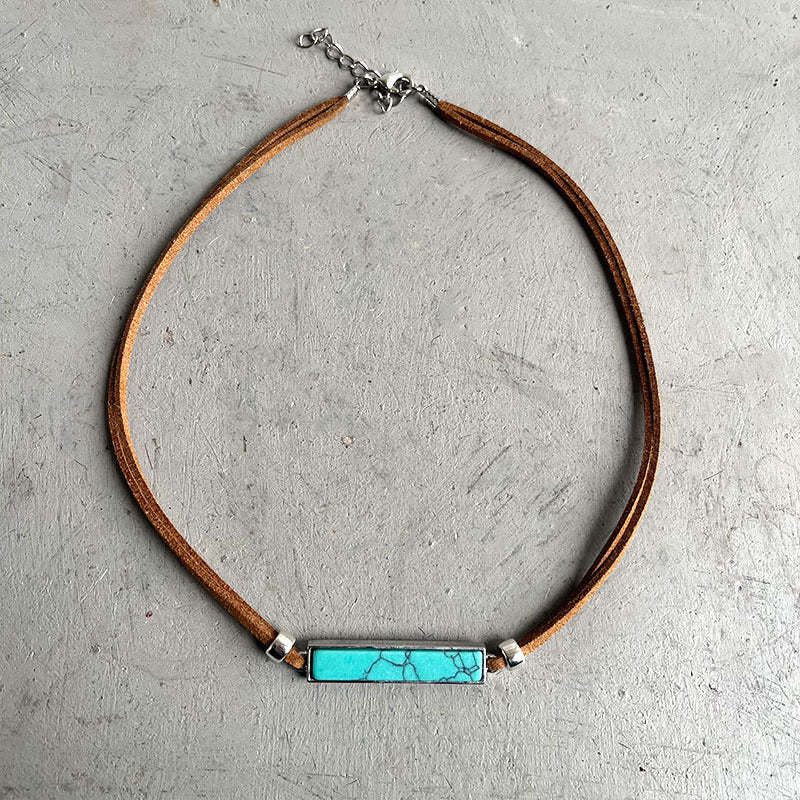
First decide what the cross means to the wearer. It may be religious, personal, cultural, memorial, aesthetic, or unsuitable; the seller and stylist should not assign that meaning. If the wearer chooses it, let the cross be the only large symbolic motif in the upper outfit. Use a plain shirt, restrained jacket hardware, and compact earrings.
Save the selected Design label and matching gallery image, then request its exact specifications. Reproduce the documented pendant area against the neckline. A cross outline may need more open space than a compact teardrop because recognizable horizontal and vertical arms can visually intersect collar points, buttons, snaps, or printed text.
Compare the Two Listings Like a Setlist Editor
| Decision field | Teardrop pendant | Geometric cross necklace |
|---|---|---|
| Visible choices | One Color choice | Design 1, Design 3, Design 4 |
| Page wording | Turquoise-style center; antique-silver color | Western, turquoise, vintage, geometric, cross |
| Potential solo job | Compact shape-led focal point | Recognizable symbolic focal point |
| Main styling question | Where does the teardrop sit? | Which exact design and wearer meaning? |
| Essential missing facts | Length, size, mass, clasp, materials, care | Per-design length, size, mass, clasp, materials, care |
The higher displayed price of the cross listing does not prove natural turquoise, precious metal, handmade work, age, durability, or greater value. The teardrop page's more specific appearance wording does not make its physical specifications complete. A useful comparison asks which exact product has the evidence and fit required for the intended job.
How to Use the Authentication Video Responsibly
The Antique Nomad's short video “How to Spot Authentic Turquoise Jewelry: Learn the Telltale Signs!” invites viewers to look for clues and ask questions about authenticity. Its public page also identifies a jewelry seller featured in the clip. The title is useful because it reminds a beginner that “turquoise” can be an evidence question rather than only a color choice.
No short visual test can authenticate either Oroxen necklace from web images. Color, matrix-like pattern, backing, price, weight, temperature, scratching, heat, chemicals, or another casual test should not be treated as definitive, and destructive tests can damage jewelry. Obtain a precise written disclosure covering material and treatment; for a high-stakes purchase or disputed item, use a qualified independent professional with appropriate methods.
The video does not prove either product's natural turquoise, silver content, maker, origin, age, design history, or value. It also does not provide the fit and care facts required by the five-track setlist. Keep inspiration, seller claims, and independent verification in separate columns.
Country-Music Outfit Setlists
Concert tee and denim jacket
Place one pendant outside a quiet portion of the tee or inside the open jacket frame. Avoid printed text directly behind a cross or teardrop. Test the jacket closed, open, removed, and carried. Use compact earrings and a simple hat band if the necklace leads.
Pearl-snap shirt and boots
Repeated snaps already create rhythm. Choose one necklace, open only the neckline that is appropriate and comfortable, and keep the pendant from colliding with the snap line. If the necklace sits above the shirt, verify enough chain length; if it sits below, ensure it remains visible without pulling the collar.
Simple dress for a social night
A solid or low-pattern dress gives a symbolic or geometric pendant space. Use a jacket only after the collar and lapel test. If a belt or boot already carries a large western motif, let the necklace repeat color rather than adding another motif family.
Everyday dark knit
A smooth dark background can make blue-green color and an antique-silver-colored surface more visible. Check whether the knit catches connectors or textured edges. Appearance cannot predict snag behavior, so test the actual item and stop if fabric or jewelry is at risk.
Beginner Mistakes to Remove from the Setlist
- Buying the mood instead of the measurements: obtain length, extension, pendant size, and mass for the exact option.
- Calling a turquoise-style center natural turquoise: preserve the listing's appearance wording until evidence supports more.
- Calling an antique-silver color sterling silver: color is not a metal-content statement.
- Assigning meaning to a cross for someone else: let the wearer decide whether and how the symbol belongs.
- Layering before the solo works: confirm one necklace's fit and movement before adding another.
- Using price as authentication: price alone does not establish material, age, maker, origin, or value.
- Applying an improvised test or cleaner: seek documentation or qualified help and protect the item from damage.
Frequently Asked Questions
What necklace length works with a concert tee?
There is no universal length because neck, shirt graphic, collar, pendant, and preference differ. Obtain the exact wearable range, reproduce it against the actual tee, and test sitting, movement, and layers.
Can a turquoise-colored necklace be worn with other blue-green jewelry?
Yes, but exact matching is unnecessary. Start with one focal necklace and one smaller distant echo. Remove any piece that competes, tangles, or makes the outfit harder to use.
Are the two Oroxen examples natural turquoise?
The visible information reviewed did not establish that. The teardrop page says turquoise-style center stone; the cross page uses turquoise in its styling name without a complete material statement. Ask for exact documentation.
Does “vintage” mean the necklace is old?
Not automatically. “Vintage-inspired” is clearly styling language. A “vintage” title alone does not prove a manufacturing date, ownership history, or period. Request provenance when historical age matters.
Can the necklaces be layered together?
Only after exact lengths, pendant dimensions, masses, clasps, materials, finishes, and movement are known. The teardrop page suggests layering with simpler necklaces; the cross may be too visually or physically demanding for the same combination. Test rather than assume.
How should a necklace be stored after a show?
Follow item-specific instructions. In general planning, use separate supported storage that prevents tangling and uncontrolled contact, but do not add anti-tarnish materials, chemicals, oils, or cleaners without knowing the construction.
What if authenticity matters to the purchase?
Request written material and treatment disclosure with supporting documentation. For substantial financial, cultural, historical, or resale importance, seek a qualified independent professional rather than relying on photographs or casual online tests.
Five-Track Final Checklist
- Soundcheck: the exact option, dimensions, mass, clasp, components, materials, finish, construction, care, and terms are documented or marked unknown.
- Solo: the pendant has a clear background and passes close, conversation, and full-outfit views.
- Duet: any second necklace has a separate job, verified spacing, and no unresolved contact.
- Live set: clothing, hat, hair, phone, bag, hearing protection, seating, weather, and venue rules are rehearsed.
- Encore: removal, secure storage, inspection, and exact care are planned.
Conclusion: Let Evidence Keep the Beat
A turquoise-style necklace can express a country-music connection without carrying claims the page cannot support. Define its job, soundcheck the facts, let it play solo, add a duet only when spacing works, rehearse the real context, and prepare a safe encore. That sequence turns a favorite-looking pendant into a considered wardrobe decision.
Explore additional shapes in the Western Jewelry collection or start again from the Oroxen homepage. Choose the exact option, preserve the seller's exact wording, and let documented fit, wearer meaning, and responsible verification determine which necklace makes the final setlist.