“Statement” and “everyday” are not permanent labels attached to a piece of jewelry. They describe the relationship between that piece, the wearer, the clothing, the setting, and the frequency of use. A cross earring can become the loudest element in a plain black outfit or a supporting detail beside a decorated jacket and hat. A sculptural turquoise-style earring can feel special for one person and routine for another.
This comparison is for men who want a practical way to choose and style turquoise-colored jewelry without being boxed into arbitrary gender rules. The method uses two axes—visual intensity and use frequency—then adds comfort, dress code, evidence, and maintenance. The current product examples happen to be earrings, but the decision framework also works for rings, necklaces, and bracelets. Product names are treated as retail language, not proof of stone identity, metal content, origin, age, or construction.
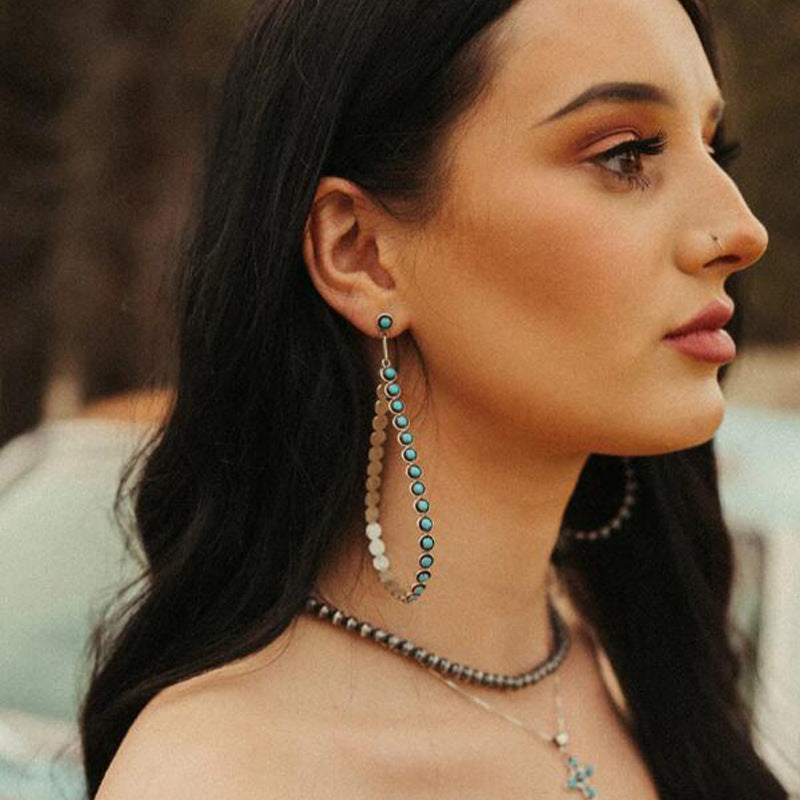
Quick Answer: Choose a Role, Not a Gender Uniform
Start with the life the jewelry must enter. List three real settings from the last month: work, class, dinner, concert, travel, weekend errands, or a formal event. Then decide whether the piece should disappear into a repeatable personal uniform, provide a controlled accent, or lead the entire outfit.
Everyday styling usually reduces management. The item works with several outfits, survives normal movement, fits the dress environment, and does not require constant adjustment. Statement styling intentionally increases visual priority through scale, motif, contrast, movement, repetition, or empty space. Neither role implies higher quality or greater masculinity. Both require accurate product facts and personal comfort.
The Turquoise Jewelry Guides provide topic context. For a broader introduction to Western motifs and product language, use What Is Western Jewelry?.
The Two-Axis Comparison
Axis 1: visual intensity
Rate the complete look from one to five. One means the jewelry is noticed only after the clothing. Five means it becomes the first visible signal. Judge from full-outfit distance, not a product close-up. Contrast with hair, skin, shirt, jacket, hat, and other accessories changes the score.
Axis 2: use frequency
Estimate realistic wear in the next thirty days. Use calendar events and existing outfits rather than an imagined future identity. An item worn twice a week has a different role from one reserved for concerts or celebrations, even if both have the same visual intensity.
The four zones
- Low intensity, high frequency: quiet daily uniform.
- High intensity, high frequency: recognizable personal signature.
- High intensity, low frequency: event statement.
- Low intensity, low frequency: weak wardrobe fit or a very specialized purpose.
The fourth zone deserves scrutiny before purchase. A piece can be attractive yet lack a real job. Move it into another zone by identifying more outfits, changing its supporting clothes, or deciding that admiration does not require ownership.
Everyday Styling Criteria
An everyday piece must pass repetition, movement, and compatibility tests.
- Repetition: it works with at least three outfits already owned.
- Movement: it clears hair, collar, headphones, glasses, helmet or hat, and bag straps.
- Environment: it fits the actual workplace, school, venue, or activity expectations.
- Maintenance: the documented care routine is realistic for frequent use.
- Evidence: necessary dimensions, weight, attachment, materials, and terms are known.
Everyday does not have to mean tiny. A noticeable earring can become a signature when the rest of the wardrobe is consistent. The defining feature is repeatability, not invisibility.
Statement Styling Criteria
A statement role needs intention and space.
- Priority: the jewelry is deliberately first or second in the visual order.
- Contrast: neighboring colors and shapes make the silhouette readable.
- Editing: other motifs, graphics, hardware, and accessories are controlled.
- Destination: the visual impact suits the event rather than fighting practical conditions.
- Comfort: increased scale or movement has been tested for the necessary duration.
Statement styling can be minimalist. A single turquoise-colored cross against a plain shirt may carry more impact than five themed accessories. Empty space is an active styling tool.
Compare Current Options with One Scorecard
Browse the Turquoise Jewelry collection and rate every shortlisted item on the same seven lines: visible intensity, outfit count, occasion count, movement compatibility, documented fit, documented materials and care, and return flexibility.
Do not give one product a pass because its photograph is more dramatic while demanding detailed proof from another. Fair comparison uses equal evidence standards. If a score depends on a missing measurement or material statement, mark it “unknown,” not “good” or “bad.”
| Criterion | Everyday question | Statement question |
|---|---|---|
| Visibility | Can it support several outfits? | Can it lead without visual competition? |
| Comfort | Can I forget I am managing it? | Can I tolerate it for the whole event? |
| Wardrobe | Which three outfits exist now? | Which exact outfit provides the stage? |
| Evidence | Are repeat-use care facts clear? | Are scale, weight, and attachment verified? |
| Value | How many realistic wears? | How important is the occasion role? |
Option A: Turquoise Statement Cross Earrings
The Turquoise Statement Cross Earrings provide a recognizable motif. The current page shows a single color selector and describes turquoise, statement, and cross design language. The gallery supports visual observation of the cross silhouette and turquoise-colored details. It does not visibly document the exact dimensions, weight, materials, attachment, or care needed for a complete fit decision.
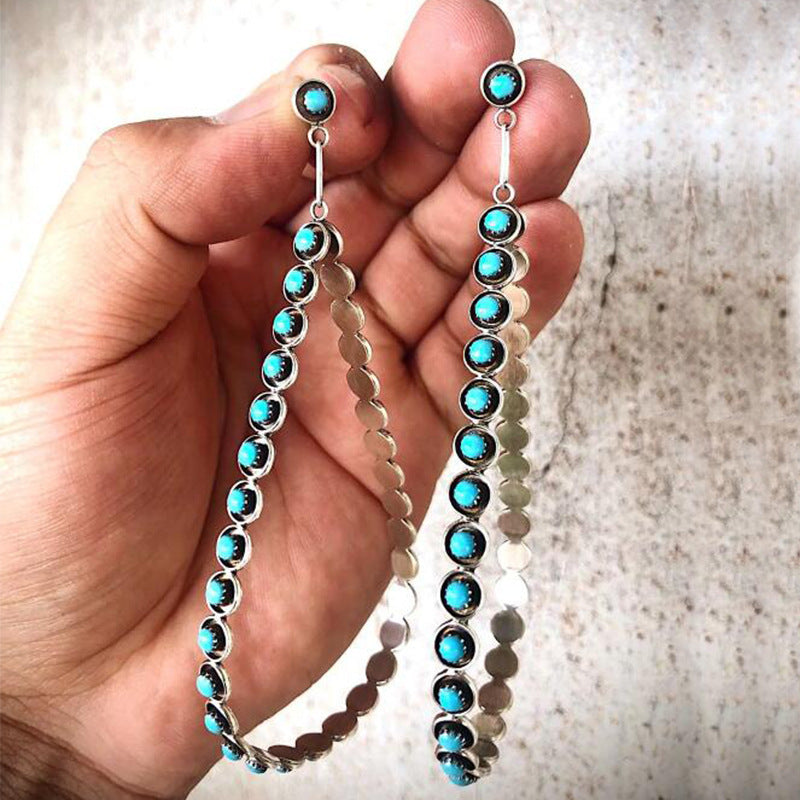
Everyday route
Pair the earrings with a plain tee or knit, dark or medium denim, and restrained neck jewelry. Keep hair and the jacket collar from hiding or striking the selected design. Repetition can turn the cross into part of a personal uniform. Photograph three actual outfits and identify which one requires the fewest adjustments.
Statement route
Use a monochrome shirt or clean jacket field, remove competing face-level motifs, and let the cross outline lead. A hat can frame the composition, but a strong brim adds another line; compare front and side views. Place any second bold element farther away, such as footwear, rather than clustering everything around the head and chest.
Tradeoffs and questions
A literal motif communicates quickly, which is useful for a statement and potentially limiting for some dress environments. Ask for length, width, weight per earring, attachment type, materials, and care. Test jaw, collar, hair, glasses, headphones, and hat clearance using the documented measurements.
Option B: Turquoise Western Statement Earrings
The live Turquoise Western Statement Earrings page describes a sculptural silhouette, turquoise-style center stones, and vintage-inspired detailing. “Turquoise-style” is appearance language and should not be changed into a natural-stone assertion. The page suggests denim, boots, dresses, everyday cowgirl looks, festivals, and Western-themed events, but personal styling and comfort still need direct testing.
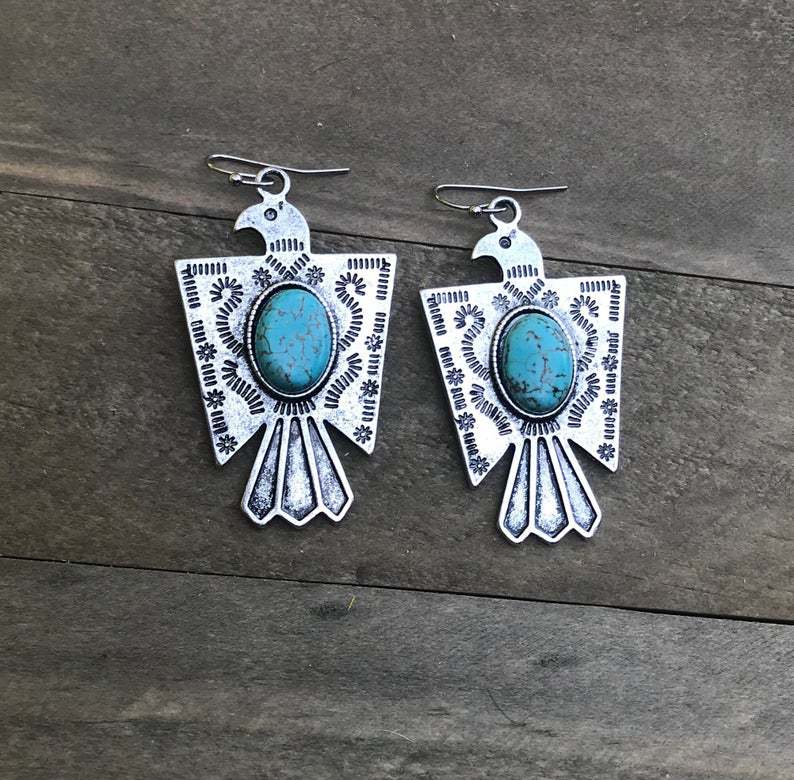
Everyday route
Use the earrings with a simple workwear or denim outfit and keep other jewelry geometric and quiet. Repeating one metal color is optional; controlled scale matters more than perfect matching. If the sculptural outline is already strong beside facial hair, glasses, or a textured collar, leave the neckline open rather than adding another centerpiece.
Statement route
Choose a high-contrast shirt and remove extra collar detail. Let the turquoise-style center and silhouette become the face-level color signal. A dark denim jacket can create a structured base, while boots provide a distant echo. Judge at full length and in event lighting.
Tradeoffs and questions
Shape-led jewelry may be more adaptable than a literal motif for some wardrobes, but that is personal, not universal. Request dimensions, weight, attachment, materials, surface treatment, and care. Decide only after testing the selected silhouette against hair, jaw, collar, and expected wear time.
Men’s Outfit Scenarios
Work or class
Start with dress expectations and safety requirements. Choose an everyday role when headphones, uniforms, protective equipment, or frequent layer changes make large movement impractical. A statement role can still work in a creative environment when the piece has clear space and documented comfort.
Weekend errands
Use a repeatable base: tee, overshirt or denim jacket, trousers or jeans, and practical shoes. Test sunglasses, hair, a cap, and bag straps. Everyday success means the jewelry does not require a new wardrobe or constant rearrangement.
Country concert
A statement earring can photograph well, but movement, crowds, temperature, security, hats, and bags matter. Use the published Country Concert Jewelry Guide for the full venue test.
Dinner or date
A sculptural or motif-led earring can provide the only strong accent above a dark shirt. Check seated proportions and restaurant lighting. A necklace is optional; a clean neckline can make the earring look more deliberate.
Travel
Consider headphones, neck pillows, seat belts, luggage straps, and secure storage. A lower-intensity or smaller role may be easier, but any design that passes the actual travel circuit can become everyday.
What a Ring-Focused Video Can and Cannot Add
The paired video is “Turquoise in Rings” by Turquoise in America. It is ring-focused rather than an earring styling tutorial. That difference should be explicit. The video may introduce visual or terminology questions related to turquoise jewelry, but it does not establish facts about either Oroxen earring example.
Watch the full video before citing a specific idea. Do not copy its transcript or transfer claims about a ring, stone, treatment, maker, period, or construction to a photographed earring. Use it to form better questions, then verify those questions with option-specific documentation or appropriate professional expertise.
Comparison Errors to Avoid
- Calling large “statement” and small “everyday”: role depends on contrast, motif, placement, and wearer.
- Treating men’s style as a narrow rulebook: fit the jewelry to the person, wardrobe, and setting.
- Comparing one product close-up with another full outfit: use equal distance and lighting.
- Assuming price proves material or quality: require explicit product evidence.
- Estimating weight from appearance: ask for the number and test personal tolerance.
- Counting imaginary occasions: use calendar-based realistic wear.
- Ignoring returns: fit and visual scale can differ from expectations.
Run a Thirty-Day Wear Simulation Before Buying
Draw a calendar with the next thirty days and mark only events that are already likely to happen. Give each day one of four codes: work or class, routine leisure, social occasion, or special event. Now place the proposed earring role beside each relevant date. An everyday candidate should appear repeatedly without requiring an entirely new outfit. A statement candidate may appear fewer times, but each appearance should have a clear purpose and a complete outfit.
For every planned wear, record the supporting shirt or jacket, expected duration, headwear, glasses, headphones, travel method, and whether the environment has dress or safety restrictions. This exposes false versatility. If the same hypothetical black shirt is doing all the work but that shirt is not owned, the jewelry is not yet compatible with the current wardrobe.
You can also calculate a planning number: current price divided by realistic first-year wears. It is not a quality score and it should not replace taste. It simply shows how the everyday and statement scenarios use the budget differently. A frequently worn signature may spread cost across many days; an event piece may justify fewer wears when the occasions are meaningful. Do not inflate the denominator with imagined events.
Finally, assign each planned wear a management score from zero to three. Zero means the piece can be worn without adjustments. One means a hairstyle or collar choice is required. Two means several outfit changes are necessary. Three means the setting, movement, or missing product facts make the wear unlikely. A strong everyday candidate accumulates many zeroes and ones. A strong statement candidate may include more planning, but not unresolved fit or safety problems.
Frequently Asked Questions
Can men wear turquoise-colored statement earrings every day?
Yes, if the design fits the wearer’s routine, dress environment, comfort, and wardrobe. High visual intensity can become a repeatable signature.
Is a cross earring more masculine than a sculptural earring?
There is no objective masculinity score. Choose the motif or shape that fits personal expression, clothing, and context.
Which option is more versatile?
Count real outfits and occasions, then test each design at equal distance. A literal motif may be highly versatile for one wearer and specialized for another.
Does “turquoise” prove natural turquoise?
No. Treat titles and color language as merchandising unless an explicit, option-specific material statement provides evidence.
What facts matter most for earrings?
Exact selected option, dimensions, weight per earring, attachment, materials, finish, care, comfort, current price, stock, shipping, and returns.
How should jewelry be gifted to a man?
Use the recipient’s actual style, ear piercing and attachment preference, comfort tolerance, dress context, and return needs. The published Western Jewelry Gift Guide offers a transferable recipient-and-occasion method even though its title focuses on gifts for her.
Where should I browse next?
Compare current styles in Turquoise Jewelry, expand to the Western Jewelry collection, or return to the Oroxen home page.
Final Decision: Set the Intensity and Frequency on Purpose
Choose the everyday route when the jewelry must repeat easily across existing clothes, movement, and environments. Choose the statement route when the outfit can give the piece deliberate space and the event benefits from stronger visual priority. A single product can serve both roles with different styling.
Record the intended zone, three real outfits, documented measurements, expected wear time, and any unanswered product fact. That record is more useful than a gender stereotype or an isolated close-up. Turquoise-colored jewelry for men works best when personal expression, evidence, comfort, and real life are all included in the comparison.