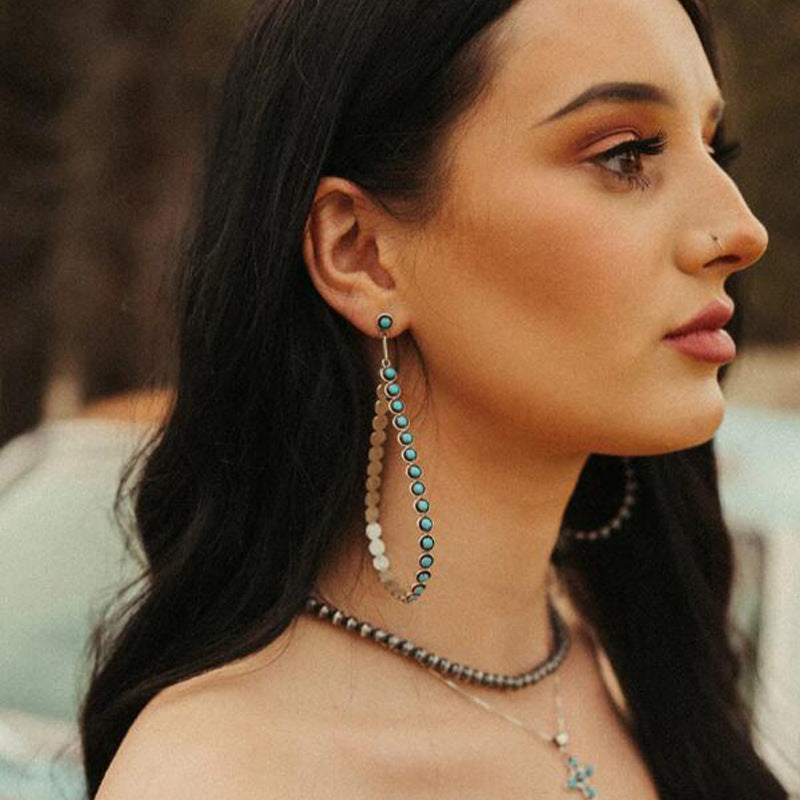
Turquoise Earrings in a Capsule Wardrobe for Cowgirl-Style Beginners
A cowgirl-inspired capsule wardrobe does not need dozens of themed pieces. It needs a small group of clothes and accessories with clear jobs. Turquoise-colored earrings can serve as the visual signature, but only when the rest of the capsule gives them room, the exact product facts are verified, and the wearer can repeat the combination without discomfort. This guide builds a practical twelve-outfit test around four clothing bases, two earring roles, and three levels of styling intensity.
The method is designed for a beginner who likes western character but does not want to look costumed. It separates appearance from evidence: a blue-green center may create a turquoise look without proving natural turquoise, and a product title may describe a cross or statement silhouette without establishing size, materials, weight, attachment, or care. The goal is not to make every outfit louder. The goal is to make a few compatible pieces work harder.
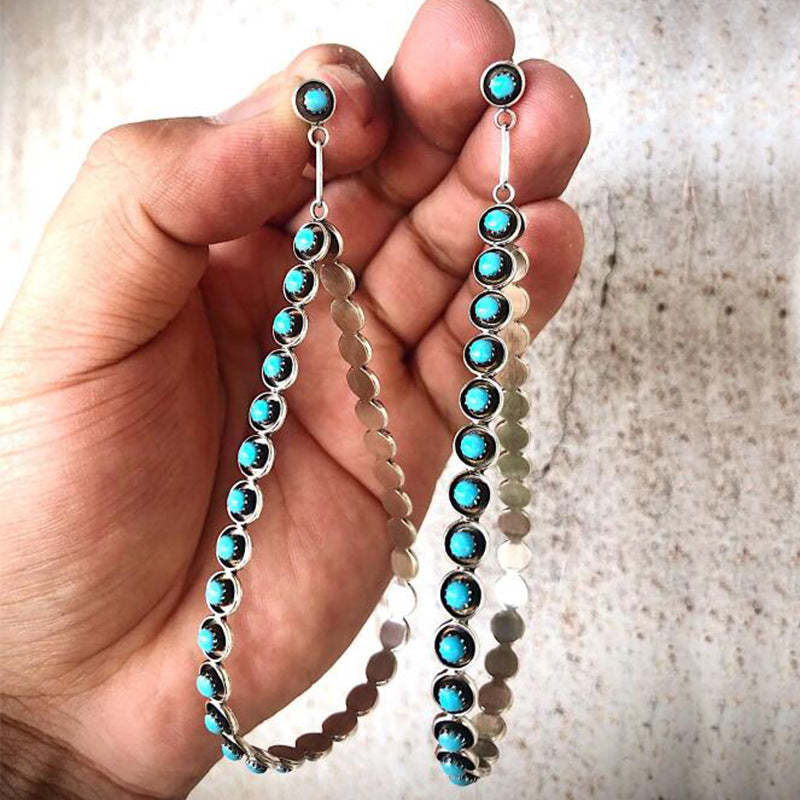
Quick Answer: Give Every Earring a Capsule Job
Begin with four clothing bases: a white or cream top with straight denim, a dark solid top with denim, a simple dress, and a workwear combination such as a plain shirt with a jacket. Then define two earring jobs. The signature job supplies the main motif or color. The support job keeps the ear visible while another part of the outfit leads. One pair may do both jobs if its scale, movement, and visual detail work across the bases; two pairs can divide the work more precisely.
Test each base at three intensities: quiet, balanced, and event-ready. That creates twelve outfits without buying twelve looks. A quiet version uses one western cue. A balanced version adds one distant echo, such as a belt shape, boot texture, or small blue-green detail. An event-ready version adds a stronger layer or accessory while keeping one focal zone. Photograph the results, record comfort, and keep only combinations you would repeat.
For broader context before choosing a candidate, read the published complete western turquoise jewelry guide. The published cowgirl jewelry style guide also shows how earrings, necklaces, and other categories can share the outfit without competing.
What a Capsule Wardrobe Means Here
A capsule is a decision system, not a fixed number. The useful question is whether each item connects to several others and performs a real job. An earring that works with one photograph but tangles with every collar, hat, hairstyle, or headset is not an efficient capsule piece. A pair that works with three bases, survives a realistic movement test, and can shift between quiet and expressive styling may earn its place even if it looks distinctive.
Do not use “timeless,” “versatile,” or “comfortable” as assumptions. Turn them into tests. Timeless means you can name several future occasions and still want the look. Versatile means the exact pair passes multiple outfit cells. Comfortable means the exact dimensions, mass, attachment, contact materials, and movement have been checked—not that the gallery makes the earrings look light.
The Four Base Outfits
Base One: Light top and denim
A white, cream, oatmeal, or pale chambray top gives blue-green color and darker metal-like detail a clear background. Use a simple neckline and let the earrings carry the first western cue. If the shirt has embroidery, pearl-like snaps, fringe, or a strong yoke, count that as an existing cue and reduce the jewelry elsewhere.
Base Two: Dark solid top and denim
Black, navy, charcoal, chocolate, or deep olive changes the contrast. Photograph the earrings against the actual fabric and hair rather than predicting from a product page. A dark ground may make a bright center stand out, while dark hair may hide an outline. Move the hair, change the neckline, or choose a different visual role before buying another accessory.
Base Three: Simple dress
A solid or low-contrast dress lets a statement pair create western direction without a full themed outfit. Check the relationship between earring length, neckline, sleeve volume, and any hat brim. A dress with a large floral print already carries pattern; add earrings as a controlled accent rather than matching every color in the print.
Base Four: Workwear layer
Use a plain tee or shirt under denim, canvas, suede-look, or other workwear-inspired outerwear. The jacket creates hardware, seams, and collar movement, so rehearse putting it on and taking it off. Earrings that look clear with the jacket open may become crowded when the collar closes. The published guide to styling western jewelry with denim, dresses, boots, and workwear expands these clothing relationships.
The Twelve-Outfit Wear Test
| Base | Quiet | Balanced | Event-ready |
|---|---|---|---|
| Light top + denim | Earrings only | Add one belt or boot echo | Add a jacket, then retest collar contact |
| Dark top + denim | Clear ear zone | Add one restrained hand or wrist detail | Add a hat with a quiet band |
| Simple dress | Earrings as the only western cue | Add boots or a small bag detail | Add an outer layer without covering the ear |
| Workwear layer | Open jacket and no necklace | Add one small distant echo | Close, remove, and carry the jacket during the test |
Score every cell from zero to two in five categories: visual clarity, physical comfort, movement security, repeatability, and confidence. Zero means the combination fails, one means it needs adjustment, and two means you would wear it again as shown. A possible total of ten is less important than the notes. “Collar touches earring when seated” is actionable; “not sure” is not.
Run the test at home for at least the movements the outfit will face: walking, sitting, turning the head, using a phone, putting on glasses, lifting a bag strap, adding a hat, and handling the jacket. If music events are part of the capsule, include hearing protection. The published country concert jewelry guide provides a fuller venue rehearsal.
Choose a Signature Job Before a Product
Write one sentence describing what the earrings must do. Examples include “bring a single cross motif to plain denim,” “add a blue-green accent to dark basics,” or “make a simple dress feel western without a necklace.” This sentence prevents a product page from setting the agenda. If a pair is beautiful but cannot perform the stated job in several cells, it belongs on a different list.
Separate motif, color, and scale. A cross is a recognizable symbol; the wearer decides whether it has religious, personal, cultural, or purely decorative meaning. Turquoise-like color creates contrast; it does not identify a mineral. Statement scale means visual prominence; it does not prove physical dimensions or weight. These three variables can be strong together, so nearby accessories may need to become quieter.
Product Study One: Turquoise Statement Cross Earrings
The Turquoise Statement Cross Earrings page was reviewed on August 24, 2026. It displayed a current price of $127.26 USD, one visible Color choice, and an eleven-image gallery. The visible name and page language establish a turquoise, statement, and cross styling direction. They do not establish that the blue-green elements are natural turquoise.
The visible page reviewed did not state exact dimensions, drop, total or per-earring mass, attachment, backing, included quantity, complete components, finish, construction, or care. Those omissions matter to a capsule decision because repetition magnifies friction. A pair intended for several outfits needs facts about what touches the skin, how it is secured, how it moves, and how it should be stored.
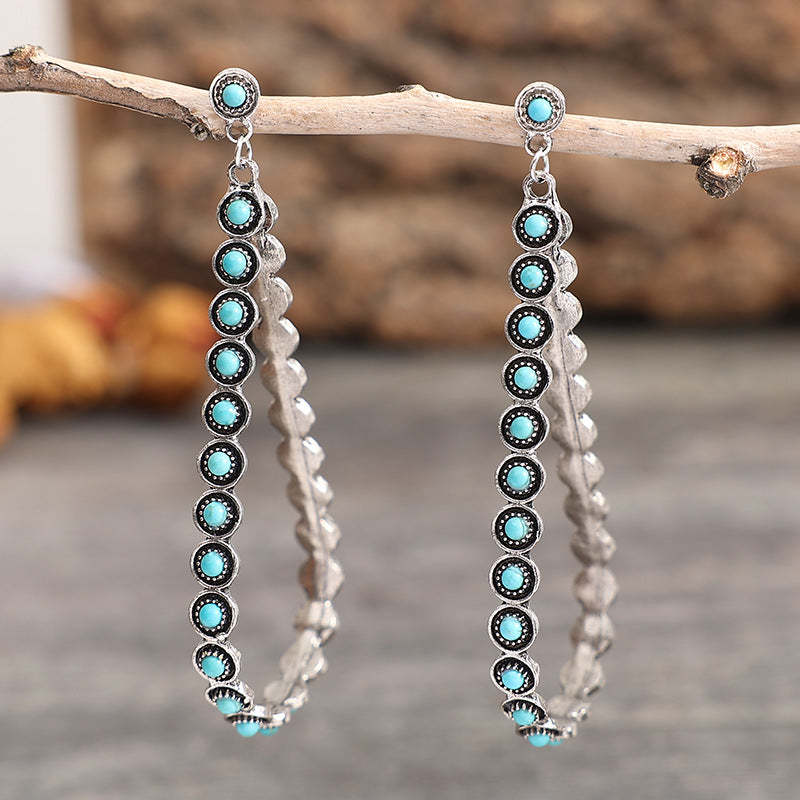
Best provisional capsule role
From the visible styling information, the provisional job is “signature motif for simple bases.” Try it first with a light solid top, dark solid top, and plain dress. Keep the necklace absent or restrained so the cross form remains readable. If the wearer gives the symbol personal meaning, that meaning—not a trend forecast—should guide how often it appears.
Before purchase, request a specification tied to this exact item: whether the listing includes a pair, dimensions, drop, mass for each earring, attachment and backing, every contact component, decorative materials, finish, construction, and care. Reproduce the dimensions in paper and attach the template temporarily near the ear to check the outline against hair, collars, and a hat. Do not imitate the mass with an unsafe object.
Product Study Two: Turquoise Western Statement Earrings
The Turquoise Western Statement Earrings page was checked on August 24, 2026. It displayed $29.99 USD, one visible Color choice, and a six-image gallery. The page copy specifically describes turquoise-style center stones, a sculptural western silhouette, and vintage-inspired detailing. “Turquoise-style” is the accurate wording from the page; it should not be silently upgraded to natural turquoise. “Vintage-inspired” describes design direction, not documented age.
The visible information did not provide dimensions, drop, mass, attachment, backing, included count, complete components or materials, finish, construction, or care. The lower displayed price compared with the first study does not prove lighter weight, simpler construction, lower durability, or better value. Prices can also change. Compare each product against the capsule job and evidence checklist instead of ranking by price alone.
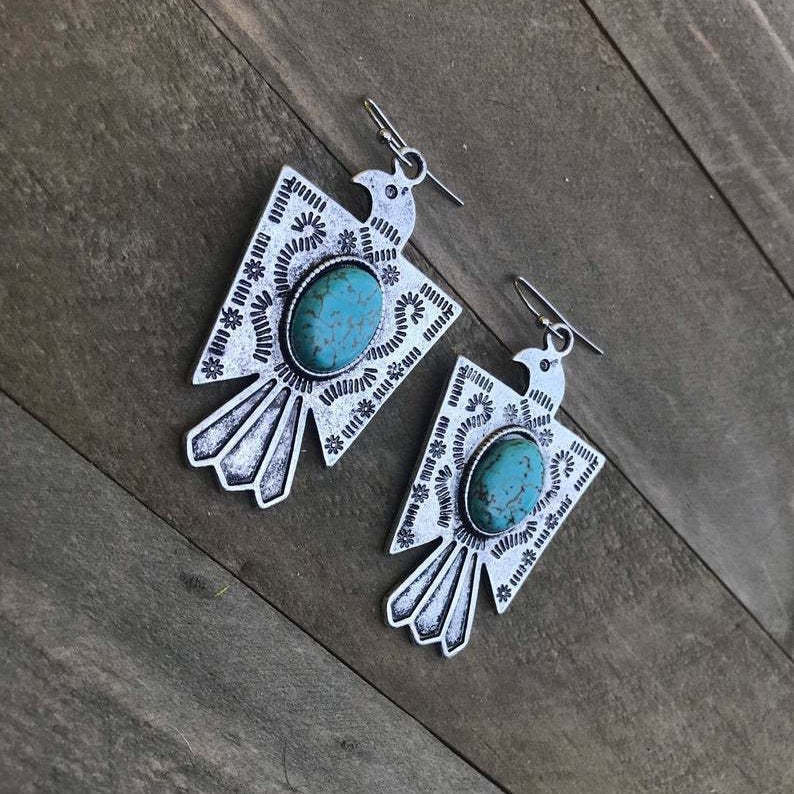
Best provisional capsule role
The provisional job is “western shape and blue-green center for low-pattern clothing.” Test it against the four bases without adding another large turquoise-colored object. Because the silhouette is described as sculptural, include profile photographs and movement tests. A front-facing gallery view cannot show every contact point or predict how the piece behaves beside a jawline, collar, hair, or phone.
Ask the same specification questions used for the cross pair. Add one question about the center-stone wording: what exact material does “turquoise-style” identify? Preserve the seller's answer and any care instructions with the order record. Do not borrow material, metal, or care claims from a visually similar earring.
How to Compare the Two Without Guessing
| Decision field | Cross pair | Western sculptural pair |
|---|---|---|
| Visible design job | Recognizable cross motif | Western silhouette with blue-green centers |
| Material language | Natural turquoise not established | Turquoise-style center stones |
| Best first bases | Plain denim looks and simple dress | Solid tops and low-pattern layers |
| Evidence still needed | Size, mass, attachment, components, care | Size, mass, attachment, components, care |
| Primary styling risk | Too many competing symbols | Too many competing shapes or blue-green accents |
A capsule winner is the pair that clears more real outfit cells after facts are obtained. It is not automatically the more expensive pair, the pair with more images, or the pair with a stronger name. If both pass different cells, assign separate jobs. If neither clears physical verification, continue comparing within the Western Earrings collection and keep the same evidence standard.
Use the Video as a Styling Prompt, Not Product Proof
Audrey Coyne's video “How to Layer Jewelry | Chic Ways to Wear Necklaces, Rings & Earrings” is a useful companion because it focuses on coordinating multiple jewelry zones. The public video page describes tips for layering jewelry, and the visible chapter themes emphasize relationships such as balance, spacing, thickness, texture, and avoiding excessive visual weight on one side. Those are creator styling ideas, not universal rules.
Translate the ideas into the capsule rather than copying a specific look. If statement earrings lead, a necklace can become thinner, shorter, quieter, or absent. If a hat, collar, and earrings already load the upper half of the outfit, move any echo to the hand, belt, or boot. If mixed textures look busy in the photograph, remove one texture before replacing the earrings.
The video cannot identify the materials, dimensions, mass, attachments, comfort, care, authenticity, or durability of either Oroxen product. It cannot determine whether a symbol suits the wearer's meaning. Use it to ask better composition questions; use the exact product page and seller documentation to answer product questions.
Create a Cost-Per-Wear Plan Without Pretending
Cost per wear is a planning calculation, not a promise. Record the price actually paid, including relevant delivery or tax, and divide by documented wears. Do not divide a current page price by imagined future use. A statement pair worn twenty comfortable times may be more efficient for one person than a cheaper pair abandoned after one irritating test, but neither outcome can be known from the gallery.
Before buying, estimate only with scenarios. For example, list four base outfits and three occasions. After buying, replace estimates with a simple wear log: date, outfit cell, hours worn, comfort notes, attachment security, weather exposure, and care performed. This reveals whether the piece deserves its capsule space and whether a second pair would solve a real gap.
Prevent a Beginner Capsule from Becoming a Costume Box
- Limit simultaneous stories. Cross, floral, animal, fringe, concho, tooled pattern, and large buckle details do not all need to appear together.
- Repeat color selectively. One small distant echo connects the outfit; several large blue-green objects may compete.
- Let clothing remain functional. Do not choose a collar, hat, or jacket only because it frames an earring if it fails the actual day.
- Keep evidence with the item. Save specifications, option, receipt, care, and return terms instead of relying on memory.
- Respect personal meaning. Wear symbolic motifs because they fit the wearer, not because a capsule formula demands them.
Care and Rotation When Product Details Are Incomplete
Exact care must follow exact materials and construction. Until those facts are supplied, do not assume resistance to water, sweat, perfume, sunscreen, hairspray, cleaners, heat, or friction. Do not apply silver polish, stone cleaner, leather conditioner, or adhesive repair based on appearance. Remove jewelry before uncertain exposure, handle it with clean dry hands, and store pieces so surfaces and attachments do not strike or tangle.
Rotation is useful only when it reflects actual wear. After each use, record whether the earrings contacted hair, collar, phone, glasses, hat, or headset. Note redness, pressure, pulling, looseness, or noise without diagnosing a medical cause. Stop wearing an item if it causes pain or a concerning reaction and seek appropriate professional advice when needed.
Frequently Asked Questions
How many pairs of earrings belong in a beginner cowgirl capsule?
There is no required number. Start with one verified pair assigned to a clear job. Add a second only when the wear matrix reveals a real unmet role, such as a quieter pair for workwear layers or a stronger pair for an event outfit.
Must turquoise earrings match a turquoise necklace?
No. Exact matching can make every zone compete. Begin with earrings as the focal point and use a restrained necklace or none. If you want repetition, try one smaller blue-green or shape echo at a distant zone.
Are the cross earrings made with natural turquoise?
The visible page reviewed did not establish natural turquoise. Ask for exact decorative and contact materials, any treatment or composite information, and supporting documentation. Do not infer mineral identity from color or title.
What does “turquoise-style center stones” mean?
It is the product page's appearance-oriented wording. It does not by itself identify a mineral, resin, glass, composite, dyed material, or another component. Request the actual material statement before using a more specific label.
Can a statement earring be worn with a hat?
Possibly, but test the exact combination. Check the brim, band, cords, hair, glasses, and head movement. Confirm dimensions, mass, attachment, and backing before relying on it for extended wear.
How do I know whether the capsule is working?
Look for repeated high-scoring cells, specific comfort notes, and fewer last-minute decisions. If an item works only in one staged photo or repeatedly fails physical tests, reassign or remove it rather than buying more items to rescue it.
Your One-Page Capsule Worksheet
- Write the earring job in one sentence.
- List four clothing bases already owned.
- Create quiet, balanced, and event-ready versions of each base.
- Verify included quantity, dimensions, mass, attachment, backing, components, finish, construction, and care.
- Photograph front, profile, seated, jacket-on, and jacket-off views.
- Test hair, phone, glasses, hat, bag, collar, and hearing protection where relevant.
- Score clarity, comfort, security, repeatability, and confidence.
- Buy or keep only when the evidence and the wear matrix agree.
Conclusion: Build Connections, Not Quantity
Turquoise-colored earrings can make a small wardrobe feel recognizable when they have a defined job and several proven connections. Begin with four clothing bases, run the twelve-outfit test, and separate visible styling from material and comfort evidence. Let one pair be a signature only after it works in real movement—not merely because it looks dramatic in a gallery.
Browse the broader Western Jewelry collection when the matrix reveals another category that would serve a genuine role, or return to the Oroxen homepage to review the store from the beginning. A useful capsule is not the one with the most western pieces. It is the one whose pieces are understood, wearable, connected, and chosen on purpose.