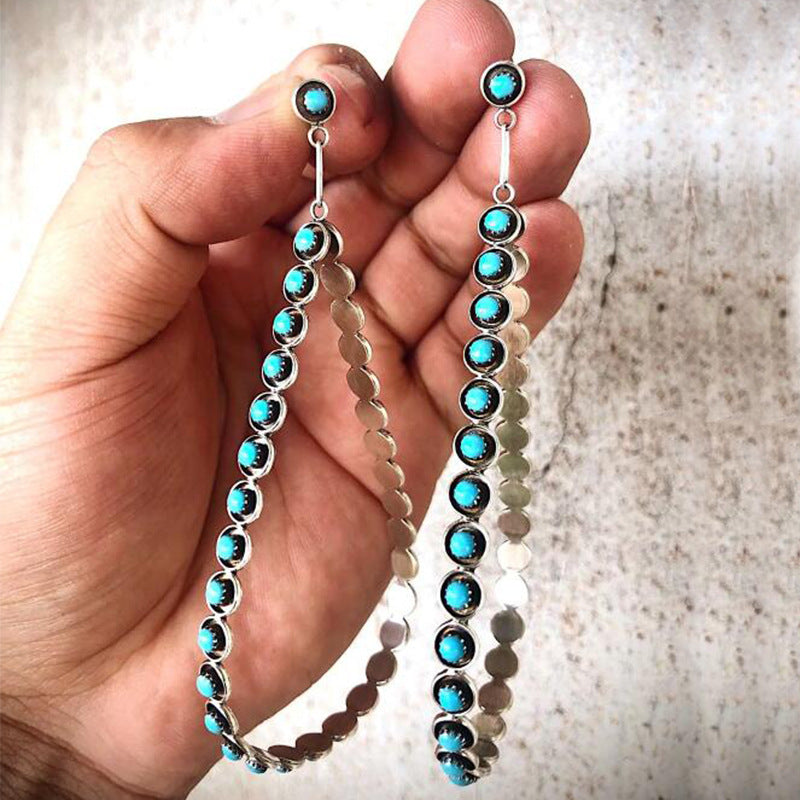
Turquoise Earrings Care Guide: How to Store Pieces Without Tangling
Earring care begins before cleaning. A dangling pair can knot around itself, hook another pair, lose a backing, press against a decorative center, rub a finish, or disappear into the bottom of a travel bag. Cleaning an unidentified product may add another risk because turquoise-colored components, natural turquoise, resin, glass, composite materials, metals, coatings, adhesives, and vintage-inspired finishes do not share one universal method.
This guide uses a simple storage rule: one pair, one bay, one record. “One pair” keeps the intended earrings together. “One bay” gives them a separate supported space. “One record” preserves the selected option, components, condition, and care instructions. The system prevents tangling by controlling contact rather than applying an unverified cleaner.
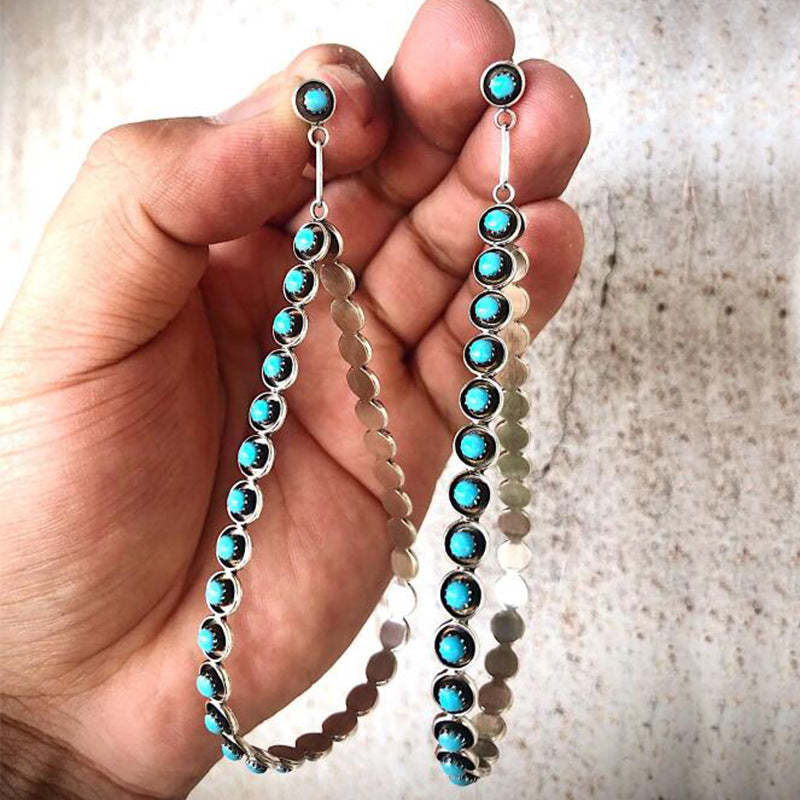
Quick Answer: Isolate, Support, Label, and Delay Cleaning
Store each verified pair in its own compartment or individually secured position so hooks, posts, backs, chains, drops, and decorative parts cannot cross another piece. Support the item without tight bends or pressure. Keep the exact backing with its earring in a small labeled sub-area. Photograph the pair before storage and note anything loose, bent-looking, discolored, cracked, missing, or uncomfortable.
Do not add water, soap, solvent, polish, oil, baking soda, toothpaste, ultrasonic cleaning, steam, glue, heat, or an abrasive cloth until every relevant component and finish is identified and the exact care instruction supports the method. “Turquoise” in a title is not enough. When care is missing, separate dry storage and professional assessment are safer than improvisation.
The published complete western turquoise jewelry guide explains broader material and buying distinctions. The published western jewelry motifs and materials guide helps separate visible style words from component evidence.
Step One: Identify the Exact Earring Before Touching It
Create an identification record with the product URL, title, review or purchase date, selected Color or Design, matching image, included quantity, dimensions, drop, projection, total and per-earring mass, attachment, backing, every contact component, decorative material, stated treatment, finish, construction, adhesive if disclosed, and exact care. Include the receipt and current return conditions when relevant.
Write “not stated” in every blank. Do not infer natural turquoise from blue-green color, matrix-like markings, price, a hand-held photograph, or the word turquoise. Do not infer sterling silver from a silver color, “antique” appearance, or a polishing recommendation for another item. Do not assume “vintage-inspired” means an old object.
If several earrings share one page, match each Design to its gallery image and specification. A family page can contain hooks, posts, longer drops, compact studs, or different decorative arrangements. One storage setup may not fit every option.
Step Two: Photograph the Condition at Five Points
Use neutral light and take a front, back, side, attachment, and pair photograph. Include a scale only when it does not touch or endanger the item, and label the unit. The photographs are a condition record, not proof of materials or value.
Look for changes without diagnosing the cause: missing backing, loose connector, bent-looking post or hook, open jump ring, cracked or detached decorative element, surface residue, color change, damaged coating, stretched opening, tangled drop, or unequal pair. If a structural problem is present, isolate the item and stop wearing it. Do not bend it back, tighten it with household tools, or add glue before the construction and repair implications are known.
Record which side is left or right only if the design requires it. Store asymmetrical or intentionally mismatched earrings with a clear pair label so the next wearer does not mistake the arrangement for a missing item.
Step Three: Build a One-Pair-One-Bay Storage Map
The outer container
Choose a stable container that protects the pieces from uncontrolled movement, crushing, dust, pets, children, and accidental disposal. It should close reliably but should not be called airtight unless the exact components and environmental plan require that condition. Trapping moisture or unknown vapors can create new problems.
The individual bay
Give each pair a compartment wide and deep enough for its verified dimensions. The pair should not need to be folded, twisted, stacked under pressure, or forced against a wall. A long drop may need two separate attachment points or a larger flat compartment. A cross or sculptural shape needs space around projecting edges.
The support surface
Use the original clean packaging when it is appropriate and does not strain the item, or a smooth non-shedding support confirmed compatible with the materials. Unknown foam, dyed fabric, treated paper, elastic, rubber, adhesive, PVC-like plastic, wood finish, and scented liner may transfer color, chemicals, fibers, or pressure. A professional jeweler or conservator can recommend storage for valuable or sensitive construction.
The backing sub-area
Keep backs with the exact pair, but do not let loose backs strike decorative surfaces. A labeled mini-compartment within the bay is useful. If the manufacturer intends the backing to remain on a post during storage, confirm that it does not compress a component or create tension. Do not assume one practice fits hooks, posts, clips, threaded backs, or other systems.
Step Four: Separate the Parts That Can Tangle
Identify every catching point: open hook, chain segment, articulated drop, connector, fringe, bead string, prong-like projection, cross arm, floral edge, backing, and tag. Arrange the pair so catching points face away from one another and cannot overlap during movement.
For a hook earring, use a purpose-built support only if the hook can hang without forced bending and the lower element does not strike the container. For a post, provide clearance behind the post and keep the backing accounted for. For a multi-part drop, support the entire length instead of suspending all mass from one unknown connector.
Do not tie the earrings together with thread, wire, rubber bands, tape, twist ties, or an improvised plastic bag. Those methods can add pressure, residue, abrasion, snagging, or trapped moisture. The goal is independent support, not stronger restraint.
Step Five: Control the Environment Without Inventing a Number
Avoid direct sunlight, high heat, rapid temperature change, uncontrolled moisture, bathroom steam, cooking residue, cosmetics, cleaners, and places where the container may be crushed. Exact temperature and humidity recommendations depend on the identified materials, treatments, adhesives, and finishes. Do not choose a universal numeric setting from a different gemstone or museum object.
Desiccant, anti-tarnish strips, sealed bags, and corrosion inhibitors are not automatic upgrades. They may be useful for a known system but can be inappropriate, exhausted, contaminated, or incompatible with other parts. Use them only when the seller or qualified professional recommends the exact material, amount, enclosure, replacement interval, and separation method.
Keep a storage-location record. A labeled drawer, cabinet, or case position reduces unnecessary searching and handling. Do not label a container “natural turquoise,” “silver,” or “leather” when the evidence says only turquoise-colored, silver-colored, or material not stated.
Step Six: Use a Check-In and Check-Out Routine
Before wearing, compare the pair with its five photographs. Confirm that backs, hooks, posts, connectors, and decorative components look unchanged. After wearing, place the pair in a temporary clean, protected inspection area rather than immediately mixing it with stored jewelry. Record exposure to rain, sweat, sunscreen, hair products, perfume, makeup, dust, or an accidental impact without assuming the item tolerates them.
If exact instructions permit a post-wear action, follow them. If they do not, do not invent a damp-wipe or polishing routine. Allowing an item to remain wet or contaminated can be harmful, but treating an unknown material can also be harmful. When significant exposure or a visible change occurs, isolate the item and ask the seller or a qualified professional.
Return the pair to its labeled bay only after inspection. Update the photograph when a documented change occurs. This creates a timeline that can help a professional distinguish pre-existing condition from a new problem.
Step Seven: Pack for Travel Without Creating a Moving Tangle
Use a rigid or semi-rigid travel case with one closed compartment per pair. Shake testing is not appropriate for valuable jewelry, but you can inspect whether the empty case has loose dividers, exposed hardware, rough seams, or gaps through which a backing could migrate. Size the compartment from verified earring dimensions.
Carry the case where it will not be crushed by shoes, bottles, chargers, or luggage hardware. Follow transportation and venue rules. Do not put earrings loose in a handbag, cosmetic pouch, pocket, wallet, checked suitcase corner, or shared jewelry roll where hooks and drops can cross.
For an event, photograph the pair before leaving, carry the case if removal may be needed, and perform a count before departure and after returning. The published country concert jewelry guide provides additional planning for bags, seating, outerwear, hearing protection, and safe removal.
A Minimal Care Kit for Unknown Materials
The low-risk kit is primarily documentation and separation equipment:
- A stable compartment case sized to the exact pair.
- Clean labels and a pencil or archival recording method kept away from jewelry surfaces.
- A phone or camera for condition photographs.
- A clean tray or protected inspection area with raised edges.
- Copies of exact product, component, and care information.
- Contact details for the seller and an appropriate jewelry professional.
This kit intentionally excludes a universal liquid, brush, polishing cloth, oil, adhesive, abrasive, ultrasonic unit, steam device, and household chemical. Add a tool or substance only when verified care for the exact construction supports it.
Product Study One: Turquoise Statement Cross Earrings
The Turquoise Statement Cross Earrings page was reviewed on August 24, 2026. It displayed $127.26 USD, one visible Color choice, and an eleven-image gallery. Current copy describes a turquoise, statement, and cross design for everyday, western-inspired, occasion, and gifting contexts.
The visible information reviewed did not establish natural turquoise, exact decorative material, dimensions, drop, projection, mass, attachment, backing, included quantity, complete components, finish, construction, adhesive, or care. The cross is a recognizable symbol, but symbolism does not determine the storage method. The wearer decides its meaning; the evidence determines its handling.
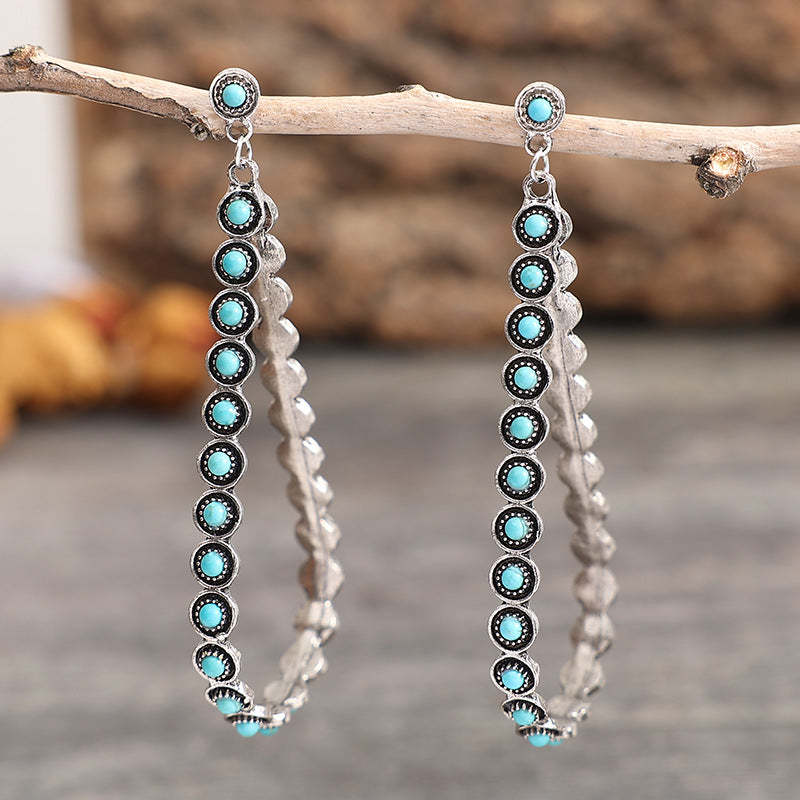
Provisional storage plan
Use a bay large enough for the complete cross outline so horizontal and vertical edges do not meet another earring. Do not stack the pair face-to-face or back-to-front until the projections and surface contact are understood. Record each earring separately and keep its backing in a sub-area.
Ask for exact height, width, thickness, drop, mass, attachment, backing, included count, all materials, finish, assembly, adhesive, and care. Do not select a foam slot or hanging card until the product's physical structure is known.
Product Study Two: Turquoise Western Statement Earrings
The Turquoise Western Statement Earrings page was checked on August 24, 2026. It displayed $29.99 USD, one visible Color choice, and a six-image gallery. Current copy specifically describes a sculptural silhouette, turquoise-style center stones, and vintage-inspired detailing. “Turquoise-style” is an appearance statement, not confirmation of natural turquoise.
The visible information reviewed did not state dimensions, drop, projection, mass, attachment, backing, included quantity, exact center material, other components, finish, construction, adhesive, or care. “Vintage-inspired” does not establish age. These gaps prevent a material-specific cleaning recommendation.
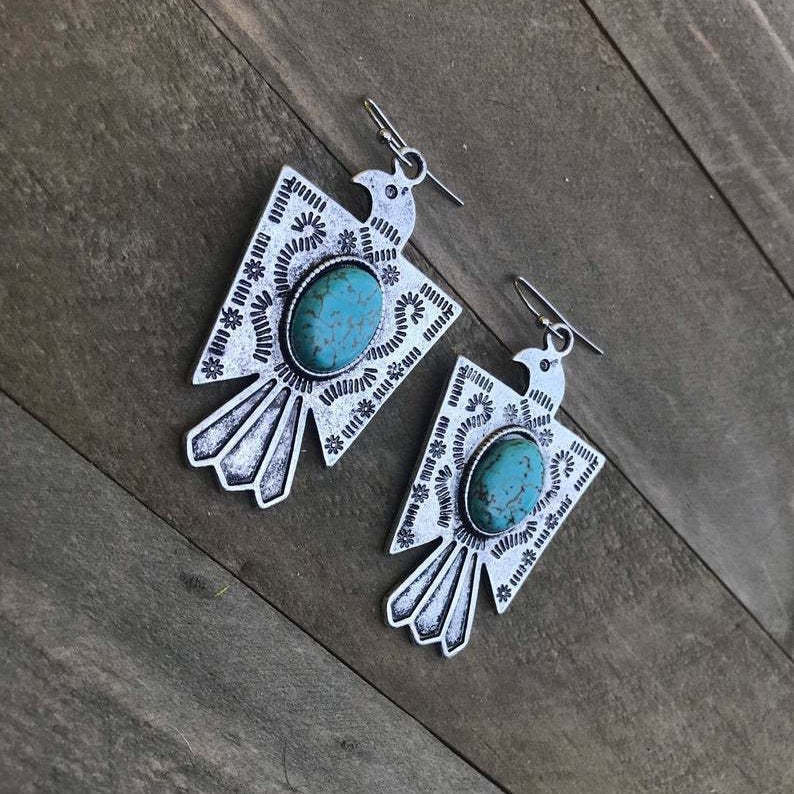
Provisional storage plan
A sculptural outline may create several catching points. Photograph front, back, and side, then give the pair a flat or supported bay with enough clearance that the two silhouettes do not interlock. Avoid pressure on the turquoise-style centers and do not suspend unknown mass from one connector.
Ask for the included count, exact center material, complete components, dimensions, mass, attachment, backing, finish, construction, adhesive, and care. A lower displayed price than the cross listing does not prove simpler materials or a different storage requirement.
Compare Storage Questions, Not Prices
| Storage field | Cross earrings | Sculptural western earrings |
|---|---|---|
| Visible shape concern | Horizontal and vertical cross edges | Multiple sculptural catching points |
| Material wording | Natural or faux turquoise not established | Turquoise-style centers; material not identified |
| First record to create | Separate front/back/side view for each cross | Complete outline and center-support view |
| Unknown attachment | Backing and included count not stated | Backing and included count not stated |
| Cleaning status | Wait for exact care | Wait for exact care |
Both examples benefit from contact control. Neither can be assigned a water, soap, polish, chemical, or ultrasonic method from the page reviewed. Separate storage is an organizational action; cleaning is a material intervention. Keep those decisions distinct.
What the Turquoise Care Video Teaches—and Its Limits
Amitis Art's “Episode 9: Turquoise Care and Cleaning Guide” discusses precautions, storage, and cleaning for turquoise described as a natural, porous gemstone. The episode recommends caution with oils, solvents, heat, impact, mechanical cleaning, chemicals, and abrasive methods, and it recommends professional help for valuable vintage pieces.
The video's guidance is not a care sheet for either Oroxen earring. The episode later discusses the creator's natural, untreated Persian turquoise and sterling-silver jewelry. The Oroxen pages reviewed do not establish those materials. Even advice that sounds gentle—such as a damp cloth, anti-tarnish cloth, pouch, cotton towel, or sealed bag—must not be generalized without checking stones, simulants, coatings, adhesives, metal finishes, moisture, and enclosure compatibility.
The transcript is auto-generated, so individual wording may be imperfect. Use the video to identify questions and risks, not to override the exact product instructions or professional assessment. Claims about mineral properties, water content, value, or universal wear frequency also should not be imported into an unrelated product page.
Cleaning Decision Tree
- Is every component and finish identified? If no, document and isolate; do not clean.
- Is exact written care available? If no, ask the seller or qualified professional.
- Is there structural damage or a valuable/vintage claim? If yes or uncertain, stop and obtain professional assessment.
- Does the instruction apply to the selected Design and entire assembled item? If not, request clarification.
- Can the method be performed without spreading liquid or friction to another component? If uncertain, stop.
- After the verified method, can the item be inspected and fully handled as instructed? If no, do not begin.
Frequently Asked Questions
Should earrings be stored together as a pair?
Keep their identity together but prevent physical overlap. One labeled bay can contain two independently supported positions plus a sub-area for exact backs. Do not let the pair rub or interlock.
Can earrings be stored in small plastic bags?
Only when the exact materials, moisture condition, bag composition, enclosure need, and pressure are compatible. A sealed bag is not a universal solution and may trap moisture or allow surfaces to rub.
Can a polishing cloth be used on silver-colored parts?
Silver color does not prove sterling silver or an uncoated metal. A polishing cloth can remove or alter a finish and may affect adjacent components. Use it only when exact care supports it and protects every other part.
How often should turquoise earrings be cleaned?
There is no universal schedule. Cleaning frequency and method depend on materials, treatment, finish, construction, exposure, condition, and exact instructions. Inspection can be routine; intervention should be evidence-based.
Can the two Oroxen examples be wiped with water?
The visible information reviewed did not provide a complete material or care statement supporting that method. Do not assume. Ask the seller for item-specific instructions.
What if two earrings are already tangled?
Place them on a protected tray, stop pulling, document the tangle, and identify every hook, connector, and fragile point. For tight, valuable, adhesive-based, coated, or material-unknown pieces, seek professional help instead of using needles, oil, solvents, heat, or force.
Where should earrings be stored between events?
Use a stable, labeled, separate bay away from direct sun, high heat, rapid environmental change, uncontrolled moisture, chemicals, pets, children, and crushing. Exact environmental settings depend on the materials.
Final One-Pair-One-Bay Checklist
- The exact pair, option, image, included quantity, and backing are identified.
- Front, back, side, attachment, and pair photographs record condition.
- The bay supports the full verified dimensions without overlap, tight bends, or pressure.
- Hooks, posts, drops, connectors, edges, and backs cannot interlock with another item.
- Container, liner, labels, desiccants, strips, and enclosure conditions are compatible or omitted.
- No cleaner, water, polish, heat, ultrasonic, steam, adhesive, or abrasive is used without exact support.
- Travel, event removal, inspection, seller questions, and professional help have a plan.
Conclusion: Prevent Contact Before Treating a Surface
Untangling is easiest when tangling never begins. Give each pair its own supported bay, separate every catching point, keep exact backs and records together, and inspect before and after wear. The system works even while materials remain unknown because it avoids pretending that all turquoise-colored earrings share one cleaning routine.
Compare other silhouettes in the Western Earrings collection, explore the broader Western Jewelry collection, or return to the Oroxen homepage. Identify first, isolate second, and clean only when the exact construction provides a defensible method.