The safest first step in caring for a turquoise-style bracelet is not cleaning it. It is identifying what the bracelet actually contains, what finish is present, how the parts are joined, and which instructions apply to the exact option. Water, polish, soap, heat, friction, and even a “soft” brush can help one documented material and harm another.
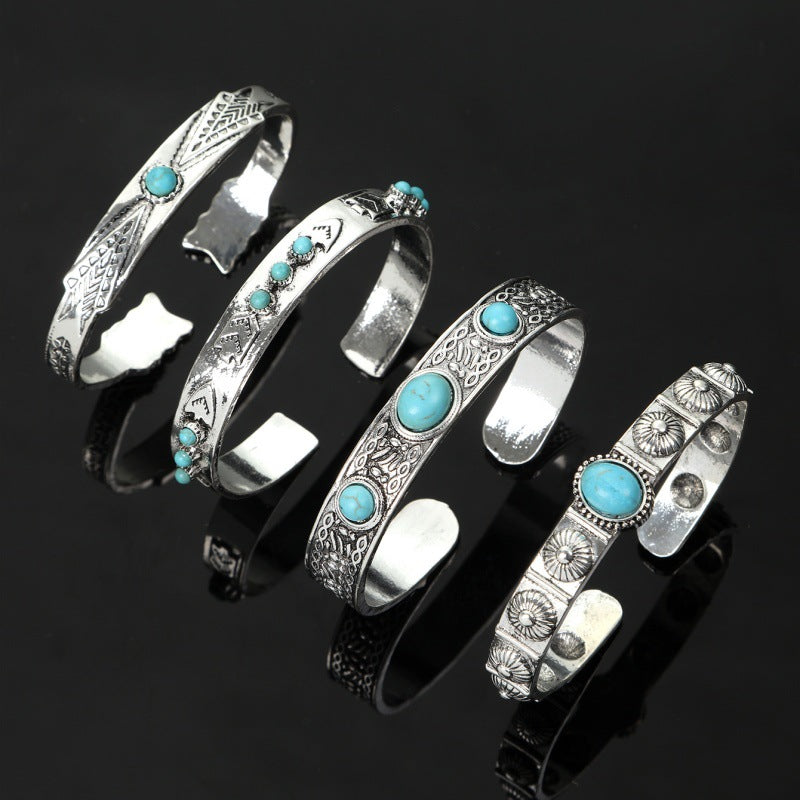
This guide uses two current Oroxen examples: the Turquoise Western Cuff Bracelet Set and the Turquoise Boho Vintage Bracelet for Women. Their turquoise-colored and vintage-inspired appearance does not independently verify natural turquoise, metal, plating, age, stone treatment, crystal, leather, maker, origin, or artisan production.
Quick Answer: Follow a Five-Gate Care System
Put every care action through five gates: identity, instruction, condition, method, and record. If the component or finish is unknown, stop at identity. If the seller has not supplied care instructions, stop at instruction. If a piece is loose, cracked, peeling, discolored, misshapen, or structurally uncertain, stop at condition.
Only then choose a method. Begin with the least invasive seller-approved action, work in a clear area, and stop at the first unexpected change. Record what was done, where, for how long, and what happened. This prevents repeated experiments and gives a repair professional a useful history.
The public Western turquoise-style buying guide explains why color and merchandising names are not material proof. That distinction controls every step of this care guide.
Why Bracelets Need a Contact-Based Care Plan
Bracelets live in a high-contact zone. They meet desks, laptop edges, coat cuffs, bag hardware, sinks, soap, lotion, fragrance, sweat, food preparation, rain, gym equipment, tools, and other bracelets. A necklace can often remain relatively still; a wrist changes angle and pressure throughout the day.
Damage prevention therefore begins before storage. Build a contact map for an ordinary day. Note when the bracelet touches hard surfaces, fabric, skin products, water, chemicals, heat, or another jewelry item. Remove it before any activity that conflicts with documented care or creates a safety risk.
Do not promise that a fashion finish will remain unchanged forever. The practical goal is to reduce avoidable exposure, catch structural problems early, and use only methods supported for the confirmed materials and finish.
Create an Option-Specific Identity Sheet
Save the product title, URL, option, dated screenshots, order record, seller answers, and current care language. Add fields for:
- base material and every surface finish or coating;
- identity and treatment of turquoise-colored elements;
- other decorative parts, adhesives, thread, elastic, cord, leather, crystals, or unknown materials;
- hinges, joints, links, clasps, settings, bezels, wraps, and open cuff ends;
- dimensions, weight, interior circumference, opening, adjustment limits, and fit;
- approved cleaning, drying, storage, moisture, cosmetics, and wear instructions;
- repair guidance, warranty, and return conditions.
Use “unknown” where the live page is silent. A photograph can help locate a component but cannot reliably identify it. The guide to what to know before buying Western jewelry for women provides a complementary pre-purchase record.
Document Condition Before Any Cleaning
Choose a table away from drains, food, pets, children, open windows, and direct sun. Place a clean light-colored towel beneath the bracelet. Photograph the front, back, sides, inside, opening, connections, decorative elements, and any existing mark. Use the same light and distance for later comparison.
Without flexing or probing, look for movement where none is expected, exposed adhesive, lifted finish, flaking, cracks, chips, stretched connections, sharp edges, bent areas, detached ends, corrosion-looking residue, or a clasp that does not close reliably. Do not diagnose the material or cause from appearance alone.
If structure is uncertain, place the bracelet in a separate container and ask the seller or an appropriately qualified repair professional. Cleaning a loose or fragile piece can turn a small issue into a loss.
Assemble a Low-Risk Work Area
A conservative setup may include a clean tray, light towel, nitrile-free or otherwise appropriate clean handling gloves when advised, a clean air blower intended for delicate work, and very soft lint-free cloths reserved for jewelry. These items are not automatic permission to use them on every component.
Keep household silver polish, metal polish, toothpaste, baking soda, vinegar, lemon juice, alcohol, acetone, bleach, ammonia, ultrasonic devices, steam, boiling water, abrasive pads, stiff brushes, and mystery jewelry dips outside the default kit. Each can affect some stones, coatings, adhesives, cords, patinas, finishes, or mixed constructions.
Do not submerge an unidentified bracelet. Do not soak turquoise-colored elements. Do not assume “natural,” “non-toxic,” or “gentle” marketing makes a substance suitable. Compatibility depends on the actual piece.
Use a Care Decision Table
| Observation | Low-risk next step | Action to avoid |
|---|---|---|
| Light loose dust; identity still incomplete | Ask for instructions; isolate and protect meanwhile | Wet cleaning or polish |
| Confirmed seller-approved dry wipe | Use the specified cloth and pressure | Changing to an abrasive cloth |
| Unknown finish or turquoise-colored part | Leave untreated and request disclosure | Testing a cleaner on the piece |
| Loose, cracked, peeling, or bent area | Stop wear; photograph; seek qualified advice | Pushing, gluing, bending, or scrubbing |
| Unexpected color on cloth | Stop immediately and preserve the cloth/photo record | Continuing to “even out” the surface |
| Moisture exposure | Follow documented response and seek advice if needed | Heat, hair dryer, radiator, or prolonged sun |
The table is a stop system, not a universal cleaning recipe. Exact product instructions override generic advice when they are credible and option-specific.
Care Example One: Turquoise Western Cuff Bracelet Set
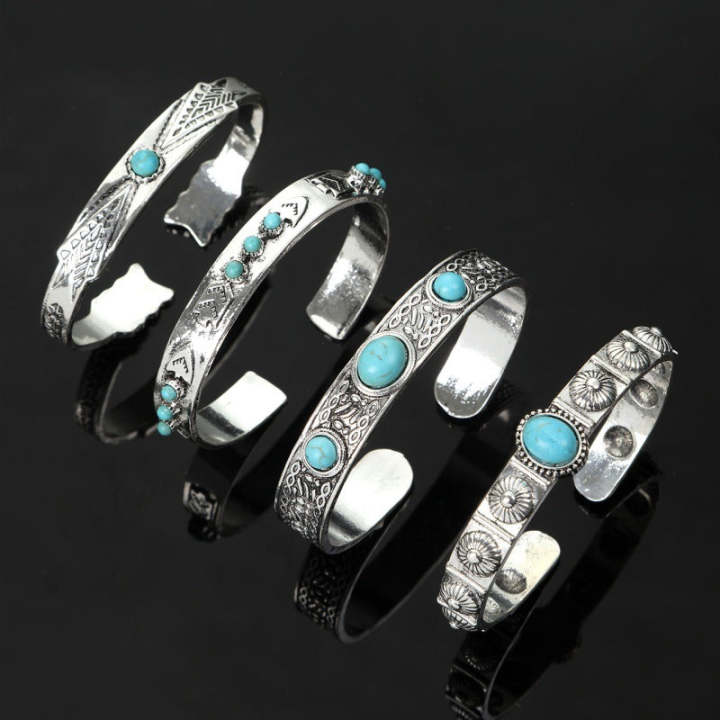
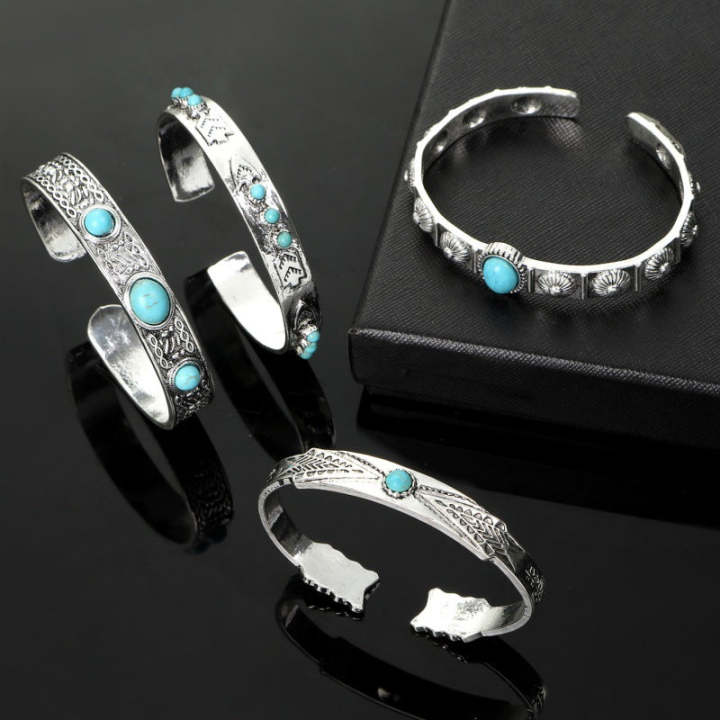
The current product page describes a set of four open cuff bracelets with turquoise-colored accents and varied vintage-inspired motifs, intended to be worn together or individually. During review it showed the 4Set option and $34.99 USD. Price, availability, and interface details can change.
The visible page did not clearly state complete components, finish, the identity of the turquoise-colored accents, dimensions, weight, construction, adjustment limits, or care. Those omissions are critical because four visually coordinated pieces may use different components or surfaces.
Separate the Four Records
Number the cuffs one through four without attaching adhesive labels to them. Photograph each separately and record its visible motif, shape, opening, current condition, and seller-confirmed components. A set description should not erase differences between pieces.
Do Not Repeatedly Bend an Open Cuff
Ask whether and how the selected cuff is intended to adjust. Repeated bending can stress some constructions or finishes. Do not squeeze, stretch, or reshape the opening to test flexibility. Confirm fit method and adjustment limits before wear.
Reduce Bracelet-on-Bracelet Friction
Although the set is marketed for stacking or individual wear, stacking can create rubbing. Photograph contact zones after short controlled wear within care and return conditions. If surfaces scrape or decorative areas strike one another, reduce the stack or wear pieces separately.
Care Example Two: Turquoise Boho Vintage Bracelet for Women
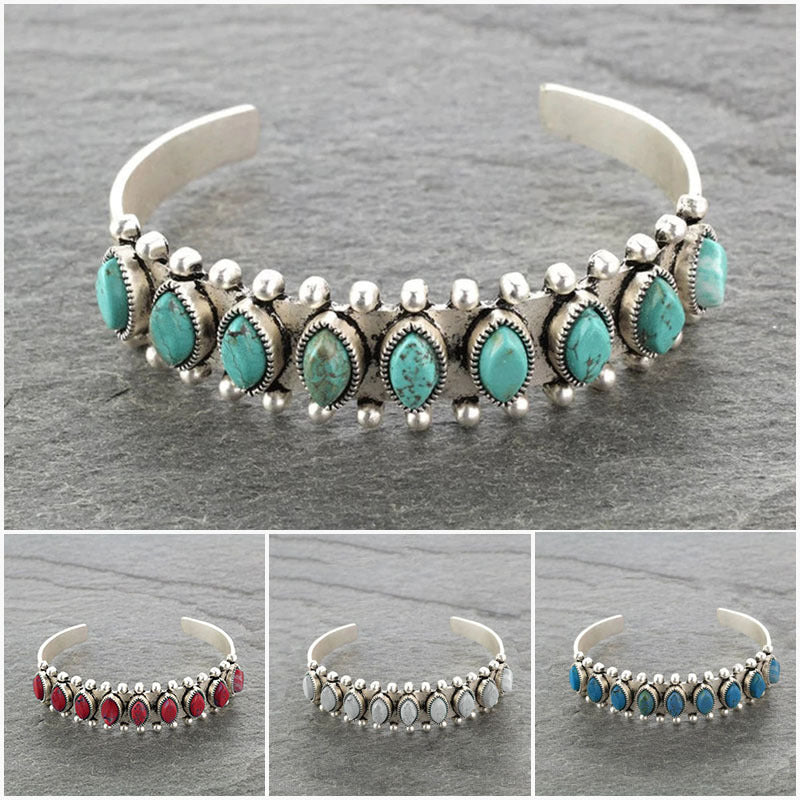
The second page displayed $90.90 USD and seven choices labeled Bracelet 1 through Bracelet 7 during review. Its visible summary describes turquoise, boho, and vintage-inspired styling but did not clearly state complete components, finish, exact measurements, weight, construction, fastening, care, or image-to-option details.
Do not assume the seven choices share identical care. Each may differ in visible structure or decoration, so obtain the selected option's image mapping and full record before treating it.
Map the Selected Option
Save a screenshot that shows the selected label beside the corresponding image. Ask whether visible wraps, beads, cords, chains, cuffs, crystals, leather-looking strips, or turquoise-colored parts are included in that exact option and what each is made from. “Leather-looking” and “crystal-like” are visual descriptions, not material claims.
Identify the Weakest-Care Component
In mixed construction, the most sensitive confirmed component often controls the whole routine. A method compatible with one metal may be unsuitable for an adhesive, coating, cord, porous stone, imitation element, or unknown finish beside it. Never clean each visible area independently while runoff reaches the others.
Protect the Shape in Storage
Ask how the selected option should rest. Avoid tight coils, compression beneath heavier jewelry, hanging that stretches flexible parts, or closures left under tension. Store it in the shape recommended for its verified construction.
Build a Wear-Before-Care Routine
Prevention can be more effective than aggressive cleaning. Put the bracelet on after fragrance, lotion, sunscreen, hair products, and other cosmetics have been applied and have settled, if that sequence matches seller guidance. Remove it before bathing, swimming, dishwashing, cleaning, gardening, exercise, sleep, food preparation, craft chemicals, or impact-heavy work unless the exact instructions clearly permit the activity.
These are conservative exposure controls, not claims that every product reacts the same way. Confirm the rules for the selected bracelet. Pay special attention to sunscreen and hand products that migrate toward the wrist.
At the end of wear, check for moisture, residue, unexpected movement, or contact marks. Follow the documented after-wear step. Never use heat to accelerate drying.
Video Care Demonstration: Verify Before Adopting
The supplemental source is Episode 9: Turquoise Care and Cleaning Guide by Amitis Art. At review, YouTube showed an approximately 32-second video with no closed captions. Its visible description refers broadly to techniques for caring for and cleaning turquoise as a gemstone.
The video does not document either Oroxen bracelet, and neither product title proves that its turquoise-colored parts are the gemstone discussed. Therefore, do not transfer a video technique until the bracelet's components, finish, treatment, adhesives, construction, and seller guidance are confirmed.
No transcript was available, so this article does not reproduce or infer unstated steps. View the original source directly, compare any recommendation with the option-specific record, and stop when compatibility is uncertain.
Storage: Build a Separate Parking Place
Give each bracelet or cuff its own clean, dry compartment or soft pouch compatible with the documented materials. Separate pieces to reduce abrasion, color transfer, tangling, compression, and impact. Keep heavy items from resting on open cuffs or raised decorations.
Choose a stable interior location away from sinks, bathrooms, kitchens, radiators, heating vents, windowsills, direct sun, vehicles, and rapidly changing humidity or temperature. A sealed container is not automatically correct; follow product-specific storage guidance, especially when mixed materials are present.
Add a simple location code to the care record so the bracelet is always returned to the same place. Do not attach labels or tape to the jewelry itself.
Travel: Use a Departure and Arrival Check
Before travel, photograph condition, confirm the closure or cuff shape, and pack each piece separately in a rigidly protected compartment where it cannot be crushed. Keep jewelry in personal control and follow carrier, venue, and security requirements.
Do not put several cuffs loose in one pouch merely because they form a set. Movement can create sustained rubbing. Do not leave jewelry in a hot or cold vehicle or unpack it beside a sink.
On arrival, move the closed container to a stable indoor environment, then inspect it in a controlled space before wear. After the trip, update the condition photos. The introduction to Western jewelry styles, symbols, materials, and wear can help separate aesthetic labels from the facts needed for storage and maintenance.
When to Stop and Seek Professional Help
Stop wearing and cleaning when a component is loose; a finish peels or changes unexpectedly; a crack, chip, sharp edge, broken thread, stretched link, failed closure, or distorted cuff appears; the product reacts to a seller-approved method; or identity remains important but unresolved.
Choose a professional with appropriate experience for the confirmed or suspected construction. Provide the product record, dated photographs, seller guidance, and full care history. Ask what will be examined, whether treatment is reversible, what risks exist, and how the result will be documented.
Do not glue, solder, plate, polish, reshape, restrain, or replace parts at home without suitable knowledge and permission. Repairs can affect appearance, fit, finish, value, warranty, and return eligibility.
Create a Twelve-Month Maintenance Calendar
A calendar should schedule inspection, not automatic cleaning. After each wear, perform the seller-approved light check. Monthly, compare current condition with baseline photographs. Quarterly, review closures, joints, openings, wraps, and storage conditions without manipulating uncertain areas. Before a high-wear season or trip, reassess fit, contact, and packing.
Cleaning frequency should respond to documented need and instructions, not a generic timetable. Unnecessary cleaning adds handling and exposure. Record “inspection only” when no action is needed.
Once a year, review whether product guidance has changed, whether seller answers remain saved, and whether repeated wear patterns suggest a professional inspection. Preserve earlier records rather than overwriting them.
Frequently Asked Care Questions
Can I wash turquoise bracelets with soap and water?
Not by default. Confirm every component, finish, treatment, adhesive, and construction and follow the exact seller-approved method. Do not submerge an unidentified mixed-material bracelet.
Can I use a silver-polishing cloth?
Only when the relevant metal and finish are confirmed and the product instructions specifically permit that cloth and technique. Polishing can alter coatings, patina-like finishes, adjacent decorations, or unknown surfaces.
How often should I clean a bracelet?
Inspect after wear and clean only when supported by condition and option-specific guidance. More frequent cleaning is not necessarily better.
Should open cuffs be squeezed to fit?
Ask whether adjustment is intended and obtain the limits and method. Repeated or forceful bending may stress some constructions or finishes.
Can a four-piece set be stored together?
Separate storage is the safer default when contact could cause abrasion or tangling, but follow instructions for the confirmed materials and construction.
What does discoloration mean?
Appearance alone cannot establish the cause. Stop experimental cleaning, document the change, review exposure history, and ask the seller or an appropriately qualified professional.
Does turquoise color require gemstone care?
No. Color does not identify a material. Obtain option-specific disclosure before applying gemstone advice.
Final Bracelet Care Checklist
- Save the exact option, images, dated page, and seller answers.
- Identify every component, finish, connection, and care instruction.
- Photograph condition before any action.
- Stop when identity, instruction, or structure is uncertain.
- Use the least invasive approved method and record the result.
- Reduce water, cosmetics, friction, impact, heat, and chemical exposure according to exact guidance.
- Store each piece separately in a stable protected location.
- Inspect before travel and after return.
- Seek qualified help for damage, loose parts, or unexpected change.
Browse current silhouettes in the Western Bracelets collection, explore broader options in Western Jewelry, or return to Oroxen for live product and store information. A lasting care routine is intentionally uneventful: identify, protect, inspect, document, and intervene only as far as the verified bracelet allows.