Denim is not one background. Dark jeans create a lower-body anchor; a faded shirt puts seams beside the face; a denim dress turns one fabric into the entire field; a skirt leaves the neckline open; and a trucker jacket adds pockets, buttons, lapels, and collar contact. Turquoise-colored Southwestern-inspired jewelry will behave differently in each version.
This guide uses a denim coordinate system: value, surface activity, seam density, coverage, and movement. Once those five coordinates are known, you can place the jewelry where it adds information instead of disappearing or competing. The two live examples are statement earrings, so the guide also treats hairstyle, hat brims, collars, and earlobe comfort as part of the outfit. “Southwestern” is used as retail and style language only. It is not a claim about community, maker, origin, tradition, or authenticity, and “turquoise” in a product name is not material proof.
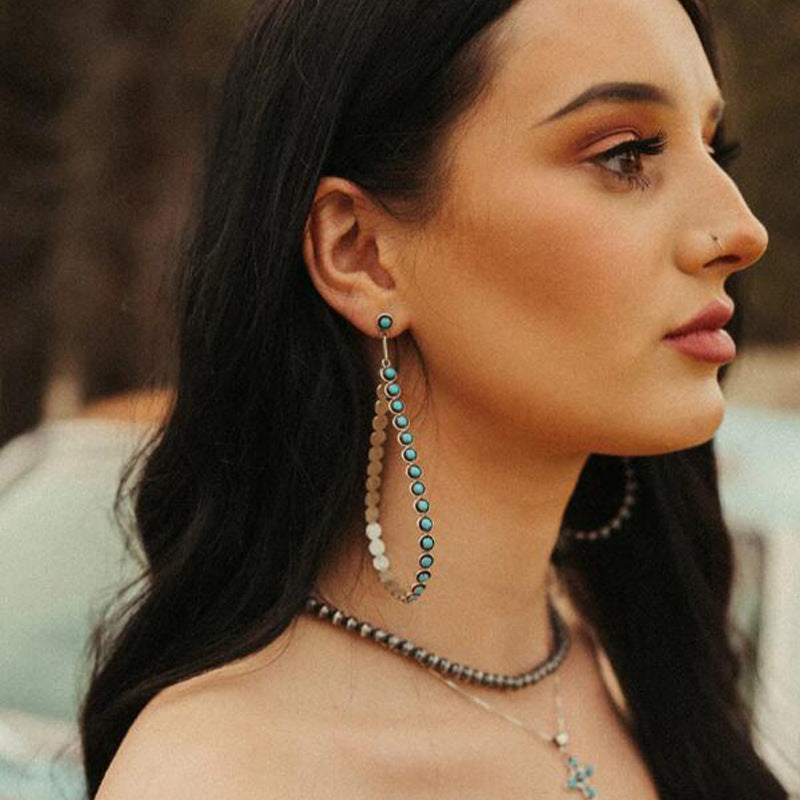
Quick Method: Identify the Denim Field, Then Place One Strong Signal
Stand in front of a mirror wearing only the denim item and a simple base layer. Decide where the denim field begins and ends. Jeans occupy the lower field. A shirt or jacket occupies the upper field. A dress can fill most of the silhouette. Next, locate its brightest seams, hardware, fading, patches, embroidery, or distressing. Those details are already accessories in visual terms.
Choose one jewelry signal to lead: color, recognizable motif, movement, or scale. If the earrings lead through motif, keep the nearest collar and necklace quieter. If they lead through turquoise-style color, repeat the color once farther away instead of matching it everywhere. Protect one low-detail zone so the eye has somewhere to rest.
Explore the larger subject through the Turquoise Jewelry Guides. For responsible distinctions among motif, material language, and style labels, read the published What Is Western Jewelry?.
The Five Denim Coordinates
1. Value
Value is relative lightness or darkness. Deep indigo, medium blue, pale stonewash, black, white, and colored denim create different contrast with turquoise-colored and metal-colored details. Test the complete outfit in the intended light; a screen and a product studio cannot predict every real setting.
2. Surface activity
A smooth, solid denim panel is quiet. Whiskering, fading, distressing, embroidery, patches, and prints increase activity. A strong earring can coexist with active jeans because the details are separated vertically. The same earring beside an embroidered denim collar may have to compete at close range.
3. Seam density
Jeans concentrate seams around pockets, fly, and legs. Jackets concentrate seams around the collar, chest, placket, and shoulders. Statement earrings occupy the face zone, so upper-body seam density matters more than lower-body seam density.
4. Coverage
A denim skirt leaves the upper field open. A buttoned shirt raises denim toward the jaw. A dress may create a continuous surface from neckline to hem. Coverage determines whether jewelry contrasts with skin, hair, a separate shirt, or denim itself.
5. Movement
Soft chambray-like fabric moves differently from rigid denim. Jackets rise at the shoulder when arms move. Collars can strike earrings. Loose sleeves hide bracelets. A good pairing survives walking, sitting, head turns, bags, and layer changes.
Formula 1: Statement Earrings with Dark Denim Jeans
Dark jeans keep the strongest denim mass below the waist, leaving the upper body available for jewelry. Start with a plain tee, knit, or shirt in a color that separates the earrings from hair and skin. Add simple footwear and photograph the full figure. If the earrings lead clearly, the outfit may not need a necklace.
A belt buckle can become a lower echo, but compare it with and without the buckle. If the eye jumps between two equally bright motifs, use a simpler belt or reduce another detail. The vertical distance between ears and waist usually helps, yet size and contrast can still produce competition.
This formula is useful for a first test because the earrings are not touching the denim. It isolates hairstyle, neckline, and jewelry visibility before a jacket or denim shirt introduces collar contact.
Formula 2: Turquoise-Style Earrings with a Faded Denim Shirt
A denim shirt moves the fabric close to the face. Open one or two buttons according to comfort and dress context, then decide whether the collar frames or crowds the earrings. Roll the sleeves only after the face zone is solved.
What often works is a pale or medium denim shirt with a quiet base beneath it and the earrings as the only large motif near the jaw. What often fails is a decorated collar, large scarf, statement necklace, hat, and earrings all occupying the same small region.
Turn your head fully left and right. Lift the collar as it may rise under a coat. Add glasses and the actual hairstyle. If the earring repeatedly touches fabric, choose a different design, alter the collar configuration, or change the lead to a piece farther from the face.
Formula 3: A Denim Skirt as the Quiet Anchor
A denim skirt provides texture and Western-adjacent wardrobe language without filling the upper body. That makes it friendly to statement earrings, a patterned blouse, or a small necklace—but not necessarily all three.
Use a solid upper layer when the earrings are complex. Let the skirt repeat the cool visual weight of the jewelry while footwear or a bag supplies a warmer texture. If the skirt has heavy distressing, embroidery, or a dramatic silhouette, use a calmer top to maintain separation.
Take one seated photograph. Skirt shape and top proportions change while seated, and the upper-body jewelry may become a larger part of the visible composition. The outfit should still have one first reading.
Formula 4: A Denim Dress with Deliberate Empty Space
A denim dress can be visually continuous, which makes every accessory stand out. Identify one empty section: collar area, waist, wrist, or neckline. Preserve it instead of filling every available position.
For earrings as the lead, keep the neckline clean and use a belt only if the dress needs shape rather than more decoration. For a hat, compare brim width and earring movement in a side photograph. The two elements can frame the face or create excessive horizontal activity.
Dark denim can make turquoise-style accents appear crisp; faded denim can make the relationship softer. Neither is universally superior. Lighting, garment wash, finish, hair, and the exact selected earring determine the result.
Formula 5: A Denim Jacket as an Adjustable Frame
An open jacket creates vertical edges; a partly closed jacket narrows the center; a buttoned jacket turns denim into the entire chest field. Because earrings sit above that field, they can lead well—provided the collar does not collide with them.
First test the earrings with the jacket closed. Then open it halfway and fully. Photograph each version from the front and three-quarter angle. Choose the version with the clearest face zone and the fewest competing hardware points. A jacket pin, scarf, necklace, and bright buckle are optional supporting actors, not mandatory proof of style.
For complete cross-category outfit planning, the published Cowgirl Jewelry Style Guide covers earrings, necklaces, bracelets, rings, clothing, and event considerations.
Shop the Collection by Signal Type
In the Turquoise Jewelry collection, create four shortlist groups: color-led, motif-led, movement-led, and texture-led. A product may fit more than one group, but identifying its primary signal helps you compare it with the denim coordinates.
- Color-led: useful when the garment field is quiet and provides clear value contrast.
- Motif-led: requires space around a recognizable outline or symbol.
- Movement-led: needs hair, collar, and activity testing.
- Texture-led: can complement smooth denim or compete with embroidery and distressing.
Move from collection thumbnail to live listing. Verify the exact option, corresponding gallery, documented dimensions, weight, materials, construction, care, current availability, shipping, and returns. Style can begin with a photograph; purchasing evidence cannot end there.
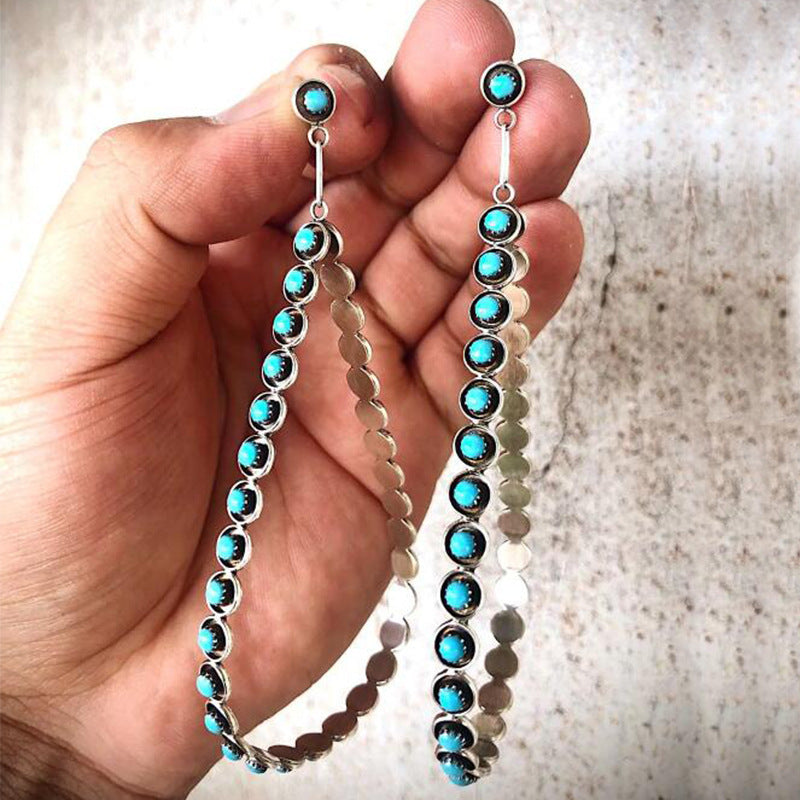
Product Example One: Turquoise Statement Cross Earrings
The Turquoise Statement Cross Earrings are a motif-led example. The current page presents a single color selector and a gallery showing a cross silhouette with turquoise-colored detail. The listing describes the design as turquoise, statement, and cross. It does not visibly provide the exact size, weight, materials, post or hook construction, or care information needed for a complete comfort decision.
Best coordinate matches
Try these earrings with dark jeans and a plain upper layer, a denim skirt with a quiet blouse, or a simple denim dress with an uncluttered neckline. A cross motif is immediately recognizable, so avoid placing several equally literal motifs nearby unless a deliberately maximal composition is the goal.
Fit and evidence questions
Ask for length, width, weight per earring, attachment type, materials, and care guidance. Confirm how the selected color corresponds to the displayed photographs. Test whether the chosen dimensions clear your jaw, hair, hat brim, scarf, headphones, and denim collar.
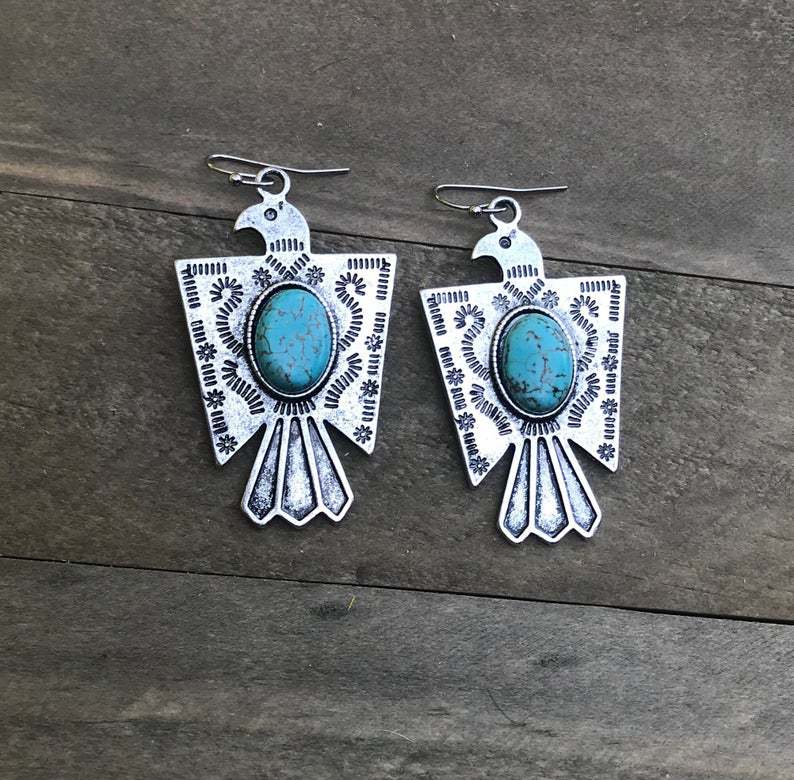
Product Example Two: Turquoise Western Statement Earrings
The current Turquoise Western Statement Earrings page describes a sculptural silhouette, turquoise-style center stones, and vintage-inspired detailing. It suggests pairing the earrings with denim, boots, dresses, and cowgirl looks. Those statements support a styling comparison, but “turquoise-style” should not be rewritten as a natural-stone claim. Exact composition, weight, dimensions, and attachment still require documentation.
Best coordinate matches
Use the sculptural outline as the face-level signal with a solid top and dark jeans. With a denim shirt, open the collar enough to keep its edge from merging with the earring. With a dress, keep the neckline or belt area quiet. Boots can reinforce the outfit direction at a useful distance without requiring a second large motif.
Fit and evidence questions
Request the exact dimensions, weight, attachment, materials, surface treatment, and care instructions. Compare front and side photographs and ask whether the visible selected color is the only option. If the earrings are intended for an all-day event, comfort information deserves the same attention as visual scale.
Choose Between the Two Earrings by Job
Do not ask which pair is universally better. Ask which job the outfit lacks.
| Outfit need | Cross silhouette route | Sculptural statement route |
|---|---|---|
| Recognizable motif | Strong candidate | Less literal, depending on exact view |
| Shape and texture | Motif remains primary | Sculptural outline can lead |
| Busy collar area | Neither should be chosen without collision and spacing tests | |
| Material certainty | Request explicit option-specific documentation | |
| All-day comfort | Compare documented size, weight, attachment, and personal tolerance | |
Use the Video as a Relationship Library
The paired video is “Wear It With Style: Turquoise Jewelry” by JTV. It is useful as a visual relationship library: notice placement, proportion, clothing value, empty space, and how a piece is presented at different distances. Watch the whole video before citing any specific claim.
Because JTV is a retailer, separate demonstration from sales messaging. The exact products in the video do not establish facts about Oroxen products. Do not copy the transcript. Independently verify statements about identity, treatment, construction, origin, age, value, care, and durability.
Common Pairing Problems and Coordinate Fixes
- Earrings vanish into hair: change hair placement or select a clearer value contrast.
- Collar hits the earring: lower, open, or replace the collar layer; otherwise choose another earring scale.
- Denim outfit feels flat: vary value or texture instead of adding several motifs.
- Too many Western signals: keep one literal motif and let denim, footwear, or color imply the rest.
- Every accent is turquoise-colored: protect a neutral zone and repeat the color only where it adds rhythm.
- Close-up looks better than the outfit: judge from full-length distance and take a rear-camera photograph.
- Product choice depends on missing weight or size: pause and ask the seller rather than estimating.
For a more detailed color and evidence workflow, continue with the published Western Turquoise Jewelry Guide.
Frequently Asked Questions
What is turquoise Southwestern jewelry?
In this article it is a retail styling phrase for turquoise-colored jewelry marketed with Southwestern- or Western-inspired visual language. It is not an authentication, geographic origin, community attribution, material certificate, or age claim.
Which denim wash is best?
No wash is universally best. Compare the jewelry’s visible value and outline with the complete garment under the intended light. Dark, faded, black, white, and colored denim create different relationships.
Can statement earrings work with a denim shirt?
Yes, if the collar, hair, and nearby accessories leave enough space and do not create repeated contact. Test head turns, extra layers, hats, and glasses.
Should I add a matching necklace?
Only if the outfit still needs a chest-level echo and the necklace does not compete with the earrings. A plain neckline may be the stronger supporting choice.
How do I choose between a motif and a sculptural shape?
Choose by job. A motif communicates a recognizable image; a sculptural shape may lead through outline and texture. Verify specifications and test both with the exact denim coordinate system.
Can product images prove materials?
No. Images support observations about visible appearance. Seek explicit documentation for materials, stones, treatments, finishes, construction, and care.
Where should I browse next?
Compare current options in Turquoise Jewelry, expand to Western Jewelry, or return to the Oroxen home page.
Final Denim Coordinate Check
Before leaving, identify the garment’s value, surface activity, seam density, coverage, and movement. Then name the jewelry’s single leading signal. Confirm that the face zone has clearance, the product option matches its gallery, and the necessary size, weight, material, attachment, care, shipping, and return facts are documented.
This method works because it treats denim as a variable, not a uniform. Jeans, shirts, skirts, dresses, and jackets each create a different field. Pair the earring with that field, preserve one quiet area, and test the result in motion. The outfit becomes easier to repeat—and easier to repair—without turning a style label into an unsupported product claim.