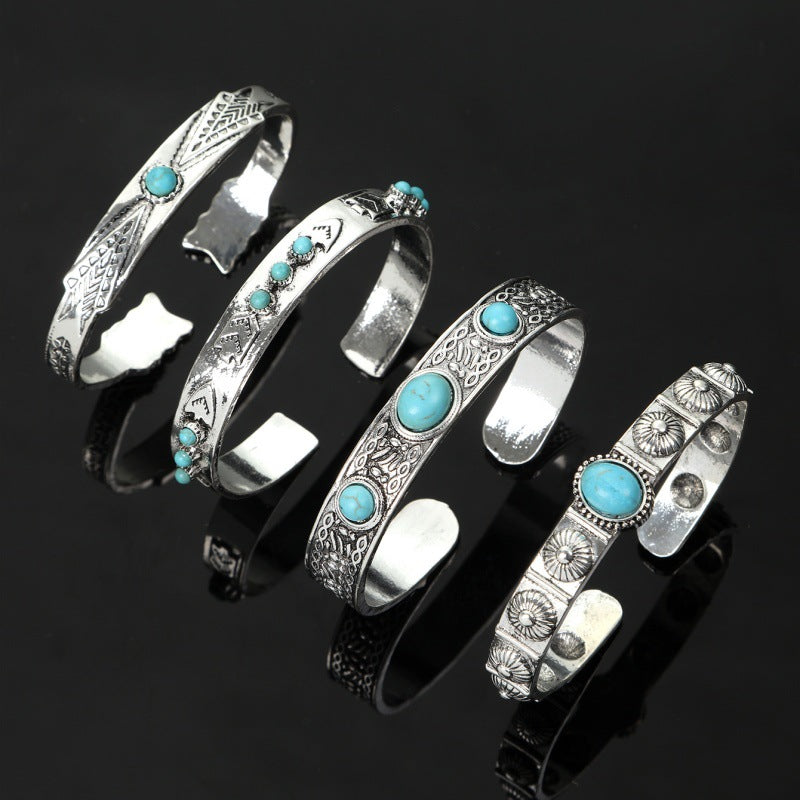
How to Pair Turquoise Bracelets with Leather
Turquoise-colored bracelets and leather can produce an easy western contrast, but “they look good together” is too vague to build a dependable outfit. Leather may appear at the jacket cuff, belt, boots, bag handle, watch strap, or several places at once. A bracelet may be a single narrow line, an open cuff, a four-piece arrangement, or a larger decorated form. The successful pairing depends on where the two materials meet, how much visual weight each occupies, and whether the exact jewelry can move safely beside leather edges and hardware.
This guide uses a three-distance leather test. First, inspect the wrist at touch distance for collision, fit, and surface contact. Second, view the upper body at conversation distance to decide whether the bracelet leads or supports. Third, view the full outfit from several steps away to see whether jacket, boots, belt, bag, and jewelry form one route or several competing routes. Product evidence and movement checks sit underneath all three distances.
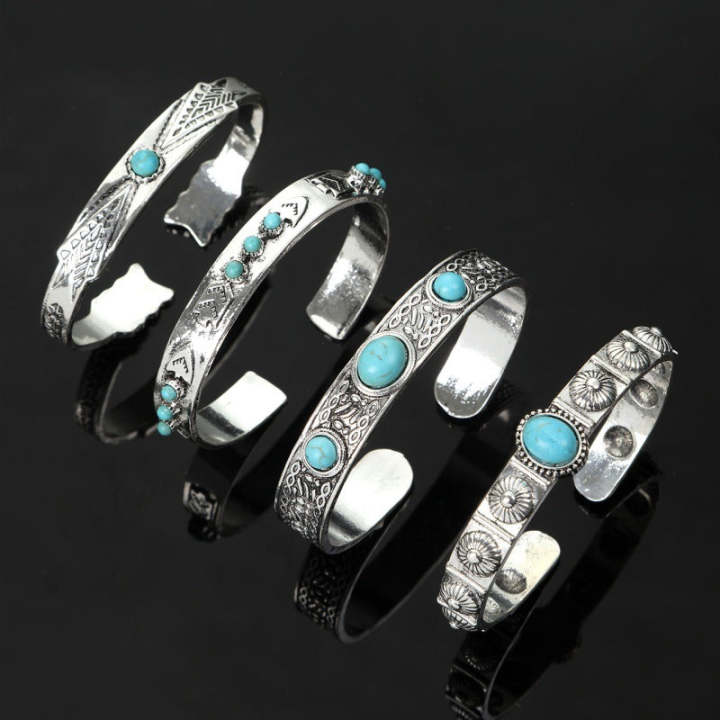
Quick Answer: Give the Leather and Bracelet Different Jobs
Let leather provide the large, quiet field while the bracelet supplies the smaller color or motif accent. With a black or dark-brown leather jacket, expose a clean section of wrist and choose either one cuff from a verified set or a controlled stack whose total width fits outside the sleeve edge. With leather boots or a bag instead of a jacket, the wrist has more freedom, but the bracelet must still clear bag handles, zippers, watch hardware, and neighboring pieces.
A reliable formula has one leader and one bridge. The leader is the first object noticed—perhaps the bracelet, jacket, buckle, or bag. The bridge repeats only one feature, such as blue-green color, warm-versus-cool contrast, an aged-looking surface, or a simple line direction. Avoid repeating every color, motif, and finish. Exact matching can make the outfit feel assembled from a costume set, while no connection at all can make the bracelet look accidental.
Before choosing the formula, record the selected product option, complete dimensions, individual and total mass, all component materials, finish or coating, decorative-material identity and treatment, construction, care, and current return terms. “Turquoise” in a title or a blue-green image does not independently establish natural turquoise, treatment, origin, or value. “Leather” in the outfit also needs precision: real leather, coated leather, suede, and synthetic alternatives may have different textures and care limits.
The Three-Distance Leather Test
Distance one: the wrist-contact zone
Put on the exact jacket, shirt, watch, bag, and bracelet. Bend the wrist, open and close the hand, operate the phone, pull the zipper, lift the bag, reach into pockets, and put on or remove the jacket. Note every point where jewelry meets a cuff seam, zipper pull, snap, watch case, leather edge, or bag handle. Contact is not automatically damaging, but repeated scraping, pressure, snagging, or forced movement is a reason to stop and revise the combination.
Measure the available exposed wrist length between the hand and sleeve at rest and during movement. Compare it with the verified assembled width of the chosen bracelet arrangement. If those dimensions are unavailable, do not estimate them from a model photograph. Request inside range, opening width, band width, top dimensions, projection, and mass for the exact option.
Distance two: the conversation view
Stand approximately as far away as another person would during conversation. The wrist should be legible without competing equally with the collar, necklace, earrings, belt, and bag. If the jacket has heavy stitching, fringe, studs, patches, embossing, or high-contrast panels, reduce the bracelet stack. If the leather is visually quiet, a broader wrist accent may become the focal point.
Distance three: the full-outfit route
Take front, side, and seated full-length photographs in neutral light. Trace the eye from face to torso to wrist to boots. A good route usually has one strong stop, one smaller repeat, and enough quiet space between them. If turquoise-colored details appear at hat, earrings, necklace, wrist, belt, bag, and boots, the color becomes a collection of separate signals rather than a deliberate route.
The published western turquoise jewelry selection guide provides a deeper method for separating styling observations from material claims. Use that distinction at every distance.
Build a Leather Texture Budget
A texture budget limits the number of surfaces asking for attention. List the visible leather features: smooth shine, matte grain, suede nap, distressing, braided trim, fringe, studs, contrast stitching, embossing, buckles, zippers, and snaps. Then list the bracelet features visible at normal distance: number of bands, open spaces, blue-green centers, motifs, crystals or crystal-related wording, edge contrast, and surface detail. Select no more than two dominant texture families for the main outfit.
For example, a smooth black jacket and a four-cuff arrangement can work because the jacket forms one large field and the cuffs form one detailed band. A fringed suede jacket, embossed belt, tooled bag, decorated boots, stacked cuffs, statement ring, and layered necklace distribute texture to nearly every zone. Removing two or three of those features often improves the bracelet more effectively than searching for a different shade.
Color temperature matters, but use observation rather than material mythology. Warm brown leather can create a warm-cool contrast with a blue-green center. Black leather can make pale or saturated accents appear sharper. Cream, tan, and cognac can lower the contrast. Screen display, lighting, and photography affect apparent color, so test the delivered item against the actual leather in daylight and the lighting expected at the event.
Use the Western Bracelets Collection as a Silhouette Index
Browse the Western Bracelets collection to compare visible structure before comparing stories. Sort candidates mentally into single cuffs, multi-piece sets, linked or flexible forms, wider decorative tops, and quieter linear accents. A collection page can help reveal shape and styling range; it does not prove that all items share the same materials, manufacturing method, cultural origin, dimensions, or care requirements.
Open each candidate page and build the same evidence card. Record option labels, gallery mapping, included quantity, inner circumference or diameter range, opening width, total width, projection, individual and assembled mass, closure or adjustment method, all materials, surface finish, treatment, and care. When the page is silent, put the field in an “ask seller” column.
The wider Western Jewelry collection is useful for checking neighboring zones. If a bracelet is broad and detailed, compare it with simpler rings and earrings. If the wrist is quiet, a stronger necklace may lead. Coordination is a hierarchy exercise, not a requirement to buy a matching set.
Current Example One: Turquoise Western Cuff Bracelet Set
On August 24, 2026, the Turquoise Western Cuff Bracelet Set page displayed $34.99 USD and a `4Set` option. It described a set of four open cuff bracelets with turquoise-colored accents and varied vintage-inspired motifs that may be worn together or individually. Ten numbered product-image positions were visible. The page also advised checking product images and the selected option and noted that screen color can vary.
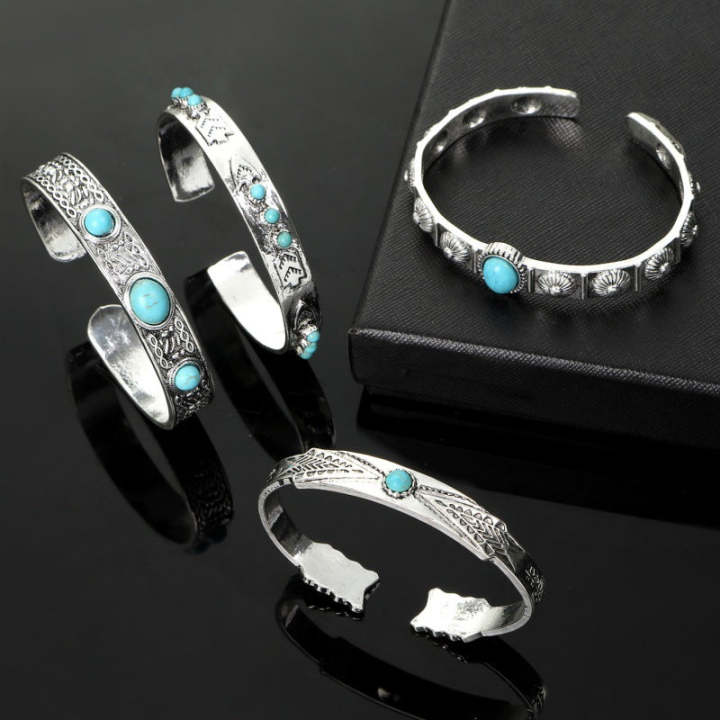
The four-piece format creates a useful variable: the wearer can test one, two, three, and four pieces as separate compositions. Start with one cuff against the leather sleeve, photograph the conversation view, and add only when the new piece has a job. One may supply the main blue-green point; another may extend the line; the remaining pieces may be unnecessary. This stepwise method makes the total width and movement route easier to judge.
The listing facts reviewed did not establish each cuff's inside dimensions, opening width, band width, top dimensions, projection, mass, exact component materials, decorative-material identity, treatment, finish, construction, or care method. Open cuffs also require precise adjustment guidance. Ask whether they arrive in a fixed opening, whether adjustment is permitted, the approved range and method, and whether repeated flexing is allowed. Do not bend a visually inferred metal construction merely because the form is open.
With a leather jacket, test a single cuff first on the wrist opposite a watch or bag-carrying hand. Keep it outside the sleeve edge rather than trapped under a zipper or snap. With leather boots and no leather at the wrist, the complete set may have more visual room, but the full-outfit photograph must still show a clear leader.
Current Example Two: Turquoise Boho Vintage Crystal Bracelet
On the same review date, the Turquoise Boho Vintage Crystal Bracelet page displayed $112.11 USD, two visual Color choices, and seventeen numbered gallery positions. The visible description used turquoise, boho, vintage, and crystal language and suggested casual, western-inspired, occasion, and gifting contexts.
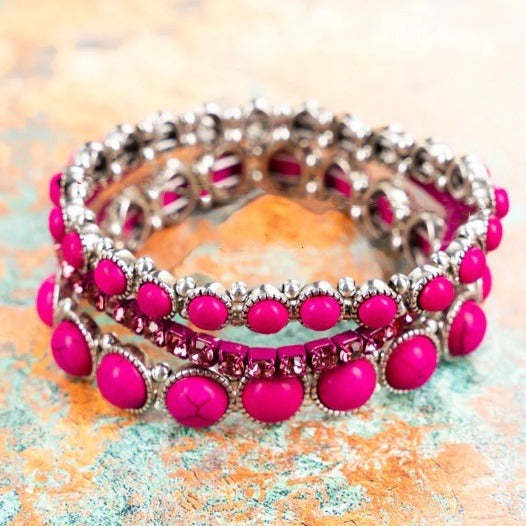
For styling, treat each Color choice as its own item. Match the chosen swatch to exact gallery images before comparing it with black, brown, tan, or colored leather. A photograph can show visible color relationships and apparent motif density, but it cannot establish actual crystal identity, turquoise identity, metal, coating, size, mass, or care tolerance. Preserve the product title while keeping composition fields unresolved until documented.
This bracelet can be tested as a single refined wrist point with a smooth leather jacket, structured leather bag, or plain leather boots. Use a clean sleeve, keep neighboring rings restrained, and repeat the bracelet color once at most. If the leather includes studs, chains, ornate buckles, or strong stitching, simplify the rest of the wrist. If the bracelet's exact profile projects far enough to meet a bag handle or zipper, change wrists, change the bag route, or choose a lower-contact occasion.
Before purchase, request inside circumference or adjustable range, complete width, top dimensions, projection, total mass, closure or fastening method, every material and treatment, finish or coating, attachment construction, included quantity, and product-specific care. The reviewed visible page did not establish those details. A dressier visual impression does not prove comfort through several hours of movement.
Two Leather Formulas and One Deliberate Non-Match
Formula A: smooth jacket, measured cuff subset
Choose a smooth or lightly grained leather jacket with minimal wrist hardware. Start with one documented cuff from the four-piece set. If the outfit needs more wrist presence, add a second cuff that changes line or spacing without adding another competing motif. Keep the necklace quiet and move any statement ring to the opposite hand.
Formula B: leather below the waist, single bracelet above
When leather appears in boots, belt, or a crossbody bag, use the crystal-bracelet candidate as a separated upper-body color point. The vertical distance prevents the two textures from physically touching while the full-length view supplies connection. Make the bag strap and buckle supporting lines rather than extra focal centers.
Deliberate non-match: repeat contrast, not motif
Pair a geometric wrist design with unadorned leather and repeat only the light-dark contrast elsewhere. Do not add the same cross, floral, concho-like, or blue-green motif at every zone. The result feels related because the values and spacing agree, even though the objects are not identical. This approach is especially useful when product materials or origin stories are not verified; it relies on visible composition rather than invented meaning.
Leather Hardware Is Part of the Jewelry Plan
Zippers, snaps, buckles, studs, chain straps, rivets, and metal bag fittings create reflective points that behave like jewelry. Count them before adding bracelets. A sleeve with a zipper and snap may already contain two wrist accents. A bag handle with rings and clasps may sit beside the bracelet whenever the arm rests. If hardware and jewelry collide, the problem is physical as well as visual.
Rehearse the outfit with real objects. Close and open the jacket, shoulder the bag, reach for keys, sit, drive, and use the phone. Listen and feel for repeated contact. Inspect both surfaces afterward in neutral light. Do not assume that either the bracelet or leather can tolerate rubbing because both are marketed as durable-looking styles. Exact finish, coating, treatment, and care evidence must decide.
What the 43-Second JTV Video Contributes
The corresponding video, “Wear It With Style: Turquoise Jewelry” by JTV, runs about 43 seconds and was watched in full on August 24, 2026. The reviewed page did not offer closed captions. The short retailer-produced montage shows turquoise-related jewelry worn across several zones—including necklace, rings, and bracelets—with light-blue, coral, white, and neutral clothing.
The useful idea is visual hierarchy across the whole person. A bright bracelet can be a small echo when a necklace leads, or a bracelet can gain importance when the neckline is quieter. The montage is not a leather-specific test, and it does not identify the exact Oroxen products, their materials, dimensions, comfort, care, or cultural background. Use it to generate full-outfit questions, not to copy claims or guarantee a result.
Six Common Pairing Mistakes and Better Corrections
- Matching every blue-green point: keep one primary color point and one smaller echo instead.
- Stacking by quantity: add each cuff only when it changes line, spacing, or hierarchy in a useful way.
- Ignoring the sleeve edge: measure exposed wrist space and test every zipper, snap, and seam.
- Treating “open cuff” as permission to bend: obtain the approved adjustment range and procedure first.
- Borrowing material claims from a video or collection: verify each selected item's own specification record.
- Planning temporary removal too late: prepare a dedicated closed compartment before leaving home.
The published guide to western jewelry motifs, styles, and materials helps keep descriptive terms separate from unsupported claims about maker, age, origin, tradition, or composition. That separation is important when leather and western motifs are combined.
A Full Outfit Rehearsal for Concerts and Everyday Wear
- Record the event, weather, seating, bag, transport, and current venue rules.
- Document the exact bracelet option and every required product fact.
- Dress in the planned leather piece, shirt, belt, boots, bag, watch, and all jewelry.
- Photograph wrist contact, conversation distance, and the full outfit.
- Walk, sit, reach, use the phone, open the jacket, operate the bag, and use pockets.
- Remove and replace the bracelet in a stable place using the dedicated compartment.
- Inspect jewelry and leather after rehearsal; stop if there is pain, snagging, pressure, or visible change.
- Review current shipping and return terms before wearing, adjusting, or altering packaging.
For crowded-event considerations, the published country concert jewelry guide adds bag, seating, outerwear, hearing-protection, and storage questions. Adapt them to the actual venue instead of assuming every concert has the same rules.
Frequently Asked Questions About Turquoise Bracelets and Leather
Should the bracelet touch the leather sleeve?
Not by default. Test the exact surfaces and movement. Repeated rubbing, catching, pressure, or contact with hardware is a reason to separate the bracelet from the sleeve or change the arrangement. Compatibility depends on documented finishes and care limits.
Can all four cuffs be worn together?
The page describes a four-piece set that may be stacked or worn individually, but a specific wearer still needs verified dimensions, opening guidance, mass, and movement testing. Add one cuff at a time and stop when width, hierarchy, or clearance becomes poor.
Does the word “crystal” prove the decorative material?
No. Preserve the product title, then request the exact identity and treatment of every decorative component. A product name and photograph are not a complete material certificate.
Which leather color works best?
There is no universal winner. Black usually increases contrast, warm brown creates a warm-cool relationship, and tan may soften the transition. Test the delivered bracelet under real lighting with the actual leather.
Can I wear a bracelet and leather watch strap together?
Only after measuring the available space and checking contact between bracelet, watch case, buckle, strap edge, and sleeve. The simpler beginner option is often to place them on opposite wrists.
How should I clean the bracelet after it touches leather?
Follow product-specific instructions for the exact jewelry and the leather item. Do not transfer leather cleaner to jewelry or jewelry cleaner to leather. When component materials are unknown, pause chemical treatment and request guidance.
Where can I compare more bracelet shapes?
Start with the Western Bracelets collection and expand to the Western Jewelry collection. Rebuild the evidence card for every candidate.
Final Leather-and-Bracelet Check
- Leather has a clear job as field, bridge, or supporting texture.
- The bracelet has one role at wrist, conversation, and full-outfit distance.
- Exact option, included quantity, dimensions, mass, materials, construction, and care are documented.
- Sleeve, zipper, snap, watch, bag, and phone contact routes have been rehearsed.
- The color route contains one leader and one smaller repeat rather than many equal focal points.
- The video supplies styling questions only; it proves nothing about the exact products.
- Temporary removal and protected storage are prepared before the outfit leaves home.
Conclusion: Connect the Textures, Protect the Evidence
Pairing turquoise bracelets with leather is most convincing when the relationship is intentional at three distances. Protect the wrist from hardware contact, let one surface lead, repeat only one visible attribute, and add stack width gradually. Beneath the styling, maintain a complete record of option, fit, construction, care, and return facts. Missing information is a question to resolve, not permission to guess.
Explore current shapes in Western Bracelets, compare supporting categories in Western Jewelry, or return to the Oroxen homepage. Build the final outfit around the real bracelet, the real leather, and the real movement route.