A black dress removes one common shopping distraction: color coordination. The remaining decision is more revealing. Should cowgirl turquoise jewelry frame the face, animate the wrist, or stay out of the outfit entirely? A good purchase answers that question with actual dress details, physical measurements, and a clear wearing plan—not with a mood board alone.
This buying guide compares two current Oroxen paths: the Turquoise Western Cuff Bracelet Set and the Turquoise Western Statement Earrings. The storefront provides useful option and styling information, but words such as “turquoise,” “vintage,” “Western,” and “statement” do not independently establish gemstone identity, age, metal content, origin, or construction.
Buying Decision in One Sentence
Choose the bracelet set when the dress leaves the wrist visible, the wearer enjoys arranging several pieces, and the confirmed cuff dimensions fit safely. Choose the statement earrings when face-level contrast matters, the neckline or waist already carries detail, and the documented weight and closure suit the wearer. Choose neither when the dress, activity, or missing product facts leave no reliable role.
Use the Cowgirl Jewelry collection to compare current silhouettes, then narrow the shortlist by physical requirements rather than trend labels.
Step 1: Classify the Black Dress
Record neckline, sleeve length, waist structure, hem, fabric, hardware, texture, and intended setting. A sleeveless matte shift exposes the wrist and gives a cuff set room. A long-sleeve dress may hide bracelets or press against open ends. A high-neck dress can support strong earrings, while a dramatic neckline may already lead the face and chest.
Photograph the dress without jewelry under the lighting where it will be worn. Identify the first three visible signals. If sleeve volume, neckline, and shoes already compete, adding both bracelet stack and statement earrings may obscure the dress’s design.
Step 2: Choose the Primary Zone
Decide whether the outfit needs activity near the face or near the hands. Earrings remain visible in conversation and portraits. Bracelets appear through gesture, bag handling, and movement. This difference affects photographs, comfort, and the way a wearer experiences the outfit.
Mark face and wrist as lead, support, or quiet. Only one should lead for the first trial. A supporting zone can receive a smaller piece later, after the main hierarchy works.
Step 3: Read the Bracelet Listing Precisely
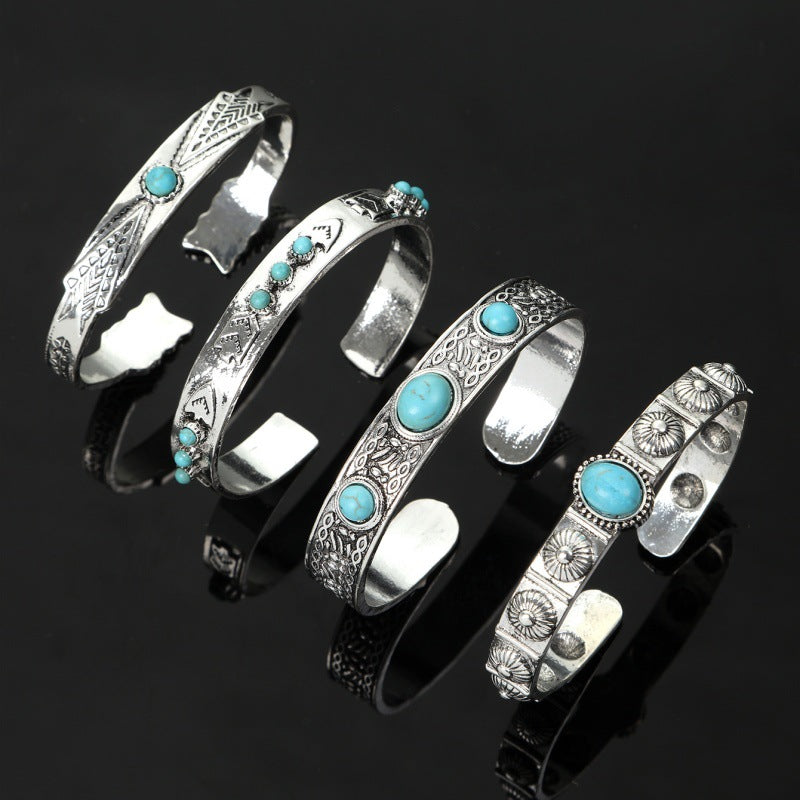
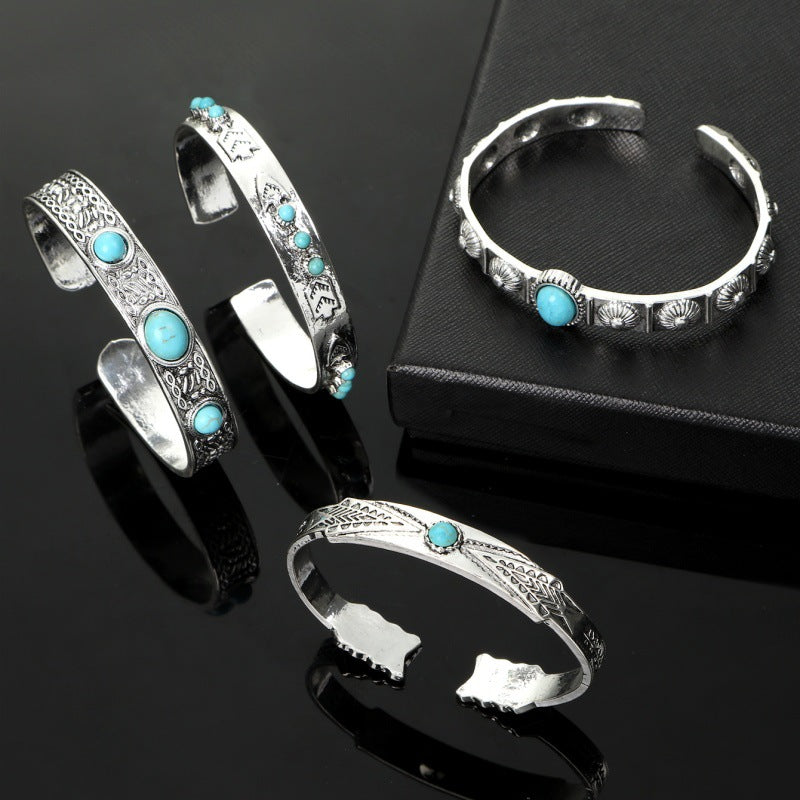
The Turquoise Western Cuff Bracelet Set page currently shows a “4Set” option and describes four open cuff bracelets with turquoise-colored accents and varied vintage-inspired motifs. It says they may be worn together or individually. Those are useful set facts.
The visible page reviewed for this guide did not provide inner circumference, opening width, band width, thickness, individual or total weight, materials, permitted adjustment, or care. Ask for those details for all four pieces. Confirm whether every pictured cuff belongs to the selected set and whether their sizes differ.
Open cuffs are not automatically universal or meant for repeated bending. Request the intended wrist range and approved method for putting them on. A cuff should not compress circulation, slide off, rotate into an uncomfortable position, or catch fabric.
Step 4: Read the Statement Earring Listing Precisely
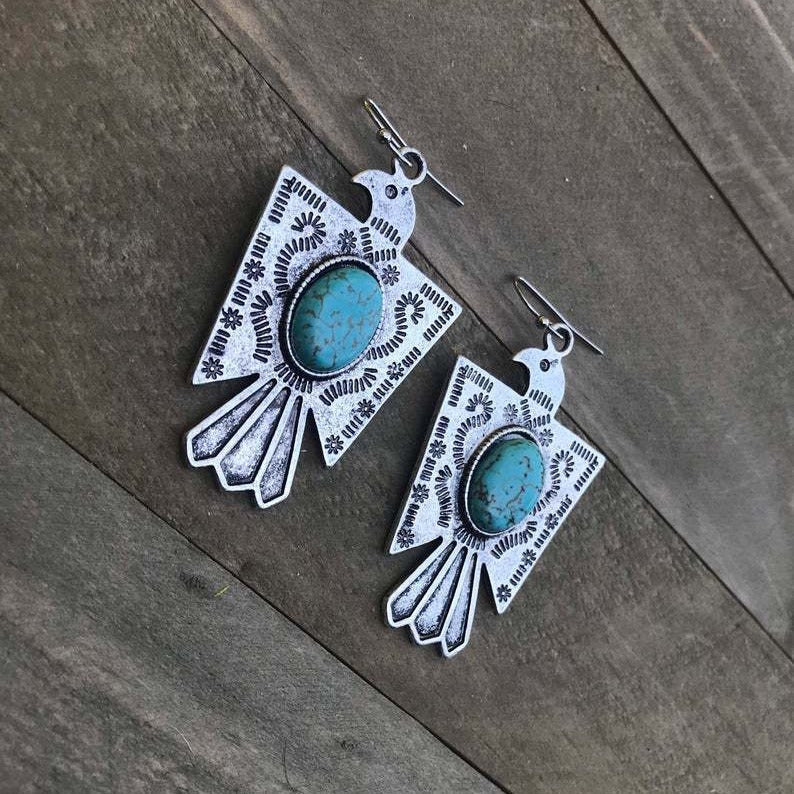
The Turquoise Western Statement Earrings page presents a Color selector and describes a sculptural Western silhouette with turquoise-style accents and vintage-inspired detailing. The captured page did not visibly state height, width, projection, single-earring weight, closure or hook type, post material, decorative materials, or option-specific care.
Request those facts before purchase. Large visual scale does not reliably predict physical weight, and an attractive front view does not reveal how the earring meets hair, glasses, phone, hat, scarf, or dress collar. Confirm what is included and whether the selected color matches the intended images.
Step 5: Measure the Wearer, Not the Photograph
For cuffs, measure the wrist at the intended placement and note the hand width that the piece must pass if relevant to its construction. For earrings, measure the available distance from piercing to shoulder or collar and record nearby glasses, hair, hats, and devices. Use a known comfortable item for comparison.
Never force a cuff, repeatedly flex unknown metal, or hang a substitute weight from the ear. The goal is to compare documented dimensions safely. When the seller cannot provide essential fit information, preserve that uncertainty in the decision instead of guessing.
Step 6: Build Three Outfit Versions Before Checkout
- Wrist-led: bracelet set, quiet earrings, simple bag, dress sleeves clear of the cuffs.
- Face-led: statement earrings, bare wrist, controlled neckline, hair arranged to prevent repeated contact.
- Edited combination: one cuff rather than four, statement earrings, restrained shoes and bag.
Photograph each at full-body and upper-body distance. Reject a version that succeeds only in a wrist or face close-up. The dress should remain part of the composition.
Step 7: Match the Purchase to the Occasion
For a routine dinner or daytime event, one or two cuffs may provide movement without making the face zone busy. For a portrait-heavy celebration, earrings may deliver more visible impact. For dancing, crowded venues, active work, or travel, test snag risk, security, and comfort carefully; remove jewelry when safety requires it.
A product is not inherently casual or formal. Dress fabric, shoe structure, bag, outer layer, grooming, and venue lighting determine much of the result. Use jewelry to support that system.
Step 8: Calculate the Real Set Value
A four-piece set is useful only if the wearer can use several arrangements. List four-cuff, two-cuff, single-cuff, and split-wrist versions. Delete arrangements that fail fit, comfort, or dress compatibility. Divide the checkout cost by realistic expected wears only as a planning estimate.
Do the same for earrings across actual outfits. A lower price does not automatically mean better value, and a set does not automatically create four times the utility. Versatility must survive real use.
Step 9: Separate Style Language From Material Claims
“Turquoise-style” and “turquoise-colored” can describe appearance without authenticating gemstone material. Ask what each colored component, metal-looking component, coating, setting, backing, and decorative surface is made from. Request information about treatments or plating when relevant.
If collectible value, origin, or gemstone identity significantly affects the purchase, seek evidence appropriate to those claims. Styling photography and a retailer title are not a substitute for independent professional assessment.
Step 10: Use the Buying Turquoise Video Carefully
The supplementary video is Buying Turquoise by Turquoise in America. Its page was accessible while this draft was prepared, but no transcript was available for review. This article does not quote it or use it to authenticate the cuff set or earrings.
Watch the complete video and turn its buying criteria into questions. Verify claims about material, treatment, origin, value, construction, and care through suitable sources and seller documentation. Never transfer a general example to a product whose components remain unconfirmed.
Step 11: Audit Return Risk
Before checkout, confirm the selected option, included pieces, current total, stock, processing time, delivery destination, and return or exchange terms. Earrings may have hygiene-related conditions; cuff sets may need all pieces and packaging returned together. Do not assume the storefront’s general return message describes every eligibility detail.
Save a dated screenshot or written record of the exact option and seller answers. If the purchase is for an event, include a backup plan that does not depend on uncertain delivery or first-wear comfort.
Step 12: Create a Wear Test
Once received and while preserving return eligibility, inspect the order against the selected listing. Follow permitted try-on procedures. Test bracelets while sitting, walking, holding a bag, using the phone, and moving sleeves. Test earrings with head turns, hair, glasses, phone, and collar.
Stop if jewelry pinches, pulls, catches, irritates, obstructs movement, or appears insecure. Record the exact issue and use the documented return or exchange path rather than forcing adaptation.
How to Combine Earrings and Cuffs Without Overloading the Dress
If both products are used, reduce the bracelet set first. One cuff plus statement earrings usually creates clearer separation than four cuffs plus strong face jewelry. Keep necklace, belt, bag, and shoe hardware restrained. The black dress amplifies high-contrast accents, so every additional item has more visual weight.
Use one distant echo—perhaps denim, cool-toned stitching, or a simple metal finish—rather than exact matching. For wider outfit context, read the public Western jewelry with dresses and boots guide.
Care Questions Before Purchase
Ask for instructions matched to each confirmed material and construction. Avoid soaking, steam, ultrasonic cleaning, chemical dips, abrasives, and polishing compounds unless documentation permits them. Cuff finishes, adhesives, imitation components, stones, coatings, posts, and backs can require different treatment.
Store cuffs separately so open ends and motifs do not scratch other pieces. Keep earring pairs and backs together. Remove jewelry for swimming, exercise, tools, harsh chemicals, and unsafe activities. Stop wear if irritation, looseness, distortion, or surface changes appear.
Run a Sleeve-and-Hair Interference Grid
The two product categories fail in different places. A cuff usually meets sleeves, bags, tables, and the opposite wrist. A statement earring usually meets hair, collars, glasses, phones, and headwear. Test those contact points systematically instead of declaring a piece comfortable after one minute.
For the black dress, photograph three sleeve states if available: bare wrist, sleeve ending above the wrist, and sleeve covering part of the wrist. Add the intended jacket or coat as a fourth state. For each, note whether a cuff remains visible, presses the fabric, enters the sleeve, or catches a seam. Repeat with one cuff, two cuffs, and the proposed stack only after individual fit is safe.
For earrings, test hair fully down, behind the ear, and secured away from the face. Add glasses, phone, and the outer-layer collar. Turn the head slowly and change the dress carefully. A pair that works with hair up may repeatedly snag when hair is loose; that difference belongs in the buying decision.
Create a four-column grid labeled “clear,” “occasional contact,” “repeated contact,” and “unsafe or uncomfortable.” Keep only combinations in the first column, or in the second when the contact is harmless and acceptable under verified care guidance. Do not buy with a plan to tolerate repeated pulling or force the garment around the jewelry.
Interview the Purchase With Five Questions
- Which exact black dress and occasion justify this item?
- What verified measurement proves it fits the intended wrist or ear context?
- Which material and care facts remain unknown?
- What jewelry already owned performs the same visual job?
- What is the return plan if the first controlled wear test fails?
Answer in writing without using “probably,” “looks like,” or “should fit.” If an answer is missing, ask the seller, measure the wardrobe, or wait. This interview prevents a striking photograph from becoming the only reason to purchase.
A Buy / Wait / Skip Decision Card
- Buy: option, dimensions, weight, materials, care, wardrobe role, comfort plan, delivery, and returns are adequate.
- Wait: the product fits the style plan, but one important fact or event timeline remains unresolved.
- Skip: fit is unsuitable, the motif is unwanted, care is unrealistic, or the item duplicates jewelry already owned.
Waiting is a successful decision when it prevents a purchase built on missing information.
Frequently Asked Questions
Are four cuffs better than one?
No. Four provide arrangement options, but fit, comfort, sleeve clearance, and visual hierarchy determine how many should be worn.
Will statement earrings work with every neckline?
No. Compare dimensions, projection, collar height, shoulder distance, hair, and the dress’s existing neckline detail.
Can the set and earrings be a gift?
Yes, when the recipient’s wrist fit, pierced-ear status, sensitivities, motif preference, comfort, and return options are known. A shared-choice gift is safer when they are not.
Where should a shopper compare more options?
Browse Cowgirl Jewelry, the broader Western Jewelry collection, visit the Turquoise Jewelry Guides hub, read the public Western turquoise jewelry buying guide, or return to the Oroxen home page.
Final Purchase Rule
Buy the wrist option when the dress exposes the wrist, all four cuffs are documented, and the wearer values arrangement. Buy the face option when earring measurements, weight, closure, and daily interactions work. Combine them only after separate wear tests.
A black dress makes cowgirl turquoise jewelry visible; it does not make the product facts optional. Let measurements, materials, comfort, existing outfits, and return conditions decide whether the visual promise becomes a useful purchase.