Common Questions About Men's Turquoise Jewelry for Cowgirl-Style Beginners
“Men's turquoise jewelry” sounds like a simple shopping category, but a beginner quickly meets several different questions: Is turquoise a color or a verified gemstone in this listing? Does a product marketed to women become unsuitable for a man? Does “vintage” describe age or only appearance? Is an earring assortment one pair, several pairs, or something else? Can a 52cm necklace be compared with a 90cm option without knowing the pendant size and total mass?
This FAQ uses an Evidence Traffic Light. Green answers come directly from a current product page or the wearer's known preference. Yellow answers are plausible but need a measurement, component statement, or direct confirmation. Red answers are assumptions based on a title, photo, gender label, trend, or cultural stereotype. The method helps cowgirl-style beginners explore a western-inspired look while keeping product facts, personal meaning, and fit decisions separate.
Quick Answer: Choose by Person, Placement, and Proof
First ask what the wearer wants to place at the ear, neck, wrist, or hand. A product's marketing gender does not determine who may wear it. The practical issues are preference, piercing or fastening needs, dimensions, mass, materials, contact, symbolism, outfit, and activity. A man who wants a compact blue-green stud and a woman who wants the same stud need the same exact product facts.
Second, treat “turquoise” as a navigation or appearance term unless the listing explicitly identifies and documents the material. Say turquoise-colored or turquoise-style when that is what the evidence supports. Do the same with silver-colored, vintage-inspired, western, and boho. These words can describe a design without proving stone, metal, age, origin, or artisan.
Third, build a verification card before purchase: URL, review date, exact option, included quantity, dimensions, total and per-item mass, attachment or fastening, components, materials, finish, construction, care, current price, delivery, and return conditions. For a broader introduction, read the published western turquoise jewelry guide and the published explainer on western jewelry motifs, styles, and materials.
What Does “Men's Turquoise Jewelry” Mean?
It can mean jewelry marketed to men, jewelry selected by a man, or a style people often associate with menswear. Those meanings are not interchangeable. A product title may help search, but it does not establish a physical standard for every man. Wrist size, neck circumference, piercing, finger size, skin contact, wardrobe, and personal taste vary within every gender.
A useful definition is wearer-led: men's turquoise jewelry is turquoise-colored or documented turquoise jewelry a man chooses to wear. That definition allows comparison across product categories without telling the wearer that a small stud is too feminine or a large cross is automatically masculine. It also prevents marketing language from replacing measurement.
Use the Evidence Traffic Light. Green: the wearer likes the exact silhouette and has the required piercing or fastening preference. Yellow: the item is photographed attractively but dimensions and mass are absent. Red: “all men prefer larger pieces” or “a product labeled for women cannot be worn by men.” Neither claim follows from reliable evidence.
Does “Turquoise” Prove the Product Contains Natural Turquoise?
No. A product or collection name may refer to color, style, a turquoise-like center, a documented material, or a mixture of components. The current listing must say which. If it uses “turquoise-style,” that is an appearance description. If it simply says “turquoise” without a material statement, do not add “natural,” a mine name, treatment status, matrix type, or geographic origin.
Browse the Cowgirl Jewelry collection to recognize motifs and silhouettes, not to authenticate components. A collection can bring related aesthetics together while the exact material evidence remains product-specific. Ask the seller what each blue-green part is made from, whether any treatment is documented, what other components contact the skin, and what care applies.
Color variation on a screen does not prove natural variation. Matrix-like marks in an image do not prove a gemstone. A material conclusion needs words, documentation, or testing appropriate to the claim. Until then, “turquoise-colored” is both accurate and useful.
Can a Cowgirl-Style Beginner Use Men's Jewelry?
Yes. Cowgirl style can describe an outfit direction—denim, boots, western-inspired shapes, ranch-related motifs, certain textures, or country-concert dressing—without limiting the wearer to products in a women's category. The same principle works in reverse: a product titled “for Women” can be considered by a man if the shape, verified length, fit, meaning, and attachment suit him.
Start with one known preference. If the beginner already wears small earrings, consider a stud silhouette. If the beginner wears necklaces and welcomes a cross, compare lengths. If neither is known, choose together. Avoid inferring gender identity, religion, culture, ranch experience, or personal history from an outfit preference.
The published cowgirl jewelry style guide can help compare categories, but the final decision should stay with the individual wearer.
Product Example One: What Can Be Said About the Stud Set?
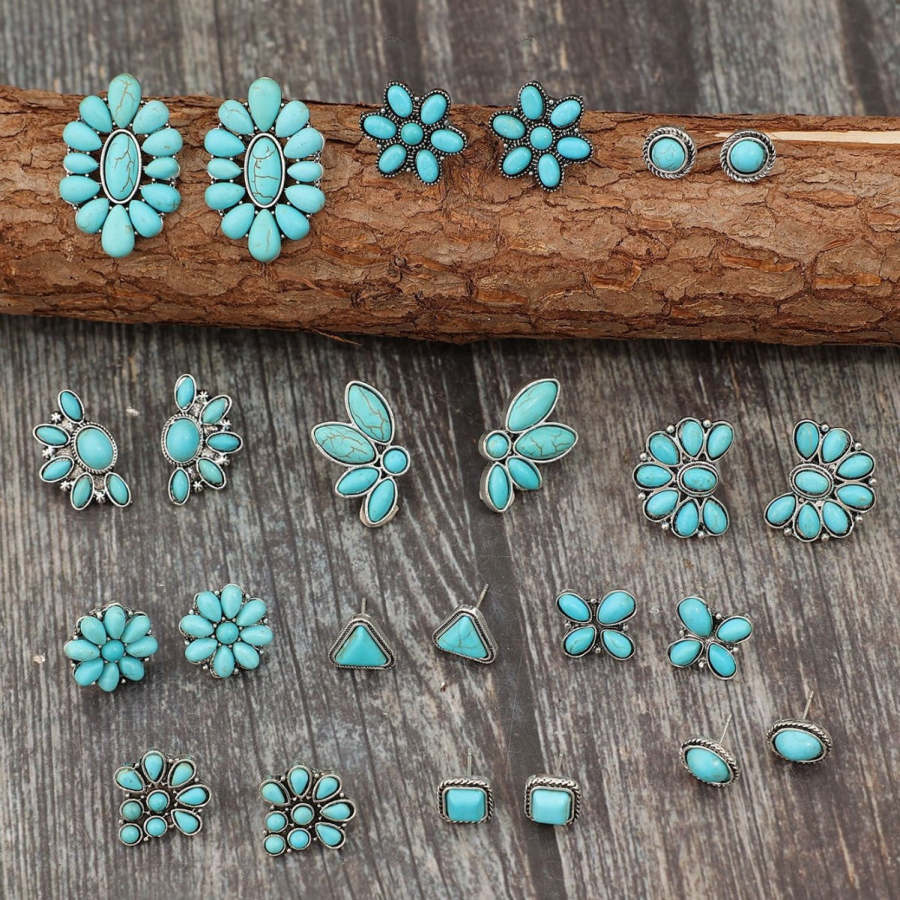
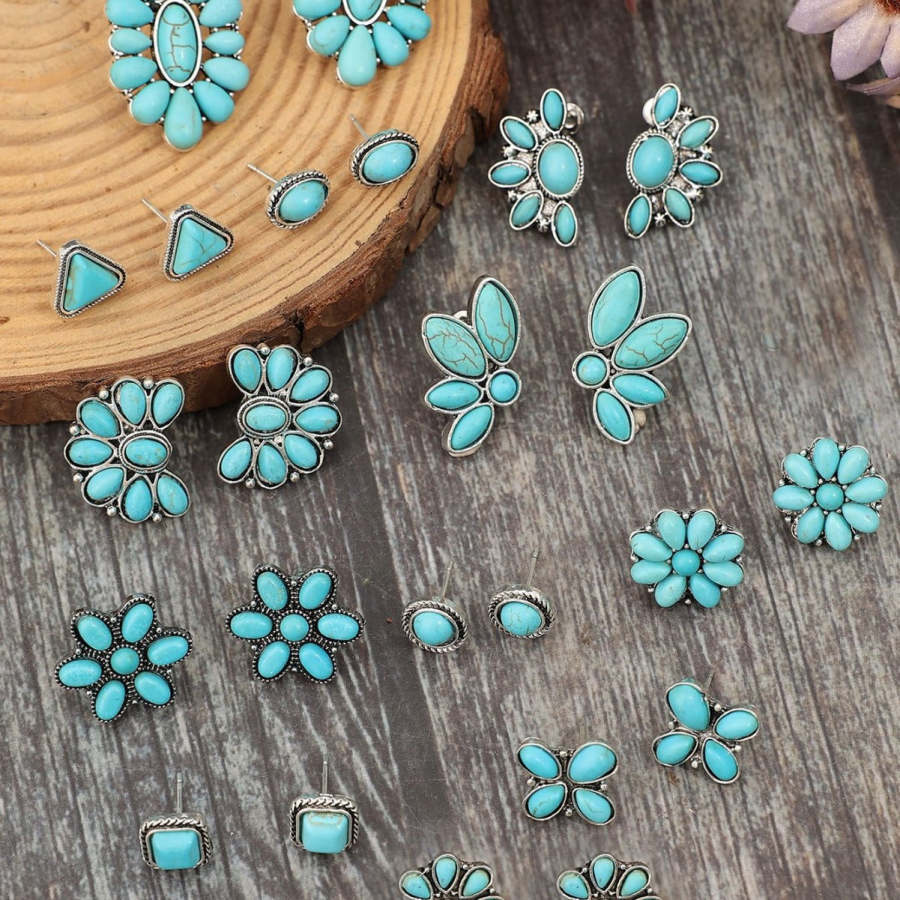
The Turquoise Western Stud Earring Set page was reviewed on August 24, 2026. It displayed $29.99 USD, one visible color selection, and a nine-image gallery. Its current copy describes a coordinated assortment of turquoise-style studs with floral, geometric, and classic shapes. Those observations are green because they are visible on the current page.
The exact included count, number of pairs, dimensions, projection, total and per-earring mass, post structure, backing, components, material identity, finish, construction, and care were not stated in the visible information reviewed. Those fields are yellow: they require confirmation. It would be red to count the earrings from a lifestyle image and promise that the buyer receives every visible item.
Are stud earrings a good beginner choice?
They can be when the wearer has an appropriate piercing, wants a compact ear-zone detail, and can verify the backing, dimensions, projection, mass, components, and included quantity. “Stud” does not guarantee light weight, low projection, a certain post, or comfort. The exact design matters.
Can a man wear floral or geometric studs?
Yes, if he wants them. Floral, geometric, and classic are design descriptions rather than gender rules. Compare each shape with the wearer's wardrobe and the space around eyewear, hair, hat, phone, helmet, or hearing protection.
Should several studs from the assortment be worn at once?
Only when the wearer has the piercings, knows the exact included designs, and prefers the combination. Begin with one visible shape. Add another only if the spacing remains clear and every attachment is secure. A coordinated assortment does not require simultaneous use.
Product Example Two: How Should the Cross Jewelry Page Be Read?
The Western Turquoise Vintage Cross Jewelry for Women page was checked on August 24, 2026. It displayed $112.11 USD, a thirteen-image gallery, and two visible length choices: 52cm and 90cm. The page showed 52cm selected during the review. These values are current page facts, not permanent promises.
Its title uses western, turquoise, vintage, cross, and “for Women.” None of those words proves natural turquoise, documented age, cultural origin, artisan identity, or a wearer restriction. The visible page did not provide pendant dimensions, total mass, fastening, extension, full components, material identity, finish, construction, care, or the precise difference between the two lengths beyond the stated centimeter values.
Can a man choose the product even though the title says “for Women”?
Yes. The title is marketing language. Measure where 52cm and 90cm would place the item on the exact wearer, confirm what each option includes, and ask whether the cross symbol and silhouette are wanted. Comfort and meaning matter more than the gender label.
How should 52cm and 90cm be compared?
Convert the lengths if necessary, then reproduce them with cord on the intended outfit. Do not assume pendant size or extension is included in the stated number. Ask whether the measurement is end-to-end, whether it includes an extender, and whether pendant position differs between options. Check sitting, bending, jacket, belt, bag strap, and seat-belt contact.
Does the cross carry one universal meaning?
No. It may be religious, personal, familial, decorative, or unwelcome. The wearer defines the meaning. A seller title cannot decide it, and a cowgirl-inspired outfit does not automatically imply it.
How Do Beginners Compare Earrings and Necklaces?
| Question | Stud assortment | 52cm/90cm cross jewelry |
|---|---|---|
| Primary fit point | Piercing, post, backing, projection | Neck length, pendant position, fastening |
| Included quantity risk | Exact items/pairs not visibly stated | Confirm exact necklace and option contents |
| Strong meaning check | Floral/geometric preference | Cross symbolism |
| Visible current options | One color selection | 52cm and 90cm |
| Critical missing facts | Count, size, mass, backing, components | Pendant size, mass, clasp, components |
Do not rank the categories only by price. Score each option from zero to two for preference evidence, fit information, material evidence, activity compatibility, and return readiness. A lower-priced assortment with an unknown count is not automatically lower risk. A length-labeled necklace without pendant dimensions is not automatically solved.
How Should Men's Turquoise Jewelry Be Styled?
Choose one body zone to lead. If a stud is the focal detail, expose enough of the ear and keep the neckline quiet. If the 52cm or 90cm necklace is the lead, reduce earrings and hat decoration. Repeat blue-green color once at a distant zone only if the outfit needs connection. Avoid repeating a large cross at the neck, buckle, ears, and hat unless the wearer intentionally wants a highly thematic look.
Use real activity as the test. A country concert requires walking, sitting, moving through crowds, handling a phone and bag, adding an event wristband, and possibly using hearing protection. The published country concert jewelry guide provides a fuller venue checklist.
For everyday dressing, try one turquoise-colored detail against denim, black, cream, brown, or olive. These are examples, not gender rules. The wearer may prefer brighter pattern, multiple motifs, or a different palette. Use a phone photo and a movement rehearsal rather than a universal formula.
What Does the “Top 10” Turquoise Video Contribute?
GEMDELUX's “Top 10 things to know about Turquoise” is a general educational video about turquoise. Its value here is as a prompt to ask more precise questions about a term that carries material, historical, and geographic associations. A beginner should distinguish information about turquoise as a gemstone from evidence about a specific retail listing.
The video does not inspect either Oroxen product and cannot authenticate their blue-green components, metal, treatment, origin, age, construction, value, or care. General history and beliefs also should not be turned into claims about a wearer. Use the video to generate verification questions, then rely on product-specific documentation for the answer.
What Are the Most Common Beginner Mistakes?
- Reading “turquoise” as natural turquoise: use exact listing language and request a component statement.
- Reading “for Women” as a prohibition: let the wearer choose and verify fit.
- Counting an assortment from pictures: confirm the exact included items and pairs in writing.
- Treating a stated chain length as complete fit data: request pendant dimensions, extension, fastening, and mass.
- Assigning one meaning to a cross: ask the wearer and avoid assumptions.
- Calling a piece hypoallergenic or lightweight from appearance: verify contact materials and mass.
- Using cultural imagery as a costume shortcut: describe only documented design and origin information.
- Skipping the return policy: verify the current window, condition rules, costs, and process before ordering.
More Frequently Asked Questions
Is men's turquoise jewelry only for western outfits?
No. A blue-green stud or necklace can be worn with many wardrobes. Western-inspired styling is one option. Let the wearer decide whether the piece is everyday, concert, dressy, minimalist, or expressive.
Can turquoise-style jewelry be gifted without knowing the exact size?
It is safer to obtain dimensions and fit information first. For an uncertain gift, use a documented exchange plan or let the recipient select the option.
How should the jewelry be cleaned?
Follow care instructions tied to the exact components and finish. Do not assume that gemstone, metal, plated, coated, resin, or adhesive care applies when the construction is unknown.
Can the stud set and long cross necklace be worn together?
Yes if the exact pieces are verified and the wearer likes the combination. Start with the necklace as the upper-body lead and choose one compact stud shape as support. Check symbol, spacing, and physical contact.
What does a beginner need to save before ordering?
Save the URL, date, current price, selected option, matching image, included quantity, measurements, mass, attachment, components, materials, finish, construction, care, shipping estimate, and return terms.
Final Evidence Traffic Light
- Green: exact product page, current option, visible price, written measurement, documented component, and direct wearer preference.
- Yellow: product photo, collection label, approximate placement, generic care advice, unconfirmed included count, and unspecified material.
- Red: gender stereotypes, gemstone assumptions, invented cultural origin, unverified sensitivity claims, and comfort promised from appearance.
Before purchase, move every important yellow item to green or accept it explicitly as an unknown with a return-ready plan. Never turn a red assumption into marketing copy.
Conclusion: Curiosity Is Better Than Certainty
A cowgirl-style beginner does not need a rigid definition of men's turquoise jewelry. The useful questions are personal and observable: Who wants the piece? Where will it sit? What does the symbol mean to that wearer? What does the current page actually say? Which dimensions, components, and care facts remain missing?
Explore additional categories in the Western Jewelry collection or begin from the Oroxen homepage. Keep green evidence distinct from yellow uncertainty, reject red assumptions, and let the wearer—not a gendered product title—make the final style decision.