Beaded Turquoise Jewelry and a Rodeo Outfit: A Proportion and Balance Guide
Beaded turquoise jewelry can create a field of repeated color, while a rodeo outfit already contains repeated signals: hat brim, shirt seams, snaps, belt tooling, buckle edges, boot shafts, and sometimes fringe. The styling problem is therefore not “How many Western details can fit in one look?” It is “Which detail owns the first glance, and where does the eye rest next?”
This guide uses a dot–drop–span ledger. Dot measures repeated visual units such as documented beads, stud shapes, buttons, or stones. Drop measures the vertical travel of earrings and necklaces. Span measures how much horizontal territory is occupied by a hat, collar, yoke, buckle, cuff, or jewelry arrangement. A balanced rodeo outfit gives one of those measurements the lead and keeps the other two in support.
Quick Answer: Choose One Repetition Zone and One Quiet Corridor
If the jewelry is genuinely beaded, decide where its repeated units will appear: around the neckline, at the wrist, or as a smaller face-level rhythm. Do not repeat the same color density at every zone. Give the chosen piece a quiet corridor—plain shirt fabric, an open neckline, an undecorated sleeve, or negative space between the hat and collar—so the repeated units read as intentional rather than busy.
Then test the outfit at three distances. At mirror distance, check edges, closures, and contact points. At conversation distance, identify the first and second focal areas. At a full-body photo distance, confirm that the jewelry still has a role after the hat and buckle enter the frame. If every object competes at the same strength, reduce one dot field, shorten one drop, or narrow one span.
First verify that “beaded” is an accurate construction term. Product names, search phrases, and turquoise-colored photographs cannot establish bead material, stone identity, treatment, stringing method, thread, knots, wire, spacers, clasp, age, origin, or cultural affiliation. Styling advice becomes more useful when appearance and construction are kept in separate columns.
Before Styling, Define What “Beaded” Would Need to Mean
A bead is a discrete component with a documented form and attachment route. A turquoise-colored center in a stud or pendant is not automatically a bead. A row of photographed blue-green shapes may be cabochons, molded decoration, linked components, printed pattern, or another construction. The term should be supported by the exact listing or a seller’s written answer for the selected option.
Create a bead evidence card with fields for component count, bead diameter or dimension range, shape, material identity, treatment, color variation, hole direction, stringing medium, knotting or wire method, spacer material, closure, total length, adjustment, mass, repairability, and care. Record whether the count includes spacers and whether the measurements describe every strand or only one sample. Leave unsupported fields blank.
The public guide to Western jewelry motifs, styles, materials, and selection explains why style vocabulary and verified construction should not be merged. Use its evidence boundary before applying any of the proportion tests below.
Visible repetition is not material proof
The dot part of the ledger describes what the eye sees: repeated units, intervals, and color pulses. It does not authenticate the units. You can say that a photographed arrangement creates a dotted or clustered visual rhythm without saying that every visible blue-green element is natural turquoise. If the listing uses “turquoise-style,” “turquoise-colored,” or similar language, preserve that qualification.
Construction changes how proportion behaves
A rigid cluster, a flexible strand, and individually linked components can occupy similar space while moving very differently. Movement affects whether a piece stays centered, twists, contacts skin, catches clothing, or collides with a hat cord or jacket. Exact construction and mass are therefore part of the styling plan, not merely technical details.
Build a Five-Zone Rodeo Map
Draw five horizontal zones: hat and hair; ears and face; neckline and chest; waist and hands; boots and ground. Place every visible object in one zone before choosing jewelry. This makes competition visible on paper. A large hat belongs in the first zone, statement earrings in the second, a necklace and embroidered yoke in the third, a buckle and stacked bracelets in the fourth, and decorated boots in the fifth.
Assign each object a dot score from zero to three, a drop score from zero to three, and a span score from zero to three. The numbers are comparative, not universal measurements. A plain hat might be span two and dot zero. A necklace with many documented small beads could be dot three, drop one, span two. A large buckle could be dot one, drop zero, span three. If three objects earn the maximum score in adjacent zones, the outfit probably needs editing.
Choose the lead zone
The lead zone should be deliberate. If beaded jewelry is the reason for the outfit, let its zone earn the highest score and reduce the nearest competition. If the hat or buckle must lead, move the jewelry into a supporting role through lower contrast, smaller scale, or fewer repeated units. Balance does not require every zone to be equally strong.
Create the quiet corridor
A quiet corridor is the fabric or negative space surrounding the lead. For a necklace, it may be a solid shirt panel without embroidery. For earrings, it may be hair placement and an uncomplicated collar. For a bracelet, it may be a plain sleeve and an unoccupied neighboring wrist. The corridor must remain quiet in motion, not only in a posed photograph.
Dot: Control the Density of Repeated Units
Dot density depends on more than count. Contrast, spacing, size variation, reflective edges, and the amount of visible background all change how crowded a field feels. Ten widely spaced small units can look quieter than five large high-contrast units. A rodeo shirt with pearl-like snaps already contributes repeated dots; boot stitching and belt tooling can add further rhythm.
When a verified beaded necklace is the lead, reduce repeated dots elsewhere. Choose a calmer hatband, simple earrings, an untooled belt, or a buckle without a ring of repeated accents. When the shirt’s snap line is the lead, use jewelry with a single center rather than another dense sequence.
Do a blur test on a full-outfit photograph. Slightly defocus your eyes or view a small thumbnail. Dense dot fields merge into larger blocks. If the necklace, shirt snaps, buckle border, and boot decoration all become separate bright blocks of equal weight, remove or quiet one field. This is a composition test, not a product-quality judgment.
Drop: Set Vertical Jewelry Travel Against the Shirt
Drop is the distance from the attachment point to the lowest visible endpoint. For earrings, measure from the piercing to the bottom. For a necklace, separate wearing length from pendant drop and total front endpoint. A listing photograph cannot provide those numbers without a reliable scale. Ask for exact dimensions and record the selected option.
Align the endpoint with a calm garment area. Avoid landing a pendant directly on the top edge of a buckle, embroidered motif, pocket flap, snap cluster, or jacket closure. A short necklace may share the collar zone; a longer one may cross the shirt’s visual architecture. The best drop is the one that creates separation from competing edges during standing, sitting, and walking.
For earrings, include hat brim, hair, collar, and head movement. A drop that looks clear in a front-facing image may touch the collar when the wearer turns. Studs reduce vertical travel, but their actual dimensions, post type, backing, mass, and included assortment still need verification.
Span: Limit How Much Territory Each Statement Occupies
Span measures horizontal territory. A wide hat, decorated shoulder yoke, broad necklace arrangement, large buckle, and multiple cuffs can divide the body into competing bars. Choose one or two structural spans and narrow the rest. For example, a wide hat and moderate necklace can work with a restrained buckle; a large buckle may work with a narrow pendant and simple hatband.
Check span at seated height. In arena seating, the waist can fold and jacket fronts can move inward. A broad necklace arrangement may meet lapels, while bracelets may meet rails or armrests. Venue and activity rules override styling. Remove anything that creates snagging, impact, or handling difficulty.
Product Reference One: Turquoise Western Stud Earring Set
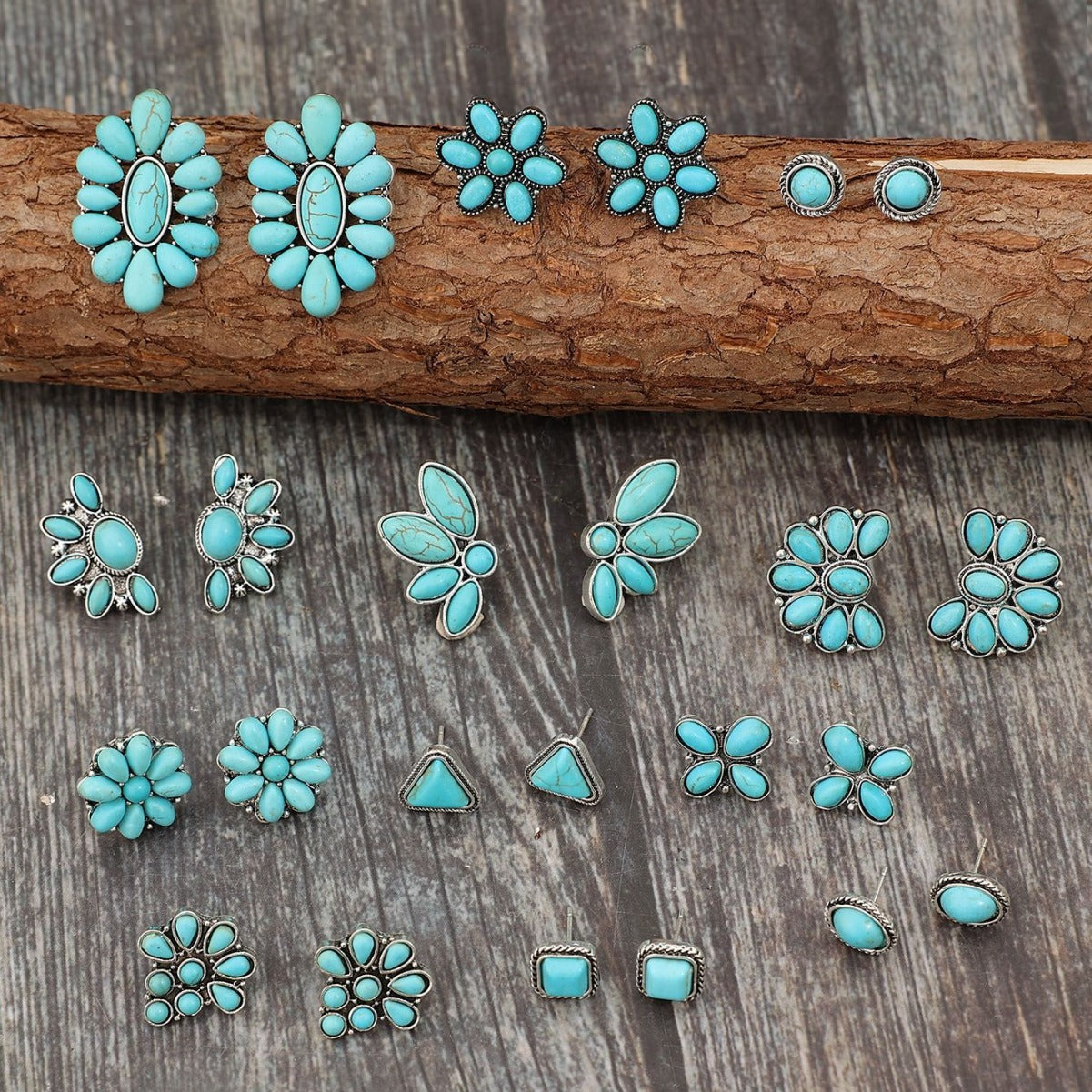
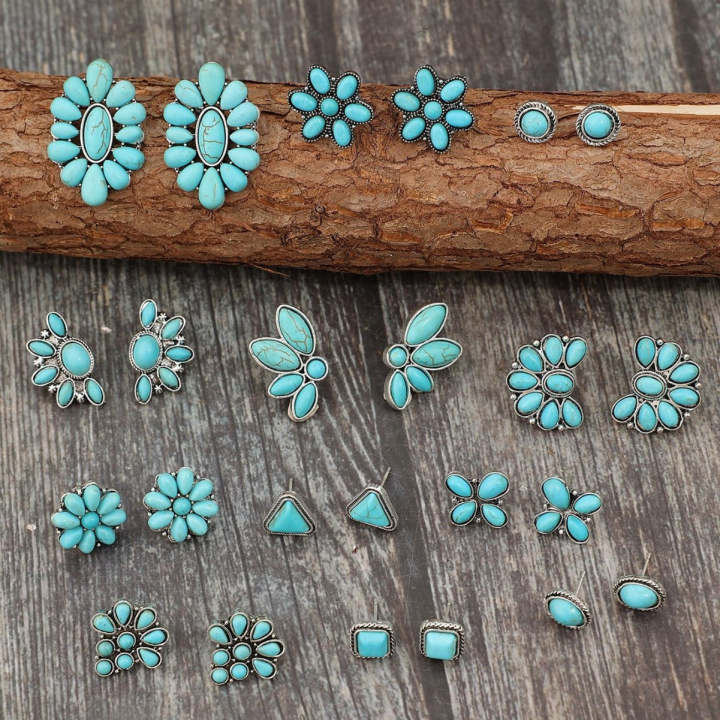
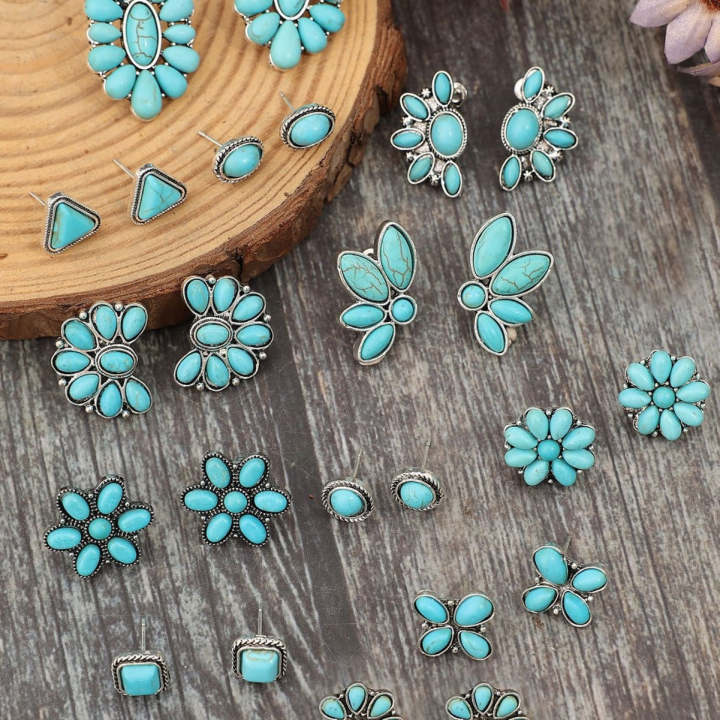
The Turquoise Western Stud Earring Set page was reviewed on August 24, 2026. It displayed $29.99 USD, one visible Color radio, and nine numbered product-image positions. The current copy describes a coordinated turquoise-style stud assortment with floral, geometric, and classic shapes, and suggests denim, boots, dresses, everyday cowgirl looks, festivals, Western-themed events, and gifting.
Those statements support a face-level dot comparison. They do not prove that the earrings are beaded. The reviewed page did not establish the exact number of wearable pairs included, dimensions for each shape, individual or total mass, post and backing type, component materials, decorative-material identity or treatment, coating, construction, care, or whether every photographed arrangement is included in the selected Color option.
Before using the set in a rodeo plan, request a packing list and a measurement card for every included piece. Choose one verified pair, not the entire photographed assortment as a styling assumption. A small stud can support a necklace-led look by supplying a low-drop dot near the face. A larger clustered shape may become its own focal point and require a quieter neckline.
Product Reference Two: Turquoise Western Teardrop Pendant Necklace
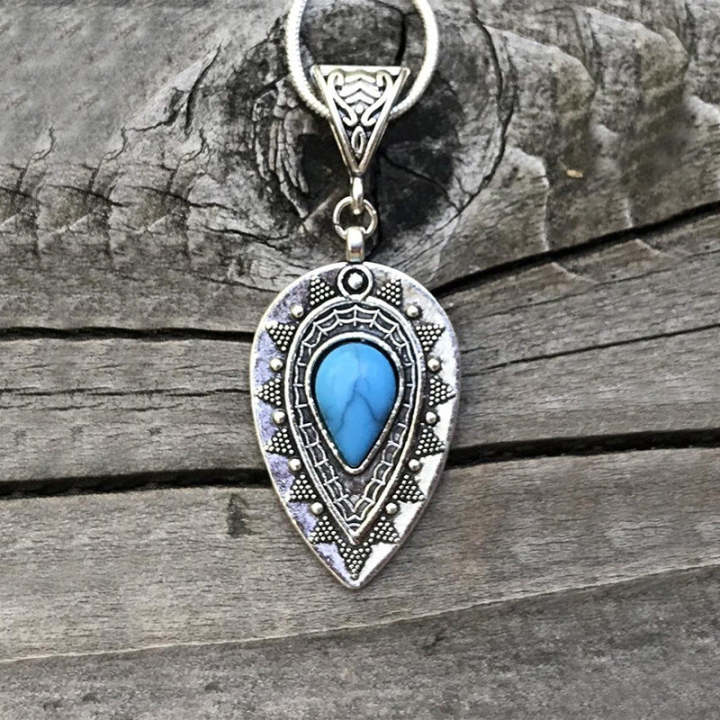
The Turquoise Western Teardrop Pendant Necklace page was reviewed on the same date. It displayed $39.99 USD, one visible Color radio, and eleven numbered product-image positions. The page describes a Western pendant necklace, vintage-inspired statement design, teardrop silhouette, turquoise-style center stone, and antique-silver color. It suggests wearing the piece alone or layering it with simpler necklaces.
This is a useful single-center contrast to a true beaded field. It does not establish a bead construction. The page as reviewed did not visibly state wearable length, adjustment range, pendant height and width, total drop, mass, closure, chain material, pendant material, center-material identity or treatment, coating, construction, or item-specific care details.
Use the necklace only after the missing dimensions allow it to be plotted against the intended shirt, jacket, and buckle. If its verified endpoint lands in the quiet corridor, it can create one strong drop with relatively low dot density. If it lands on embroidery or buckle hardware, change the garment, choose another length, or select a different piece. Do not add a beaded strand simply to satisfy the article keyword; add it only if the measured composition needs another layer and the construction is documented.
Three Rodeo Outfit Formulas
Formula A: verified beaded necklace as the lead
Choose a solid shirt or dress with an open, undecorated chest corridor. Use a simple hatband, a low-dot earring pair, a restrained buckle, and no competing necklace. Record the strand count, bead dimensions, total wearing length, mass, closure, and movement. The necklace earns the highest dot score; the hat supplies span; the rest of the outfit stays below both.
Formula B: stud pair as the lead near the face
Select one documented pair from the stud set. Arrange hair and hat clearance so the shape remains visible. Use a quiet neckline or a single narrow pendant with a low contrast endpoint. Keep shirt snaps and hatband repetition below the earring’s visual density. The face zone leads through dot; the necklace zone supplies only a small drop.
Formula C: teardrop pendant as the vertical lead
Place the verified pendant endpoint on an uninterrupted shirt panel. Choose compact earrings, a belt with lower contrast than the pendant, and a hat whose band does not repeat the same blue-green center. The necklace earns the highest drop score while dot density stays moderate. Photograph the look seated and standing to make sure the pendant does not merge with waist hardware.
What the Corresponding Video Contributes
The video How to Wear Men’s Jewelry with ANY Outfit by Parker York Smith is not about either Oroxen product and does not authenticate beaded turquoise jewelry. Its published chapters—The Core Rule, Necklaces, Bracelets, Rings, and Outfit Examples—make it useful as a category-and-outfit planning companion. The description presents jewelry as a way to distinguish an outfit and build confidence.
Translate that broad organization into a rodeo audit: evaluate necklaces, bracelets, and rings as separate zones before viewing the total outfit. Then test the whole composition rather than copying an example from another wardrobe, body, or occasion. The video’s sponsorship and linked brand are also reasons to keep product evidence separate; it cannot supply Oroxen dimensions, materials, care, stock, or return facts.
For event-specific movement and venue questions, use the published country-concert jewelry guide. Rodeos and concerts differ, but both require practical checks for crowds, seating, bags, weather, and activity.
Common Balance Failures and Specific Repairs
Failure: calling every turquoise-colored unit a bead
Repair: use visual language until the construction is documented. Ask for bead shape, dimension, material, treatment, stringing, spacer, closure, and care facts. Keep the article’s keyword separate from the featured item’s verified identity.
Failure: repeating turquoise color at every body zone
Repair: select one turquoise-color lead. Let other zones repeat a metal tone, dark outline, or geometric direction without adding another blue-green center. Photograph the result at full-body scale.
Failure: matching every Western motif
Repair: coordinate through proportion rather than motif duplication. One cross, floral cluster, concho-like shape, buckle, or hatband can be enough. Never assign religious, cultural, artisan, ranch, or regional meaning without evidence and wearer permission.
Failure: judging only in a still pose
Repair: walk, sit, turn the head, raise the arms, use the phone, handle the bag, and put on the jacket. Record collisions and hidden endpoints. Remove pieces that snag, strike, twist, or require constant adjustment.
Failure: accepting one size label as complete fit information
Repair: request measurements. Color options do not answer earring dimension, necklace length, pendant drop, bracelet circumference, or ring fit. A gallery count does not prove included quantity.
A Twenty-Point Rodeo Balance Checklist
- Name the intended lead zone.
- List every visible hat, shirt, belt, buckle, boot, bag, and jewelry detail.
- Verify whether “beaded” is an accurate construction term.
- Record the exact selected product option.
- Measure bead units, strand length, earring scale, or pendant size as applicable.
- Record total and component mass.
- Document closures, posts, backs, stringing, knots, wire, and connectors.
- Document all component materials and any treatment claims.
- Plot the jewelry on the five-zone map.
- Give each object a dot, drop, and span score.
- Reduce maximum scores in neighboring zones.
- Create a quiet corridor around the lead.
- Check the necklace endpoint against embroidery, pockets, and buckle edges.
- Check earrings against hair, hat, and collar.
- Check wrist pieces against sleeves, rails, bags, and equipment.
- Run standing, seated, walking, and head-turn tests.
- Review a conversation-distance image.
- Review a full-body thumbnail with the blur test.
- Confirm current care, shipping, and return information.
- Remove any piece that fails safety, comfort, evidence, or venue requirements.
Frequently Asked Questions
How should a beginner choose beaded turquoise jewelry for a rodeo?
Begin with one verified piece and a complete evidence card. Choose its body zone, give it a quiet corridor, and keep nearby dot density lower. Verify construction, measurements, mass, closure, materials, care, and event suitability before buying or wearing.
Can stud earrings balance a beaded necklace?
They can if the selected studs have a lower verified scale and visual density than the necklace. Use one documented pair, confirm clearance from hat, hair, and collar, and avoid assuming that an entire photographed set is included.
Can I layer a teardrop pendant with beads?
Only after both wearable lengths, endpoints, masses, closures, and movement paths are known. The pieces need vertical separation and should not strike or tangle. A single pendant may already provide enough drop for a rodeo outfit.
What if the product page does not say whether the item is beaded?
Do not call it beaded. Ask the seller for construction facts or describe only the visible shape, arrangement, and color. The complete Western turquoise jewelry guide provides a broader workflow for separating visual appeal from unsupported material claims.
Should the buckle and jewelry match?
No. They can relate through scale, line, contrast, or a restrained finish without repeating every motif. If both are large and high contrast, decide which leads and reduce the other.
Where can I compare current alternatives?
Browse the Turquoise Jewelry collection for blue-green visual directions and the Western Jewelry collection for broader outfit options. Treat collections as discovery pages; the exact listing remains the source for current price, options, measurements, construction, materials, care, shipping, and returns.
Final Proportion Decision
The most convincing rodeo outfit does not distribute attention equally. It gives one zone a clear job and supplies enough quiet space for that job to be visible. A verified beaded strand may lead through repeated dots. A teardrop pendant may lead through vertical drop. A wide hat or buckle may lead through span. The remaining pieces should support that hierarchy rather than fight it.
Return to the Oroxen homepage for current store navigation, then open each live product page before making a decision. Complete the construction record first, score dot, drop, and span second, and test the whole outfit in motion last. That order protects both styling clarity and factual accuracy.