A Checklist for Wearing Women's Turquoise Jewelry with a Wedding Guest Look
A wedding guest outfit has two audiences: the wearer who must feel comfortable for hours and the event whose invitation sets the context. Women's turquoise jewelry can add blue-green color, Western-inspired lines, or a visible cross form, but the jewelry should never replace the dress code, the wearer's consent, or verified product information. A listing image alone cannot settle length, weight, closure, materials, or how an item behaves beside a collar.
This guide turns the decision into a six-column invitation card. The columns are host, wearer, outfit, movement, item identity, and exit route. Complete every column before checkout. The method works for a long cross-design piece and a multi-design earring listing while avoiding unsupported claims about natural turquoise, metal, age, maker, origin, cultural affiliation, or meaning.
Quick Checklist Before Choosing a Piece
- Read the actual invitation, venue guidance, and ceremony context.
- Let the wearer choose the jewelry category, body placement, and visible motif.
- Name one focal area instead of filling every accessory zone.
- Test the exact neckline, hair, eyewear, bag, wrap, and outerwear.
- Confirm the selected product option and the matching image.
- Request dimensions, mass, closure, components, care, and purchase terms.
- Prepare a secure removal or substitution route before the event.
Browse the Turquoise Jewelry Guides hub for broader category navigation. The six columns below show how to turn this short list into an outfit decision.
Column One: Host and Event
Copy the invitation's exact dress-code words. Add venue, time, weather exposure, ceremony setting, meal style, photography, and expected movement. Do not translate “ranch,” “country,” or “Western” into permission for every cowboy-associated motif. Those words may describe location or atmosphere rather than a required costume.
If a faith community, culture, family, or venue has expectations that are not clear, ask the couple, host, or an appropriate knowledgeable person. A cross or another symbolic form may be personally important, purely decorative to a wearer, or unsuitable in a particular context. The product page cannot decide that meaning.
The host column is complete when the jewelry supports participation without pulling attention away from stated expectations. It does not require invisibility; it requires context.
Column Two: Wearer
Write the wearer's preferences and constraints before browsing: necklace or earrings, small or visible form, preferred color, motif boundaries, pierced or non-pierced needs, closure needs, chain-length range, weight tolerance, sensory considerations, skin-contact requirements, accessibility, and care limits. Gendered product or collection language can help navigation, but it does not determine who may wear an item.
Use an already-owned comfortable piece as a reference. Measure its wearable length, decorative area, or mass when safe and practical. Record why it succeeds: it stays clear of a collar, works with glasses, does not rotate, or can be operated independently. The reference is more useful than a generic body-type rule.
For choosing between a quiet and a focal role, see the published turquoise jewelry for women statement-versus-everyday styling guide.
Column Three: Outfit Architecture
Draw the outfit as five zones: hair and headwear, neckline, waist, hands, and shoes. Mark the intended focal zone with a star. A long necklace may occupy neckline and torso; earrings occupy the face zone; decorated boots, belt hardware, or an ornate bag may already supply Western-inspired detail elsewhere.
Check shape as well as color. A cross form introduces vertical and horizontal lines. A teardrop or elongated earring may repeat a V-neck. A clustered design can contrast with plain fabric but compete with a floral print. The goal is hierarchy, not exact matching.
Photograph the complete outfit at conversational and full-length distance. Product close-ups enlarge jewelry relative to the clothing. Compare the published Western jewelry styling guide for denim, dresses, boots, and workwear when the outfit uses these recurring wardrobe elements.
Column Four: Movement and Contact
List every object likely to meet the jewelry: hair, glasses, hearing device, hat, collar, scarf, wrap, coat, lanyard, crossbody strap, seat belt, phone, bouquet, children, mobility equipment, and headphones used during travel. Then rehearse ordinary movements with a safe, already-owned item of comparable known scale.
Sit, stand, greet, turn, use the phone, put on outerwear, carry the planned bag, and imitate only low-risk dance movement. Stop if anything catches, presses, pinches, obstructs, or distracts. Never bend, pull, wet, heat, or chemically test a new undocumented product.
A reception can resemble a live-music setting in noise and movement, but it remains a wedding. The published country concert jewelry guide supplies motion questions; the invitation and wearer still control the final choice.
Column Five: Item Identity
Make two boxes for each candidate. The first contains facts visible or stated on the current page: exact title, price, option labels, image, and seller language. The second contains information still required: included pieces, measurements, mass, closure, connectors, backs, materials, finish, turquoise-colored component identity, all skin-contact parts, care, availability, delivery estimate, and current return requirements.
Do not move a fact from the second box because it seems obvious in a photograph. Turquoise color does not prove natural turquoise. Vintage wording does not prove age. A cross shape does not supply a universal meaning. A higher price does not authenticate components or construction.
The published guide to Western jewelry motifs, styles, and materials offers vocabulary for maintaining that evidence boundary.
Column Six: Exit Route
Decide what happens if the piece becomes uncomfortable, arrives late, does not match the selected option, or lacks required information. Name a substitute already owned by the wearer, a secure storage compartment, the return deadline, and the person who will handle the paperwork if the item is a gift.
Do not place loose jewelry in an open pocket or beside keys, liquids, or cosmetics. Preserve packaging and avoid alterations until current return-condition requirements are understood. A planned exit protects the wearer from feeling obligated to continue using a problematic accessory for photographs or because it was purchased for the event.
Run a Seated Table Rehearsal
Most outfit checks happen while standing in front of a mirror, yet a wedding guest may spend a large portion of the event seated. Build a simple table rehearsal with a chair, an empty place setting, the planned bag, and the jacket or wrap. Use only familiar, safe accessories during this exercise. Sit naturally, move the chair, place the bag, lift a glass of water, unfold a napkin, turn toward an imagined neighbor, and reach for an object without stretching.
Record three paths on the invitation card. The chin path covers jewelry that approaches the face when the wearer looks down. The fabric path covers a long piece that rests against a bodice, lapel, or napkin. The hand path covers earrings or a necklace touched while adjusting hair, glasses, a collar, or the chair. A collision in one path does not necessarily reject the jewelry; it identifies a measurement or substitution question that must be solved before purchase.
Next, rehearse the transition from dinner to dancing. Put the wrap on and take it off at normal speed. Move the bag from chair to shoulder. If the outfit includes a long necklace, mark where it travels when the wearer leans forward. If earrings are planned, notice whether hair or headwear is adjusted repeatedly. Do not imitate aggressive motion or use an undocumented item as a test object.
Finish with a two-minute reset. Every accessory must have one obvious destination: remain worn, return to a closed compartment, or be replaced by the named backup. Photograph the storage layout rather than relying on memory. This small rehearsal makes the exit column operational and exposes whether the outfit asks the wearer to manage too many separate objects during the event.
Product Example One: Western Turquoise Vintage Cross Jewelry for Women
The live Western Turquoise Vintage Cross Jewelry for Women page displayed $112.11 USD during review. Under Size, it listed 90cm and 52cm, with 52cm selected. The page used Western, turquoise, vintage, and cross language and suggested everyday, Western-inspired, occasion, and gifting use.
The inspected page did not clearly state whether each length corresponds to the same full piece, the exact included components, pendant dimensions, total mass, connectors, closure, materials, finish, decorative-component identity, skin-contact parts, item-specific care, maker, age, origin, or cultural affiliation. The numeric labels are useful, but confirm how they are measured and what the selected option includes.
For the invitation card, place this item primarily in the neckline and torso zones. Compare 52cm and 90cm against the exact dress or jacket, not against a generic illustration. A longer setting can meet belts, bags, table edges, or outerwear; a shorter setting can meet collars and necklines. Those are contact questions, not predictions about this product.
Product Example Two: Western Turquoise Vintage Earrings
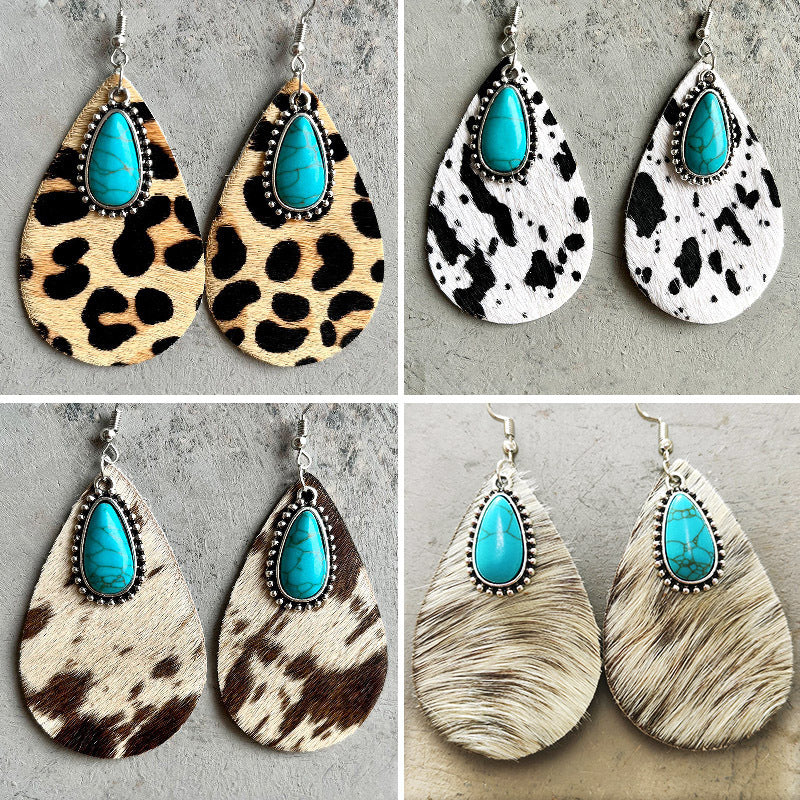
The live Western Turquoise Vintage Earrings page displayed $126.25 USD during review. Under Size, it listed Design 1 through Design 7, with Design 1 selected. Its copy used Western, turquoise, and vintage styling language and suggested casual, Western-inspired, occasion, and gifting contexts.
The inspected text did not document included pair or piece count, dimensions for each design, mass per earring, closure, posts or hooks, backs, materials, finish, decorative-component identity, skin-contact parts, item-specific care, maker, age, origin, or cultural affiliation. Seven design labels do not imply seven included pairs, shared fit, or identical construction.
Save the selected label and matching image before ordering. In the outfit column, earrings may suit a dress whose neckline should remain open. In the movement column, verify hair, eyewear, headwear, wrap, and coat interaction. Do not call a design light, small, secure, or sensitivity-friendly without supporting data.
Choose Between the Two Paths
| Invitation-card question | Cross jewelry listing | Earrings listing |
|---|---|---|
| Observed price | $112.11 USD | $126.25 USD |
| Displayed options | 90cm and 52cm | Design 1–7 |
| Main outfit zone | Neckline and torso | Face and hair |
| Primary unresolved issue | Length measurement and contents | Exact design fit and included quantity |
Neither option is universally more formal, authentic, comfortable, or valuable. Choose the body placement the wearer wants, the visible form appropriate to the event, and the page whose missing specifications can be resolved. Price cannot substitute for evidence.
Related YouTube Video: Metadata Only
The corresponding video is “FESTIVAL OUTFIT IDEAS - what I'm wearing Glastonbury Festival 2024 | feat Beautiful Earth Jewellery” by Ellen Kate. This article uses only the verified title, channel, URL, and broad outfit-and-jewelry topic relationship. The video was not watched in full, so no specific look, statement, demonstration, product, material claim, or recommendation from it is cited.
A festival outfit is not a wedding dress code, and the video does not verify either Oroxen listing. Use it only as related metadata. Current product pages, seller clarification, the invitation, and the wearer's needs remain the decision sources.
Frequently Asked Questions
Must women's turquoise jewelry match the dress color?
No. It can repeat one blue-green accent, contrast with a neutral, or stand alone. Fit and outfit hierarchy matter more than exact screen color.
Is the 90cm option automatically more dramatic?
Do not assume so. Confirm how the length is measured, what is included, and where the exact item lands on the wearer.
Are seven earring designs included?
The inspected page lists seven selectable designs; that does not prove all seven are included. Obtain an exact contents statement.
Can turquoise color prove the stone is natural?
No. Request item-specific material documentation and use professional evaluation when authenticity matters.
Can a cross-design piece be worn to every wedding?
No universal answer applies. The wearer, hosts, ceremony, community, and venue matter. Ask when the context is uncertain.
What if the jewelry becomes uncomfortable?
Remove it safely and use the prepared substitute or no jewelry. Participation and comfort are more important than maintaining a planned photograph.
Where should the checklist continue?
Visit Oroxen, compare the Turquoise Jewelry collection and Western Jewelry collection, then complete all six columns for the exact invitation.
Conclusion: Complete the Card Before Checkout
A wedding guest look works when jewelry supports the person and occasion at the same time. The host column protects context. The wearer column protects consent and comfort. The outfit column establishes hierarchy. The movement column finds conflicts. The identity column keeps claims honest. The exit column prevents pressure.
Use product titles and photographs as a starting point, not a substitute for specifications. Confirm the exact 52cm or 90cm selection, or the exact earring design, and request every missing fit and component detail. A completed invitation card turns women's turquoise jewelry from a themed guess into a considered choice.
页面页面