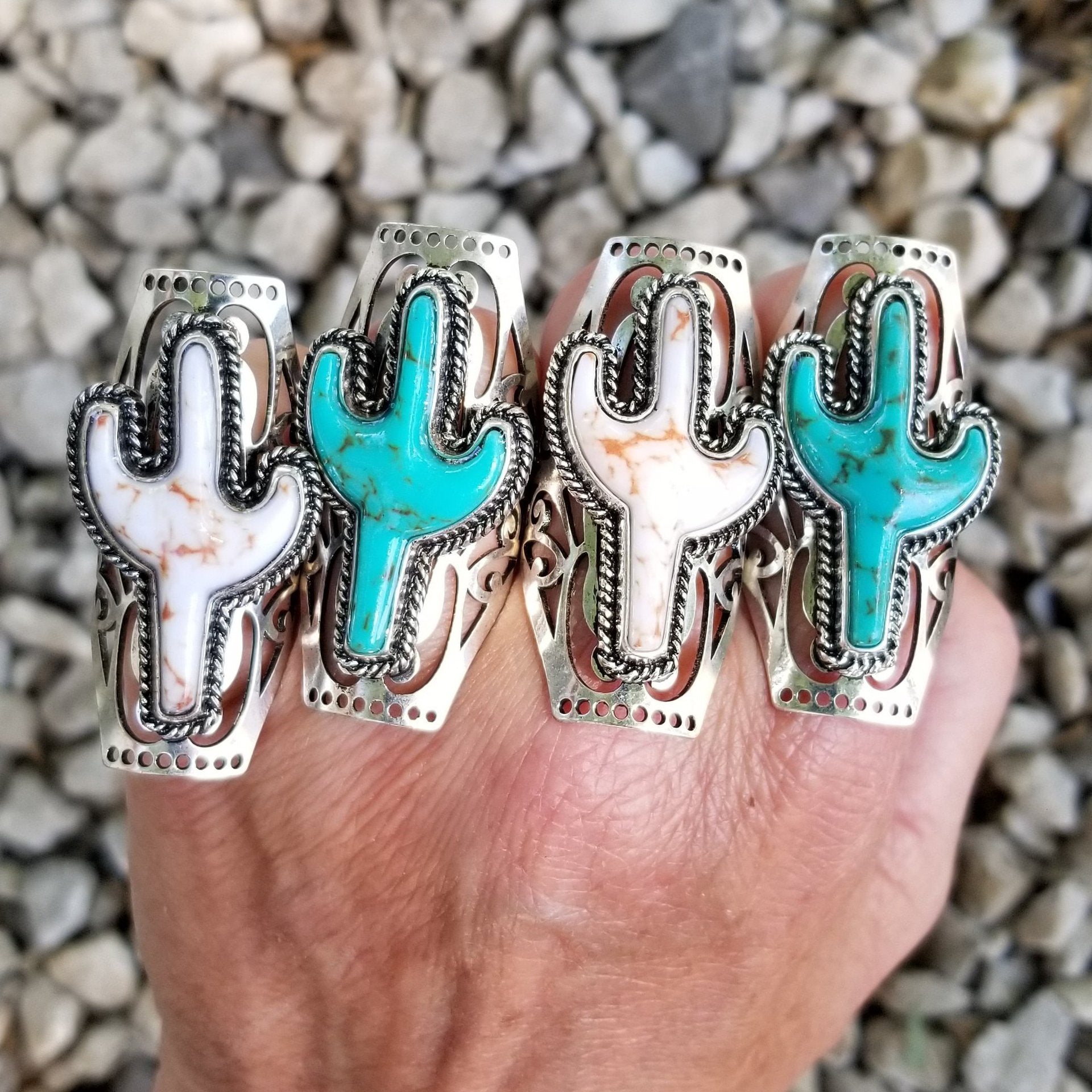
A first turquoise-colored Western ring should teach a beginner how to observe, measure, ask, and test—not how to repeat a romantic product story. “Turquoise,” “cactus,” “cross,” “vintage,” “cowgirl,” “one size,” and “adjustable” can help organize a search, but each word leaves practical questions unanswered.
This field guide uses the Turquoise Cactus Cross Ring and the Turquoise Vintage Cross Ring as two current examples. Their titles and images support discussion of visible color, motif, and styling. They do not independently verify natural turquoise, metal identity, age, maker, origin, handmade status, construction, or cultural affiliation.
Quick Answer: Use Five Checkpoints
- Identity: record the exact listing, selected option, current price, date, and correct gallery.
- Fit: request the supported inside range and decide which finger and hand will wear the ring.
- Scale: obtain face width, length, projection, and mass rather than estimating from a hand photograph.
- Evidence: ask for full components, finish, construction, adjustment method, care, and return conditions.
- Use: rehearse grip, clothing, bags, phones, washing, drying, removal, and storage.
Browse the Western Rings collection to compare shapes, but open every candidate's product page before deciding. Use the Western Jewelry collection when a ring is not the best body-location choice for the planned outfit or activity.
Checkpoint 1: Learn the Difference Between a Style Word and a Fact
A style word helps a shopper find visual families. A fact can be recorded and checked for the exact option. “Cactus” and “cross” can describe visible motifs. “Vintage” often describes inspiration rather than documented age. “Turquoise” can mean a color, design language, or a material claim that needs clarification. “Cowgirl” can describe a styling direction without proving identity, occupation, heritage, or cultural connection.
Write two columns. Under observed, record visible outline, apparent color, gallery views, displayed price, and option labels. Under unverified, record stone identity, treatment, components, finish, age, maker, origin, construction, cultural attribution, and anything else the page does not clearly document. Do not move an item from the second column to the first because it looks convincing.
Checkpoint 2: Decode “One Size” and “Adjustable”
One Size is a seller option label, not proof that every finger will fit. Adjustable indicates some intended fitting capability, but it does not define the supported inside range, the correct pressure point, the number of safe fitting cycles, or whether a professional should perform the change. Neither label permits repeated bending.
Ask for the numerical supported range and written fitting method. Choose one intended finger. If the ring must be forced, leaves deep pressure, rotates uncontrollably, opens during normal use, or contacts neighboring fingers painfully, stop. Fit should be assessed when the hands are in their ordinary condition, while recognizing that temperature and activity can change finger size.
Checkpoint 3: Measure the Decorative Face
Ring size describes the path around a finger; it does not describe the decorative face. Beginners also need face width, length, projection above the finger, band width, opening geometry if applicable, and total mass. These numbers control finger clearance, rotation, grip, snag risk, and visual proportion.
When exact measurements are available, cut a paper rectangle to the face width and length and rest it over the intended finger without attaching it. Slowly close the hand around a phone and bag handle. This is only a scale preview, not a fit or safety test, but it can expose an obviously incompatible footprint before purchase.
Checkpoint 4: Map Every Color Option
Both reviewed listings showed two visible color choices without accessible text labels during the latest observation. A beginner should not identify those choices by memory or assume the same materials, finish, price, or availability. Select one option at a time and record the main image, thumbnail order, displayed price, availability, and cart text.
Ask the seller to confirm which description belongs to the chosen visual option. Screens and lighting can shift apparent color, so a screenshot is not a universal color standard. If the delivered item differs materially from the saved option record, preserve packaging and review the current return process before altering or wearing it.
Example One: Turquoise Cactus Cross Ring
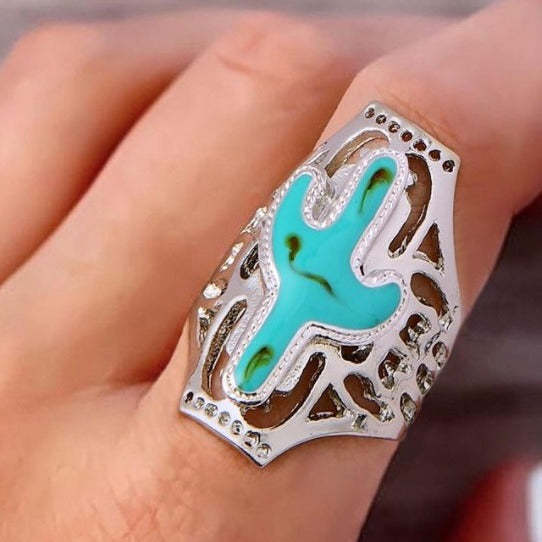
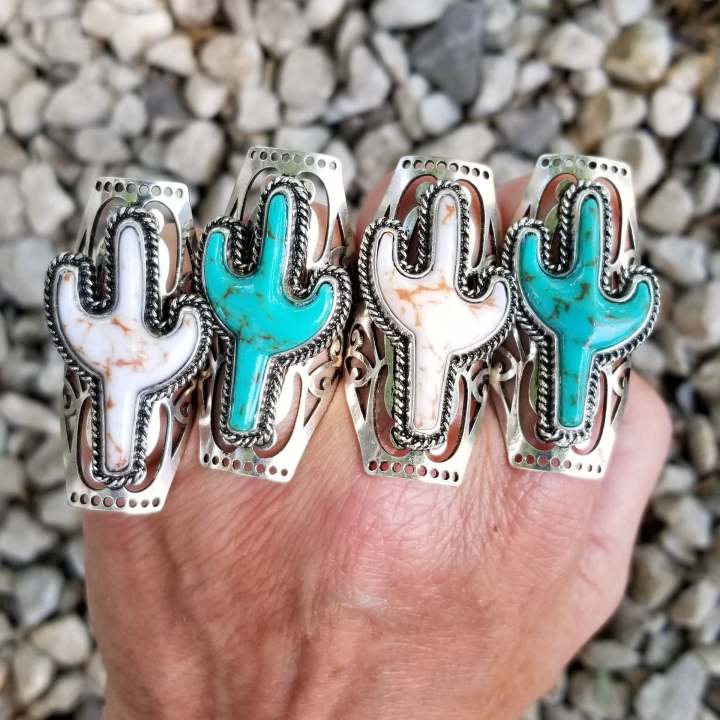
The Turquoise Cactus Cross Ring displayed $74.74 USD during review. Two visible, unlabeled color choices appeared, and the size option “One Size” was checked. The page described turquoise, cactus, and cross styling for everyday, Western-inspired, occasion, and gifting contexts.
The visible listing did not clearly state the supported inside range, whether any fitting change is intended, ring-face dimensions, projection, mass, band dimensions, full skin-contact and decorative components, finish, construction, turquoise disclosure, treatment, care, or option-specific return conditions. One Size should therefore remain an unanswered fit question until a number is supplied.
The cactus and cross shapes can create a complex outline. Ask whether any edge extends across neighboring fingers or can catch a knit, fringe, pocket, glove, bag lining, or hair. Confirm the intended face orientation. Do not assume the wearer identifies with either motif; discuss the visual and personal meaning before gifting.
Beginner Outfit Formula for the Cactus Cross Option
Use the ring as the hand focal point against a quiet denim, black, cream, or brown outfit. Keep the nearest wrist relatively open and let a belt or boot provide one lower-body Western reference. Avoid automatically adding cactus earrings, a cross necklace, turquoise bracelets, and an oversized buckle.
Evaluate the whole hand from arm's length. If the ring is primary, a simple band on the opposite hand may balance it better than several neighboring rings. The guide to turquoise Western ring styling mistakes provides a full hand-clearance and venue-action rehearsal.
Example Two: Turquoise Vintage Cross Ring
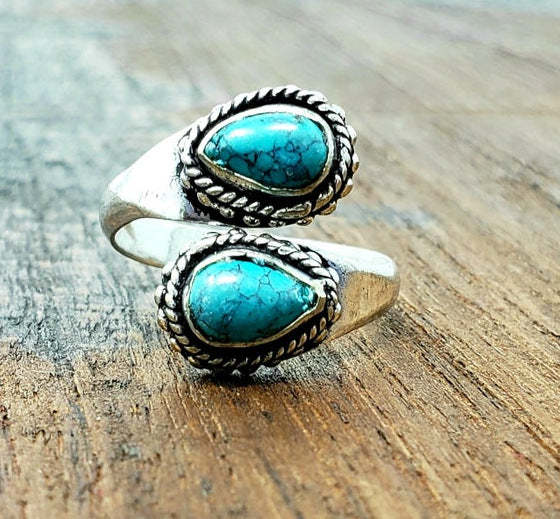
The Turquoise Vintage Cross Ring displayed $69.69 USD during the latest review. Two visible, unlabeled color choices appeared, and “Adjustable” was the checked size. The page used turquoise, vintage, cross, everyday, Western-inspired, occasion, and gift language.
The visible page did not clearly give the supported inside range, exact adjustment method, number of intended fitting cycles, face dimensions, projection, mass, band width, components, finish, construction, turquoise identity, treatment, or care. “Vintage” should be read as vintage-inspired unless age and provenance are documented.
An adjustable ring should be fitted once to an intended finger as directed, then left stable whenever possible. Repeatedly opening it for different people or fingers may stress an unknown construction. Ask where force may be applied and whether the decorative face or setting must remain untouched.
Beginner Outfit Formula for the Vintage Cross Option
Try a plain shirt and jeans with the ring as one compact Western-inspired detail. Use either a small earring or an understated necklace as secondary support, not both at statement scale. Repeat color only once and separate the accents vertically.
For a softer formula, use cream or muted warm neutrals with a denim jacket and the ring as the hand contrast. Check cuffs, buttons, jacket pockets, and the bag closure. Styling succeeds only if the wearer can use the hand normally and remove the ring safely when necessary.
A Fair Side-by-Side Comparison
| Field | Cactus Cross Ring | Vintage Cross Ring |
|---|---|---|
| Current displayed price | $74.74 USD | $69.69 USD |
| Visible color options | Two, unlabeled in accessible text | Two, unlabeled in accessible text |
| Size label | One Size | Adjustable |
| First fit question | What inside range does One Size mean? | What range and method does Adjustable mean? |
| Distinct visible idea | Cactus plus cross motif | Vintage-inspired cross motif |
| Shared missing fields | Face dimensions, projection, mass, components, finish, construction, turquoise disclosure, care | |
Do not choose by the five-dollar price difference until the fit and evidence fields are comparable. Price cannot authenticate a material or make an unusable ring fit. Give greater weight to an exact option map, clear specifications, seller accountability, wearable comfort, and return conditions.
Checkpoint 5: Understand Materials Without Home Authentication
Visible blue-green color and matrix-like pattern cannot independently establish natural turquoise, treatment, composite material, imitation, or origin. If material identity affects price, care, sensitivity, ethics, symbolism, or gifting, request an option-specific written disclosure and suitable documentation.
Do not scratch, heat, bend, soak, apply solvent, or perform another destructive “test.” Online photographs and household experiments are not a substitute for a qualified independent professional when the stakes justify expert identification.
Use the LaCkore Couture Video as a Starting Prompt
The YouTube video “A Beginners Guide To Turquoise Jewelry” by LaCkore Couture offers a creator's general introduction to turquoise jewelry. It can help a new shopper notice that turquoise-related jewelry involves terminology, stories, color, and many design forms.
Do not treat every historical, cultural, metaphysical, geographic, value, or material statement in a short creator video as established for a specific product. Verify important claims with appropriate primary or scholarly sources. The video does not inspect, test, measure, price, or endorse either Oroxen ring, and it cannot establish their material, age, origin, construction, fit, care, or cultural affiliation.
A Seven-Action Wear Test
- Open and close the hand without pressure against neighboring fingers.
- Hold the phone in ordinary portrait and landscape positions.
- Open the planned bag, lift its handle, and use its zippers or snaps.
- Put the ring hand into every pocket and through the planned sleeve or glove.
- Wash and dry hands using the documented care method, or remove the ring safely when required.
- Sit, stand, walk, and make natural gestures while observing rotation.
- Remove the ring directly into a dedicated case without placing it over a sink or crowded floor.
Stop for pain, numbness, swelling, unstable fit, impaired grip, skin reaction, or repeated catching. A home rehearsal cannot guarantee safety or durability, but it can reveal predictable incompatibilities.
Beginner Mistakes to Avoid
“One Size Means It Will Fit Me”
Request a numerical inside range and compare it with the intended finger.
“Adjustable Means I Can Bend It Every Day”
Follow the seller's exact method and minimize fitting cycles.
“Vintage Means Antique”
Use vintage-inspired unless age and provenance are documented.
“The Photo Proves the Stone”
Color and pattern are observations, not independent material identification.
“Cowgirl Style Requires Every Motif”
Choose one focal point and let the wearer's wardrobe, preferences, and activities lead. The observation-first framework in the Southwestern jewelry beginner guide helps prevent theme words from becoming unsupported identity claims.
Care and Storage for Unknown Components
A ring can combine multiple decorative, structural, and skin-contact elements. Until the complete components, finish, and construction are known, aggressive cleaning is an experiment. Water, detergent, alcohol, perfume, sanitizer, cosmetics, sunscreen, steam, ultrasonic equipment, dips, polishing compounds, and abrasives can affect different products differently.
Ask for product-specific care. When compatible, put jewelry on after personal-care products have dried. Inspect the ring under good light after wear, stop if an element becomes loose, and store it separately in a dry dedicated container as directed. Keep the option record and seller answer with the purchase.
Gifting Without Guessing
Do not guess finger size, preferred hand, cross symbolism, cactus symbolism, material expectations, sensitivities, or tolerance for a large ring face. Build a shared shortlist and let the recipient choose the exact option. Review the current return terms before any fitting or removal of packaging.
A good beginner gift can be a decision process rather than a surprise object: two verified candidates, written measurements, a safe fitting plan, and the freedom to decline. The beginner's guide to beaded turquoise jewelry applies the same evidence-first logic to another product family.
Frequently Asked Questions
Which finger should wear a statement ring?
There is no universal finger. Choose by supported size, hand use, neighboring-finger clearance, symbolism preferred by the wearer, and the seven-action test.
Can a turquoise-colored ring be worn every day?
That depends on verified components, finish, construction, fit, care limits, and daily tasks. A style description alone cannot establish everyday durability.
Can men's and women's ring styling rules be shared?
Any wearer can use the same fit, evidence, comfort, and hierarchy method. Product gender labels are less useful than exact dimensions, the intended finger, personal preference, and real activity.
Should a ring match a turquoise necklace exactly?
No. One separated color repeat is often enough. Exact matching can crowd the outfit and screen color is not a reliable physical standard.
What should a beginner save before checkout?
Save the exact option, gallery, current price and date, seller answers, measurements, component and care disclosures, and return conditions. The buying checklist in What to Know Before Buying Turquoise Cowboy Jewelry adds a consequence-based way to score unanswered questions.
Conclusion: A Beginner's Best Tool Is a Complete Record
The right first ring is not the one with the strongest theme word. It is the exact option whose fit range, face scale, construction, components, care, meaning, and use have been understood well enough for the wearer to make an informed decision. Unknown facts should remain visible, not be filled with assumptions.
Compare the cactus-cross and vintage-cross examples with the same five checkpoints, minimize adjustment, rehearse real hand movements, and choose personal symbolism rather than assigned symbolism. Explore more current products and guides from the Oroxen homepage, while treating every listing as a new evidence task. That habit will serve a beginner long after the first cowgirl-inspired outfit is complete.