A Beginner's Guide to Turquoise Rings for Country-Music Fans
A turquoise ring can look like the easiest part of a country-music outfit: choose a blue-green focal point, put it on, and go. The difficult part begins when a beginner asks what the listing actually proves, which size or option will arrive, whether the ring will remain comfortable through a concert, and how it should be cleaned afterward. Those are separate questions. A photograph can answer some styling questions while leaving fit, construction, materials, and care unresolved.
This guide gives first-time buyers a practical method built around three records: a product record, a hand map, and a wear plan. The product record preserves what the current page states and what it does not state. The hand map assigns a job to each finger and checks contact with neighboring objects. The wear plan follows the ring through dressing, travel, the venue, temporary removal, and storage. Together, the three records make a better decision than a keyword or close-up image alone.
Quick Answer: Start with Evidence, Fit, and One Clear Job
A beginner-friendly ring is not automatically the smallest or quietest design. It is the option whose identity, fit, contact points, and care limits can be understood before use. Start by deciding one job for the ring. It may be the main color point in a simple denim-and-boots outfit, a supporting accent beside a necklace, or an occasional statement reserved for low-contact situations. Do not ask one ring to be the focal point, an everyday work ring, a stacking ring, and a rugged activity piece until the exact product evidence supports all four roles.
Before checkout, save the product URL, title, displayed price, selected size or option, matching gallery image, and date reviewed. Then request the information the page does not provide but your use requires: complete dimensions, total mass, all materials, decorative material, treatments, metal or alloy, coating or finish, setting or attachment method, care instructions, and what is included. A blue-green appearance and the word “turquoise” do not independently establish mineral identity, treatment, origin, age, or value. A silver-colored surface does not establish sterling silver.
For broader terminology and shopping questions, use the published complete guide to choosing western turquoise jewelry. It helps separate an observable design feature from a material claim. The aim here is narrower: make one ring work for one real country-music plan.
Build the Product Record Before You Build the Outfit
Create two columns headed “visible or stated” and “still needed.” The first column can include the listing title, current option labels, gallery count, displayed price, and features you can describe without interpreting them. The second column should contain every fact required for fit, care, safety, or comparison that is absent or ambiguous. This structure prevents an empty specification field from quietly turning into an assumption.
Facts that belong in the record
- Exact product title, URL, review date, displayed currency, and displayed price.
- The option selected at the time of review and an image that clearly corresponds to it.
- Internal diameter or circumference for a fixed-size ring, plus band width and maximum top dimensions.
- Total mass, underside profile, edge shape, and distance the top projects above and beyond the finger.
- All component materials, decorative-material identity, treatments, metal or alloy, coating, and setting or attachment method.
- Seller-provided care limits and any activities, chemicals, water exposure, or storage conditions to avoid.
- Current shipping and return terms, especially the treatment of worn, resized, bent, or altered items.
Do not fill gaps with information from a different product, a collection page, a social post, or a video. Two rings can look similar while using different dimensions, construction, coatings, adhesives, or care requirements. The correct response to a missing fact is “unresolved,” followed by a focused question.
Make a Hand Map: Finger, Neighbors, and Contact Routes
A ring is worn inside a moving system. Draw a simple outline of the hand and mark the intended finger. Add every neighboring object: another ring, phone case, steering wheel, bag handle, drink container, camera, instrument, rail, jacket cuff, glove, and seat arm. The map is not a medical or safety certification. It is a way to notice predictable contact before a long event.
Measure the finger according to the seller's sizing method, at a time and under conditions relevant to wear. If the seller does not give a method or dimensional chart, request one. A label such as US 8 is more useful when it is supported by an inside measurement and an exchange path. For an adjustable ring, ask for the delivered internal range, the approved adjustment range, the adjustment method, and whether repeated bending is permitted. “Adjustable” does not mean unlimited, tool-free, or suitable for every finger.
Next, test the footprint with a paper template based on verified dimensions. Bend the finger, make a relaxed fist, hold the phone, lift a bag, put on the jacket, and use a pocket. A wide top that looks balanced in a still photograph may touch an adjacent finger or catch a cuff. A high projection may strike a hard surface. A broad band may feel different after several hours. Stop the test if there is pain, numbness, pinching, skin change, or restricted movement; seek appropriate professional guidance when a health concern exists.
Use the Western Rings Collection as a Shape Library
The Western Rings collection is useful for comparing visible silhouettes: compact tops, elongated faces, cross-related motifs, floral arrangements, clustered accents, and broader statement profiles. Treat it as a navigation and observation tool, not as proof that every item shares the same material, size system, origin, or care method.
Open candidates in separate tabs and compare the same fields in the same order. First compare the maximum visible footprint; then the band, underside, option system, gallery clarity, and written specifications. Finally compare whether each listing supplies enough evidence for the ring's intended job. A product with a dramatic image but an unresolved option map may be harder for a beginner to buy responsibly than a product with a quieter image and complete measurements.
The wider Western Jewelry collection can help with outfit coordination. Check how much visual activity is already present at the face, neckline, wrist, and waist. If a ring will lead, let the other zones support it. If a necklace or buckle is already the anchor, select a ring that contributes color or line without demanding equal attention.
Current Example One: Turquoise Vintage Ring for Women
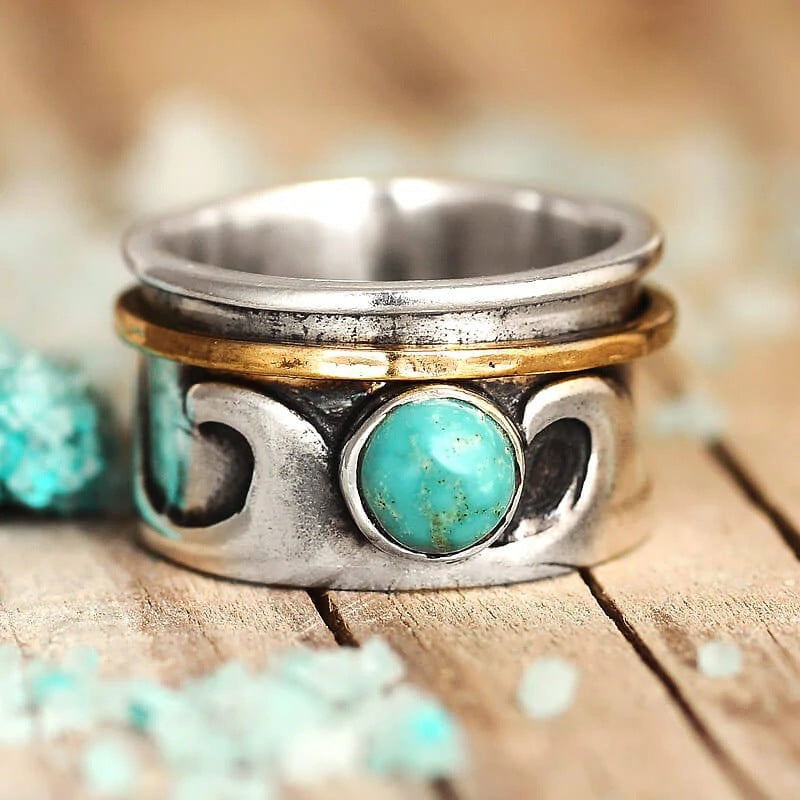
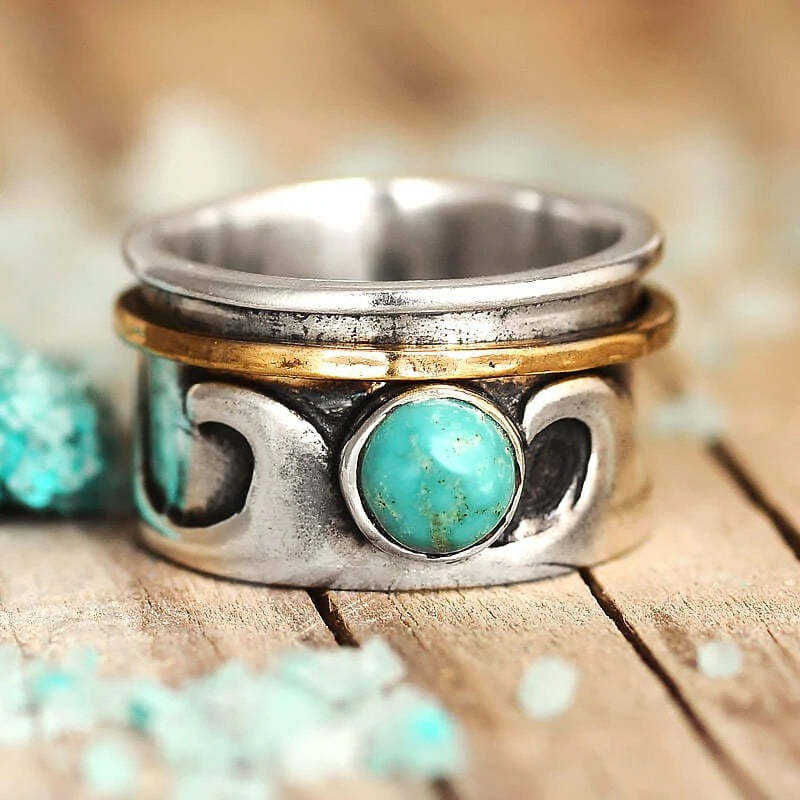
On August 24, 2026, the Turquoise Vintage Ring for Women page displayed a price of $66.66 USD. It showed one visual Color choice and fixed size labels US 6, US 7, US 8, US 9, US 10, and US 11; US 6 was selected when reviewed. Nine numbered gallery positions were visible. The page described a turquoise and vintage design, encouraged review of the selected option and images, and warned that screen color may vary.
Those observations support a sizing workflow but not a final fit conclusion. A beginner can identify the labeled range and compare gallery views, then ask for the dimensional chart used for those labels. At the time reviewed, the visible page did not establish the internal diameter or circumference of each size, band width, top dimensions, projection, mass, exact decorative material, treatments, metal or alloy, finish, setting method, or product-specific care limits. Record those as unanswered rather than inferring them from the name or photograph.
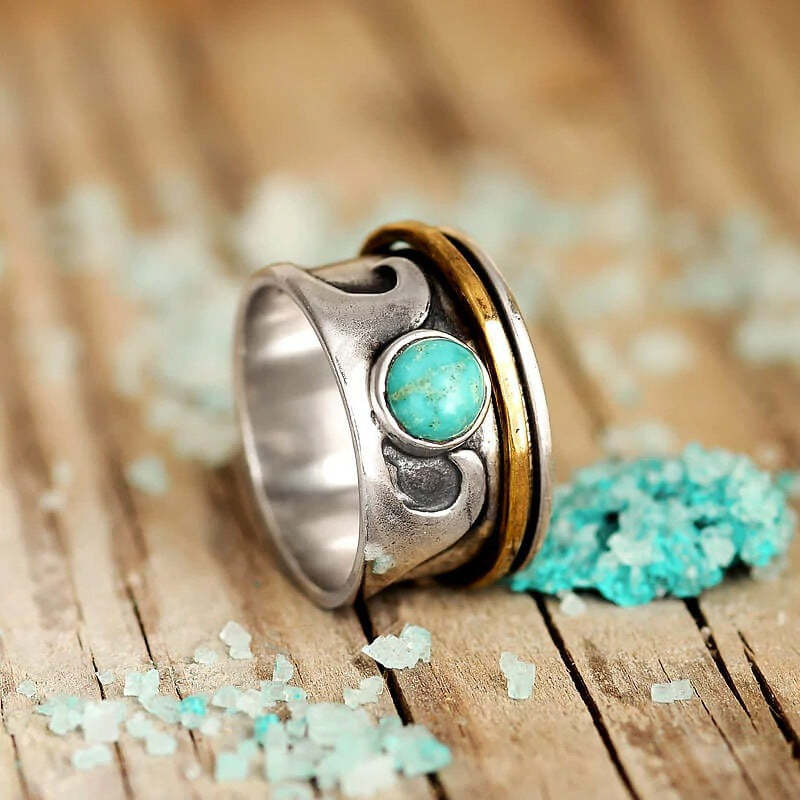
For a country-music outfit, this candidate can be tested as the hand's only high-contrast focal point. Pair the selected size with a plain or lightly textured sleeve and reduce competing rings on adjacent fingers. Use the second gallery view to generate questions about height, underside, and contact—not to estimate measurements. The ring becomes a qualified choice only after the exact size is mapped to dimensions, the delivered item fits without pressure or rotation problems, and the materials and care guidance suit the planned use.
Current Example Two: Turquoise Vintage Statement Cross Ring
On the same review date, the Turquoise Vintage Statement Cross Ring page displayed $96.96 USD, two visual Color choices, and an Adjustable size option. Fourteen numbered gallery positions were visible, with the fifth position active during review. The page used turquoise, vintage, statement, and cross language and again told buyers to review the selected option and product images.
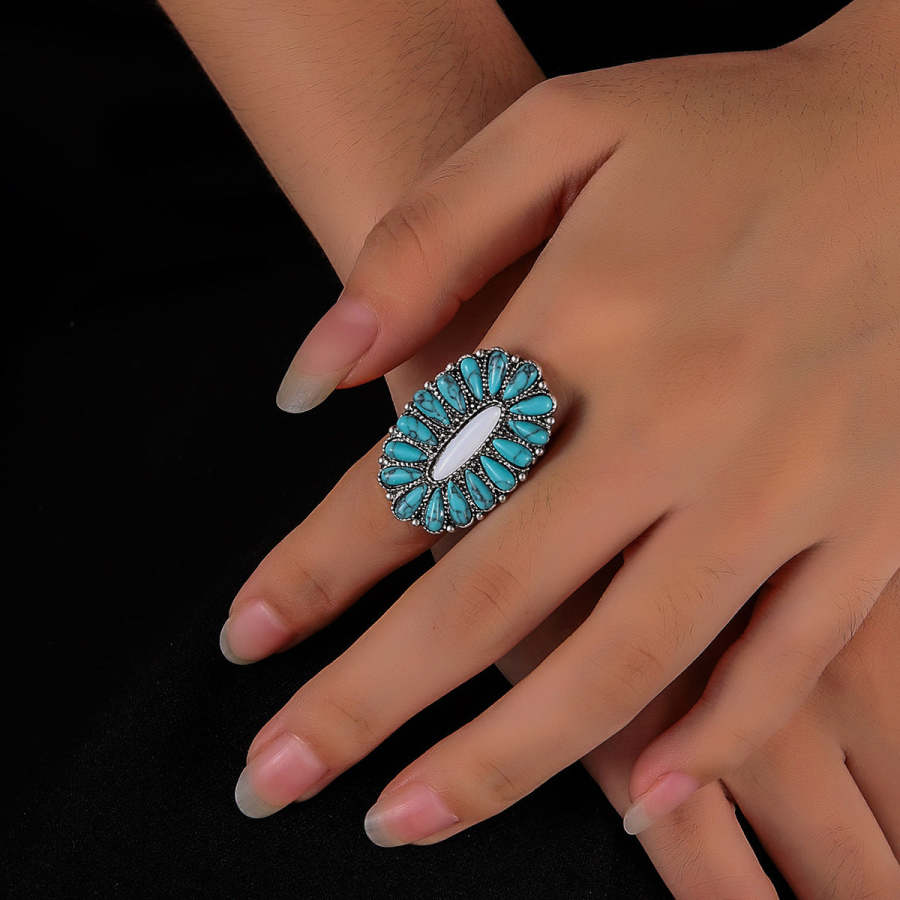
“Adjustable” changes the questions; it does not remove them. Ask for the ring's delivered inside dimension, intended adjustment range, correct adjustment procedure, number or frequency of adjustments the construction is designed to tolerate, and whether adjustment affects return eligibility. Also request maximum top length and width, band width, mass, edge profile, all materials, finish, attachment method, and product-specific care. Without those facts, the suitability of the ring for repeated event use remains unresolved.
Visually, the cross-related statement form may work as the only assertive jewelry object on the hand. Keep neighboring fingers quiet and compare the motif density with the belt buckle, earrings, and necklace. If another large cross or blue-green centerpiece is already dominant, this ring can produce a tie rather than a hierarchy. That is a styling issue, not a quality judgment. Test both color options independently because an option image, contrast pattern, or finish may change the way the ring reads with the outfit.
Side-by-Side Beginner Decision Sheet
| Decision field | Vintage Ring for Women | Statement Cross Ring |
|---|---|---|
| Observed size system | US 6 through US 11 | Adjustable |
| Observed color choices | One visual choice shown | Two visual choices shown |
| Observed gallery count | Nine numbered positions | Fourteen numbered positions |
| Beginner's next fit question | What inside measurement corresponds to each US label? | What is the delivered size and approved adjustment range? |
| Styling role to test | Single hand focal point with a quiet sleeve | Motif-led statement with restrained neighboring zones |
| Do not assume | Material, treatment, mass, projection, or care | Unlimited adjustment, material, durability, or care |
This sheet does not declare a winner. The better option is the one whose exact variation can be documented, fitted, worn, removed, and cared for in the buyer's real plan. A fixed-size ring may offer a clearer size label but still need a dimensional chart. An adjustable ring may offer flexibility but still require a defined range and a safe procedure.
Turn a Country-Music Outfit into a Wear Plan
Write the event sequence from door to door. Include dressing, driving or transit, security, standing, seating, food and drink, photography, merchandise shopping, restroom use, outerwear changes, and the trip home. Mark every stage in which the ring may contact a hard surface, enter a crowded bag, or need to be removed. This is especially useful for statement tops that extend beyond the finger.
Choose one of three hand roles
- Solo anchor: one ring leads the hand; bracelets and adjacent fingers remain restrained. This is the simplest beginner formula.
- Color echo: the ring repeats one blue-green point from the face or torso but uses a different scale so it stays secondary.
- Motif bridge: a cross-related or geometric detail connects two outfit zones. Use this only when the bridge does not create three equal focal points.
Photograph the complete outfit at full length, upper-body distance, and normal hand-rest position. A close-up can confirm visible detail but cannot show hierarchy. Then rehearse ordinary motions with the exact jacket, bag, phone case, and accessories. The published country concert jewelry guide adds planning questions for crowds, bags, seating, hearing protection, and temporary storage. Apply only the advice relevant to the actual venue and its current rules.
If the ring must come off, do not place it loose in a pocket, cup holder, restroom surface, shared pouch, or open bag. Prepare one rigid or padded compartment, remove the ring in a stable place, close the compartment immediately, and count the piece before leaving. Review the current return policy before wearing, adjusting, or altering packaging, because those actions may affect eligibility.
What the 46-Second Cleaning Video Can—and Cannot—Teach
The reviewed eHowArtsAndCrafts video, “Cleaning Jewelry: Cleaning Turquoise & Silver Jewelry”, runs about 46 seconds and was watched in full on August 24, 2026. Its visible materials list included Tarn-X, brushes, and jewelry wipes; the YouTube description also mentioned a toothbrush and an end brush. Closed captions were unavailable on the reviewed page.
The useful beginner lesson is not “use these products on every turquoise-colored ring.” It is that cleaning is a material-specific procedure involving a chosen agent, an applicator, and controlled contact. The video does not prove the composition, treatment, setting, coating, adhesive use, or cleaning tolerance of either Oroxen example. It therefore cannot authorize Tarn-X, wipes, brushing, soaking, or polishing on an item whose components and care instructions have not been established.
A Conservative Care Decision Tree for Beginners
Step 1: Can every component be identified?
If the answer is no, pause chemical cleaning. Ask the seller for the decorative material, any treatment, metal or alloy, coating, setting or adhesive, and official care instructions. Do not treat “turquoise” as a complete material record. Do not apply a silver-cleaning method merely because the surface appears silver-colored.
Step 2: Is the planned method explicitly permitted?
Match each cleaner, wipe, brush, cloth, water exposure, and duration to the seller's instructions for the exact assembled piece. A method suitable for one metal can be unsuitable for a decorative material, coating, adhesive, or surface treatment attached to it. When instructions conflict or remain incomplete, request clarification from the seller or an appropriately qualified professional who can inspect the item.
Step 3: Can routine storage reduce cleaning demand?
Give the ring its own clean compartment so it does not rub other jewelry. Handle it with clean, dry hands and check it in neutral light after wear. Record changes in fit, looseness, movement, surface appearance, or attachment. Do not perform home repair, bending, gluing, or aggressive polishing to solve an unknown problem. Preservation begins with reducing contact and documenting change, not with using the strongest available product.
Eight Questions to Send Before Buying
- Which exact gallery image corresponds to the color and size option I selected?
- What are the internal ring dimensions, band width, maximum top dimensions, and projection?
- What is the total mass of the selected variation?
- What are all component materials, including the decorative material, treatments, metal or alloy, coating, and any adhesive?
- How is the decorative top attached or set?
- For the adjustable option, what is the delivered size, approved range, and adjustment procedure?
- What cleaning agents, water exposure, tools, and activities are approved or prohibited for the assembled ring?
- How do wearing, adjusting, resizing, or altering packaging affect the current return policy?
Save the answers with the selected option and date. If an answer uses a broad phrase such as “standard size” or “normal care,” ask for the measurement or procedure. Precision helps both buyer and seller avoid mismatched expectations.
Beginner Mistakes That Create Expensive Confusion
- Buying from the title alone: a title is a navigation label, not a complete gemological or metallurgical report.
- Estimating size from a hand photograph: camera angle, cropping, and unknown hand dimensions make visual measurement unreliable.
- Choosing the number without the chart: record the dimensional system used for US 6–11 before assuming fit.
- Opening an adjustable ring repeatedly: first obtain the approved range and method; do not improvise with tools.
- Stacking before checking edges: neighboring rings can rub, collide, or change finger clearance.
- Copying a video cleaner: a general demonstration does not establish compatibility with an unidentified assembled product.
- Testing only at home: rehearse the complete jacket, bag, phone, seating, and removal sequence.
- Leaving storage until the event: a dedicated compartment belongs in the plan before the ring is worn.
The published guide to western jewelry motifs, styles, and materials is a useful next read when words such as vintage, western, statement, and cross begin to blur with claims about age, origin, maker, or composition. Keep aesthetic language and verified product evidence in separate lines of the record.
Frequently Asked Questions About Turquoise Rings
Which ring is easier for a first-time buyer: fixed-size or adjustable?
Neither system is automatically easier. A fixed-size ring needs an accurate dimensional chart and correct finger measurement. An adjustable ring needs a documented delivered size, approved range, and adjustment procedure. Choose the system whose exact option can be verified for your hand and use.
Can I identify real turquoise from the product image?
No. A photograph can show color, visible pattern, and design, but it cannot by itself establish mineral identity, treatment, stabilization, dye, composite construction, origin, or value. Request exact written material information.
What outfit is safest for a first style test?
Use a quiet sleeve, one ring as the hand anchor, and restrained neighboring jewelry. Then test movement with the actual jacket, bag, phone, and venue plan. “Safest” here means easiest to observe visually; it is not a substitute for product, health, activity, or venue safety guidance.
Should the ring match my turquoise-colored necklace exactly?
Exact matching is unnecessary. Repeat one attribute—color family, contrast, line, or motif—and vary the scale. If both objects compete for first attention, let one lead and simplify the other.
Can I use Tarn-X or a jewelry wipe on these rings?
Do not assume so. The video shows particular cleaning materials, but the reviewed product pages did not establish every component or product-specific compatibility. Obtain instructions for the exact assembled ring before using any cleaner, wipe, brush, soak, or polish.
What should I do if the ring spins or feels tight?
Stop wearing it if there is pain, numbness, pressure, or skin change. Do not bend or modify an unknown construction. Recheck the fit record and consult the seller or an appropriately qualified professional about options relevant to the exact item.
Where should I browse next?
Compare silhouettes in the Western Rings collection, then review supporting pieces in the Western Jewelry collection. Rebuild the same evidence record for every candidate.
Final Beginner Ring Card
- The exact option is tied to a current image and dimensional record.
- The finger size or approved adjustment range is documented rather than guessed.
- Top dimensions, band width, projection, mass, edges, and underside are known.
- Materials, treatments, metal, coating, attachment, and care are confirmed for the assembled piece.
- The ring has one clear outfit role and passes the full hand-contact rehearsal.
- Venue, activity, temporary-removal, storage, shipping, and return questions are resolved.
- The YouTube demonstration is used as a source of questions, not as proof of product compatibility.
Conclusion: Buy the Record, Not Just the Photograph
A first turquoise ring becomes easier to choose when the decision is divided into observable tasks. Preserve the current listing, map the exact option to dimensions, assign the ring one hand role, test contact through the full event sequence, and obtain care instructions for every component. If a needed fact is absent, label it unresolved and ask. That discipline protects originality in the outfit and accuracy in the purchase.
Return to the Oroxen homepage, compare current candidates in Western Rings, or broaden the outfit in Western Jewelry. The best beginner choice is the ring whose evidence, fit, care, and real-life route all make sense together.