“Chunky” describes visual and physical presence, not a material. A piece can look substantial because it is wide, long, layered, brightly colored, densely detailed, or grouped with several components. First-time buyers should therefore translate the word into measurable questions instead of assuming that every chunky-looking item has the same weight, construction, or styling role.
This beginner guide uses the Turquoise Western Stud Earring Set and the Western Turquoise Boho Vintage Cow Skull Earrings. Their names describe style and appearance. They do not independently establish natural turquoise, vintage age, metal identity, origin, maker, treatment, or cultural affiliation. Confirm facts for the exact option.
Quick Answer: Define Chunky in Six Fields
Record height, width, profile, weight, color coverage, and movement. The first four are physical facts; the last two describe how the jewelry reads in an outfit. Request exact measurements and per-piece weight. Use photographs only to identify shapes and questions.
Start with one focal location—face, neck, wrist, or hand. Keep the nearest clothing and jewelry simpler. Test the piece through movement and ordinary contact. A substantial look works when its scale is intentional and its construction suits the wearer; it fails when appearance hides missing fit information.
For category context, read the public Western jewelry terms and selection guide.
What Chunky Can and Cannot Tell You
| Chunky may describe | Chunky does not prove |
|---|---|
| Large visible area | High weight |
| Wide or long silhouette | Solid construction |
| Layered components | Any specific metal or stone |
| Strong color contrast | Natural turquoise |
| Dense motif or texture | Age, origin, maker, or value |
Two products can appear equally substantial for different reasons. A compact group of studs becomes visually dense through quantity, while a hanging motif may occupy more vertical space through length and movement. Compare the reason for presence rather than applying one label to everything.
Create a Beginner’s Measurement Card
For earrings, request overall height and width, profile, drop, per-earring weight, closure, post or hook dimensions, materials, finish, and care. For sets, record the count and measurements of every included unit. Ask whether option images show the complete set or styling examples.
Draw each silhouette at life size on paper. Hold it near the ear while wearing the intended top, jacket, glasses, and hairstyle. This predicts visual coverage, not comfort. Only verified weight, closure, construction, and a careful wear test address physical suitability.
Set personal limits before checkout. These might include maximum drop, no collar contact, an easy closure, low movement, documented materials, or a return period long enough for inspection. Limits are individual; do not copy another wearer’s tolerance.
Browse by Silhouette, Not Hype
Use the Turquoise Jewelry collection to identify clusters: studs, drops, hoops, necklaces, cuffs, and rings. Open candidates in separate tabs and compare the same fields. Eliminate pieces whose important unknowns cannot be resolved.
Do not rank a candidate as more authentic, valuable, or durable because it looks larger. Information quality belongs in the comparison. A smaller item with documented measurements and care may be a more confident purchase than a dramatic item described only through adjectives.
Example One: The Western Stud Earring Set
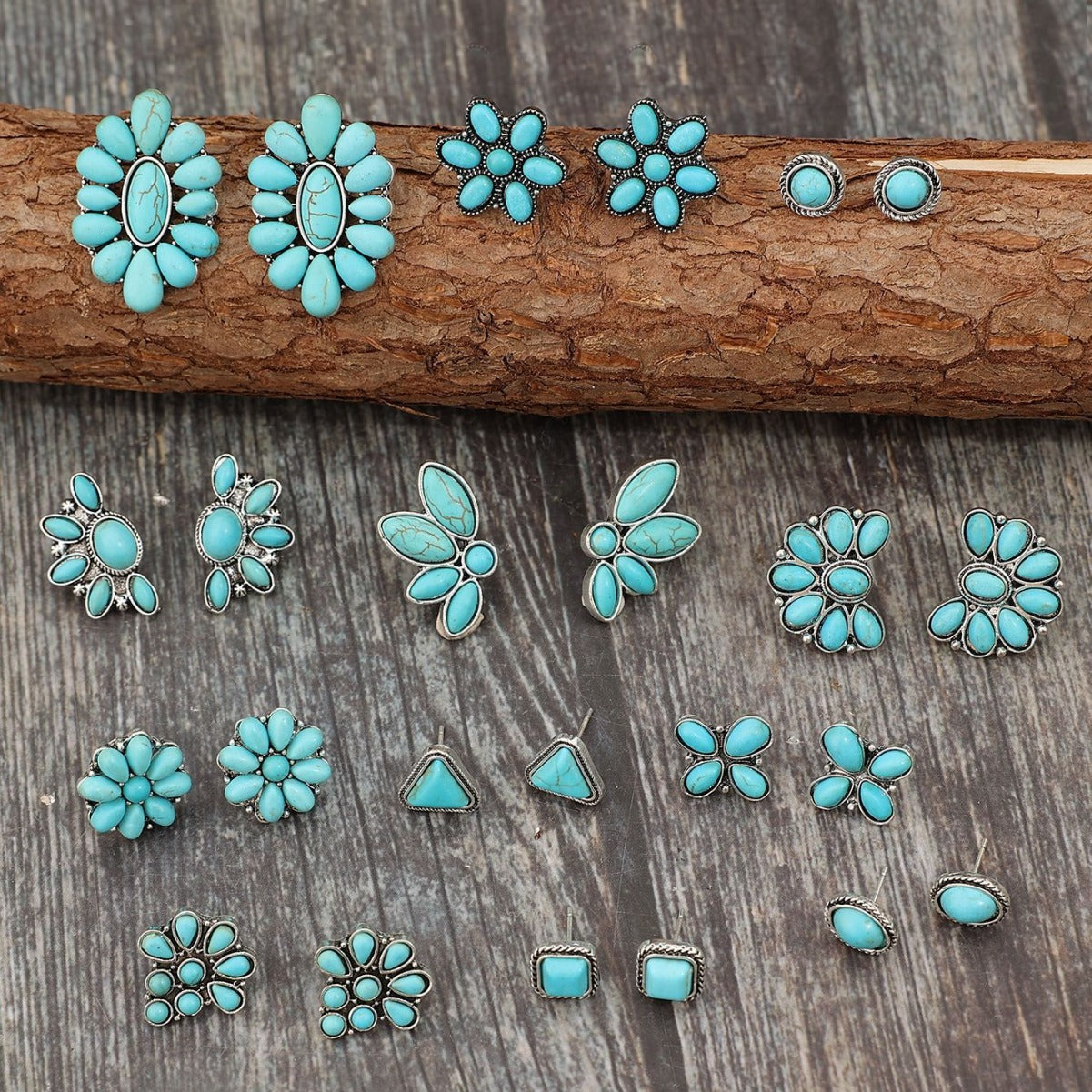
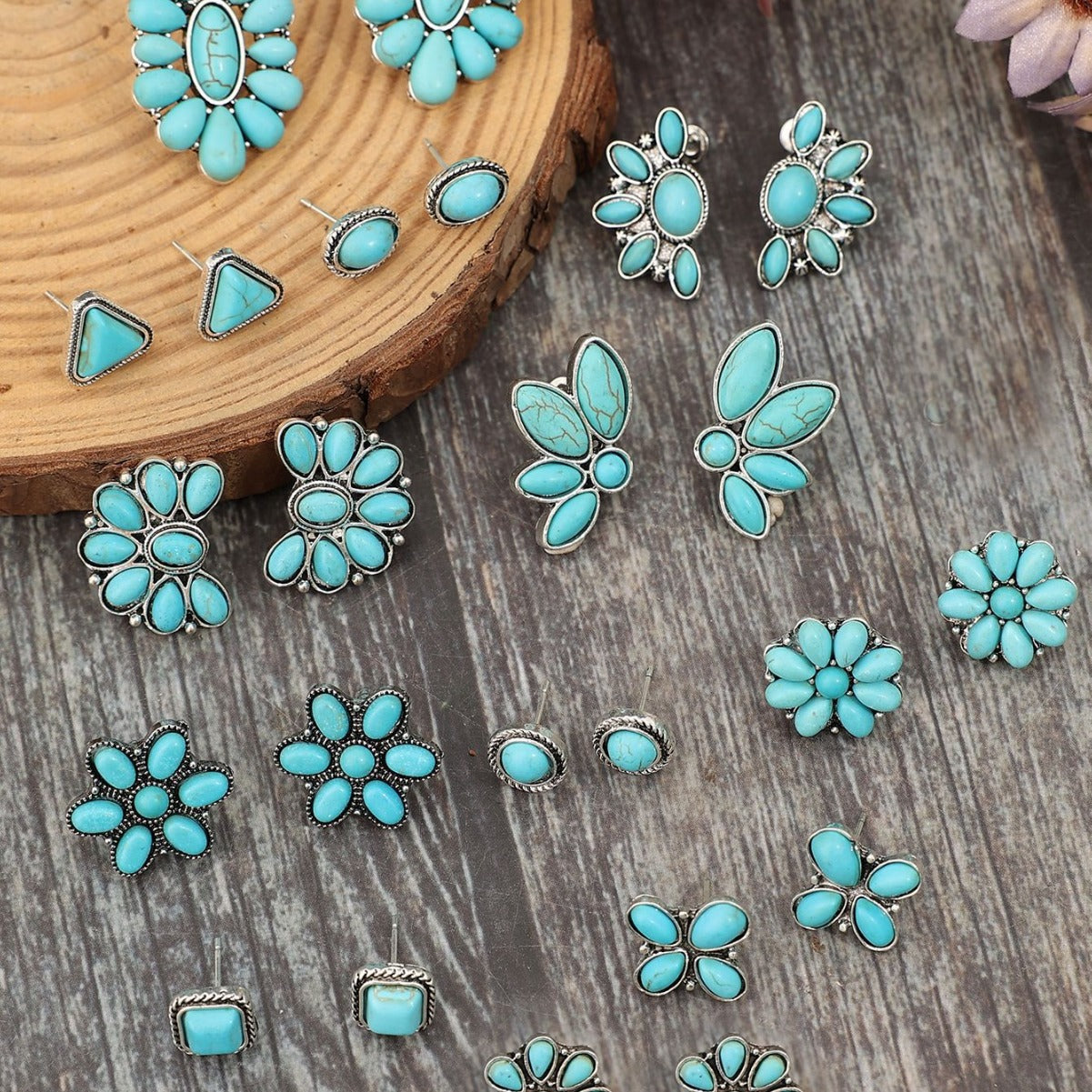
The current page presents a coordinated assortment mixing floral, geometric, and classic turquoise-style studs. One visible color option appears. The captured page does not state the exact included count, dimensions, per-earring weight, post and backing materials, decorative materials, or construction.
This example shows how “chunky” can be created by curation rather than one oversized object. Several motifs displayed together feel abundant, but a wearer chooses a pair or combination for the actual outfit. Inventory the delivered set and label each earring and backing so pieces do not become interchangeable unknowns.
Ask for the exact contents, a measurement chart, weight, closure information, and care for every component. Do not share earrings. Stop using any post or backing that is rough, damaged, contaminated, insecure, or associated with irritation.
How to Style the Set Without Visual Clutter
Choose one pair with a clear relationship to the outfit. If the clothing has a busy collar or print, use a simpler visible motif. If the neckline is plain, a denser pair can lead. Keep the necklace quiet until the face frame is judged from full-body distance.
Do not wear mismatched earrings merely because the set offers variety. Mismatch works when scale, color coverage, or shape creates an intentional relationship and both sides remain comfortable. Photograph the head straight and turned before deciding.
Example Two: Cow-Skull Earrings
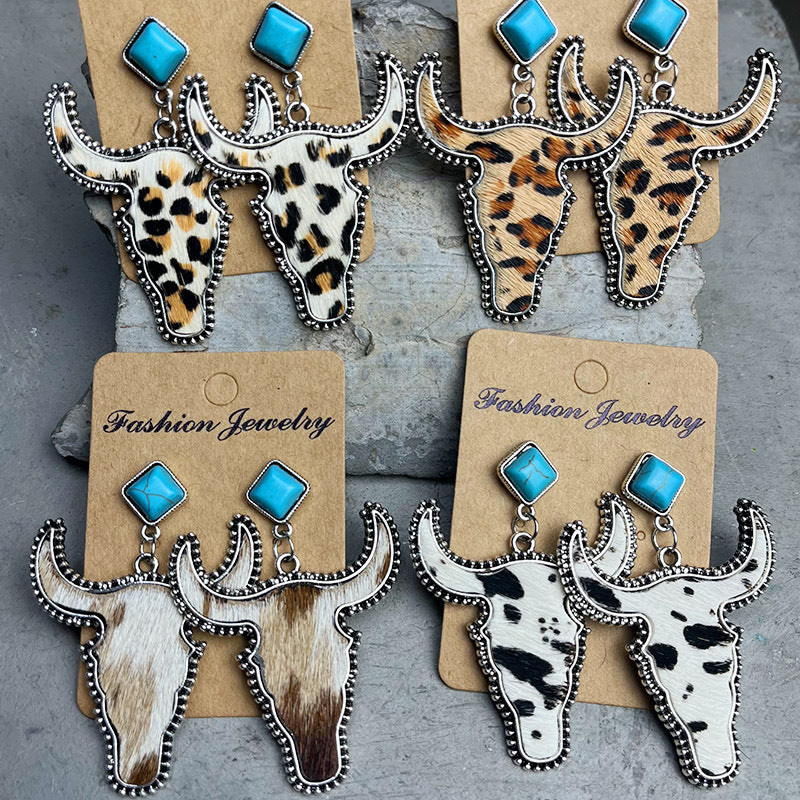
The current cow-skull listing shows Design 1 through Design 4 under a selector labeled “Size.” Those labels are not measurements. The page does not visibly state exact dimensions, per-earring weight, closure, materials, finish, construction, or care for each design.
A specific motif can make jewelry feel substantial even when measurements are moderate. Request which photographs belong to each design and ask for complete physical facts. Consider the skull’s personal and situational meaning rather than assigning a universal Western story.
Style one verified design with a simple neckline and limited nearby motifs. Test hair, collar, shoulder, hat, and headphone clearance. A large-looking earring that disappears behind hair behaves differently from a smaller high-contrast shape exposed against skin or black fabric.
Compare the Two Examples Fairly
| Decision | Stud assortment | Cow-skull designs |
|---|---|---|
| Type of presence | Variety and grouping | Motif and visible drop |
| Main unknown | Exact contents and per-piece facts | Design-to-image mapping and measurements |
| Outfit strategy | Select one pair or controlled mismatch | Let one motif lead |
| Storage need | Individual labeled compartments | Protected space for shape and closure |
Neither is automatically more versatile. Count repeatable outfits, comfort, closure confidence, care requirements, and available documentation. Choose the option that solves the intended wardrobe problem with fewer important uncertainties.
Use the “Fake Turquoise” Video Carefully
The supplemental video is Expert: How to Spot Fake Turquoise by KOAT. Its page was accessible during review, but no transcript was available. This article does not quote it or use it to identify either Oroxen product.
Watch the complete report and turn every identification statement into a question about evidence, limits, and finished jewelry. Visual tips from a short news segment cannot authenticate a product photograph. When identity materially affects price or meaning, rely on accountable disclosure and suitable independent expertise.
Beginner Errors to Avoid
- Using “chunky” as a substitute for measurements.
- Assuming blue-green color proves natural turquoise.
- Buying a multi-option listing without mapping the selected design.
- Judging weight from a photograph.
- Combining several large motifs before testing one.
- Ignoring hair, collar, shoulder, and closure contact.
- Cleaning unknown materials with a universal method.
The public complete Western turquoise-style buying guide provides additional verification questions, while the cowgirl earrings and necklaces guide offers broader outfit placement ideas.
Run a Visual-Scale Laboratory
Choose three plain tops with different necklines and one jacket. Photograph each outfit without jewelry from the same camera distance. Add a life-size paper outline of the verified earring dimensions and repeat the images. Keep hair, glasses, and camera height consistent so the test compares scale rather than photography.
Mark the outline as small, balanced, or dominant in each outfit. These labels describe the relationship, not the person. A shape can be dominant with a crew neck and balanced with an open collar. A jacket can reduce or increase the apparent size depending on its collar, hardware, and contrast.
Repeat the exercise at full-body distance. Close-ups exaggerate detail and hide the relationship with shoes, bag, and outerwear. The successful option should work in both the face frame and the full silhouette.
Build a Ten-Wear Rotation Before Buying
List ten realistic outfits already in the wardrobe. Include work, weekend, event, warm-weather, cold-weather, and outerwear states that actually occur. Assign the proposed earrings to each outfit and name the supporting accessories that would be removed.
If the jewelry fits only one imagined occasion, decide whether that limited role is acceptable. A statement purchase does not need to be universal, but its purpose should be clear. If the same piece works in seven or eight outfits with comfortable contact points, it may be an everyday statement rather than an occasional novelty.
Count outfit changes, not color matches. The same turquoise-colored earring can work through contrast, silhouette, motif, or apparent finish without repeating blue-green elsewhere.
Score Product Information Quality
| Field | Two points | One point | Zero points |
|---|---|---|---|
| Option mapping | Every design matches named images | Seller can clarify | Selection remains ambiguous |
| Measurements | Complete dimensions and weight | Some fields supplied | Critical fields absent |
| Construction | Closure and attachments documented | Partial explanation | Unknown |
| Materials and care | Option-specific disclosure | General guidance | Unsupported assumptions required |
| Return readiness | Current terms fit the test plan | One unresolved condition | Testing cannot be completed safely |
Use the same scoring system for both products. Do not award points for confident adjectives, high image count, or apparent popularity. The score measures decision readiness, not beauty.
Plan Storage Before the Package Arrives
Substantial shapes and assortments need defined storage. Give every stud and backing a labeled compartment. Protect hanging motifs from compression, tangling, and contact with harder objects. Keep pieces dry and away from direct light, bathroom humidity, cosmetics, and household chemicals.
Do not store all components loose in one pouch. Posts can scratch decorative faces, backings disappear, and raised motifs can catch. A rigid outer box with clean soft dividers is useful for travel when it prevents pressure and movement.
Photograph the stored inventory. This makes missing parts obvious and creates a condition baseline for later comparison.
Buying Chunky Jewelry as a Gift
Ask about motif preference, usual earring size, closure needs, metal sensitivities, hair length, glasses, work restrictions, and statement tolerance. Do not assume that someone who likes turquoise color wants a cow-skull motif or a large visible shape.
Prioritize complete measurements, documented materials, and current return terms. Include the product record with the gift without inventing claims about natural turquoise, vintage age, or cultural origin. Giftability improves when the recipient can evaluate the exact piece rather than inherit the buyer’s assumptions.
Arrival and First-Wear Protocol
Open the package over a clean tray. Compare contents and selected option with the order. Photograph fronts, backs, sides, posts or hooks, backings, connectors, and decorative joints. Measure without bending and record any rough edge, gap, unexpected movement, or transfer.
Keep the jewelry unchanged while resolving a problem. Do not polish, glue, soak, or reshape it before a return decision. Perform a short wear test over a soft surface, then add the intended clothing and normal movement. Stop when comfort or security is uncertain.
Frequently Asked Questions
Does chunky jewelry have to be heavy?
No. Visual area, color, layering, and motif can create presence. Request actual weight.
Can a beginner wear statement earrings every day?
Possibly, if verified size, weight, closure, materials, outfit contacts, and personal comfort support repeated wear.
Can multiple studs be worn together?
Only where piercings, spacing, closures, hygiene, and comfort are appropriate. Do not improvise around irritation or damaged jewelry.
How should unknown fashion finishes be cared for?
Keep them dry and separate while requesting exact instructions. Avoid perfume, lotion, chemicals, impact, and improvised cleaners.
Where should a first-time buyer go next?
Compare current categories in Western Jewelry and evaluate every exact option with the same measurement card.
Final Beginner Checklist
- Define chunky through six fields.
- Choose one focal location.
- Map every option to its photographs.
- Request dimensions, weight, closure, materials, construction, and care.
- Create a life-size paper test.
- Inspect the arrival before alteration.
- Wear-test with real clothing and movement.
Keep the completed measurement card, option screenshot, seller answers, arrival photographs, and first-wear notes together. Review them before adding another substantial piece. A small personal archive prevents forgotten assumptions from turning into future buying rules and makes later comparisons faster, fairer, and more specific.
Visit Oroxen for current product and store information. A first substantial jewelry purchase becomes manageable when adjectives are translated into measurements, motifs into outfit roles, and uncertainty into specific questions.