A cowgirl-style beginner does not need a hat, boots, belt buckle, fringe, denim, turquoise-colored jewelry, and several Western motifs in the first outfit. A stronger starting point is one familiar uniform, one clearly chosen jewelry zone, and one documented product. The style can expand after the first combination proves comfortable and repeatable.
This practical guide uses two current Oroxen examples: the Turquoise Western Stud Earring Set and the Turquoise Western Teardrop Pendant Necklace. Their turquoise, Western, boho, and vintage-inspired wording communicates aesthetics. It does not independently verify natural turquoise, metal, age, maker, origin, treatment, artisan production, or cultural affiliation.
Quick Answer: Use Three Beginner Dials
Set three dials from zero to three. The motif dial measures recognizable Western symbols. The texture dial measures denim, leather-looking surfaces, embroidery, fringe, and visible grain. The color dial measures turquoise-colored accents and other strong contrast.
For the first outfit, set only one dial to three. For example, let turquoise-style earrings supply the full color signal while motif and texture stay quiet. Or let a teardrop pendant provide the Western focal shape over a simple shirt while boots and belt remain understated.
The dials are styling tools, not product facts. A leather-looking surface does not prove leather; turquoise color does not prove natural turquoise; Western or Southwestern appearance does not establish geographic, tribal, or artisan origin.
The public Western turquoise-style buying guide provides the broader evidence framework. This article turns it into a first-week wardrobe plan.
Choose a Starter Uniform You Already Wear
Select one outfit that fits, functions, and requires no costume behavior. Good candidates include a white shirt and jeans, a plain tee with denim, a black dress with a simple jacket, a knit and straight trousers, or a work-appropriate uniform. Record the exact garments.
| Starter uniform | First jewelry zone | Dial to raise | First physical test |
|---|---|---|---|
| White shirt and jeans | Ears | Color | Collar and hair clearance |
| Plain tee and denim | Neck | Motif or shape | Pendant and bag contact |
| Black dress | Ears or neck | Color | Full-outfit hierarchy |
| Knit and trousers | Ears | Motif | Fabric catching and outer layers |
| Work uniform | Safest permitted zone | One only | Equipment and policy compatibility |
Do not buy a new uniform to support the jewelry. The first test should reveal whether the product joins the wearer's life rather than requiring a new identity.
Learn the Difference Between Style and Provenance
Western, cowgirl, boho, and Southwestern can be broad navigation or aesthetic terms. They may describe silhouettes, color relationships, familiar motifs, or merchandising categories. They do not prove who made a piece, where it was produced, whether a design is culturally affiliated, or whether a component is natural.
Use accurate phrases such as turquoise-colored accent, teardrop silhouette, floral or geometric stud, vintage-inspired detail, or Western-inspired outfit. Avoid tribal, Native American, Indigenous, sacred, artisan, ranch-made, antique, mine-specific, or regional claims without evidence and appropriate context.
When a symbol such as a cross, cow skull, cactus, horseshoe, or religious motif appears, confirm that the wearer wants it and that the setting is suitable.
Explore Cowgirl Jewelry by Zone
Use the Cowgirl Jewelry collection as a current visual index. Sort products into face, neckline, wrist, hand, waist, and footwear-adjacent zones. Choose one zone for the first week.
Next, make a product fact card. Record exact option, numerical dimensions, weight, closure or fit, components, finish, construction, care, image mapping, current availability, and return terms. A collection photograph helps discover silhouettes; it does not replace the individual record.
The public cowgirl jewelry style guide helps assign separate roles to earrings, necklaces, and other accessories without requiring every zone at once.
Example One: Turquoise Western Stud Earring Set
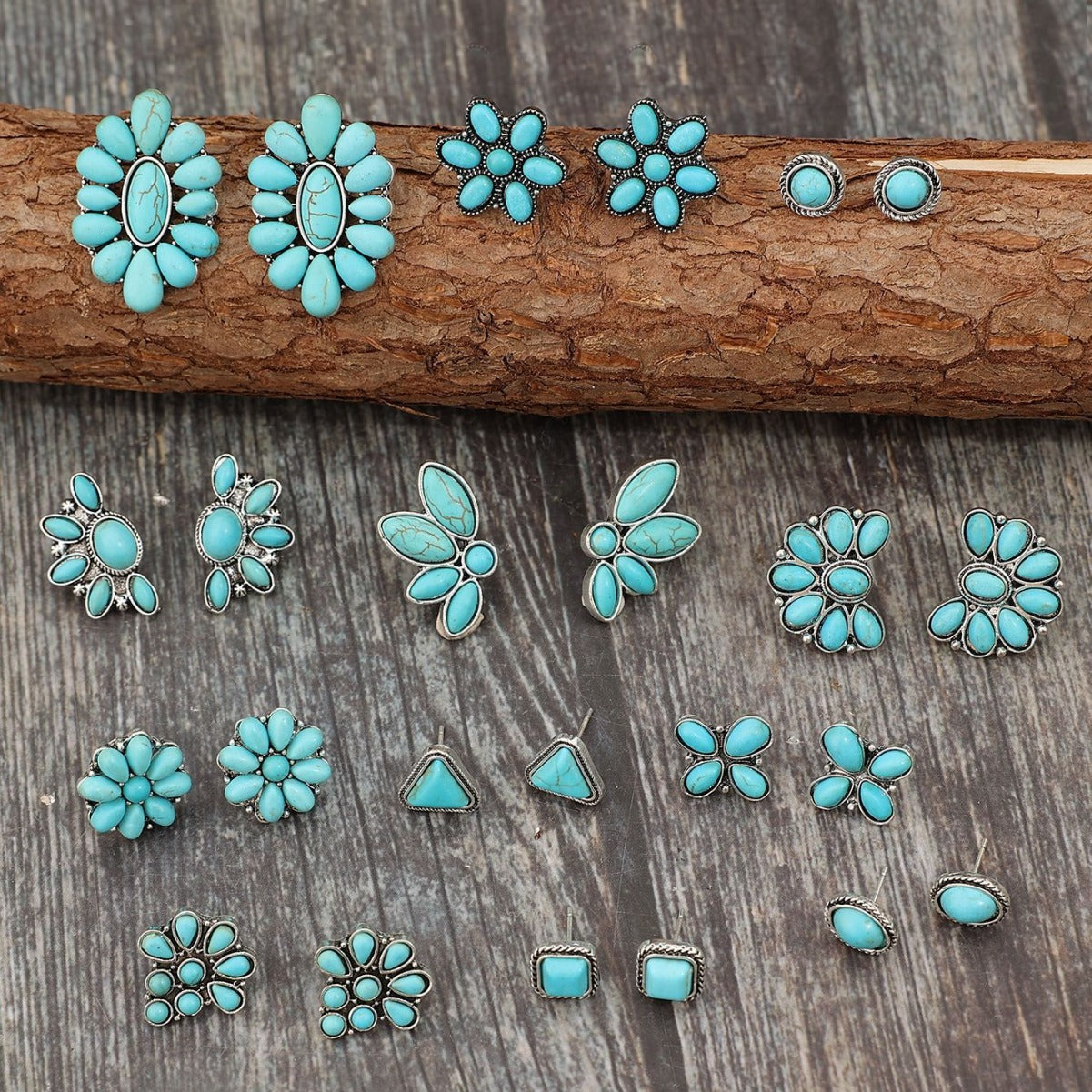
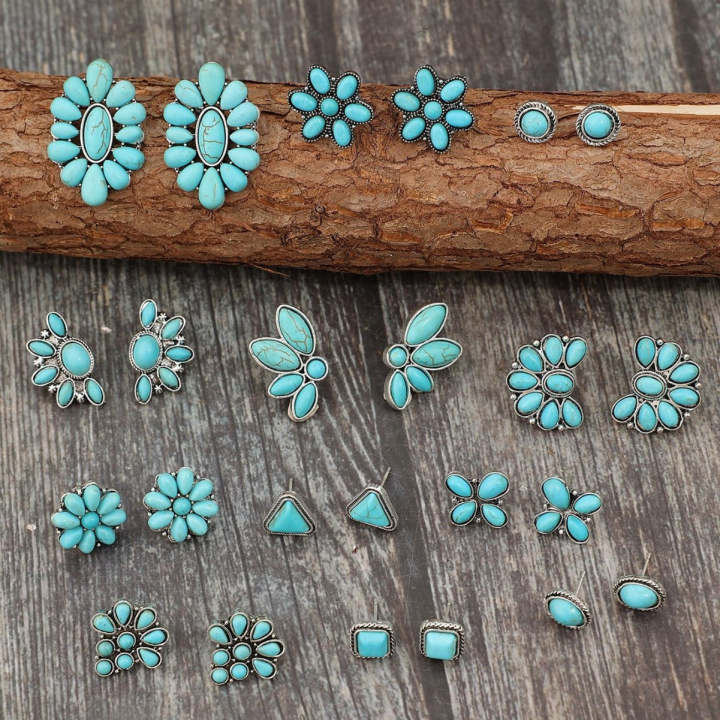
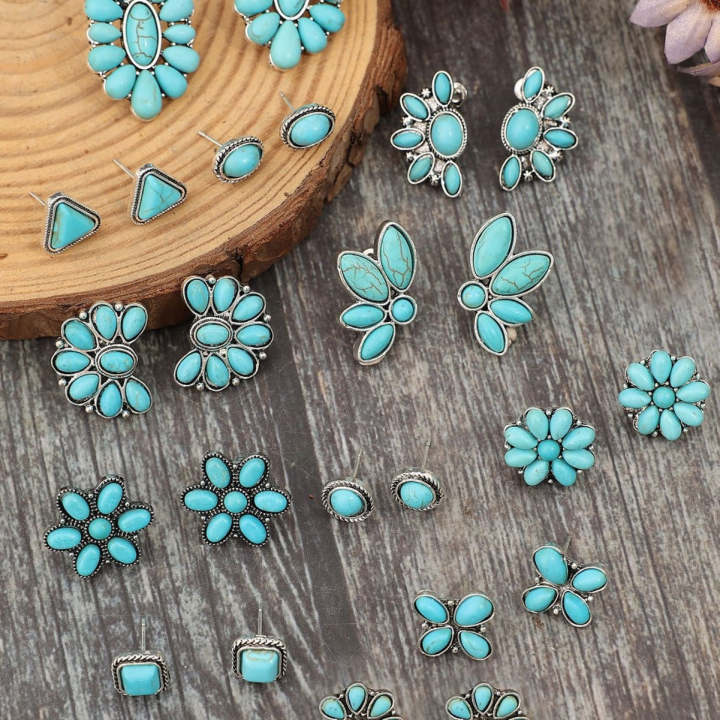
The current page describes a coordinated turquoise-style stud assortment with floral, geometric, and classic shapes. It shows one visible color choice. The visible information does not clearly state the exact number of wearable pairs, individual dimensions, per-earring weights, post and backing types, component materials, finishes, construction, or care for each shape.
A set can lower styling risk because the wearer may test a quieter shape before a more decorative one. That benefit depends on a confirmed component inventory, image mapping, piercings, anatomy, fit, and backing. Do not assume every visible item in a styled photograph is included or intended for every piercing.
First Outfit
Use a white shirt or plain tee with jeans and no necklace. Choose one seller-confirmed stud arrangement, clear the collar and hair, and keep the belt and footwear quiet. Photograph portrait, half-body, and full-body views.
First Wear Test
Check fastening, security, phone use, hair, glasses, hat, collar, headset, jacket removal, and normal head movement. Test only within current return conditions. The earring should not require constant touching or repositioning.
First Expansion
After three successful wears, change one variable: another stud shape, a denim layer, or a small supporting ring. Do not change all three dials on the same day.
Example Two: Teardrop Pendant Necklace
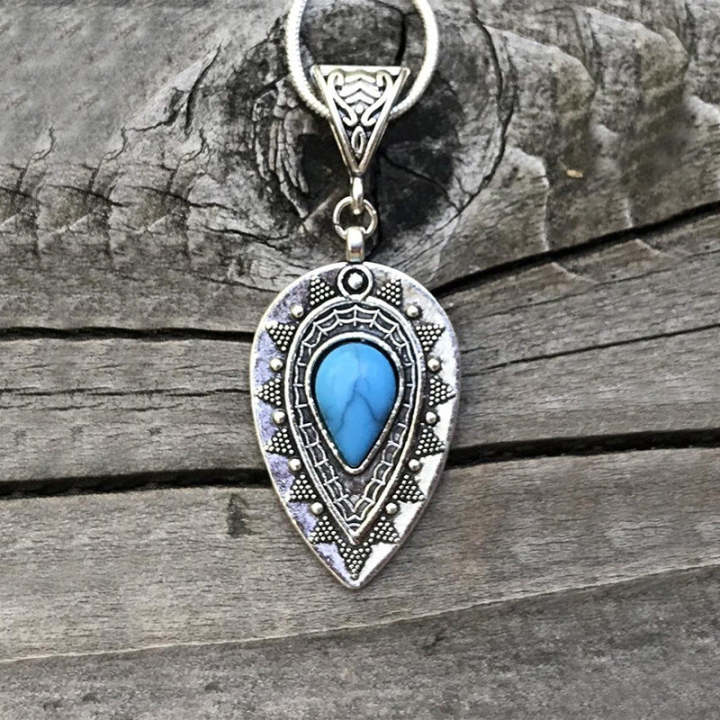
The current page describes a Western pendant with a turquoise-style center, teardrop silhouette, antique-silver-colored appearance, and vintage-inspired detail. It shows one visible color choice and no clearly stated size option. Exact chain length, adjustment range, pendant dimensions, profile, weight, closure, components, and construction are not visibly supplied.
The visible care section advises keeping the jewelry dry, avoiding direct perfume and lotion contact, and storing it in a soft pouch, while noting that material details may vary by option. Confirm the exact selected product guidance before cleaning or exposure.
First Outfit
Place the necklace over a plain tee or within a clean open collar. Use jeans, simple shoes, and no strong earrings. Mark the collar, placket, zipper, pocket, belt, and bag strap before choosing the pendant zone.
First Wear Test
Request total wearable length and complete pendant dimensions. Make a life-size paper outline and rehearse walking, sitting, bending, outerwear, bag use, phone use, and seat-belt fastening. Stop if the pendant reaches hard hardware.
First Expansion
After three successful wears, introduce one small face-level accent or a different outer layer. Preserve the teardrop as the leader instead of building a full turquoise-colored set immediately.
Which Example Should a Beginner Choose?
Choose the stud set when the wearer prefers face-level accents, an empty neckline, and modular shape testing. Choose the teardrop when the wearer prefers one central vertical line and can obtain reliable length, pendant, closure, and care information.
Compare both on the same ten fields: option clarity, dimensions, weight, fastening, components, care, wardrobe reach, movement, motif preference, and return terms. Do not compare earrings on comfort while comparing the necklace only on color.
A pending component or measurement field stays pending. Visual preference cannot convert missing evidence into confirmation.
Build a Seven-Day Beginner Sequence
- Day 1: wear the starter uniform without jewelry and photograph its existing detail.
- Day 2: make life-size outlines and map contact paths.
- Day 3: test one jewelry zone for a short controlled wear.
- Day 4: repeat the same formula without changes.
- Day 5: add an outer layer and run transition checks.
- Day 6: change one supported styling variable.
- Day 7: score comfort, security, contact, hierarchy, and desire to repeat.
Repeat the sequence after delivery only within the seller's current return and care conditions. The plan is about observation, not stressing or altering the product.
Create a Beginner Evidence Folder
Save product screenshots with date, selected option, seller answers, measurements, care instructions, order record, return deadline, and successful outfit photographs. Keep personal fit or sensitivity information private and share it only when necessary.
Name the first successful formula in plain language, such as “white shirt, dark jeans, geometric stud, no necklace.” A specific record is easier to repeat than “cowgirl look.”
Add failures too: collar contact, unclear backing, pendant reaching zipper, or visual competition. Failure notes prevent repeat purchases that recreate the same problem.
Complete a Thirty-Item No-Buy Styling Board
Before purchasing more Western-inspired clothing, list thirty items already owned: five tops, four bottoms, three dresses or one-piece outfits, four layers, four pairs of shoes, four bags, three belts, and three hair or headwear options. Cross out anything that does not fit, function, or suit the intended setting.
Pair the selected earring or necklace direction with the remaining items on paper. Mark green when the product facts and garment relationship appear compatible, amber when measurements or care are missing, and red when a known conflict exists. Do not buy supporting clothes to turn amber into green; resolve the jewelry question first.
Choose six green candidates and arrange them from least to most Western-coded. The first might be a plain tee, jeans, simple shoes, and one stud. The sixth might add a denim layer, boots, and the teardrop necklace. This creates a personal intensity ladder without assuming every occasion needs the highest level.
Wear the first two formulas before ordering anything else. Record which elements feel natural, which require explanation, and which are repeatedly removed. If the wearer prefers a low-intensity outfit, preserve it. Beginner progress is not measured by accumulating more motifs.
Review the board after one month. Items that never leave the page should not justify new purchases. A strong cowgirl-style wardrobe grows from verified repetition, not from a checklist of stereotyped objects.
Video Lesson: Use a Short Source Carefully
The supplemental video is A Beginners Guide To Turquoise Jewelry by LaCkore Couture. The currently available video is approximately 30 seconds long, and a transcript was not available during review. Its description contains broad historical and cultural statements that should be independently checked with authoritative sources before reuse.
The video does not document either Oroxen product. It cannot verify their natural-stone identity, components, maker, origin, treatment, age, measurements, construction, or care. Use it only as a prompt to ask better questions.
Beginner Mistakes and Better Alternatives
- Buying a complete costume at once. Start with one familiar uniform and one zone.
- Turning style labels into provenance. Use supported visual descriptions.
- Raising all three dials. Let color, motif, or texture lead—one at a time.
- Ignoring product-page gaps. Request numerical and component facts.
- Changing outfits before repeating a success. Wear the same formula at least three times.
- Assuming a set must be worn together. Confirm contents and test only appropriate arrangements.
Frequently Asked Questions
Do beginners need cowboy boots?
No. Use shoes that fit the real activity and wardrobe. Jewelry, color, or one garment can provide the Western-inspired direction.
Can anyone wear cowgirl-style jewelry?
Style is not restricted by gendered merchandising labels. Choose for the wearer, context, fit, symbolism, and documented product facts.
Is turquoise Western jewelry always natural turquoise?
No conclusion follows from a title or color. Use option-specific material disclosure or qualified analysis.
Should earrings and necklace match?
No. Let one lead and use the other only when scale, spacing, components, and care support the combination.
How should Southwestern turquoise jewelry be described?
Treat Southwestern as a broad style term unless geographic, tribal, artisan, or cultural provenance is documented. Avoid unsupported sacred or cultural claims.
Where should beginners go next?
Use the public introduction to Western jewelry styles, symbols, materials, and wear, then return to exact product pages for current evidence.
Final Beginner Checklist
- Choose one owned starter uniform.
- Set motif, texture, and color dials; raise only one to three.
- Select one jewelry zone.
- Confirm option mapping, dimensions, weight, closure or backing, components, finish, and care.
- Run the seven-day sequence and keep an evidence folder.
- Repeat the first success before adding another accessory.
- Use visual style terms without inventing material or cultural provenance.
Explore more current choices in Western Jewelry and return to Oroxen for current product and store information. Cowgirl style becomes practical when one documented piece joins the clothes the beginner already trusts.
Revisit the first formula after thirty days and keep it only when the wearer still chooses it willingly, the jewelry remains secure, the garments stay clear, and every care step fits the real routine. Repetition is the final proof that the beginner outfit belongs in the wardrobe.