A turquoise-style necklace works with a white shirt and jeans when its verified drop occupies a clear corridor, its shape has one readable job, and it remains stable through the wearer's real day. It does not work when a collar, placket, pocket, belt, bag, or seat belt repeatedly crosses the same space—or when a photograph is asked to supply facts the product page does not.
This guide compares the Turquoise Western Teardrop Pendant Necklace with the Western Turquoise Vintage Geometric Cross Necklace. Their turquoise-colored, Western, teardrop, geometric, cross, and vintage-inspired language describes style. It does not independently verify natural turquoise, metal, age, treatment, maker, origin, artisan production, or cultural affiliation.
Quick Answer: Use the Corridor Test
Put on the exact shirt and jeans. Draw an imaginary corridor from the base of the neck to the top button, placket, pockets, and belt. Add the paths of a jacket, bag strap, lanyard, badge, scarf, and seat belt. A necklace works when its verified chain and decorative area stay visible and clear inside a chosen corridor.
Request total wearable length, adjustment range, complete pendant or decorative dimensions, profile, weight, clasp, components, finish, construction, and care. Make a string-and-paper mock-up at full scale. Test it while walking, sitting, bending, layering, carrying, and traveling.
A necklace does not work merely because turquoise color contrasts with white fabric. Fit, movement, meaning, and documentation must also pass. The published guide to choosing turquoise-style necklaces for a denim jacket provides a related outer-layer test.
Build a Shirt-Neckline Matrix
“White shirt” can mean a buttoned Oxford, soft blouse, camp shirt, ribbed knit, linen top, Western yoke shirt, or oversized poplin layer. Each creates a different corridor. Photograph the shirt front and measure the open area rather than relying on a garment category.
| Shirt condition | What may work | What often does not work |
|---|---|---|
| Open collar with clean chest space | Verified pendant fully contained inside the opening | Decorative edges touching both collar points |
| Buttoned smooth front | Verified drop resting in one uninterrupted zone | Pendant repeatedly striking buttons or pocket |
| Stiff high collar | Shorter placement with confirmed clearance or no necklace | Chain trapped under the collar while pendant sits outside |
| Western yoke or embroidery | Quiet necklace that does not duplicate every signal | Large motif competing with yoke, snaps, and stitching |
| Oversized soft shirt | Stable verified placement after movement | Necklace disappearing into folds or migrating off center |
Repeat the matrix after adding a coat or jacket. A necklace approved with the shirt alone may fail when lapels narrow the corridor or a zipper creates hard contact.
What Works: One Necklace, One Visual Verb
Give the necklace a verb. A teardrop can lengthen the shirt front. A centered cross can anchor the open collar. A multi-part design might frame a neckline. Choose only one verb for the first formula.
The verb should be visible at conversational and full-body distance. If a necklace appears impressive only in a close crop, reconsider whether it performs the intended wardrobe job. If it performs two or three competing jobs, simplify surrounding details.
Use jeans as a textured lower field, not a color-matching target. Dark denim usually leaves more attention at the neckline; pale or distressed denim adds visual activity. Neither is universally correct. Photograph the whole body and watch where the eye lands first, second, and third.
What Does Not Work: Style First, Evidence Later
A product photograph can suggest silhouette and color relationship, but it cannot provide reliable wearer-specific scale, material identity, closure, weight, or care. Building an outfit around an assumed length often produces a pendant that lands on a button, pocket edge, zipper, or belt.
Create an evidence card for the selected option. Record its image mapping, contents, dimensions, weight, clasp, components, finish, construction, care, current price, shipping, and return conditions. Use “unresolved” rather than guessing.
Turquoise color does not prove natural turquoise. Antique-silver color does not prove silver or age. Vintage-inspired describes appearance unless dated provenance is documented. Geometric or cross styling does not establish cultural or artisan origin.
Use the Western Necklaces Collection as a Silhouette Index
Browse the Western Necklaces collection to discover vertical pendants, crosses, floral forms, layered designs, and other visible directions. Then open each candidate page separately.
Before comparing price or popularity, eliminate options whose job is wrong for the shirt corridor. A long or wide design should not remain on the shortlist when it crosses a known pocket, button, badge, or bag path. A symbol should not remain when the wearer does not want it.
Compare the finalists on identical fields. One necklace should not win on color while the other is judged on clasp or symbolism. Equal evidence makes uncertainty visible.
Product One: Teardrop Pendant—What Works
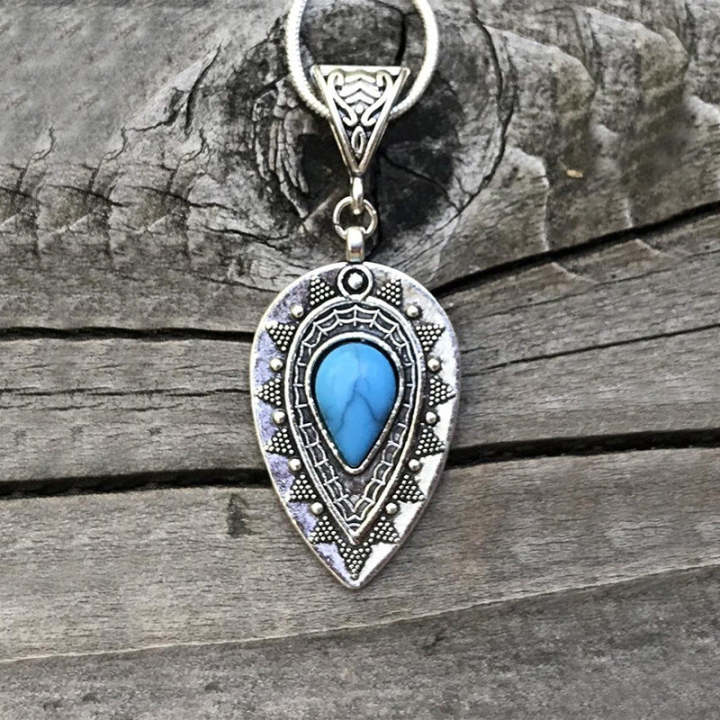
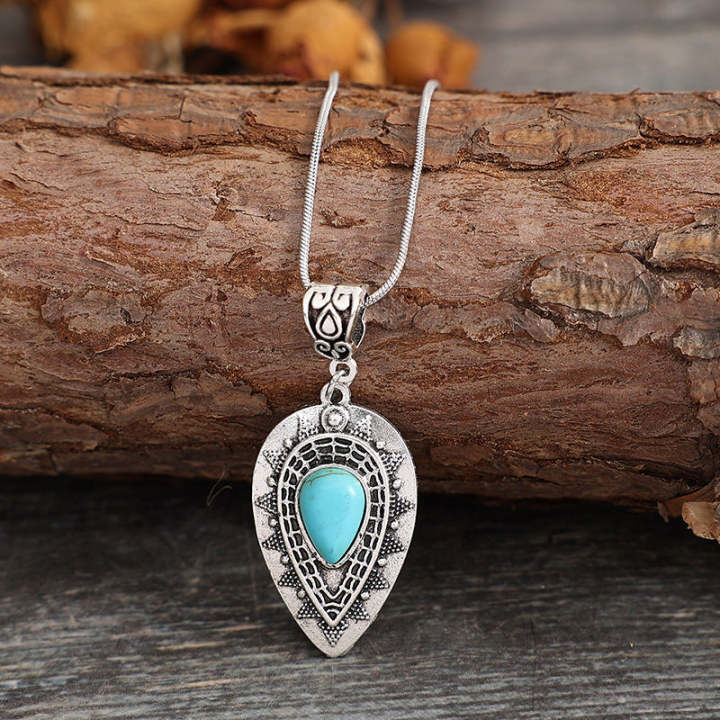
The current Turquoise Western Teardrop Pendant Necklace page displayed $39.99 USD and one visible color selection during review. Its visible page describes a Western-inspired pendant for everyday outfits, layering, and gifting, with a turquoise-style center, teardrop silhouette, antique-silver-colored appearance, and vintage-inspired detail.
The visible summary did not clearly state total wearable length, adjustment range, full pendant dimensions, profile, weight, clasp, complete components, construction, or option-specific care. A Materials & Care section was present, but the exact selected-option details should be opened and verified immediately before purchase.
A Formula That May Work
Use a smooth open-collar white shirt, straight dark jeans, restrained earrings, a plain belt, and simple shoes. Place a full-scale teardrop mock-up entirely within the collar opening or on a clear shirt-front zone. Keep the bag strap outside that corridor.
A Formula That Does Not Work
Do not layer it immediately with another pendant, a lanyard, a large buckle, and strong earrings. Do not let the teardrop terminate on the top button or zipper. If the verified drop cannot find a clear lane, choose another shirt or necklace.
Questions to Resolve
- What are the total wearable length and adjustment range?
- What are the pendant height, width, depth, and total drop?
- What clasp, chain, components, finish, construction, and care apply?
- What exactly is the turquoise-style center element?
Product Two: Geometric Cross—What Works
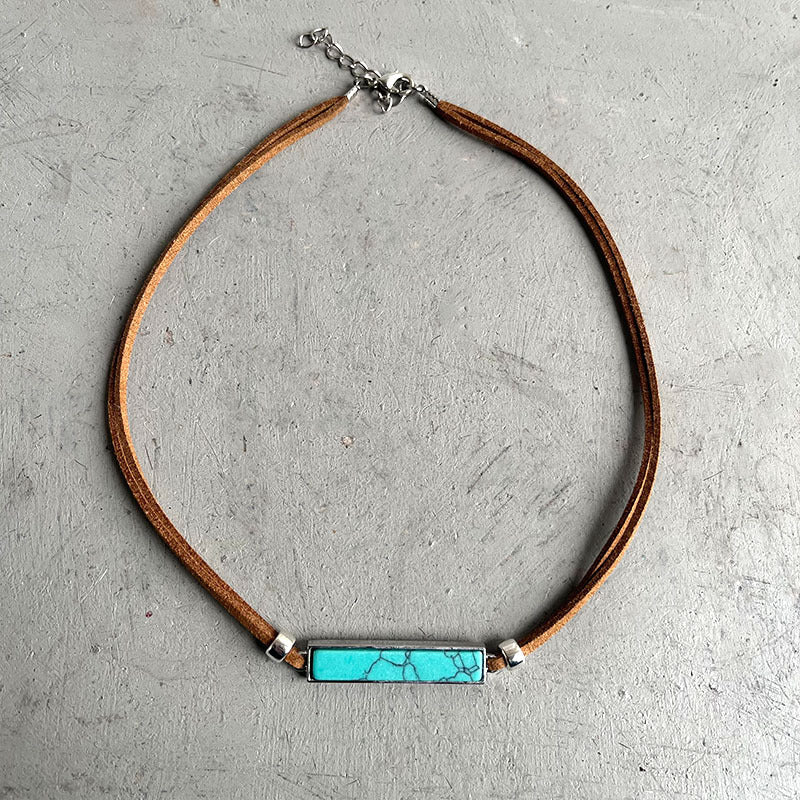
The Western Turquoise Vintage Geometric Cross Necklace page displayed $126.25 USD and Design 1, Design 3, and Design 4 choices during review. Its visible summary emphasizes Western, turquoise, and vintage-inspired styling and notes that screen color may vary.
The visible summary did not clearly provide written image mapping, total length, adjustment, cross dimensions, profile, weight, clasp, complete components, finish, construction, or care. The absent Design 2 label should not be interpreted without seller clarification.
A Formula That May Work
Use an uncomplicated button-down with a verified cross drop in one clean front zone, medium or dark jeans, no competing cross, quiet earrings, and a bag without neckline hardware. Confirm that the wearer wants the symbol and the setting permits it.
A Formula That Does Not Work
Do not repeat the cross in earrings, ring, belt, and bag simply to create a theme. Avoid unsupported Native American, Indigenous, tribal, sacred, regional, mine-specific, or artisan claims. Visual similarity cannot establish provenance.
Questions to Resolve
- Which photograph maps to Design 1, Design 3, and Design 4?
- What does one order include?
- What are the full length, adjustment, cross size, profile, and weight?
- What clasp, components, finish, construction, and care apply?
Compare Teardrop and Cross on Equal Fields
| Decision field | Teardrop direction | Geometric cross direction |
|---|---|---|
| Primary visual verb | Lengthen | Anchor |
| Symbol decision | Shape preference | Explicit cross consent and context |
| Critical measurement | Total drop and teardrop size | Total drop and cross dimensions |
| Shirt risk | Landing on placket or pocket | Motif competition and hardware contact |
| Evidence status | Keep missing components, weight, fastening, construction, and care unresolved until confirmed | |
The table gives each product the same chance to succeed. A lower price does not solve an unknown fit, and a stronger motif does not solve an unsuitable corridor.
Run Four Movement Experiments
Experiment One: Placket Drift
Walk, sit, stand, and turn for five minutes. Photograph whether the mock-up or approved product drifts onto buttons or pockets.
Experiment Two: Layer Transfer
Add and remove the intended jacket three times. Observe collar, lapel, zipper, and clasp paths. A necklace that must be held during every transition does not pass easily.
Experiment Three: Strap Crossing
Use the real bag, badge, lanyard, and seat-belt route. Reject persistent hard contact rather than repositioning the necklace all day.
Experiment Four: End-of-Day Position
After a controlled wear within current conditions, compare the final position with the opening photograph. Score migration, contact, comfort, security, and desire to repeat.
The turquoise jewelry and denim jacket guide provides a detailed layer-contact extension for Experiment Two.
Video Context: Types Are Not Product Proof
The supplemental video is Turquoise Necklaces by John Hartman. At review, YouTube showed a 6-minute, 27-second video with no closed captions. Its visible description says it presents different types of turquoise necklaces, including bead necklaces and pendants.
The distinction between bead and pendant structures is useful for organizing a collection. The video does not document either Oroxen necklace and cannot verify their material identity, maker, origin, treatment, measurements, construction, care, or value.
Because no captions or transcript were available, this article does not quote or reconstruct the spoken presentation. Inspect the original source directly and verify every relevant product claim independently.
What Works Across Casual and Dressier Versions
For a casual version, keep the shirt softly open, use relaxed jeans, simple shoes, one necklace, and an unadorned bag. For a dressier version, use a crisper shirt, dark clean denim, structured shoes, and a refined bag. Keep the same verified necklace placement so the change comes from garment finish rather than accessory accumulation.
Do not define dressy as adding more motifs. A single centered pendant can look more intentional than a fully matched set. The public statement-versus-everyday styling guide helps calibrate the final intensity.
Frequent Failures and Better Repairs
- Failure: pendant lands on a button. Repair: change the verified length zone or shirt.
- Failure: collar covers half the design. Repair: select a clear internal or external corridor.
- Failure: every accessory repeats turquoise color. Repair: keep one colored leader.
- Failure: cross motif is repeated everywhere. Repair: use one intentional symbol.
- Failure: unknown length is estimated from images. Repair: request numbers and make a mock-up.
- Failure: video examples become product claims. Repair: separate context from listing evidence.
- Failure: bag or seat belt crosses the pendant. Repair: change the corridor or accessory.
- Failure: only the front photo is checked. Repair: review profiles, back, movement, and end-of-day position.
Frequently Asked Questions
Should a pendant be worn inside or over a white shirt?
Either can work when verified length, decorative dimensions, body, collar, placket, fabric, and movement produce a clear corridor.
Can turquoise-style necklaces match blue jeans?
They can relate without matching exactly. Evaluate the physical product and garment under real light; screen colors vary.
Can a teardrop and cross be layered?
Only after both are documented and their lengths, weights, clasps, components, care, symbolism, and contact paths are compatible. One necklace is the stronger first test.
Does turquoise-style mean natural turquoise?
No. Product color, title, category, photograph, or unrelated video does not establish material identity. Request option-specific disclosure.
How should a necklace be chosen for a gift?
Confirm the recipient's neckline preferences, symbolism, component needs, fastening, length, wardrobe, care tolerance, delivery timing, and return conditions.
What if the seller does not provide measurements?
Keep fit unresolved and ask. Consider another option when missing information prevents a practical decision.
Final Works-or-Does-Not Checklist
- Map the exact shirt corridor and all straps, layers, pockets, buttons, and hardware.
- Give the necklace one visual verb.
- Confirm option, contents, length, adjustment, dimensions, profile, weight, clasp, components, construction, and care.
- Use accurate style language without inventing material or provenance.
- Make a full-scale mock-up and run four movement experiments.
- Compare teardrop and cross on identical fields.
- Repeat the successful formula before layering.
Explore current silhouettes in Western Jewelry or return to Oroxen for current store and product information. What works is the necklace whose documented size, shape, meaning, and movement fit one clear white-shirt corridor. What does not work is a design that needs constant correction or unsupported assumptions.