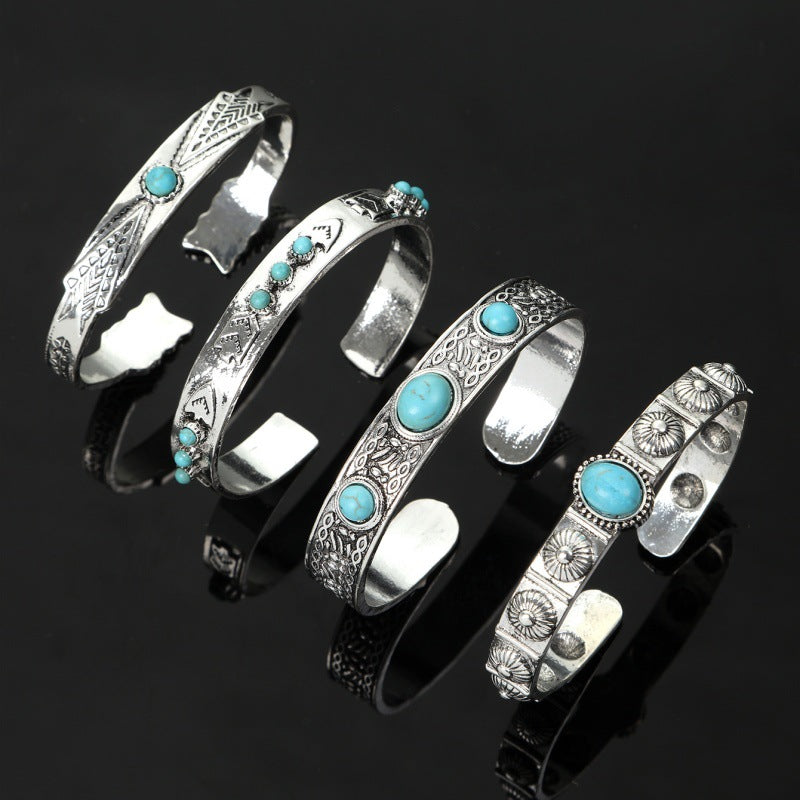
A capsule wardrobe does not require a bracelet to match every garment. It requires the bracelet to complete several real outfits without creating repeated fit, contact, or care problems. The most useful turquoise-colored wrist piece is therefore not automatically the most neutral. It is the one with a clear role, documented physical facts, and enough wardrobe evidence to justify its space.
This first-time buyer guide compares the Turquoise Western Cuff Bracelet Set with the Turquoise Boho Vintage Crystal Bracelet. Their names and photographs communicate style, not automatic proof of natural turquoise, crystal composition, metal, age, maker, origin, treatment, or construction. Use seller documentation for every material and care decision.
Quick Answer: Build a 12-by-3 Wrist Grid
Select twelve owned garments or outfit anchors: three tops, two bottoms, one dress, two outer layers, two pairs of shoes, and two bags. Build three wrist states: no bracelet, one quiet bracelet, and one leading bracelet or approved stack. Photograph every realistic combination instead of imagining “versatility.”
A capsule candidate passes when it improves at least six complete outfits, remains physically suitable through normal routines, and does not require a new supporting wardrobe. A set may pass by supplying several separate roles. A single bracelet may pass by becoming one dependable signature.
Do not count a pairing twice merely because the jacket is open in one photograph and closed in another. Count distinct wearing conditions: work, casual errands, dinner, travel, outdoor activity, or another routine that matters to the wearer.
The public statement-versus-everyday turquoise-style guide provides a visibility and repeat-wear framework. This article turns that framework into a wrist-centered capsule test.
Define the Bracelet's Capsule Job
Choose one primary job before evaluating products:
- Color signal: the only turquoise-colored point in a neutral wardrobe.
- Western bridge: connects boots, denim, leather-looking textures, or floral and geometric cues without duplicating every motif.
- Hand-zone focal point: leads when neck and ears remain quiet.
- Modular set: changes visual density through approved separate or combined wear.
- Repeat signature: appears in a defined weekly uniform.
A bracelet can perform a secondary job, but one primary purpose makes the capsule test honest. “Goes with everything” is not a job and cannot be measured.
Create a Wrist and Routine Record
Measure the wrist at the intended position according to appropriate guidance. Record dominant hand, usual watch or wearable, sleeve types, workstation, bag use, gloves, tools, sports, childcare, cooking, handwashing, and any required equipment. Do not infer component sensitivities; ask the wearer or use reliable records.
| Routine field | Question | Capsule consequence |
|---|---|---|
| Typing and desk work | Does the bracelet strike the surface? | May need opposite wrist or off-desk formula |
| Long sleeves | Can the cuff clear or sit safely beside fabric? | Limits cold-season outfits |
| Bag and coat | Do straps, zippers, and cuffs cross its path? | Changes travel and outerwear use |
| Handwashing | What do documented care rules require? | Needs a secure removal plan or another piece |
| Watch or wearable | Can both items remain separate? | May reserve one wrist for technology |
| Gestures | Does the bracelet become the intended focal point? | Affects ring, sleeve, and necklace density |
Browse Western Bracelets by Architecture
Use the Western Bracelets collection as a visual index. Sort current options by open cuff, closed bangle, linked construction, flexible strand, multi-piece set, broad surface, and separated details. Architecture affects how a bracelet may fit, move, contact clothing, and store.
Then request the physical record for each candidate: internal dimensions, opening or closure, adjustment method, width, thickness, profile, weight, components, finish, construction, care, and option mapping. Mark every missing field pending.
Do not transfer measurements or care between pieces in the same collection. Similar color and styling do not establish shared components.
Product One: Turquoise Western Cuff Bracelet Set
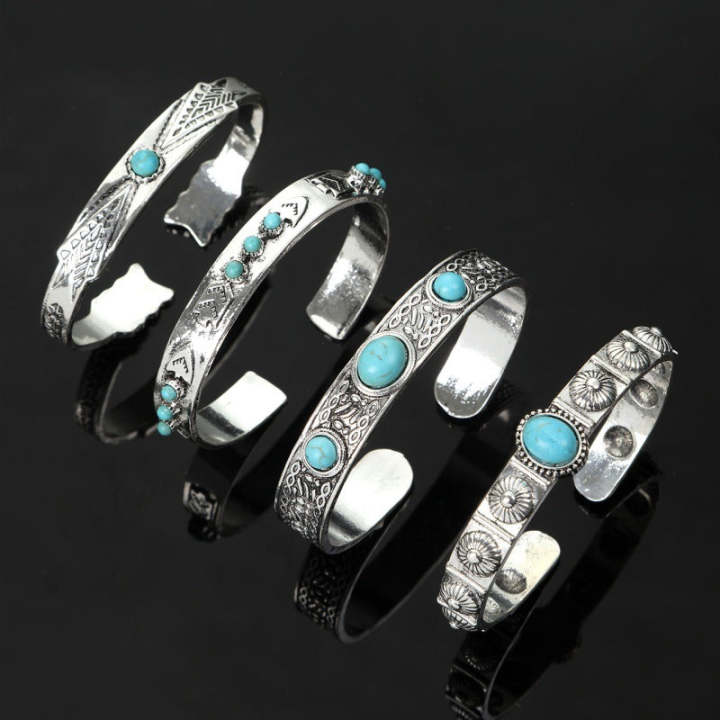
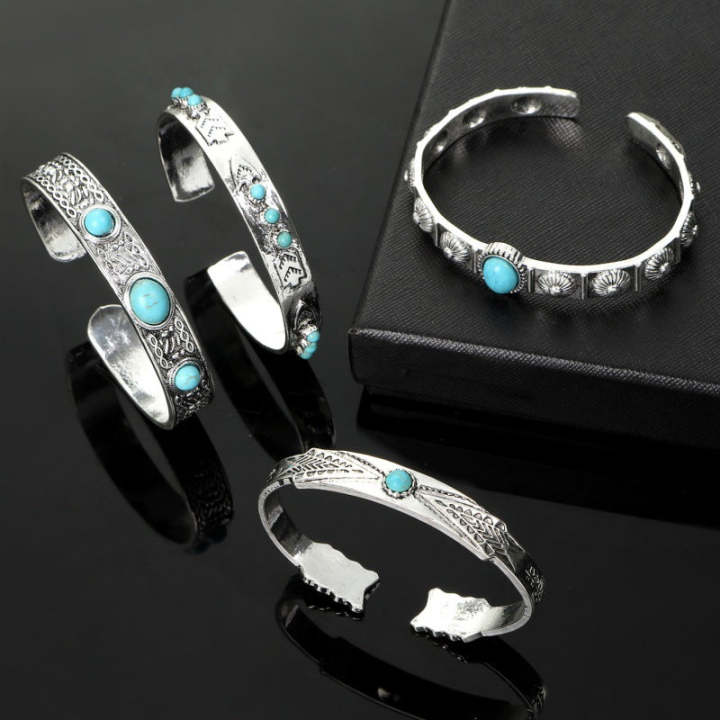
The current page identifies a 4Set and describes four open cuff bracelets with turquoise-colored accents and varied vintage-inspired motifs. It states that they may be worn together or individually. The visible information does not clearly provide each cuff's internal dimensions, opening width, adjustment method, width, thickness, profile, weight, components, finish, construction, or care.
The set's capsule strength is modularity. One cuff can provide a quiet color signal; two separated cuffs can create a stronger wrist line; all four can become a statement. That range remains theoretical until seller guidance confirms fit and whether nearby or combined wear is physically appropriate.
Set Capsule Test
- Label the four cuffs A through D from seller-confirmed images.
- Record individual fit and care facts rather than treating the set as one object.
- Test A, B, C, and D alone across the twelve garment anchors.
- Test only approved two-cuff combinations with a visible gap.
- Reserve three- or four-cuff arrangements for deliberate statement outfits.
- Stop any combination that rubs, rotates, compresses, or strikes another component.
A successful set does not need every possible stack. Three repeatable combinations may be more capsule-friendly than many uncertain ones.
Product Two: Turquoise Boho Vintage Crystal Bracelet
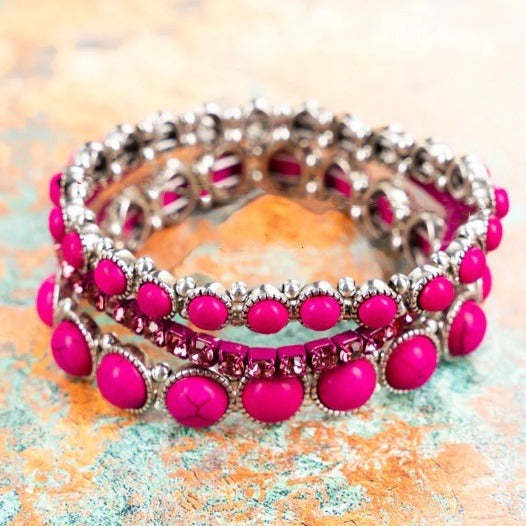
The current product page shows one visible color choice and presents turquoise, boho, vintage, and crystal wording. The visible page does not clearly state wrist fit, length or internal dimensions, adjustment range, closure, width, profile, weight, component composition, crystal identity, finish, construction, or care.
Do not interpret “crystal” as a verified mineral, glass, or other composition without disclosure. Do not interpret turquoise color as natural turquoise. Ask the seller what every decorative and skin-contact component is and which care rules follow.
Single-Bracelet Capsule Test
- Obtain exact fit and closure information.
- Make a life-size width and profile mock-up.
- Test it with bare wrist, short sleeve, fitted long sleeve, and outerwear cuff.
- Photograph it with every watch, ring, and bag normally used.
- Assign it to six real outfits and two backup outfits.
- Run a full-day routine rehearsal within current return conditions.
The single product can be more efficient than a set if it performs one role across many garments. It can be less efficient if missing fit information or strong visual density limits repetition.
Build the Twelve Garment Anchors
Three Tops
Choose one plain short sleeve, one collared or buttoned shirt, and one knit or textured top. These reveal whether the bracelet needs bare space, conflicts with cuffs, or becomes lost beside texture.
Two Bottoms
Use one denim and one quiet neutral bottom. The wrist does not directly touch them, but the total color and Western direction determine whether the bracelet leads or repeats.
One Dress
Select the dress most likely to be repeated. Photograph the hands relaxed at the side, waist, table, and face. A bracelet often changes role as the hand moves.
Two Outer Layers
Choose the lightest and heaviest regular layer. Test sleeve opening, zipper, snap, bag, and coat-removal paths. A bracelet that works only without outerwear may still deserve a seasonal capsule role.
Two Shoes and Two Bags
Use practical and occasion shoes plus the two bags carried most. Bags are especially important because straps, handles, zippers, and internal searches repeatedly involve the wrist.
Score a 30-Wear Calendar
Place thirty real days on a calendar: work, weekend, dinner, travel, outdoor plans, and formal or social events. Assign a bracelet state to each—none, one cuff, approved pair, full set, or single crystal-style bracelet. Count only days supported by fit, contact, care, and wardrobe evidence.
Calculate three scores. Reach is the number of days the product can serve. Friction is the number of extra steps needed for removal, storage, outfit changes, or contact management. Identity is whether the bracelet gives those outfits a consistent desired direction.
A capsule winner has adequate reach, manageable friction, and clear identity. Maximum reach is unnecessary if the wearer prefers several quiet days without wrist jewelry.
Run a Ninety-Day Capsule Audit
After one season, compare the planned calendar with actual wear. Count how often each bracelet state was chosen, skipped, removed early, or replaced. Record the reason in plain language: sleeve collision, difficult removal, unclear care, insufficient fit, excessive visual density, or simply a preference for another piece.
Inspect condition according to the documented care process. Do not use the audit as an excuse to polish, tighten, bend, or clean unidentified components. If a closure, opening, surface, or decorative attachment appears changed, stop wear and seek appropriate product guidance.
Update the twelve garment anchors when clothes leave the wardrobe or routines change. A new coat sleeve, watch, workstation, bag, or dress can alter bracelet reach even when the jewelry stays the same. Repeat only the combinations affected by the change instead of rebuilding every photograph.
For denim-heavy capsules, use the public turquoise-style jewelry and denim-jacket guide to recheck collar, sleeve, hardware, and layering relationships. Apply its garment logic while keeping bracelet fit and care tied to the exact product.
The audit is successful when it removes false versatility. A piece worn confidently in eight repeatable outfits may deserve capsule space more than a piece theoretically assigned to twenty outfits but repeatedly avoided.
Coordinate Rings Without Crowding the Hand
Rings turquoise jewelry can create a second nearby color cluster. Begin with the bracelet on one wrist and no ring on that hand. Add one documented ring to the opposite hand only after the wrist formula works.
Watch how the hands overlap during typing, holding a phone, and photographs. The ring and bracelet may merge visually even when worn on different hands. Use different scales or let one remain neutral.
The public turquoise-style ring occasion checklist provides additional hand-movement and storage checks.
Use the Necklace Video to Ask Capsule Questions
The supplemental source is Turquoise Necklaces by John Hartman. The title concerns necklaces rather than these bracelets. Its value here is to prompt questions about visual density, repetition, focal placement, and how a jewelry collection may contain several distinct roles.
Watch the complete source before applying any idea. It does not document either Oroxen bracelet and cannot verify their materials, components, fit, construction, origin, treatment, age, value, or care. Translate visual inspiration into product-specific questions.
Common Capsule Mistakes
- Counting photographs instead of wear days. Use real routines and garments.
- Assuming a set creates unlimited combinations. Confirm fit and physical compatibility first.
- Adding clothes to rescue the bracelet. Test owned garments before shopping.
- Stacking against a watch immediately. Establish separate clearance and care.
- Using every turquoise-colored accessory. Keep one leading zone.
- Ignoring removal friction. A capsule item should have a practical storage plan.
Frequently Asked Questions
How many bracelets belong in a capsule wardrobe?
There is no required number. One signature bracelet or a documented modular set can work. Choose the smallest number that supports the desired outfits and routine.
Should all four cuffs be worn together?
Only when seller guidance, fit, contact, and care support the arrangement and the wearer wants a statement wrist. Individual wear may produce more capsule reach.
Can a turquoise-style bracelet be worn daily?
Yes, when documented components, fit, closure, care, and routine tests support repeat wear. “Everyday” is earned through evidence.
Do women's turquoise jewelry capsules need matching earrings?
No. Gendered category labels do not require a matching set. Coordinate through one color family, scale, or outfit direction and keep each piece independently verified.
What if the bracelet interferes with typing?
Try the opposite wrist only after confirming fit and role, reserve the piece for off-desk outfits, or choose another documented profile. Do not tolerate repeated hard contact.
How should bracelet care fit the capsule?
Store a product-specific care card with the capsule plan. Follow disclosed components and finish rather than generic turquoise, crystal, or metal advice.
Final Capsule Checklist
- Assign one primary bracelet job.
- Record wrist, routine, sleeves, watch, bags, and removal needs.
- Confirm dimensions, fit, opening or closure, weight, components, finish, construction, and care.
- Build twelve garment anchors and three wrist states.
- Complete the 30-wear calendar using evidence-based days.
- Measure reach, friction, and identity.
- Keep only combinations that remain comfortable, stable, and repeatable.
Explore more current options in Western Jewelry and return to Oroxen for current product and store information. A turquoise-style bracelet earns capsule status when it serves real outfits with fewer decisions, not when it merely looks versatile on a product page.