A denim jacket creates a strong frame around the neck. Its collar, seams, metal buttons, chest pockets, and open front already form several lines before a necklace is added. That is why a turquoise-colored necklace can look effortless with one jacket and strangely busy with another—even when the necklace itself is attractive. The solution is not a universal chain length or a rule that every western outfit needs a large pendant. The solution is to decide where the pendant should land, how the jacket will be worn, and which visual element gets priority.
This guide builds the outfit from the neckline outward. You will test the jacket open and closed, map three pendant landing zones, compare a teardrop pendant with a geometric cross option, control the number of focal points, and verify the current product details that matter before buying. The examples use Oroxen listings, but the method works with any turquoise-style necklace. Color and product naming describe the visible look; they do not independently prove a particular stone, metal, age, treatment, or origin.
Quick Answer: Choose the Landing Zone Before the Necklace
Put on the shirt and denim jacket you intend to wear. Stand naturally, open the jacket, and mark three possible pendant positions with small pieces of removable painter’s tape on the shirt: just below the collarbone, at the upper chest, and near the center of the open jacket. Photograph each position. Close the jacket halfway and repeat. One of those locations will usually stay visible without colliding with the collar, zipper, buttons, or pocket line.
That location is your landing zone. Now compare necklace images according to where the pendant appears likely to sit, not according to how large it looks in a cropped product photograph. If the listing does not document length or adjustment, ask rather than estimating from a model or screen. Use the Turquoise Jewelry Guides hub for focused reading and the live Western Necklaces collection to build a current shortlist. Final options, availability, price, shipping, returns, and care must be checked on the live product page.
Start with the Denim Jacket, Not the Jewelry Box
Denim jackets differ in ways that change necklace placement. A classic trucker collar creates a pointed frame. An oversized jacket may fall farther from the neck and expose more shirt. A cropped style raises the visual center of the outfit. Sherpa lining, embroidery, studs, contrast stitching, patches, and oversized hardware add texture that can compete with a detailed pendant.
Make a quick jacket inventory. Record the wash as light, medium, dark, black, white, or colored. Note the metal tone of the buttons. Count prominent details above the waist. Decide whether the jacket is usually worn open, buttoned, draped over the shoulders, or removed indoors. This tells you how much visual work the necklace must do and whether it needs to make sense with both the jacket and the base layer.
A light, faded jacket can support a darker or more defined pendant because contrast creates separation. A dark denim jacket may give a silver-colored or turquoise-style centerpiece more clarity. Heavily decorated denim often needs a simpler necklace plan: one pendant, restrained earrings, and no competing scarf. Plain denim gives more freedom to use a larger or more ornate necklace.
The four-view jacket test
- Jacket fully open over the intended shirt.
- Jacket partially closed at the center.
- Jacket removed, because many indoor outfits end this way.
- Outfit with the usual bag strap, hair position, and sunglasses or hat.
A necklace should succeed in at least three of the four views. If it only works while the jacket is arranged for a photograph, it is an outfit prop rather than a versatile wardrobe piece. That may be fine for a specific event, but it should be a conscious choice.
Map the Visual Lines Around the Neckline
The jacket collar forms a V-like shape when open. A V-neck or partially unbuttoned shirt repeats that direction, while a crew neck creates a horizontal boundary. A teardrop or elongated pendant can continue a vertical path. A broad geometric design may interrupt it and become the visual stop. Neither effect is automatically better.
Use a plain cord to test length. Tie or clip it loosely at several positions without trying to imitate the final chain. Place a paper oval, triangle, or cross-shaped cutout where the pendant would sit. Move your shoulders, sit, turn, and put on the jacket. Notice whether the mock pendant falls inside the opening, on top of a seam, under the collar point, or against a button. This exercise evaluates composition; it does not establish the fit or dimensions of a product.
Hair also changes the frame. Long hair worn forward can cover a fine chain and compete with a detailed pendant. Tucking one side behind the shoulder creates a clearer line without requiring an updo. A hat introduces another focal point near the face, so earrings and necklace scale may need to decrease. Glasses, a patterned bandana, and a bold lip color can have the same effect.
For a broader explanation of how denim, dresses, boots, and workwear affect jewelry placement, read How to Style Western Jewelry with Denim, Dresses, Boots & Workwear. The denim-jacket-specific article How to Style Turquoise Jewelry with a Denim Jacket Outfit can help you coordinate the rest of the accessories after the necklace role is fixed.
Choose One of Three Necklace Roles
Role 1: Quiet color marker
The necklace adds one blue-green point but does not dominate the jacket. This works for a busy day, a layered wardrobe, or a jacket with visible stitching and hardware. Keep the shirt relatively plain and use small earrings. The necklace should remain readable when the jacket is open without turning the entire chest into one large arrangement.
Role 2: Central pendant
The pendant is the main jewelry feature. Clear the landing zone by using a solid top and a jacket with moderate detail. Let the jacket opening point toward the pendant. Avoid a competing scarf knot, oversized brooch, or several equally strong necklaces.
Role 3: Layering anchor
The turquoise-style pendant becomes the lowest or most visually important part of a two-necklace arrangement. The supporting necklace should be simpler, shorter, and separated enough that the chains do not appear as one knot. Layering increases practical risks—tangling, chain friction, and movement under the jacket—so test the complete set while walking and sitting.
Choose the role before browsing. Otherwise every necklace seems plausible, and the shortlist becomes a collection of moods rather than a solution for one outfit.
Use the Western Necklaces Collection as a Controlled Shortlist
Open the Western Necklaces collection and save one candidate for each role: a restrained accent, a central pendant, and a possible layering anchor. Do not assume the collection image or product name supplies material facts. Open each candidate and compare the currently documented design, selectable options, product photographs, price, availability, and policies.
Create a “jacket compatibility card” for every saved product:
| Question | What you can observe | What must be verified |
|---|---|---|
| Where should it land? | Preferred spot inside the open jacket | Length, adjustment, and pendant dimensions |
| What is its role? | Accent, centerpiece, or layering anchor | Selected design and corresponding images |
| Will it stay visible? | Collar and base-layer relationship | How the real chain behaves in motion |
| Could it catch? | Jacket hardware, seams, and bag strap | Construction and product-specific care guidance |
| Does the claim matter? | Color and visible styling | Any required material, finish, or origin documentation |
A candidate with a clear visual role and one answerable question is easier to evaluate than a candidate with five unknowns. If a material, allergy, size, or care detail is essential, resolve it before ordering.
Product Option One: Turquoise Western Teardrop Pendant Necklace
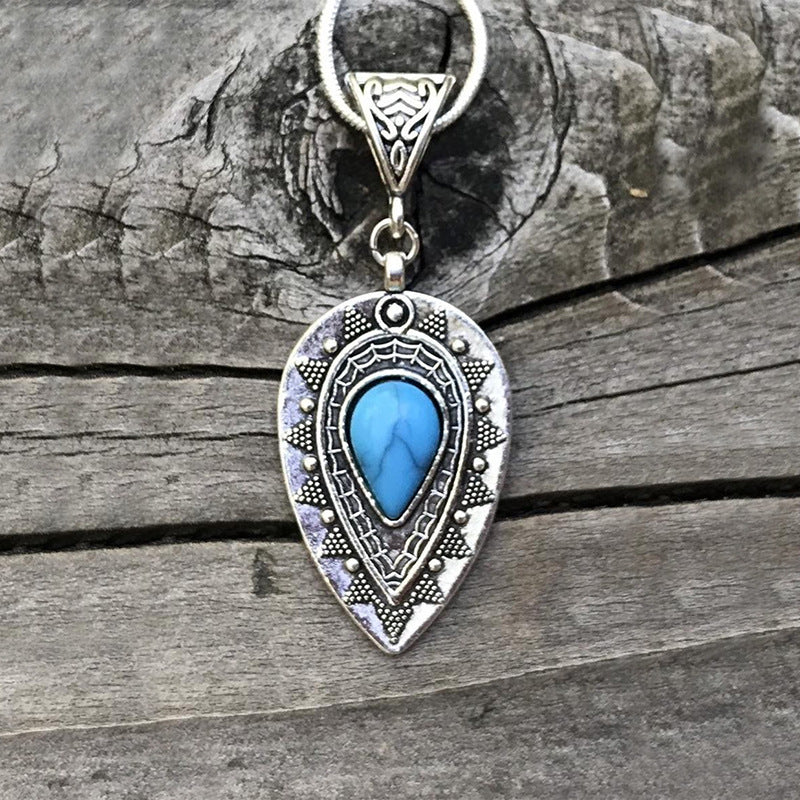
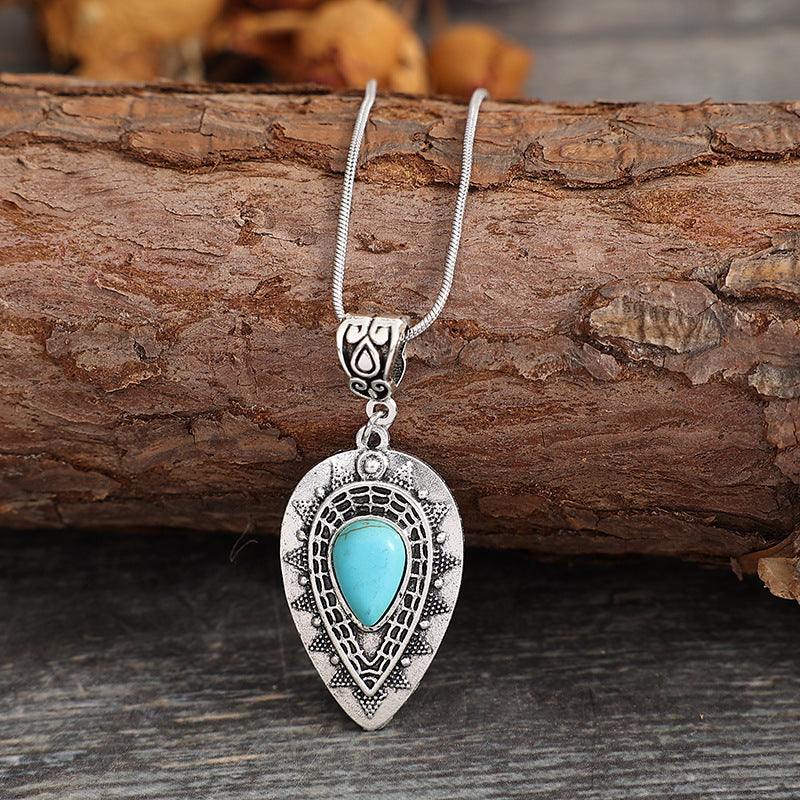
The current Turquoise Western Teardrop Pendant Necklace listing presents a western pendant with a turquoise-style center, a teardrop silhouette, vintage-inspired detailing, and an antique-silver color description. The public page recommends wearing it with denim, boots, shirts, dresses, or layered necklace looks. Those descriptions make it a natural candidate for the central-pendant role.
The teardrop outline can continue the downward line created by an open jacket. Test it over a cream crew neck, a white button-front shirt, or a black fitted top. With a light-wash jacket, the antique-silver color description and blue-green center can create a defined focal point. With dark denim, the pendant may appear brighter and more graphic. In either case, keep the upper chest free from a competing printed logo.
Use the image gallery to compare the front view, surrounding details, visible chain, and how the pendant appears against a body or neutral background when such an image is provided. Product photographs can help with styling, but they do not replace documented measurements. The public text reviewed for this draft showed a color selector but did not expose a visible length selector. If the landing zone is critical, confirm the necklace length, any extension range, pendant dimensions, closure, and care instructions before ordering.
Build a real outfit sentence: “I want the teardrop pendant to land inside the open jacket over a plain cream shirt, with small earrings and no scarf.” That sentence gives you a way to reject or accept the item when dimensions are confirmed. It also tells you which product image should become the article cover: the image that best communicates the pendant as the center of the denim frame.
Product Option Two: Western Turquoise Vintage Geometric Cross Necklace
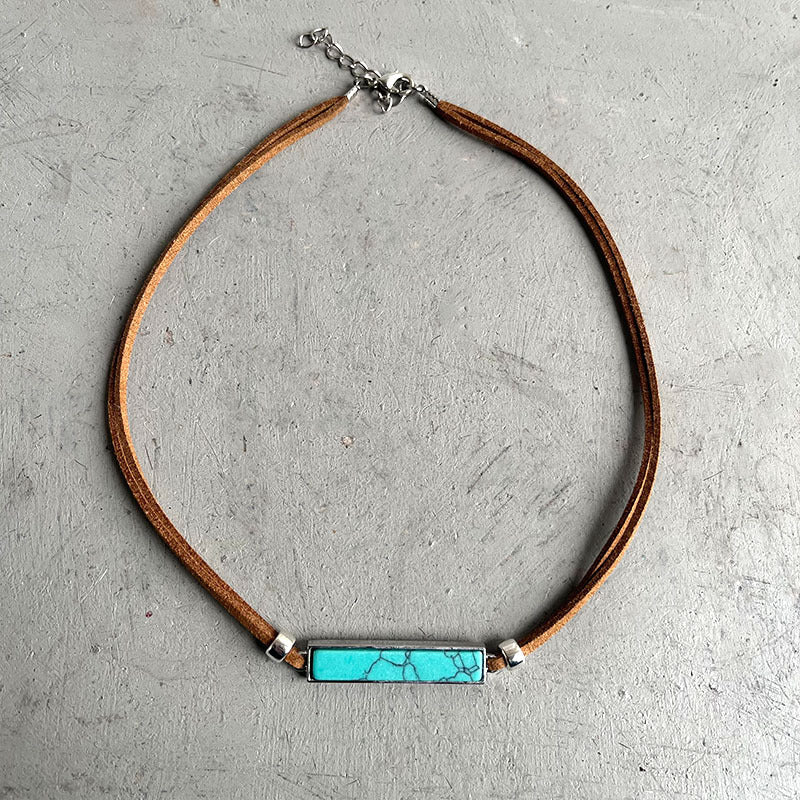
The Western Turquoise Vintage Geometric Cross Necklace uses western, turquoise, vintage, geometric, and cross language in its current presentation. The live page reviewed for this draft offered Design 1, Design 3, and Design 4 choices under its selector. A beginner should treat every design as a separate comparison rather than assuming the first photograph represents all three.
A geometric cross can act as a firmer visual stop than an elongated teardrop. That makes it useful when the base layer is simple and the jacket opening needs a definite center. It may also suit an event outfit in which the necklace is intended to be recognizable from conversational distance. Because a cross can carry personal or religious meaning, choose it because the motif fits the wearer—not merely because it is grouped under western styling.
Select the design first, then identify which gallery images correspond to it. Compare the outline against the jacket’s collar points. If the pendant and collar both create strong angles at the same height, move the landing zone lower or choose a softer neckline. If the jacket has large chest pockets and metal buttons, reduce nearby jewelry so the pendant does not become one of many competing shapes.
The current product text does not give enough visible construction detail to infer metal type, stone identity, treatment, age, or production origin. Ask when those facts matter. Also verify length, closure, design-specific size, care, availability, current shipping timing, and return conditions. A design selector is only useful when the buyer can connect the option name to the correct photographs.
Compare Teardrop and Geometric Cross with the Same Jacket
Use one jacket, one shirt, one hairstyle, and one camera distance. Put a screenshot of each necklace beside the outfit photograph. Scale the screenshots down so they do not occupy more chest area than your paper landing-zone test. This is not a virtual try-on; it is a composition check.
The teardrop candidate favors continuity. Its elongated outline can follow the open jacket toward the center of the torso. The cross candidate favors punctuation. Its geometry can create a stronger stop and may ask the rest of the outfit to become quieter. Choose continuity when the jacket already has several hard lines. Choose punctuation when the base outfit feels too plain and you want the necklace to define the look.
Now switch the jacket from open to partially closed. If the pendant disappears or sits directly against a button, the planned landing zone is fragile. Remove the jacket. If the necklace looks unfinished against the base shirt alone, the combination may depend too heavily on one outer layer. Finally, add the usual bag. A crossbody strap passing over the pendant area can move, cover, or press the necklace; a shoulder bag may leave it undisturbed.
Color Coordination Without Exact Matching
Denim is not one blue. Faded knees, seams, whiskering, black overdye, white denim, and indigo all change the background. Turquoise-style color also varies across screens and product options. Trying to make the necklace match the jacket exactly is unnecessary and often impossible.
Use a three-color envelope instead: denim blue, one warm neutral, and the necklace’s blue-green accent. Warm neutrals include tan boots, brown leather, camel knitwear, cream shirts, or a cognac bag. Black and white can replace the warm neutral for a more graphic look. Keep large printed colors outside the envelope unless the necklace is intentionally a quiet detail.
Metal-tone coordination can be loose. Jacket buttons, belt buckles, bag hardware, and necklace details do not need to match perfectly, especially in casual western styling. Repetition helps when two elements sit close together. If the pendant and jacket buttons occupy the same area, let one be dominant and the other supportive. Farther-apart hardware can vary without looking accidental.
Layering: Use Distance, Not Quantity, to Create Interest
Two necklaces can work with denim when their landing zones are clearly separated. Start with the turquoise-style pendant alone. Add a shorter, visually simpler chain only if the upper neckline still feels empty. The second necklace should support the vertical path rather than introduce another major motif.
Check chain movement under the jacket collar. Walk, sit, put on the bag, and turn your head. If the chains cross within minutes, remove one or increase the separation using product-compatible adjustments. Do not add a third layer merely because the product photographs show several necklaces. A real jacket creates friction and movement that a studio arrangement may not reveal.
Layering also changes care. Different surfaces can rub; pendants can strike; chains can knot inside the jacket. Verify that the product instructions permit the planned contact and remove the layered set before activities likely to pull or compress it.
Video Buying Lesson: Education Is Not Product Authentication
The corresponding video is “Watch This Before You Buy Turquoise – Know What You’re Buying” by GomeowCreations. Its topic is useful for learning that turquoise-related buying language can require careful examination. It does not authenticate either Oroxen necklace and should not be used to transfer material, treatment, origin, or value statements onto a turquoise-style fashion product.
Watch with two lists. On the first, write general questions the video inspires: What terminology needs clarification? Which features require expert inspection? What documentation would support a claim? On the second, write only facts confirmed on the exact product page. Do not merge the lists. If the product is bought for its fashion design, say so. If a specific material is required, request explicit evidence before checkout.
Comfort and Movement Tests for a Denim Outfit
A necklace can be comfortable while standing and irritating after an hour in a jacket. Test the intended landing zone against the collar edge, the shirt seam, and the top jacket button. Turn your head fully. Raise both arms. Sit in a car posture. Lean forward as if tying a boot. Put the bag strap on and off.
Notice three types of movement: vertical bounce, sideways drift, and rotation. A pendant that repeatedly turns may not show its intended face. A chain that drifts beneath one collar point can make the outfit appear uneven. A pendant that bounces against a hard button can create noise and wear. Length is only one variable; pendant weight, chain character, fabric texture, and body movement also matter.
When the real necklace arrives, conduct the first test indoors and within the current return conditions. Do not remove tags, adjust parts, expose the piece to cosmetics, or wear it outside until fit and appearance are accepted. Stop if there is irritation, pain, a damaged closure, or an unstable component.
Common Denim-and-Necklace Mistakes
Every detail tries to be western
A hat, embroidered jacket, large buckle, patterned boots, statement earrings, and ornate necklace can flatten one another into noise. Keep two strong western cues and let the remaining pieces provide structure.
The pendant lands on a jacket feature
A beautiful pendant becomes hard to read when it sits directly on a button, pocket flap, contrast seam, or scarf knot. Change the chain position or choose a different base layer before replacing the whole necklace.
The product name is treated as a laboratory report
Style words are not proof of stone, metal, treatment, age, or origin. Verify essential claims independently and describe appearance honestly.
The outfit is tested only from the front
Side profile, hair, collar position, and bag straps change the result. Record a short phone video while walking and turning instead of relying only on one mirror pose.
The jacket is never removed
Restaurants, offices, homes, and venues may be warmer than expected. Make sure the necklace also works with the shirt alone.
Frequently Asked Questions
What necklace length works best with a denim jacket?
There is no single best length. The right position depends on the wearer, shirt neckline, jacket collar, button placement, pendant size, and whether the jacket stays open. Mark a landing zone first, then verify the product’s documented length or adjustment range.
Can I wear a turquoise-style necklace with a blue denim jacket?
Yes. Exact color matching is not required. Create separation with a white, cream, black, or warm-neutral base layer, and let the necklace be the deliberate blue-green accent.
Should the earrings match the necklace?
They can share a color or metal direction, but they do not need to be a set. When the pendant is detailed, small earrings usually keep attention near the center of the jacket opening.
How do I choose between a teardrop and a geometric cross?
Use the same jacket test. A teardrop can continue the vertical opening; a geometric cross can create a stronger visual stop. Consider motif meaning, landing zone, scale, option clarity, and the product facts you can verify.
Does a turquoise-colored center mean natural turquoise?
Not by itself. Photographs and style names cannot establish stone identity, treatment, origin, or value. Require explicit documentation if those facts matter.
What should I confirm before buying?
Check the selected option, corresponding photos, necklace and pendant dimensions, closure, documented materials when important, care guidance, availability, current price, shipping timing, and return conditions.
A Twelve-Minute Outfit Decision
- Choose the actual jacket and base shirt.
- Photograph open, partially closed, and jacket-off views.
- Mark the pendant landing zone with removable tape.
- Select accent, centerpiece, or layering-anchor role.
- Compare one teardrop and one geometric candidate at the same scale.
- Add hair, hat, earrings, and bag one at a time.
- Remove anything that competes with the chosen focal point.
- Write down every missing product fact before checkout.
The exercise is short because clarity does not require endless scrolling. It requires one real jacket, one planned necklace position, and an honest separation between what you like and what the listing proves.
Conclusion: Let the Jacket Point to the Necklace
A denim jacket already supplies the frame. Your necklace should either continue that frame, punctuate it, or stay quiet inside it. Choose the role, mark the landing zone, compare the same outfit with different pendant shapes, and verify the product facts that affect fit, care, and expectations. This makes a turquoise-style necklace useful beyond one carefully arranged photograph.
Build a current shortlist in Oroxen’s Western Necklaces collection, then compare it with the broader Western Jewelry collection. Continue through the Turquoise Jewelry Guides hub for related decisions, or return to the Oroxen home page for current store navigation. Before ordering, rely on the live product page for the selected design, documented materials, dimensions, price, availability, shipping, returns, and care.