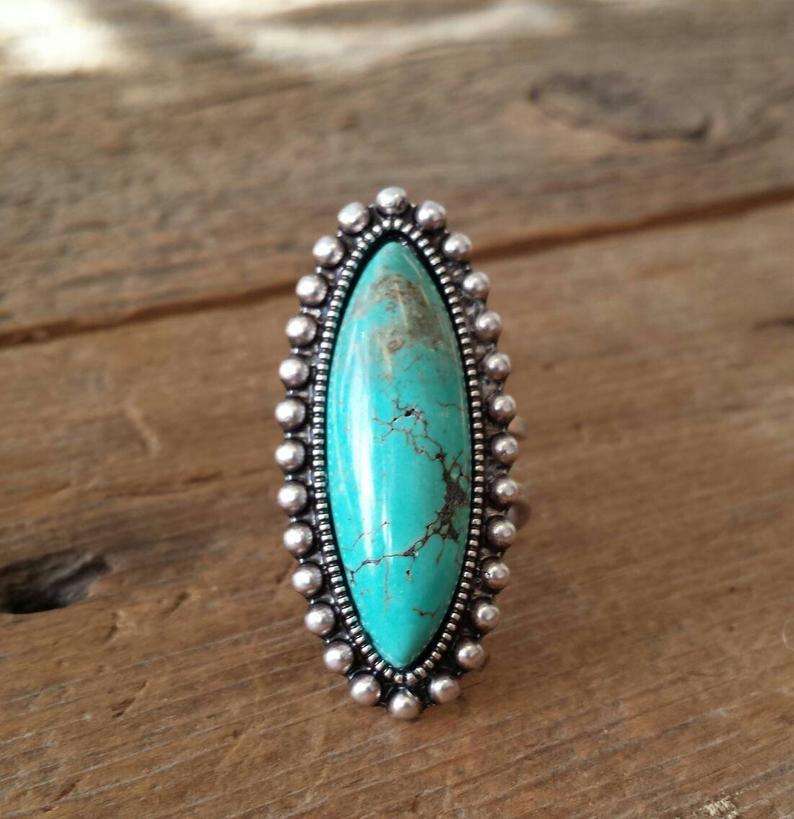
Building a white-shirt-and-jeans outfit around a turquoise-style ring starts at the hand, not at the closet. Watch where the hand rests, which cuff surrounds it, what hardware it meets, and whether the ring is meant to communicate color, a cross motif, or quiet vintage-inspired detail. The rest of the outfit should make that job easier to see and easier to wear.
This guide uses two current Oroxen examples: the Turquoise Vintage Statement Cross Ring and the Turquoise Boho Vintage Ring. Their titles and images describe turquoise-colored, statement, cross, boho, and vintage-inspired styling. They do not independently prove natural turquoise, metal, age, treatment, maker, origin, artisan production, or cultural affiliation.
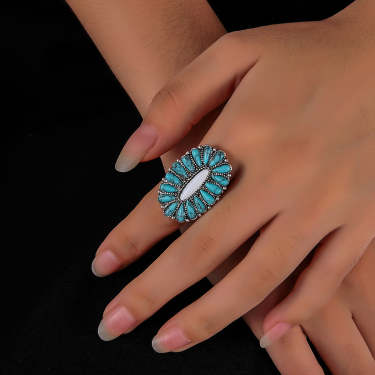
Quick Answer: Build the Outfit in Eight Rings
Imagine eight concentric rings around the product: the jewelry itself, selected finger, working hand, shirt cuff, upper outfit, jeans and belt, shoes and bag, and real activity. Resolve each circle before adding more jewelry.
- Verify the exact product option and facts.
- Measure the intended finger using the seller's system.
- Map dominant-hand tasks and neighboring fingers.
- Choose a cuff shape that clears the ring.
- Keep the shirt front visually quieter than the hand.
- Limit denim hardware and belt competition.
- Select shoes and a bag by function, not forced color matching.
- Test the complete outfit through the intended day.
The public seven-way turquoise ring guide for a black dress starts with one continuous dark field. This article solves a different construction problem: a white cuff, blue denim, buttons, pockets, seams, and hand-level hardware.
Circle One: Make an Exact Ring Record
Save the title, URL, selected option, dated price, current availability, and the photograph that maps to the option. Request numerical ring size or internal circumference, face height and width, band width, profile, total weight, complete components, finish, setting or attachment method, construction, and care.
When a field is absent, record “unresolved.” Adjustable is not a numerical fit specification. Turquoise color does not establish gemstone identity. Vintage can describe appearance rather than age. A close product photograph cannot replace measurements.
Also save current shipping timing, return deadline, condition requirements, and whether trying on or adjusting the product affects eligibility. Do not reshape, squeeze, stretch, expose, or clean a ring during evaluation unless exact instructions and return conditions permit it.
Circle Two: Choose the Finger by Function
The same ring can behave differently on the index, middle, ring, or little finger and on the dominant or non-dominant hand. Consider typing, phone grip, steering, transit rails, bags, tools, doors, pockets, hand washing, gloves, and neighboring fingers.
Measure the intended finger at relevant times and temperatures using an appropriate method, then compare it with the seller's confirmed sizing system. Personal fit varies. A ring that rotates, pinches, strikes the next finger, or catches during routine tasks should not be approved because it looks balanced in a photograph.
For an adjustable design, ask for the supported fit range, starting dimensions, approved adjustment method, and limits. Repeated bending may stress some constructions or finishes. “Adjustable” is permission to ask precise questions, not permission to experiment.
Circle Three: Map the Working Hand
Trace both hands on paper and mark contact zones: neighboring fingers, palm-side grip, knuckles, phone edge, keyboard, desk, bag zipper, pocket opening, steering wheel, and common tools. Add the planned ring face at verified scale.
Choose the hand with the cleaner operating path, unless symbolism or personal preference requires a specific placement. The ring should be considered within real movement, not only against a relaxed hand.
| Hand task | What to observe | Possible outfit response |
|---|---|---|
| Typing and desk work | Hard contact, rotation, neighboring-finger pressure | Use the opposite hand or a verified lower profile |
| Phone and bag | Edge impact, zipper, strap hardware | Move the ring hand or simplify the bag |
| Pockets | Snagging on opening, rivets, or keys | Use a cleaner pocket side |
| Gloves or equipment | Fit, safety, removal, pressure | Remove and store the ring when required |
Circle Four: Design the Shirt Cuff
The cuff is the ring's closest garment frame. Test four options with the same shirt: fully buttoned sleeve, one relaxed button, a single clean roll, and a higher double roll. Do not force a cuff position that the garment cannot hold.
A closed white cuff creates a crisp border but may strike a wide or tall ring face. A rolled sleeve exposes more forearm and creates negative space, but loose fabric can travel downward. Photograph the hand at rest, using a phone, holding a bag, and reaching into a pocket.
Select the cuff that remains stable and leaves the verified ring profile clear. Do not add a bracelet until the ring-and-cuff relationship succeeds through a complete wear test.
Circle Five: Quiet the Shirt Front
A white shirt may already include pearl-like snaps, embroidery, contrast stitching, a Western yoke, patch pockets, a wide collar, or a dramatic placket. Count those features before adding jewelry. The hand-level focal point needs visual space at full-body distance.
Use a full tuck when a clean waist suits the occasion, a half-tuck when a diagonal line helps lead toward the ring hand, or an untucked shirt when the hem is intentionally proportioned. Keep the neckline empty during the first test. A necklace creates a second jewelry center and makes it harder to judge the ring's actual contribution.
The statement-versus-everyday turquoise styling guide helps set the intensity before the shirt details are chosen.
Circle Six: Select Jeans and Belt as a Support System
Dark clean jeans provide a quieter lower field. Pale or distressed denim adds fading, seams, and texture. Neither is automatically better. View the hand where it naturally rests beside the front pocket and thigh.
Check rivets, zipper pulls, keys, belt hardware, and pocket openings. A large buckle can become a second Western focal point, especially with a cross ring. Begin with a plain belt or no visible buckle; add hardware only after the ring remains visually dominant.
Do not force the turquoise-colored area to match the denim wash. Screen color, lighting, finish, and physical fabric vary. Seek a clear relationship rather than an exact blue-green repetition.
Product Blueprint One: Statement Cross Ring
The current Turquoise Vintage Statement Cross Ring page displayed $96.96 USD, two visible color choices, and an Adjustable size label during review. Its visible summary presents turquoise, vintage-inspired, statement styling and notes that screen color may vary.
The visible page did not clearly state a numerical adjustment range, initial internal measurement, face dimensions, band width, profile, total weight, complete components, finish, setting, construction, or option-specific care. Those fields are essential before fitting or reshaping.
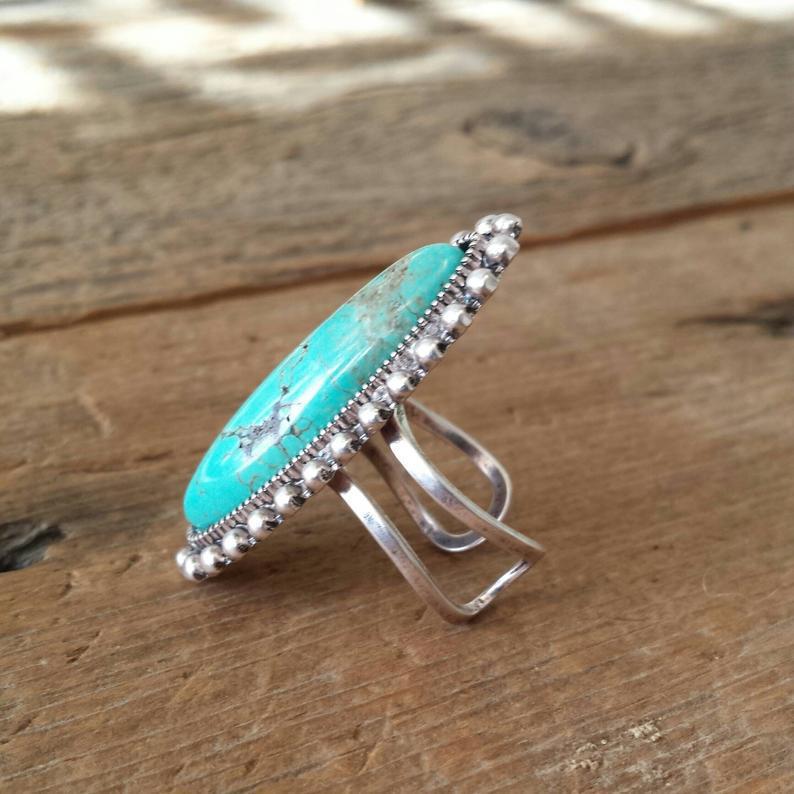
Build Outward from the Motif
A cross is a recognizable symbol, so confirm the wearer wants it and the setting is appropriate. Use a plain white shirt, dark or medium jeans, simple shoes, a quiet bag, and no competing cross or turquoise-colored necklace. Let the ring carry motif and color together.
Questions Before Styling
- Which photograph maps to each visible color choice?
- What numerical finger range is supported?
- How should the ring be adjusted, and how often?
- What are the face size, band, profile, weight, components, finish, setting, and care?
Do not describe the ring as sacred, antique, Native American, Indigenous, tribal, regional, mine-specific, or artisan-made without reliable evidence and appropriate context.
Product Blueprint Two: Boho Vintage-Inspired Ring
The Turquoise Boho Vintage Ring page displayed $77.77 USD and one visible color selection during review. Its visible summary emphasizes turquoise, boho, vintage-inspired styling and asks shoppers to review images and the selected option.
The visible page did not clearly state a numerical size selector, internal measurement, adjustability, face dimensions, band width, profile, weight, components, finish, setting, construction, or care. A shopper should not infer fit from an image or another ring.
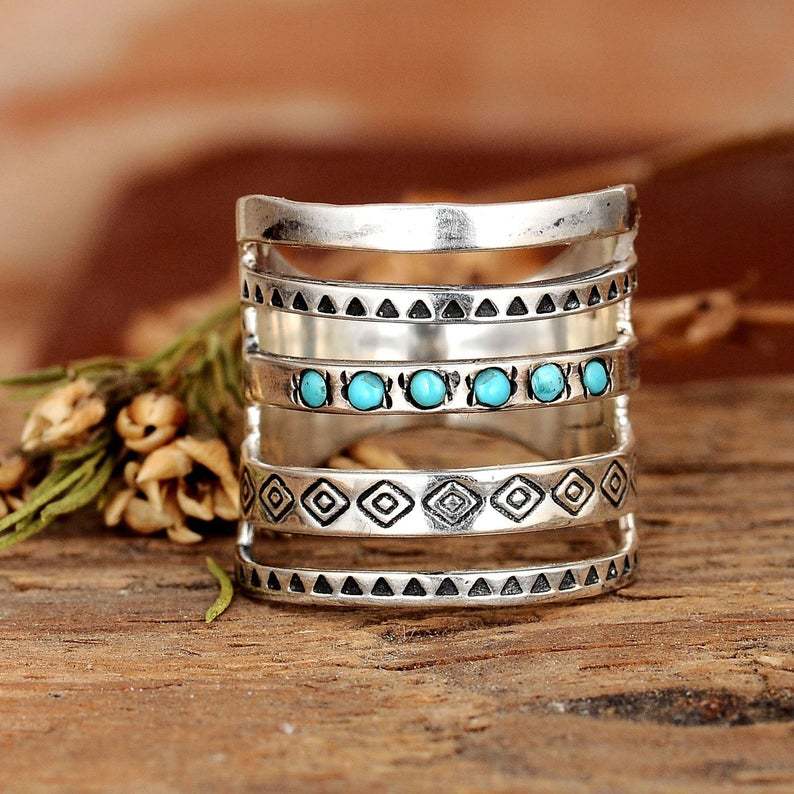
Build Outward from Surface Detail
Use a softly rolled white sleeve, mid-wash jeans, simple boots or shoes, and no bracelet on the same wrist. If the verified ring proves visually moderate, one small face-level accent may be tested later. Do not create a complete “boho set” before the single ring succeeds.
Questions Before Styling
- What size or interior measurement is supplied?
- Is any adjustment intended, and what method is approved?
- What are the full dimensions, weight, components, finish, attachment method, and care?
- What does one order include, and which image represents it?
Circle Seven: Choose Shoes and Bag by Function
Boots are optional. Select footwear for walking distance, weather, dress code, and comfort. A plain sneaker, loafer, ankle boot, or other appropriate shoe can support the ring without repeating its color.
Choose a bag whose zipper, studs, buckle, chain, and strap do not repeatedly meet the ring hand. Rehearse opening, closing, carrying, and setting down the bag. A beautiful ring-and-shirt photograph does not compensate for constant hardware impact.
If the bag already carries strong Western detail, reduce belt and shoe motifs. The ring should not compete with three distant accessories for the same role.
Circle Eight: Run the Complete Day
Write the day as verbs: dress, commute, work, eat, wash hands, carry, drive, layer, remove, and store. Test the ring's operating path through each verb within current care and return rules. Remove it for any activity involving machinery, tools, clinical hygiene, food preparation, chemicals, lifting, sports, or gloves when required.
Plan a safe parking place before removal. Use a separate protected pouch or container compatible with documented care—not a sink edge, loose pocket, desk surface, or bag bottom.
After wear, photograph the ring and score fit, rotation, neighboring-finger pressure, hard contact, snagging, visual hierarchy, care burden, and desire to repeat. One successful photograph is weaker evidence than three comfortable voluntary wears.
Video Context: Keep Cultural Examples Separate
The supplemental video is Turquoise in Rings by Turquoise in America. At review, YouTube showed an approximately 30-second video with no closed captions. Its visible description discusses turquoise set in handmade American Indian jewelry from the Southwest.
The video does not document either Oroxen ring. Its examples cannot verify these products' turquoise-colored areas, components, maker, origin, cultural affiliation, treatment, construction, or value. Do not transfer provenance from visually similar jewelry.
Use the source only as contextual viewing, inspect it directly, and verify broad historical or cultural claims with authoritative references before reuse. Product-specific styling in this guide remains grounded in the live listings and explicitly identified gaps.
Common Construction Mistakes
- Starting with boots and belt. Start with the ring hand and work outward.
- Calling adjustable a size. Request a numerical range and approved method.
- Using color as material proof. Obtain option-specific disclosure.
- Adding a necklace immediately. Keep the neckline quiet until the ring role is clear.
- Ignoring cuff movement. Test closed and rolled sleeves through real tasks.
- Matching every blue-green item. Let one colored zone lead.
- Forgetting bag hardware. Test the exact bag and ring hand.
- Reshaping during a return trial. Follow seller instructions and conditions.
For a layer-specific extension, use the published turquoise jewelry with a denim jacket guide after the shirt-and-ring baseline succeeds.
Create Three Final Outfit Blueprints
Blueprint A: Cross as the Only Motif
Verified cross ring, buttoned white cuff with confirmed clearance, dark jeans, plain belt, simple shoes, quiet bag, no necklace, and minimal earrings.
Blueprint B: Color and Texture
Verified boho vintage-inspired ring, one stable sleeve roll, mid-wash jeans, no bracelet on the same arm, simple footwear, and a bag without hand-level hardware.
Blueprint C: Layered Transition
Either verified ring, white shirt, jeans, and a neutral or denim jacket. Re-run cuff, pocket, zipper, bag, and removal tests. Keep one strong jewelry zone.
Frequently Asked Questions
Can anyone wear turquoise-style rings with a white shirt and jeans?
Merchandising labels do not restrict the wearer. Choose according to fit, activity, symbolism, personal preference, and documented product facts.
Which hand is best?
The best hand is the one compatible with personal meaning, fit, dominant-hand tasks, equipment, pockets, phone, bag, and neighboring fingers.
Should an adjustable ring fit every finger?
No. Ask for the numerical range, starting measurement, approved adjustment method, and limits. Anatomy and comfort vary.
Do turquoise-colored rings need matching earrings?
No. Establish the ring as leader first. Add another zone only when scale, spacing, components, care, and the complete outfit support it.
Can these rings be worn to work?
Only when dress rules, fit, profile, equipment, safety, hygiene, tasks, symbolism, and removal storage are compatible. Some settings require no ring.
What if the page lacks ring measurements?
Keep fit unresolved and ask the seller. Do not estimate from photographs or a different product. Consider another option when evidence is insufficient.
Final Build Checklist
- Document exact option, size, dimensions, profile, weight, components, finish, construction, and care.
- Select the finger and hand by real tasks.
- Choose a stable cuff that clears the ring.
- Quiet the shirt front, denim hardware, belt, shoes, and bag.
- Let color or cross motif lead—one clear job.
- Test the complete day and plan safe removal storage.
- Repeat the winning formula three times before adding jewelry.
Browse current silhouettes in the Western Rings collection, explore broader options in Western Jewelry, or return to Oroxen for live store and product information. A strong outfit is built from the ring outward, one verified circle at a time.