How to Build a Rodeo Outfit Around Western Turquoise Jewelry
Building a rodeo outfit around jewelry reverses the usual order. Instead of finishing a shirt, denim, boots, hat, belt, and bag and then adding every accessory that still fits, begin with one verified jewelry object. Give it a clear visual window, construct the garment lines around that window, and protect one quiet area so the look can breathe.
This guide uses an outfit architecture with five parts: the ground plane, waist line, torso column, jewelry window, and quiet boundary. The ground plane covers footwear and walking. The waist line controls belt and buckle activity. The torso column joins shirt, jacket, and necklace. The jewelry window gives the focal piece contrast and space. The quiet boundary stops hats, earrings, bags, and extra motifs from becoming another building on the same small lot.
Quick Blueprint: One Anchor, One Echo, One Quiet Boundary
Select one anchor: necklace, earrings, bracelet, ring, hat, or buckle. Add one echo that repeats a single feature—color family, line direction, shape, or surface contrast—without copying the entire anchor. Then designate one quiet boundary next to the focal area. If the necklace anchors the torso, the quiet boundary might be an unembroidered neckline and restrained earrings. If cow-skull earrings anchor the face, the boundary might be a simple hat band and an open collar.
Write the anchor's product facts before styling: exact option, included quantity, dimensions, projection, mass, attachment, materials, treatment, metal, finish, construction, care, and return conditions. Use “not stated” for every gap. Turquoise-style and turquoise-colored are appearance phrases, not proof of natural turquoise. Antique-silver color is not proof of silver content. Vintage-inspired does not establish age.
The published complete western turquoise jewelry guide provides a wider buying framework. The published cowgirl jewelry style guide helps compare accessory categories before assigning the anchor role.
Part One: Survey the Site Before Building
An outfit must work in a specific place. Confirm the current event or venue rules for bags, prohibited items, security screening, footwear, seating, weather exposure, re-entry, and activities. “Rodeo outfit” can describe spectator clothing, a themed social event, photography, travel, or participation. Jewelry that is reasonable for seated viewing may be inappropriate around animals, gates, ropes, tack, tools, machinery, food service, sport, or work.
Record the schedule: arrival, walking distance, indoor or outdoor sections, daylight, temperature shift, rain or dust exposure, seating, meal, photographs, and departure. This is the site survey. It tells you whether a necklace needs an outerwear plan, whether earrings may meet hearing protection, whether a bag strap crosses the pendant, and where removed jewelry can be stored.
Do not use styling to negotiate with a safety rule. If an activity prohibits jewelry or creates snagging, impact, compression, or entanglement risk, remove the item before the activity and store it securely. The outfit remains successful when the wearer can move safely and follow the rules.
Part Two: Lay the Ground Plane
Choose footwear and lower garments before finalizing the upper focal point. Walk, turn, use stairs, sit, and stand in the exact boots or shoes. Confirm that hems do not catch heels and that pockets, belt loops, and hardware function. A stable ground plane allows the torso and jewelry to remain visually deliberate instead of compensating for discomfort.
Decide whether the lower half is quiet, textured, or motif-heavy:
- Quiet ground: simple denim, dark trousers, or an uncluttered skirt lets necklace or earrings lead.
- Textured ground: worn denim, suede-like texture, or visible boot detail can support a small upper accent.
- Motif ground: embroidery, fringe, contrast stitching, and decorated boots already create a focal field; upper jewelry should be edited more strictly.
These are visual categories, not material claims. Verify garment composition and care separately. Photograph the lower half from ordinary viewing distance. If it already contains several hard edges, bright contrasts, and symbols, mark the jewelry window for fewer elements.
Part Three: Draw the Waist Line
The belt and buckle divide the outfit and can become the strongest graphic element. Put them on before choosing necklace length or earring scale. Check where the buckle sits when standing and seated, whether a shirt is tucked, and how the belt interacts with a jacket, vest, bag, and hands.
If the buckle leads, the jewelry should echo only one feature. A teardrop pendant might repeat a vertical direction without duplicating the buckle's motif. A small blue-green accent can connect colors while the buckle remains dominant. If the jewelry leads, reduce buckle contrast or choose a belt treatment that supports the torso column rather than competing with it.
Test the hand route: fasten the belt, use pockets, hold the bag, sit, and stand. Earrings and necklaces are not physically at the waist, but their visual relationship changes when a large buckle appears below them. Take a full-length photograph. A close product image cannot reveal whether the two focal objects divide the viewer's attention.
Part Four: Build the Torso Column
The torso column includes shirt opening, collar, placket, embroidery, scarf, vest, jacket, bag strap, and necklace path. Build one continuous route from neck to waist. A teardrop shape can reinforce a vertical route, while a wide neckline can give it a framed field. A closed high collar, necktie, dense yoke, or crossed strap may interrupt that route.
Use the actual necklace dimensions, not a generic necklace-length chart. Record chain or cord length, extension, pendant height and width, bail dimensions, total mass, closure, and whether the pendant moves freely. Then test the necklace with the exact neckline while standing and seated. Note whether it falls on skin, fabric, a button, embroidery, seam, or jacket edge.
A layering plan requires evidence for each item. Confirm that chains, cords, pendants, finishes, and closures can share space without tangling or rubbing. “Wear it with simpler necklaces” is a styling suggestion, not a statement that every material combination is contact-compatible. When construction or care is unknown, wearing the focal necklace alone is the more controlled choice.
Three torso-column options
Open column: a plain shirt or dress creates uninterrupted contrast behind the necklace. Keep the bag strap away from the pendant route.
Framed column: a jacket or vest forms two vertical edges around the pendant without striking it. Verify the pendant's projection and the garment's closure path.
Broken column: a scarf, decorative placket, dense embroidery, or crossed strap intentionally takes over. In this version, omit the necklace or choose a verified quieter piece and move the anchor to the ears.
Part Five: Cut the Jewelry Window
The jewelry window is the visible background immediately around the anchor. Its size comes from the anchor's verified dimensions plus movement clearance. Its contrast comes from garment color, texture, and line. Its boundaries come from collar, hair, hat, jacket, and bag.
For a necklace, photograph the upper torso with the pendant centered, slightly off center from normal movement, and under the evening layer. For earrings, photograph front and side views with the planned hat and hair. The window should still make sense when the wearer turns, sits, or adds outerwear.
Do not expand the window by assigning unsupported qualities. A blue-green center may provide a visible color accent, but it does not prove turquoise mineral content. A darkened silver-colored surface may support a vintage-inspired palette, but it does not establish silver, patina, age, or hand finishing. Styling uses the observed appearance; product claims require documentation.
Part Six: Protect the Quiet Boundary
The quiet boundary is an intentionally restrained zone beside the anchor. It prevents the outfit from becoming a catalog of motifs. If a pendant leads, consider plain earrings, a simple hat band, and an unstacked wrist. If cow-skull earrings lead, leave the necklace area open and use a quieter buckle or bracelet.
“Quiet” does not mean invisible or generic. Texture, stitching, denim wash, leather-colored accessories, or a tonal garment can support the anchor without introducing another turquoise-colored center, cross, heart, floral cluster, concho-like shape, skull, fringe group, and engraved buckle at once.
Use a deletion pass. Photograph the complete outfit, remove one accessory, and photograph again from the same position. If the anchor becomes easier to read and the outfit loses no function, the removed item was probably competing. Repeat until every remaining piece has a written job.
Product Study One: Turquoise Western Teardrop Pendant Necklace
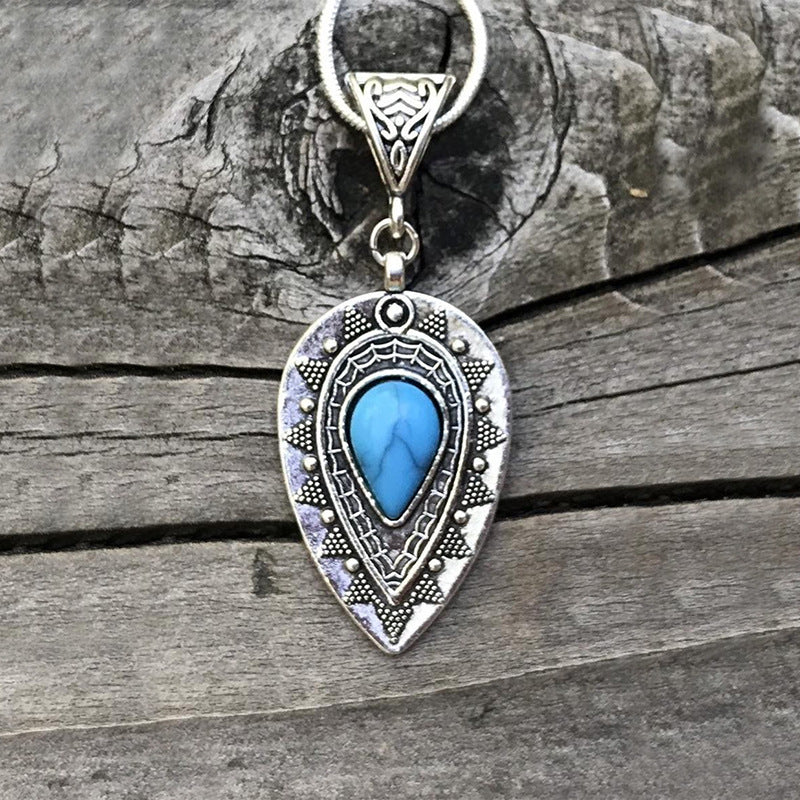
The Turquoise Western Teardrop Pendant Necklace page was reviewed on August 24, 2026. It displayed $39.99 USD, one visible Color choice, and eleven numbered gallery images. Current copy describes a turquoise-style center stone, teardrop silhouette, antique-silver color, and vintage-inspired detailing. It suggests wearing the necklace alone as a focal point or layering it with simpler necklaces.
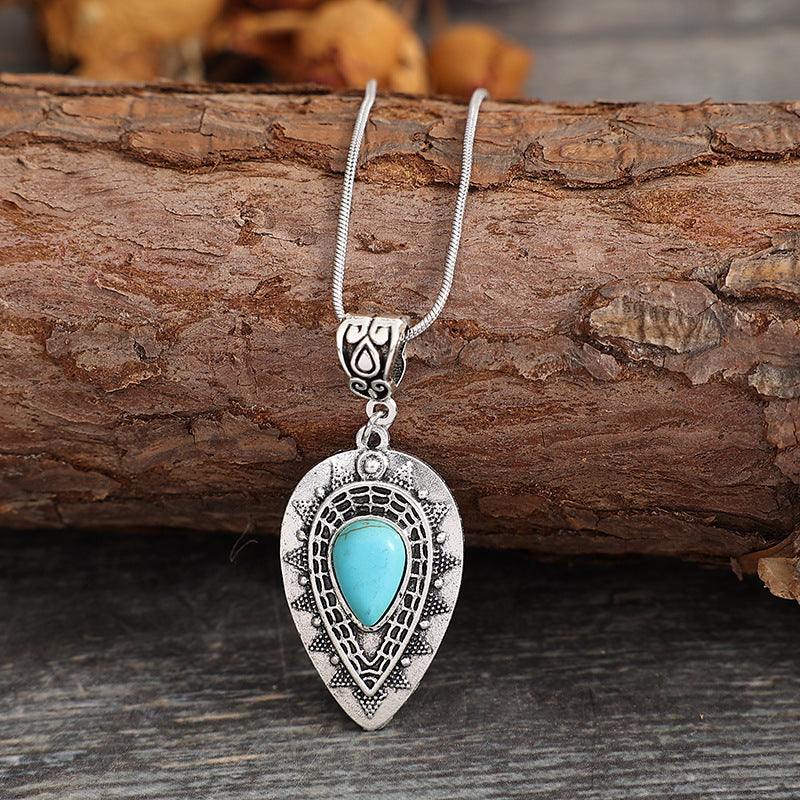
The phrases are precise appearance cues. Turquoise-style does not establish natural turquoise. Antique-silver color does not prove silver content. Vintage-inspired does not prove age. The visible information reviewed did not state chain or cord length, extension, pendant dimensions, projection, mass, closure, center material, treatment, metal composition, coating, setting, backing, adhesive, assembly, skin-contact materials, or complete care.
Necklace-first outfit blueprint
- Request the complete dimensions, length range, mass, closure, all materials, finish, construction, and care.
- Choose a neckline that gives the verified pendant a visible border without placing it on buttons, seams, or dense embroidery.
- Use simple denim or another controlled lower plane so the teardrop creates the main vertical cue.
- Keep the hat band and earrings quiet unless one small echo improves the color route.
- Test the jacket and bag strap after the necklace position is set.
- Carry a separate necklace compartment for safe removal.
Do not select a longer or shorter chain by guesswork, attach an unverified extender, or assume the supplied closure can support another pendant. Ask how the exact necklace is intended to be worn and whether alterations affect the current return or care terms.
Product Study Two: Western Turquoise Boho Vintage Cow Skull Earrings
The Western Turquoise Boho Vintage Cow Skull Earrings page was checked on August 24, 2026. It displayed $141.40 USD, four choices labeled Design 1 through Design 4 under a visible Size heading, and sixteen numbered gallery images. Current copy describes western, turquoise, and boho details for everyday, western-inspired, occasion, and gifting contexts.
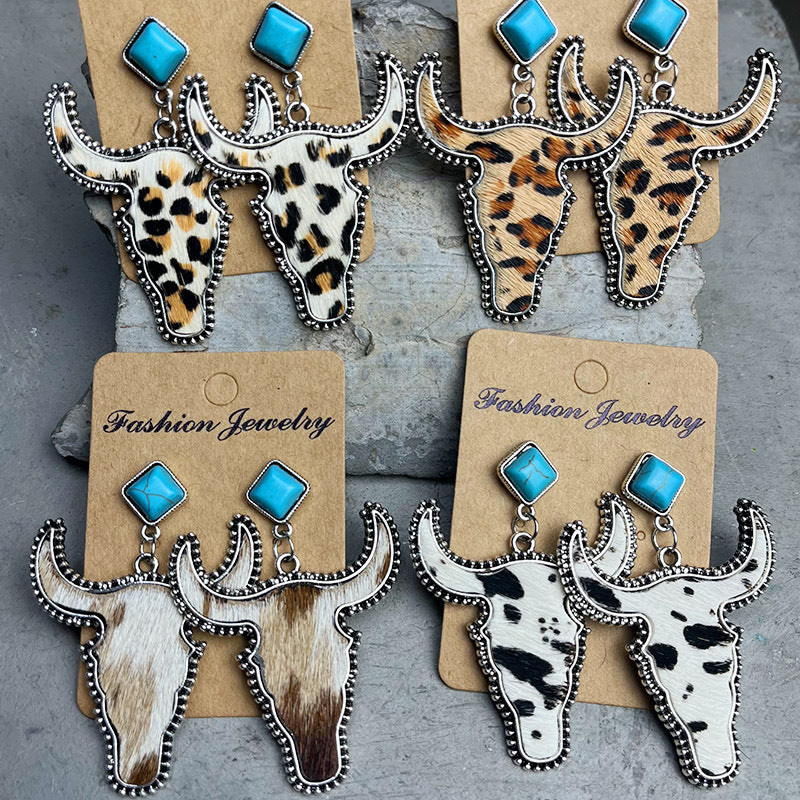
The Design labels must be matched to the gallery before purchase. The visible page state did not establish whether the Size heading is simply the option-group label, the included count, natural turquoise, exact decorative materials, dimensions, projection, per-earring mass, attachment, backing, metal composition, coatings, setting, adhesive, skin-contact parts, care, origin, artist, handmade construction, or age.
A cow-skull motif can be a strong face-level anchor. The wearer decides whether its symbolism is personally appropriate. The motif does not prove cultural origin or maker. Build the quiet boundary with a simple neckline and controlled hat treatment. If the earrings lead, omit the pendant or use a verified minimal necklace that does not create a second focal window.
Earring-first outfit blueprint
- Select the exact Design and save the matching front, side, and back images.
- Request included quantity, dimensions, projection, per-earring mass, attachment, backing, all materials, finish, construction, and care.
- Put on the planned hat, hair, glasses, hearing protection, collar, and jacket.
- Turn the head and remove the hat while checking clearance.
- Keep the torso column quieter and let one belt or wrist detail provide the echo.
- Prepare a labeled two-position compartment so the pair cannot tangle or rub if removed.
Use the Turquoise Jewelry Collection as a Materials-Neutral Shortlist
The Turquoise Jewelry collection can help compare visible silhouettes across earrings, necklaces, bracelets, and rings. It is not evidence that every item uses the same decorative material, metal, finish, size, or care method. Open the exact product page and create a specification card before moving a candidate into the outfit architecture.
Compare how much information each listing provides. Useful fields include option mapping, included quantity, dimensions, mass, attachment, closure, material, treatment, metal, coating, construction, care, delivery, and return eligibility. A missing field is not a negative product claim; it is a decision question. Do not fill the blank from another product in the same collection.
How to Use the Statement-Necklace Video Responsibly
Fashion World's YouTube video “20 Styles to Wear Statement Necklaces With Western Outfit” is approximately twenty-one seconds long. Its visible description presents the video as a source of twenty or more ideas for wearing statement necklaces with western outfits. YouTube indicated that subtitles or closed captions were unavailable, and no transcript was available for export when reviewed.
Treat the video as a fast visual mood board. Pause on a composition and identify only visible relationships: neckline shape, necklace area, garment contrast, vertical or horizontal emphasis, number of focal zones, and use of empty space. Do not assume the pictured products share the Oroxen necklace's length, mass, construction, material, care, or scale.
The short video does not establish a universal rule, product endorsement, event safety plan, or a care method. It also does not inspect the two Oroxen examples. Translate an idea into a question—“Does my pendant clear this collar?”—then answer with the exact product dimensions and a full-outfit rehearsal.
Three Complete Rodeo-Outfit Architectures
Architecture A: Pendant tower
Use a quiet denim ground, restrained belt, open or clean neckline, and the verified teardrop necklace as the vertical anchor. Keep earrings small and documented, or omit them. Use the hat as a frame rather than another motif display. The quiet boundary surrounds the collar and ears.
Architecture B: Face-level emblem
Choose one verified cow-skull earring Design and build the hat and hair around its clearance. Keep the torso column open, avoid another statement pendant, and let a simple belt or one wrist accent echo color or metal appearance. The quiet boundary lies between ear and waist.
Architecture C: Two separated markers
Use a smaller verified earring option and the teardrop necklace only if the two windows remain distinct and the hat, collar, and bag do not cross them. Simplify the buckle, wrist, and garment motifs. This version requires the most measurement because two pieces can divide attention and create more contact routes.
Common Construction Errors
- No site survey: the jewelry is selected before venue, activity, weather, and bag rules are known.
- Two anchors: a large buckle and strong necklace compete on the same vertical line.
- No quiet boundary: turquoise-related color and western motifs appear at every level.
- Generic length: necklace placement is planned from a chart rather than the exact chain, pendant, neckline, and wearer.
- Unmapped Design: an earring option is ordered without matching the label to its gallery image.
- Material transfer: facts from a video, collection, or another product are copied into the selected product record.
- Layering by slogan: necklaces are combined without checking tangling, contact, finish, mass, closure, and care.
- No exit route: removed jewelry has no dedicated compartment or count.
Full-Outfit Commissioning Test
Commission the outfit as if checking a finished structure. Dress completely, including underlayers, hat, hair, glasses, hearing protection, belt, boots, outerwear, bag, and jewelry. Photograph front, back, both sides, seated, and with the evening layer. Walk, turn, reach, use pockets, fasten the belt, handle the phone, sit, and remove the hat.
Look for contact, not merely appearance: pendant on button, chain under collar, earring against hat cord, bag strap over jewelry, buckle striking a pendant, hair catching an edge, or a backing becoming inaccessible. Stop when a piece catches, presses, pulls, rotates dangerously, or requires force. Change the architecture rather than improvising adhesive, stronger hardware, a bent component, or an unknown extender.
Before departure, count and photograph the jewelry. Carry separate supported compartments. If the event includes a country-music performance or similar crowd conditions, the published country concert jewelry guide offers additional bag, seating, outerwear, hearing-protection, and removal planning.
Frequently Asked Questions
Should the necklace or buckle be the main focal point?
Choose one after seeing the full-length outfit. If both are large, high-contrast, or motif-heavy, reduce one. A necklace usually benefits from a clean torso column; a dominant buckle benefits from a quieter upper field.
Can the teardrop necklace be layered?
The current page suggests layering with simpler necklaces, but a safe exact combination still requires lengths, mass, closures, materials, finishes, contact behavior, and care. Do not assume every chain or cord can share space.
Does antique-silver color mean the necklace is silver?
No. It describes visible color. Request the metal composition, coating, finish, and skin-contact materials for the selected option.
Which cow-skull earring Design should I choose?
Match each Design label to the gallery, then compare verified dimensions, projection, per-earring mass, attachment, backing, and the planned hat and neckline. Do not select by thumbnail alone.
Can the necklace and earrings be worn together?
Possibly, but first assign one anchor and one echo, verify both pieces, and test the two jewelry windows in the complete outfit. If the motifs, scale, or contact routes compete, wear one.
Where should I compare more western jewelry?
Browse the Western Jewelry collection and the more focused Turquoise Jewelry collection. Treat each product page as an independent record.
Final Outfit-Architecture Checklist
- The event, activity, weather, bag, seating, and jewelry rules are confirmed.
- One anchor, one echo, and one quiet boundary are named.
- The ground plane, waist line, torso column, and jewelry window work as a single composition.
- The exact product option, gallery match, dimensions, mass, attachment, materials, care, and return terms are recorded.
- Turquoise-style, antique-silver color, and vintage-inspired language remain appearance descriptions.
- The hat, hair, neckline, jacket, buckle, bag, and jewelry clear one another during movement.
- The YouTube video supplies ideas only; it supplies no facts about the Oroxen products.
- Every piece has a separate removal compartment and a before-and-after count.
Conclusion: Build Space Around the Jewelry
A jewelry-first rodeo outfit succeeds when the clothes make a clear place for the anchor. Survey the venue, stabilize the ground plane, control the buckle, draw a clean torso column, cut a measured jewelry window, and defend one quiet boundary. The process creates stronger visual hierarchy while revealing fit, contact, and evidence gaps before the event.
Explore current options in the Turquoise Jewelry collection, compare the broader Western Jewelry collection, or return to the Oroxen homepage. Verify the exact piece, then build the outfit around what is known rather than what the photograph seems to promise.