Delicate Turquoise Jewelry Styling Mistakes to Avoid with a Rodeo Outfit
A rodeo outfit does not remain still. A hat is adjusted, hair moves, sleeves travel up and down, hands meet gates and seats, a bag crosses the body, and outerwear may be added after sunset. Jewelry that looks delicate in a flat photograph can disappear visually, catch on a moving layer, compete with several western motifs, or become uncomfortable when the wearer starts using the outfit.
The most useful styling tool is therefore a motion-route map. It follows four routes: brim to ear, sleeve to wrist, belt to hand, and entrance to exit. Each route identifies what can collide, what should lead visually, what must be measured, and where a safe removal plan is needed. It also keeps appearance language separate from material claims: turquoise-colored, turquoise-style, natural turquoise, treated turquoise, composite material, glass, resin, and another decorative component are not interchangeable.
Quick Answer: Give Every Piece a Job and a Clear Travel Lane
Choose one primary visual job—frame the face, mark the wrist, or support another focal element. Let the remaining jewelry stay quieter. Then test the complete outfit through the motions that will actually occur: put on and remove the hat, turn the head, lift both arms, fasten the belt, use a phone, sit in a narrow seat, add a jacket, carry the allowed bag, and remove jewelry into a prepared case.
Do not call a piece delicate without dimensions, projection, mass, attachment, and fit information. Do not force an open cuff smaller, use an unknown earring backing, or assign a cleaning method from color. Do not stack every western motif merely because each item works alone. A rodeo look reads more clearly when one line leads and every contact point has space.
The published cowgirl jewelry style guide provides a broader category map. The published western turquoise jewelry buying guide explains why visible blue-green styling cannot establish mineral, metal, treatment, or origin.
Mistake One: Treating “Delicate” as a Product Fact
Delicate is a relationship, not a measurable specification. A bracelet may look narrow relative to a hand in one photograph yet occupy a large visual area when four pieces are stacked. A stud assortment may appear compact, but one option can be wider, heavier, more projecting, or more motif-dense than another. A pale color does not make an item physically light, smooth, flexible, or suitable for long wear.
Replace the adjective with a measurement card. Record total height, width, depth or projection, mass, attachment, contact points, adjustment design, and the amount of open space around the piece. For a set, record those facts for every component and the exact included count. For earrings, record per-earring mass rather than an unexplained pair mass. For cuffs, record internal opening, wrist range, band width, thickness, end shape, and whether the manufacturer intends adjustment.
Only after the facts are known should the stylist decide whether the piece behaves delicately in this outfit. A small earring can still conflict with a hat band or hearing protection. A thin-looking cuff can still strike a watch, squeeze a sleeve, or rotate into a wrist bone. “Visually quiet” and “physically low-interference” are separate tests.
Mistake Two: Skipping the Brim-to-Ear Route
Start at the hat. Put on the exact hat with the planned hairstyle, hat band, pins, scarf, and outer layer. Move the brim through the path used to lift, tilt, or remove it. Turn the head in both directions. Check whether hair, chin cords, glasses, ear protection, collar points, and earrings share the same space.
A stud can be a useful face-level accent because it does not automatically introduce a long swinging line. That does not mean every stud is snag-free. The front may project, edges may catch hair, a post may be long, and the backing may press behind the ear. The page must identify the selected design, included quantity, dimensions, per-earring mass, post or attachment, backing, materials, and care before the buyer can make a dependable comfort plan.
The common styling error is to add earrings after the hat look is already busy. A decorative hat band, large buckle, embroidered yoke, scarf, and multi-shape earring set can divide the face area into too many competing signals. Choose one lead around the face: hat treatment or earrings. The supporting element may echo a color without repeating every motif.
Better face-route test
- Photograph the outfit from front, three-quarter, and side views.
- Check the earring against the hat at ordinary head angles, not only a straight pose.
- Verify that the backing remains accessible for removal.
- Keep an individual compartment ready if earrings must come off.
- Do not place loose earrings in a pocket, cup holder, handbag floor, or shared cosmetic pouch.
Mistake Three: Building the Wrist Stack Before Mapping the Sleeve
The wrist route begins with the shirt and jacket, not the bracelet. Wear the exact sleeve, cuff button, fringe, embroidery, glove, watch, and bag strap. Bend the wrist, use a phone, reach overhead, sit, and rest the forearm on a surface. Observe where fabric compresses, where hardware meets jewelry, and whether the wearer can remove the bracelet without forcing it.
An open cuff set offers several styling modes: one cuff as a small color marker, two pieces with controlled spacing, or a coordinated stack. But a photographed set is not permission to compress all components into the same narrow area. The pieces may rub one another, rotate, overlap, or meet a watch. Their materials and finishes may not tolerate the same contact or care.
Use a wrist-zone drawing with three bands: hand side, center, and forearm side. Assign each verified component to a zone only if its dimensions and fit allow it. Leave an empty buffer between jewelry and a watch, sleeve hardware, or another cuff unless the product instructions support contact. Empty space is part of the composition, not a failure to accessorize.
Mistake Four: Forcing an Open Cuff to Make It “Delicate”
Repeatedly squeezing or opening an unknown cuff can weaken, distort, crack, detach, or alter components. A buyer cannot infer adjustability from an opening in a photograph. Ask for the internal dimensions, intended wrist range, material, construction, whether adjustment is allowed, the safe method, and the expected frequency. If the instructions do not support adjustment, do not reshape it.
Fit should allow ordinary circulation and movement without sliding into the hand or catching a sleeve. Skin marks, numbness, tingling, pinching, sharp edges, or a cuff that cannot be removed normally are stop signals. This article cannot determine medical suitability. People with circulation, swelling, skin, or sensory concerns should follow appropriate professional advice.
A stylist can make a cuff look lighter by reducing neighboring visual weight: wear one component, expose some wrist, simplify the sleeve, or move the focal point away from the belt. That is safer than physically changing an unidentified product to imitate a delicate silhouette.
Mistake Five: Matching Every Turquoise-Colored Detail
A coordinated rodeo outfit does not require an exact blue-green match across earrings, bracelets, belt buckle, boots, hat band, bag, and clothing. Screens, photography, lighting, finish, treatment, surface texture, and actual materials can make colors differ. Trying to force a perfect match often produces a costume-like block of repeated color and obscures the silhouette of each piece.
Choose one color role instead:
- Marker: one small blue-green accent appears near the face or wrist.
- Bridge: two separated accents connect the upper and lower outfit.
- Field: one larger jewelry area becomes the dominant color story.
- Contrast: blue-green appears once against denim, black, cream, brown, or another garment color.
The mistake is using all four roles at once. Pick one and photograph the complete outfit in daylight and the likely venue lighting. A camera is a composition check, not a material or color guarantee.
Mistake Six: Repeating Motifs Without a Hierarchy
Western-inspired products may include floral, geometric, cross, heart, concho-like, rope-like, or other decorative language. The wearer decides which symbols are personally appropriate. A product title or visual resemblance does not establish tribal affiliation, artist, handmade construction, age, or cultural provenance.
Use a motif ledger. Write every visible motif in the hat, shirt, belt, boots, bag, and jewelry. Circle one leader, underline one supporting family, and cross out repetitions that add no new function. For example, a floral earring can support embroidered flowers while the bracelet remains geometric. A strong buckle can lead while the wrist uses a single quiet cuff. The goal is a readable relationship, not total matching.
The published country concert jewelry guide also covers movement, outerwear, bag constraints, hearing protection, and a removal plan that can apply to crowded rodeo-adjacent events when the actual venue rules are checked.
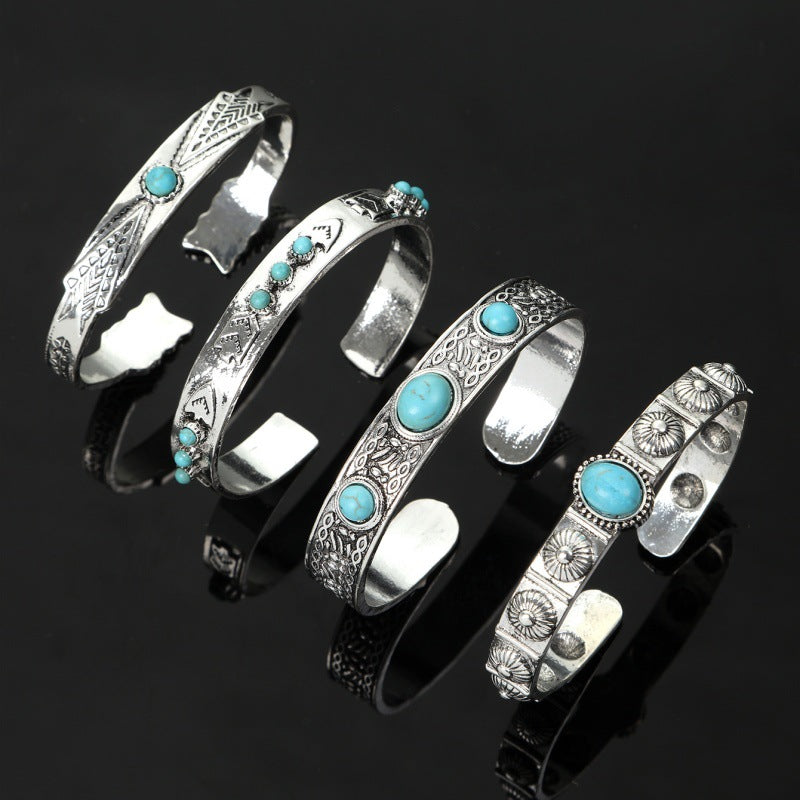
Product Study One: Turquoise Western Cuff Bracelet Set
The Turquoise Western Cuff Bracelet Set page was reviewed on August 24, 2026. It displayed $34.99 USD, a checked 4Set option, and ten numbered product-image positions. Current copy says the set contains four open cuff bracelets with turquoise-colored accents and varied vintage-inspired motifs and says they may be worn together or individually.
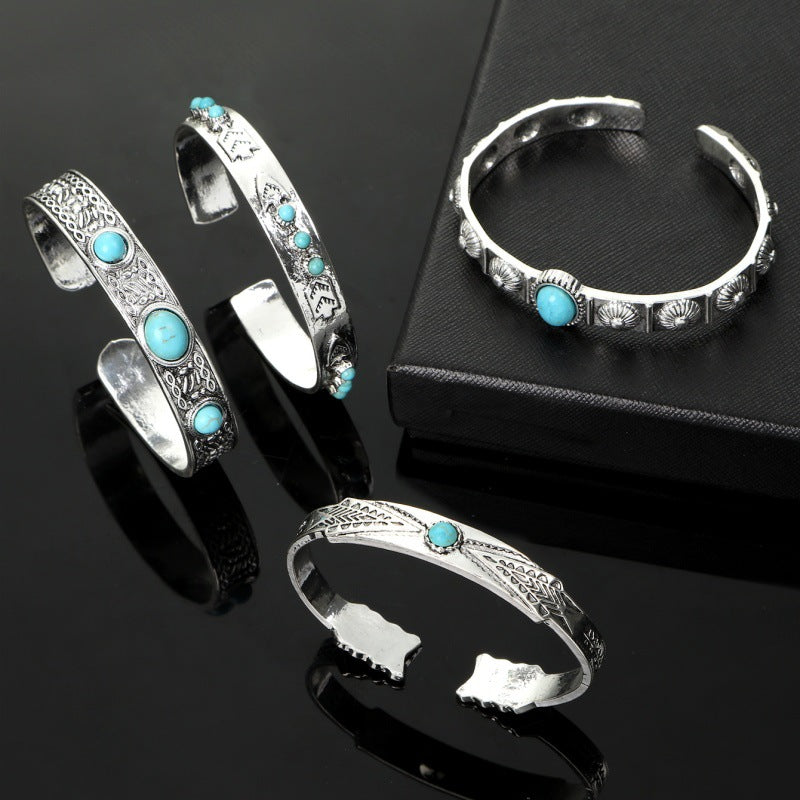
The wording “turquoise-colored” is important: it describes appearance and does not establish natural turquoise. “Vintage-inspired” does not prove age. The visible information reviewed did not state wrist dimensions, individual cuff measurements, mass, all materials, metal composition, coatings, skin-contact materials, exact motif-to-piece mapping, construction, safe adjustment method, care, or whether every photographed arrangement is included.
Three controlled styling modes
Single-marker mode: choose one verified cuff and leave the wrist otherwise clear. This can support a decorative hat or earrings without creating another focal cluster.
Two-point mode: select two components with compatible fit and leave a visible buffer. Do not assume that different cuffs may rub safely because they were sold as one set.
Full-set mode: use all four only after fit, dimensions, contact, sleeve clearance, finish compatibility, and removal have been checked. Keep the other hand and face area quieter. Photograph the stack with the belt and bag to see whether the lower half has become overloaded.
Before purchase, ask for the internal opening and diameter of each cuff, intended wrist range, material, coating, adjustment instructions, edge profile, total and individual mass, complete included count, care, and how try-on or adjustment affects the current return policy.
Product Study Two: Turquoise Western Stud Earring Set
The Turquoise Western Stud Earring Set page was checked on August 24, 2026. It displayed $29.99 USD, one visible Color choice, and nine numbered gallery positions. Current lower-page copy describes a coordinated turquoise-style stud assortment with floral, geometric, and classic shapes for styling and gifting.
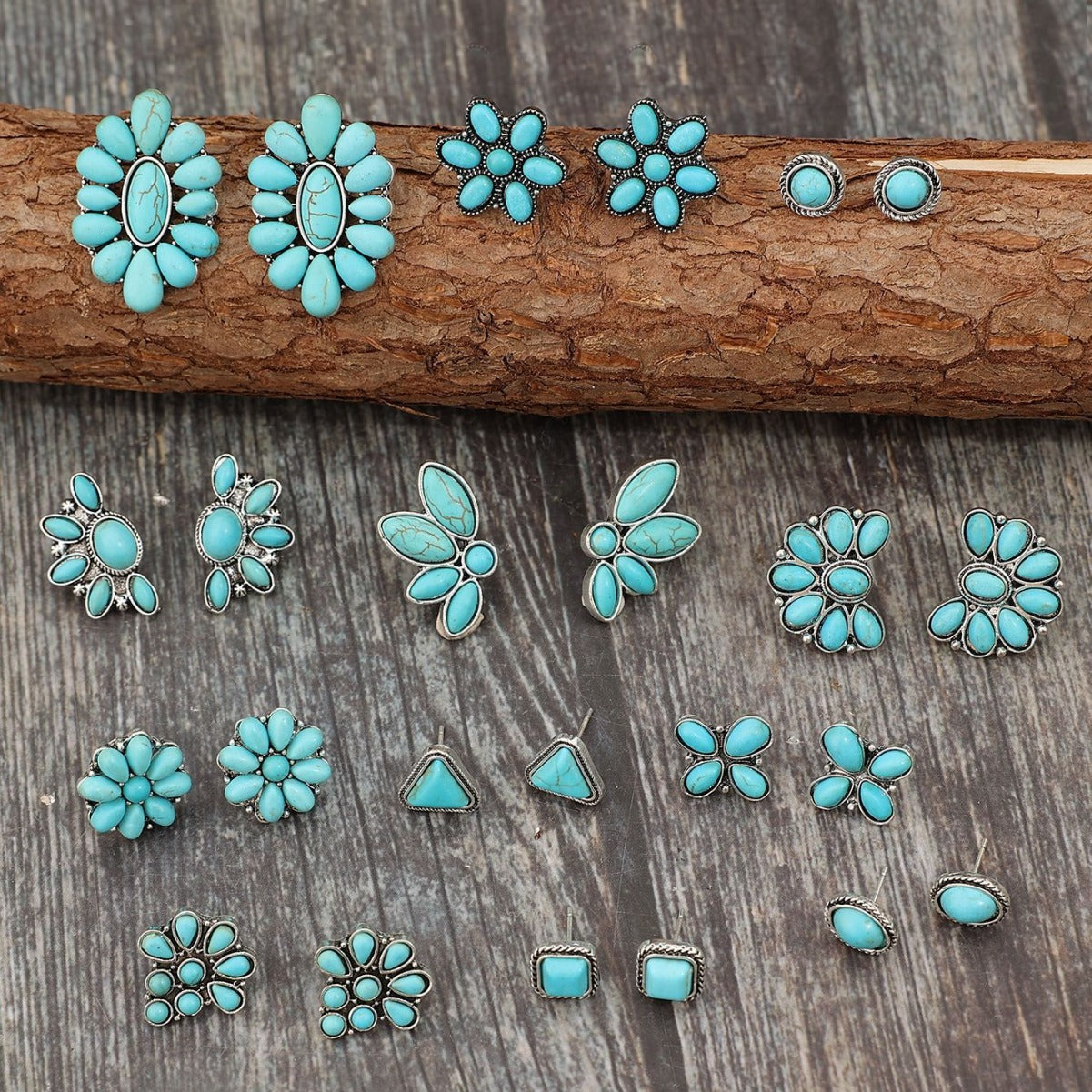
The same visible page also contained upper copy referring to “Turquoise Boho Vintage Statement Earrings” and “Western statement earrings.” That label difference needs clarification. A buyer should ask which exact designs and quantities are included, which photograph matches the selected Color, whether all items are studs, and whether the upper and lower descriptions refer to the same delivered set.
The visible information reviewed did not state included quantity, individual dimensions, projection, per-earring mass, post or attachment material, backing type, exact decorative material, metal composition, coating, construction, adhesive, skin-contact composition, care, or whether backs are included. “Turquoise-style” is not a natural-turquoise claim.
Face-zone formulas
Hat-led formula: choose the smallest verified earring option and let the hat band or crown detail lead. Keep the neckline simple.
Earring-led formula: use one selected pair as the upper focal point, simplify the hat treatment, and wear one bracelet component or none.
Quiet bridge formula: choose a modest ear option and one separated wrist marker so the blue-green color travels through the outfit without a dense cluster.
These are composition formulas, not claims about size or comfort. Confirm the selected pair's measurements, mass, post, backing, materials, and compatibility before assigning it a role.
What the “Turquoise in Rings” Video Can and Cannot Show
The YouTube video “Turquoise in Rings” by Turquoise in America is approximately fifteen seconds long. Its visible description says the creator shows turquoise set in fine handmade American Indian jewelry and discusses turquoise's jewelry use. YouTube indicated that subtitles or closed captions were unavailable, and no transcript was available for export when reviewed.
The video is useful here as a contrast lesson: the jewelry it presents has its own maker, material, setting, scale, and cultural context. None of those facts transfer to the two Oroxen products merely because their pages use turquoise-related or western styling words. It also shows why “delicate” must be evaluated relative to dimensions, neighboring items, and the complete outfit instead of being inferred from a keyword.
Do not copy an origin, tribe, artist, handmade, silver, or natural-turquoise claim from the video into an unrelated product description. Do not use a short visual as an authenticity test. For an exact item, rely on that item's documentation and, when identification matters, an appropriately qualified independent professional.
Mistake Seven: Forgetting the Belt-to-Hand Route
The hand and wrist repeatedly pass the buckle, pockets, bag, seat, phone, and rail. A decorative buckle can strike or visually compete with a stack. A crossbody strap may travel across bracelets while the bag is repositioned. Fringe can enter open cuff gaps. Test these movements in the full outfit.
If the buckle is large, keep the wrist line open or use one quiet component. If the wrist stack leads, reduce buckle contrast or move the strongest motif away from the hand route. Keep jewelry clear of tack, gates, animals, tools, machinery, and any activity where snagging or compression creates risk. Remove it before the activity if rules or conditions require; style never overrides safety.
Mistake Eight: No Entrance-to-Exit Plan
Confirm the current venue policy for bags, prohibited items, re-entry, seating, security screening, and activities. Pack one rigid or semi-rigid compartment for each pair of earrings and a separate supported space for each bracelet component. A set should not become a loose pile. Carry only what is permitted and what can be protected.
Before leaving home, photograph the complete jewelry count. On arrival, check that backings, cuffs, and closures remain present. If a piece becomes uncomfortable, remove it in a stable area over the open case—not while walking, standing in a crowd, leaning over a seat, or using a restroom sink. Count again before departure and at home.
Do not store jewelry with coins, keys, makeup, perfume, sunscreen, snacks, or loose hardware. Do not clean it at the venue. If it encounters rain, sweat, dust, cosmetics, or impact and exact care is not known, isolate it, document the exposure, and obtain item-specific guidance.
A 12-Motion Dress Rehearsal
- Put on and remove the hat without touching earrings.
- Turn the head fully left and right.
- Add and remove glasses or hearing protection.
- Button, roll, and lower the planned sleeve.
- Raise both arms and reach across the body.
- Fasten the belt and use each pocket.
- Carry and reposition the allowed bag.
- Use the phone with both hands.
- Sit, stand, and rest the forearms naturally.
- Add the evening jacket or outer layer.
- Remove each jewelry item into its own compartment.
- Repeat the final count and photograph the packed case.
Stop when an item catches, presses, rotates, collides, becomes hard to remove, or requires an unverified bend. Solve the route rather than adding a stronger backing, tighter cuff, improvised adhesive, or more force.
Frequently Asked Questions
Can a four-piece cuff set still look delicate?
It can be styled with lower visual density by wearing one or two verified components, but the physical result depends on exact dimensions, mass, fit, spacing, and finish. A four-piece stack should not be called delicate from a photograph alone.
Should earrings and bracelets match exactly?
No. Choose a relationship such as one repeated color, one supporting shape, or a deliberate contrast. Exact color matching is unreliable across screens and materials. Keep one area dominant and use empty space.
Are studs always safer with a cowboy hat?
No. Projection, edges, post length, backing, hairstyle, hat movement, cords, glasses, and hearing protection all affect contact. Test the exact pair and confirm its construction.
Can an open cuff be squeezed to fit?
Only if the seller's instructions for the exact cuff state that adjustment is intended and explain the method and range. Do not repeatedly bend an unknown metal or assembly.
Does turquoise-style mean genuine turquoise?
No. Turquoise-style and turquoise-colored describe appearance. Ask for the exact decorative material and treatment for the selected product.
How many jewelry pieces should a rodeo outfit use?
There is no universal number. Count visual jobs and contact routes instead. One leading zone plus one quieter supporting zone is a useful starting point, but the final choice depends on the garment, fit, venue, activity, and verified product facts.
Final Motion-Route Checklist
- The exact earring and cuff options, included count, and matching images are identified.
- Dimensions, projection, mass, attachment, backing, wrist range, and adjustment rules are verified.
- Turquoise-related language is not converted into an unsupported material, origin, maker, or cultural claim.
- The brim-to-ear route is clear through hat, hair, glasses, hearing protection, and collar movement.
- The sleeve-to-wrist route is clear through sleeves, gloves, watch, bag strap, and arm motion.
- The belt-to-hand route avoids hardware, pockets, rails, tack, tools, and other hazards.
- One visual zone leads; repeated color and motifs have a defined supporting job.
- Every item has a separate protected compartment and an entrance-to-exit count.
Conclusion: Style the Routes, Not Just the Photograph
A successful delicate-turquoise rodeo look is legible while the wearer moves. Define what delicate means with measurements, choose one lead zone, test the hat and sleeve routes, keep the belt and hand path clear, and prepare a safe removal plan. The result can feel intentional without turning every accessory into a focal point.
Explore current options in the Turquoise Jewelry collection, compare broader silhouettes in the Western Jewelry collection, or return to the Oroxen homepage. Verify the exact item first, then assign it a motion-safe role in the outfit.