Turquoise jewelry for men does not need a special permission slip, a fixed dress code, or a single definition of masculinity. A cowgirl-style beginner can help a male wearer explore color, earrings, Western motifs, and visible accessories without assuming what he likes or what fits. The useful starting point is a question: what does this individual want the jewelry to do?
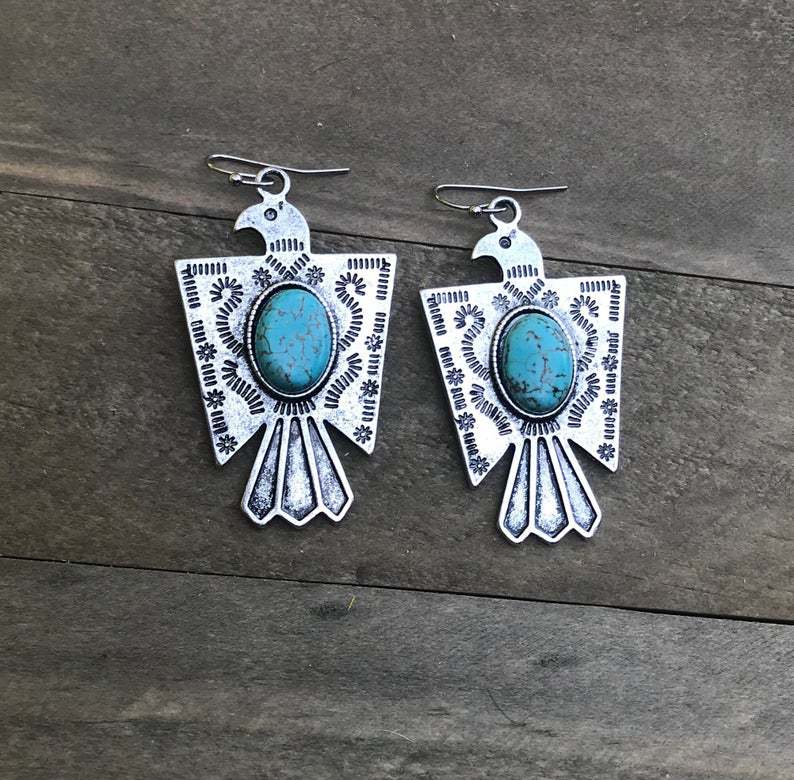
This FAQ compares the Turquoise Western Statement Earrings with the Turquoise Western Stud Earring Set. Their product names and styling copy describe appearance. They do not certify natural turquoise, metal identity, age, treatment, maker, origin, construction, handmade status, or cultural affiliation.
Quick Answer: Ask About Function Before Gender
Replace “Is this for men?” with questions that produce usable information:
- Does the wearer want a subtle daily accent or a visible focal point?
- Are the ears pierced, and which fastenings feel secure?
- What scale and movement are comfortable?
- Do workplace, sport, equipment, or uniform rules apply?
- Which colors, shapes, and symbols already appear in the wardrobe?
- Does material, maker, treatment, or origin documentation matter?
Those answers are more reliable than a gender label. They lead directly to product specifications and a real outfit test.
Question 1: Can Men Wear Turquoise-Colored Earrings?
Yes. Earrings, turquoise-colored details, floral shapes, geometric designs, and Western styling are not restricted to one gender. The wearer decides what feels expressive, appropriate, and comfortable. A beginner should avoid treating the product's merchandising audience as a rule about who may wear it.
Practical suitability still depends on piercing, dimensions, mass, fastening, skin-contact components, movement, and activity. Ask for those facts for the exact product. The public Western earring fit and comfort guide provides a detailed testing method.
Question 2: What Does “Turquoise Jewelry for Men” Mean?
It can be a search phrase, a merchandising category, or a personal description. It does not define the material, size, color saturation, motif, or construction. Some wearers prefer compact studs; others prefer long drops, broad rings, pendants, bracelets, or multiple pieces. Some want traditional menswear integration, while others want contrast.
Use the phrase to find candidates, then discard the category assumptions and inspect each product. A well-chosen piece fits the individual rather than an imaginary average man.
Question 3: Does the Word Turquoise Prove a Natural Stone?
No. Turquoise may appear in a title as a color or style term. A photograph is not enough to determine natural, stabilized, treated, composite, dyed, imitation, glass, resin, or another composition. Request the seller's option-specific disclosure and suitable documentation when identity affects price, care, gifting, or personal values.
Do not conduct home scratch, heat, solvent, acetone, or destructive tests on an unidentified product. These can damage components and still fail to establish trustworthy provenance.
Question 4: How Should a Cowgirl-Style Beginner Help?
Offer observation, not authority. The beginner may recognize how denim, boots, hats, leather-like textures, floral motifs, or turquoise-colored accents work together. The wearer remains the authority on comfort, symbolism, disclosure needs, and self-presentation.
Create three outfit photographs with the same shirt and jeans: no earring, compact earring, and statement earring. Ask which image feels most like the wearer. Do not argue with the answer or interpret a preference for subtle jewelry as fear.
Question 5: What Can the Cowgirl Jewelry Collection Tell Us?
The Cowgirl Jewelry collection can show available silhouettes, colors, motifs, and body zones. It can help a shopper compare a close-to-ear stud with a more visible statement shape. It cannot establish fit, materials, origin, durability, or care from the thumbnail alone.
Browse with a written task such as “one compact ear accent for a dark denim shirt” or “one face-level focal point with no necklace.” Open the exact product and verify its current option before making a conclusion.
Question 6: What Is Known About the Statement Earring Example?
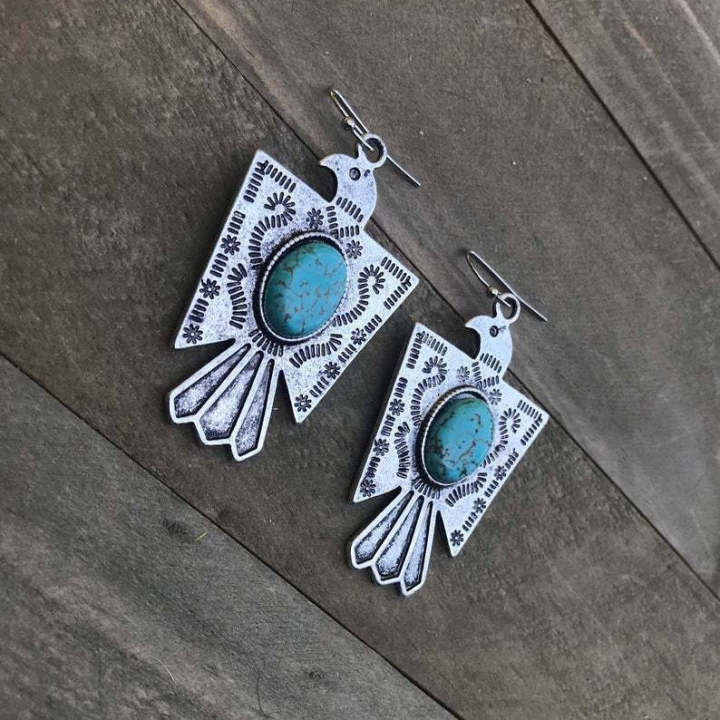
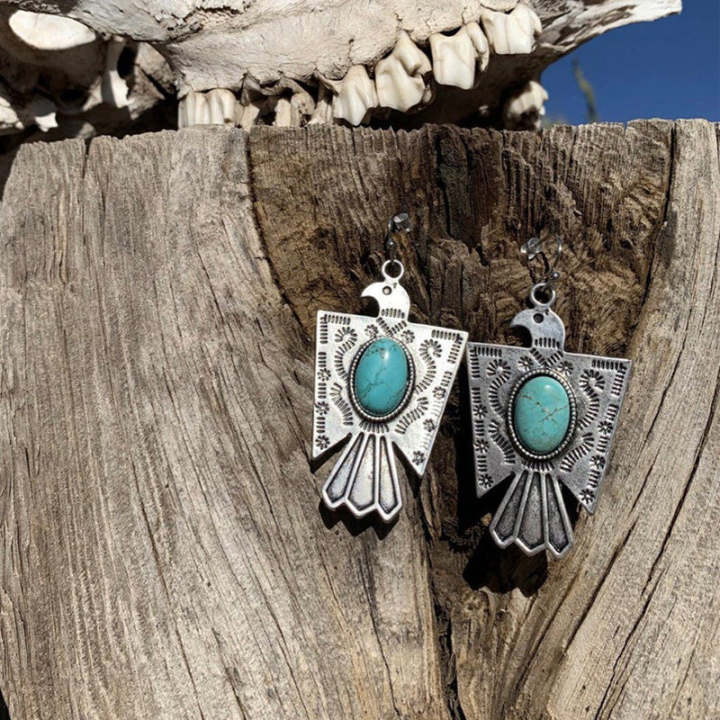
The Turquoise Western Statement Earrings page displayed $29.99 USD and one visible color selection during review. Its copy described a Western statement silhouette, turquoise-style center accents, boho texture, and vintage-inspired detailing. It suggested denim, boots, dresses, Western hats, festivals, events, and gifting.
The page's visible information did not clearly state exact height, width, total drop, projection, per-earring mass, attachment, backing, complete skin-contact and decorative components, finish, assembly, or care. “Statement” describes a styling role, not a measurement or comfort guarantee.
Use this example when the wearer already wants a visible ear-level lead. Keep the neckline simple during the first test. Tie back or reposition hair only if the wearer likes the result and the earring remains clear of snagging. Test glasses, headphones, hats, collars, a phone, and a shoulder bag.
Question 7: How Can a Statement Earring Enter a Men's Outfit?
Start with one stable clothing column: solid T-shirt and jeans, buttoned shirt and trousers, knit and dark denim, or jacket and quiet underlayer. Let the earring supply the highest contrast near the face. Avoid immediately adding a large necklace, patterned scarf, ornate hatband, prominent glasses chain, and decorated collar.
Take a full-body photograph and a conversation-distance photograph. The first shows whether the earring is balanced by footwear and silhouette. The second shows whether hair, facial hair, glasses, collar, and earring compete. The published statement-versus-everyday turquoise jewelry guide for men offers additional role comparisons.
Question 8: What Is Known About the Stud Set?
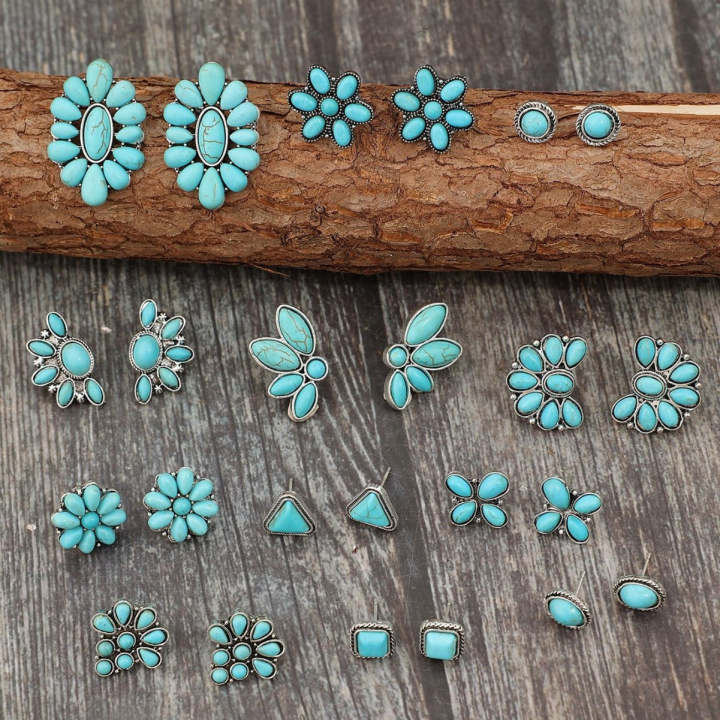
The Turquoise Western Stud Earring Set page also displayed $29.99 USD and one visible color selection during review. The page described a coordinated assortment mixing floral, geometric, and classic turquoise-style stud shapes for everyday styling and gifting.
The captured description did not clearly provide a written count of every included pair, a shape-by-shape inventory, individual dimensions, individual mass, post length, backing type, full components, finish, construction, or care. A gallery can suggest an assortment but should not be converted into an exact inventory without confirmation.
A set may support experimentation because the wearer can rotate visible shapes. That benefit depends on each component being correctly mapped, complete, comfortable, and suitable for the wearer's piercings and sensitivities.
Question 9: Is a Stud Set Always More Subtle?
No. Stud architecture usually keeps the jewelry close to the ear, but visual intensity depends on actual dimensions, color contrast, number of piercings, shape, surface detail, hair, and clothing. Several studs worn together can create more attention than one drop earring.
Test one mapped stud in one piercing. Add another only when the wearer wants the increased rhythm and the products are physically compatible. Do not assume pieces in the same set share identical posts, backs, mass, or care unless documented.
Question 10: Must Both Ears Match?
No universal styling rule requires symmetry. A wearer may prefer a matched pair, a single earring, two related studs, or deliberate asymmetry. Physical and workplace requirements may still matter. Confirm whether the product is sold and intended as a pair or set, and do not separate pieces in a way that affects safety or return eligibility without understanding the terms.
Question 11: How Do Facial Hair, Haircut, and Glasses Change the Choice?
They change the visual frame but do not create a fixed rule. A close haircut can increase contrast around the earring. Longer hair can partially hide or tangle with it. Facial hair can add texture below the ear, while glasses add a line and hardware near the same zone.
Photograph front, three-quarter, and side views with the wearer's normal hair and glasses. Test the act of putting glasses on and taking them off. If a hat or headphones are part of daily life, include them before choosing scale.
Question 12: What If the Wearer Does Not Have Pierced Ears?
Do not improvise a fastening or force a piercing-based product to work. Look for a documented non-pierced alternative, choose another jewelry zone, or consult a qualified piercing professional if the wearer independently wants a piercing. A gift should never create pressure to alter the body.
Question 13: Can These Earrings Be Worn at Work?
It depends on workplace dress, hygiene, safety, equipment, and communication rules. Food service, medical settings, manufacturing, sports, machinery, protective headgear, uniforms, and client-facing environments can impose different limits. Check the actual policy rather than relying on a general idea of business casual.
Compact studs may reduce movement, but their fastening, dimensions, materials, and compatibility still require verification. A statement design may be suitable in one creative workplace and unsafe in another.
Question 14: How Should Metal Sensitivity Be Handled?
Color and price cannot establish skin-contact composition. Request the materials for posts, hooks, backs, solder, coatings, adhesives, settings, and decorative components. If the information is incomplete and the wearer has a known sensitivity, choose a fully disclosed alternative or another body zone.
Do not coat the post with an improvised substance or rely on a vague “hypoallergenic” assumption. Follow qualified medical guidance for reactions and stop wear when discomfort appears.
Question 15: What Does the Video Add?
Turquoise Jewelry Guide | Everything You Need to Know About Turquoise by Turquoise Skies (T.Skies) Jewelry Gallery was available during review as a recorded stream lasting 1 hour, 22 minutes, and 14 seconds. Captions were unavailable, and the visible description linked to the channel's own signature collections.
Use the recording to build research questions about terminology, product identity, makers, and purchasing. Do not transfer the channel's product claims, maker information, materials, or provenance to the two Oroxen examples. No transcript is reproduced, and this article does not summarize claims that could not be checked against option-specific documentation.
Question 16: How Should a Beginner Evaluate Cultural Language?
Western, cowgirl, Southwestern, American Indian, Native American, tribal, handmade, artisan, and traditional are not interchangeable. Some describe broad aesthetics; others can make specific claims about people, makers, origin, or community. Use precise documentation and respectful attribution.
If the Oroxen page does not identify a maker, people, or origin, do not add one. The public introduction to Western jewelry can help keep motifs, materials, and provenance separate.
Question 17: How Should the Earrings Be Cleaned?
First obtain the full component and finish disclosure and follow the exact product instructions. Do not use toothpaste, vinegar, dips, abrasives, heat, ultrasonic devices, scratch tests, or generic metal polish on an unidentified mixed construction.
Handle posts and backs with clean dry hands when compatible with the instructions. Keep the pieces separated in a protected container so different shapes and finishes do not rub. Photograph condition before cleaning, repair, or return.
Question 18: Can These Products Be Gifts for Men?
Yes, when the recipient wears or wants earrings and the exact style, fastening, components, scale, and symbolism suit him. Do not use the gift to test whether a person is “confident enough” for visible jewelry. Share a shortlist when preference or body-contact facts are uncertain, and make exchange easy.
Question 19: What Is the Best First Outfit?
Use the wearer's most familiar neutral top, jeans or trousers, normal shoes, and no competing necklace. Test one earring role at a time. The best first outfit reduces variables and allows the wearer to judge the jewelry rather than a new costume.
Question 20: Where Should a Reader Browse Next?
After documenting the desired jewelry zone, scale, fastening, and styling role, compare current silhouettes in the wider Western Jewelry collection. Keep a list of facts that remain pending and open the exact product page before deciding.
Final Beginner Question Card
- What does the wearer want the jewelry to do?
- Are the ears pierced, and what fastening is comfortable?
- What are the exact dimensions and per-item mass?
- What touches the skin, and are all components disclosed?
- Does the wearer want matched, single, or asymmetric styling?
- Which work, sport, hat, glasses, or headphone conflicts exist?
- What material, maker, origin, or treatment evidence is available?
- What care and storage instructions apply to the exact item?
Return to Oroxen for current store and product information. The right turquoise-colored jewelry for a man is not defined by a gender stereotype. It is the option that matches his chosen style, documented physical needs, daily context, and standards for evidence.