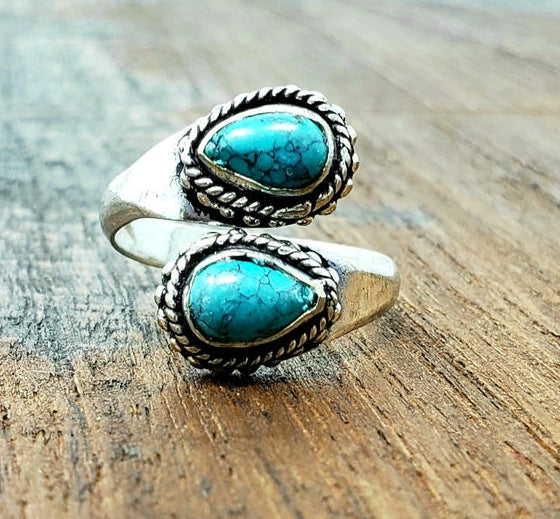
A turquoise-colored ring can be the smallest visible accent on a black dress and still become the detail people remember. Hands move through greetings, photographs, dinner, phones, bags, coats, and conversation. That movement repeatedly carries a ring into the portrait and waist zones, so the styling decision must account for more than color.
This checklist uses two current Oroxen examples: the Turquoise Vintage Cross Ring and the Turquoise Vintage Geometric Cross Ring. Their titles communicate turquoise-style, vintage-inspired, and cross or geometric design. They do not independently prove natural turquoise, metal, age, maker, origin, treatment, construction, or cultural affiliation. Verify every physical fact for the exact selected option.
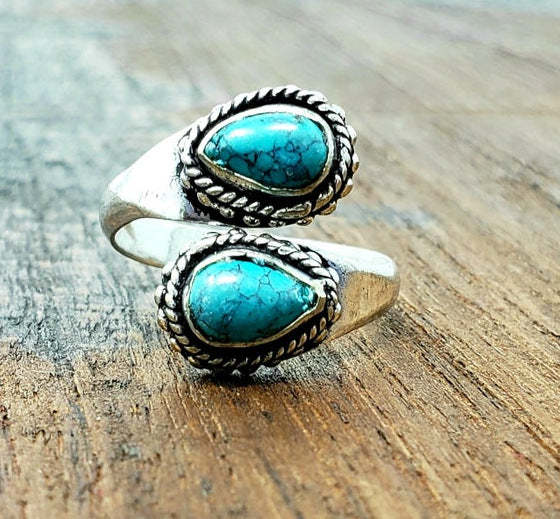
Quick Answer: Rehearse the Whole Occasion Loop
Put on the black dress, the intended ring, and every normal accessory. Rehearse arrival, greeting, coat removal, photographs, sitting, dining, phone use, bag access, handwashing, dancing or other movement, and departure. Stop when the ring rotates, catches, presses, collides, or requires constant protection.
Choose one leading hand. Keep the other hand visually quieter until the first formula works. If the ring carries a cross motif, confirm the wearer wants that symbolism and that it is suitable for the occasion. Match the black dress through proportion and spacing rather than forcing every accessory to repeat turquoise color.
For additional outfit variations, see the public seven ways to wear turquoise-style rings with a black dress. The present guide focuses on a pass-or-fail event checklist.
Checklist 1: Verify the Product Language
- Does “turquoise” identify a documented material or a color and style direction?
- Does “vintage” describe verified age or only appearance?
- Which image and description belong to the selected option?
- What component statement is provided for the decorative top and band?
- Which care instructions apply to that exact configuration?
Keep unsupported claims out of the outfit story. Say turquoise-colored, turquoise-style, cross motif, geometric outline, or vintage-inspired appearance when those are the facts available. Do not describe a ring as natural turquoise, silver, antique, handmade, Indigenous, tribal, or regionally produced without evidence.
Checklist 2: Obtain a Numerical Fit Record
Record the target finger, current professional size, internal ring measurement, band width and thickness, top height and width, profile above the finger, total weight, and any adjustment range. A size label is not a complete fit record.
| Fit field | Why it matters with a black dress | How to test |
|---|---|---|
| Internal size | Controls basic security and circulation | Use professional sizing and seller measurements |
| Top width | Determines how much hand area becomes the color focal point | Make a life-size paper outline |
| Profile | Affects catching on sleeves, bags, and table linens | Request side-view dimensions |
| Weight and balance | Influence rotation during gestures | Timed wear within return conditions |
| Band geometry | Affects adjacent-finger comfort | Test relaxed hand, grip, and seated states |
| Adjustment method | Controls intended fit range and durability | Follow option-specific instructions |
Do not repeatedly bend an adjustable-looking ring. Confirm whether adjustment is intended, who should perform it, and how often the construction permits it.
Checklist 3: Map the Black Dress and Hand Zones
Photograph the dress from front, side, seated, and walking views. Mark neckline, waist, pockets, sleeves, buttons, zippers, belt, and surface decoration. Then mark where the hands rest naturally. A ring can overlap the dress at the hip, waist, chest, face, and table during normal gestures.
If the black dress has long sleeves, check the cuff opening and fabric texture. If it has pockets, practice entry and removal. If it has a belt or zipper, confirm the ring cannot strike the hardware. A sleeveless dress reduces sleeve contact but may make the hand color more prominent.
Take photographs with hands relaxed rather than posed on the waist. A successful formula must work when the wearer forgets the camera.
Checklist 4: Browse Western Rings by Practical Role
Use the Western Rings collection as a current silhouette index. Sort candidates into low-profile everyday accents, broad statement tops, open or adjustable-looking bands, symbolic motifs, and multi-ring combinations. These are visual categories, not construction claims.
Assign one role before comparing products: portrait accent, hand focal point, outfit bridge, gift, or repeat-wear signature. The same ring can fill different roles, but each role needs its own fit and movement test.
Use the public pre-purchase Western jewelry checklist to prevent product-page gaps from disappearing behind styling preferences.
Checklist 5: Evaluate the Turquoise Vintage Cross Ring
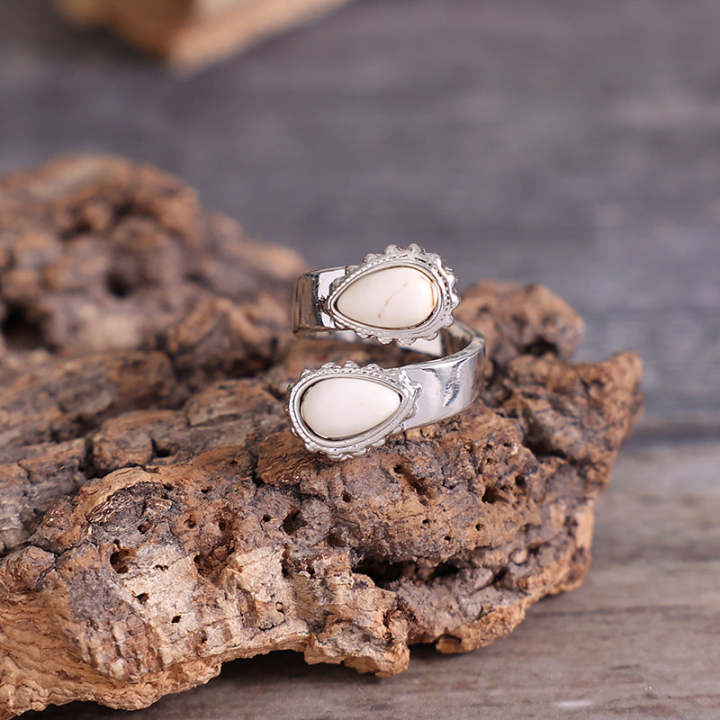
The current page shows one visible color choice and a size labeled “Adjustable.” The visible information does not clearly state the numerical adjustment range, initial internal size, top dimensions, profile, weight, band measurements, components, finish, construction, stone identity, or care.
The cross motif can create a recognizable center on the hand and may carry religious or personal significance. Confirm that meaning with the wearer and event context. The ring may suit a simple black dress when the hand is the only strong turquoise-colored zone, but visual suitability does not solve fit.
Pass Questions
- Is the exact adjustment range compatible with the target finger?
- Does the top remain centered through relaxed and active hand positions?
- Can the ring clear the dress sleeve, pockets, bag, and table setting?
- Are the cross meaning, components, finish, and care acceptable?
- Can the wearer complete the occasion loop without guarding it?
Checklist 6: Evaluate the Geometric Cross Ring
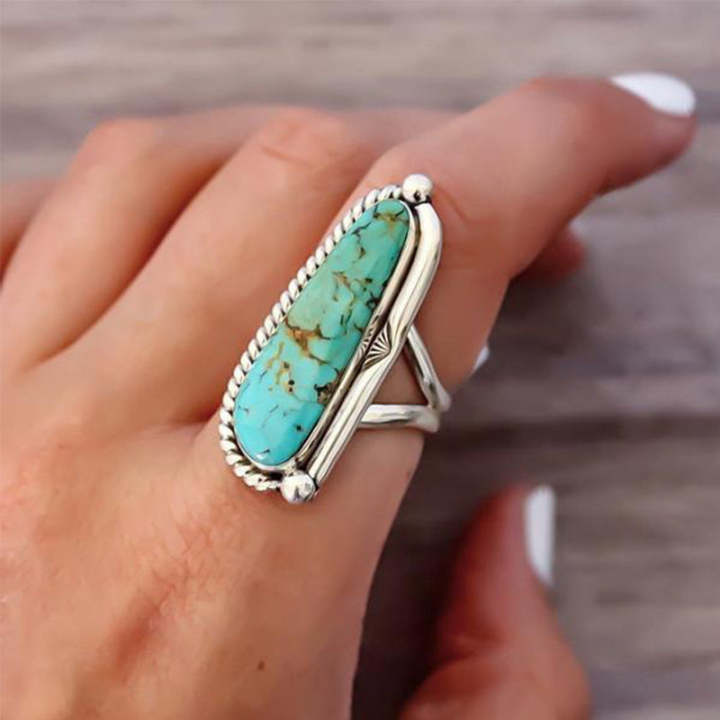
The current Turquoise Vintage Geometric Cross Ring page shows one visible color choice and a size labeled “One Size.” The visible page does not clearly explain the numerical size, whether adjustment is intended, the top measurements, profile, weight, band dimensions, components, finish, construction, stone identity, or care.
A geometric cross can occupy a broader or more angular visual area than a compact ring, but only verified measurements establish this product's scale. A photograph can show outline, not the fit on the intended finger.
Pass Questions
- What internal measurement does “One Size” represent?
- Is any adjustment intended, and what method is supported?
- How wide and high is the geometric top, including all projections?
- Does the ring clear neighboring fingers during a natural grip?
- Does the motif remain appropriate without competing with another cross?
Checklist 7: Choose One Hand Hierarchy
Begin with the cross ring on one hand and no other rings. Add a quiet band only if it does not change comfort, spacing, or the leading motif. Keep a watch or bracelet on the opposite wrist during the first test.
If the black dress includes a bright buckle or bag hardware, photograph both hands near that area. A hand focal point can disappear when surrounded by several reflective objects. Remove remote competitors before making the ring larger.
Do not use gender rules to assign fingers or quantity. Anatomy, fit, symbolism, routine, workplace needs, and wearer preference are more useful. The video below presents one perspective; it is not a universal rulebook.
Checklist 8: Rehearse Arrival and Greeting
Put on outerwear, carry the usual bag, open the door, remove a coat, and exchange a normal greeting. Note ring contact with handles, zippers, buttons, straps, and another person's hand. Avoid forceful testing; stop at the first sign of collision.
A ring that requires a special hand position during every greeting is not ready for that event. Change the finger only after confirming fit, meaning, and comfort for the new position.
Checklist 9: Rehearse Dining and Table Contact
Sit at a similar table and practice utensils, glassware, napkin use, phone handling, and bag placement. Check whether the ring knocks hard surfaces or catches table linens. Do not deliberately strike the product.
Photograph hands at table height. A broad ring may become more prominent when the black dress is mostly out of frame. Reduce bracelets or other hand jewelry if the composition becomes crowded.
Checklist 10: Plan Handwashing and Removal
Follow exact care instructions. Do not assume an unidentified turquoise-style component, finish, or adjustable band can tolerate water, soap, sanitizer, lotion, perfume, or heat. Plan whether the ring stays on or is removed before a routine begins.
If removal is required, use a secure, non-abrasive case rather than a sink edge, pocket, tissue, or loose bag. Practice the process at home without exposing the jewelry to incompatible products. Never leave a ring unattended in a public washroom.
Checklist 11: Coordinate Earrings and Neckline
Turquoise jewelry earrings can support the ring when their scale is clearly smaller and the face and hand zones remain separated. Start with neutral or very compact earrings. Avoid placing an equally strong turquoise-colored necklace between them unless the event calls for a deliberate full set.
The black dress neckline should direct the eye rather than create another motif. With a decorated neckline, let the ring become the only Western-inspired focal point. With a plain neckline, choose whether the empty space supports restraint or needs one quiet line.
Checklist 12: Use the Video as a Perspective
The supplemental video is 5 Rules For Men Wearing Rings | Ring Symbolism & Significance by Real Men Real Style. The currently available video is approximately 30 seconds long, and a transcript was not available during review. Treat it as one concise styling perspective rather than an authoritative rule for every wearer.
Ring symbolism can vary across people, communities, traditions, and contexts. Confirm meaning with the wearer. The video does not document either Oroxen ring and cannot verify their materials, age, origin, treatment, fit, construction, or care.
Checklist 13: Photograph Six Honest States
- Hand relaxed beside the black dress.
- Hands joined naturally at the waist.
- Seated with hands on the table.
- Holding the usual phone or bag.
- Wearing and removing outerwear.
- Walking or gesturing in a short private recording.
Score visibility, rotation, contact, adjacent-finger comfort, motif hierarchy, and repeatability from zero to two. A visually strong ring fails if any physical field remains unacceptable.
Checklist 14: Build a Backup Plan
Bring a secure case and identify a simpler ring or no-ring version of the outfit. The black dress should remain complete without the turquoise-colored accent. A backup prevents the wearer from tolerating discomfort merely to preserve the styling plan.
Save the successful finger, dress, sleeve, bag, event length, and movement notes after the occasion. Future rings still require new measurements, but the record shows which routine conditions matter most.
Common Mistakes and Better Alternatives
- Assuming adjustable means universal. Obtain the numerical range and intended method.
- Assuming one size fits every finger. Request the internal measurement.
- Stacking two cross motifs immediately. Establish one leader first.
- Matching every turquoise-colored accessory. Use one focal color zone.
- Testing only a posed photograph. Complete the occasion loop.
- Using generic cleaning advice. Follow documented components and finish.
Frequently Asked Questions
Which finger should wear a turquoise-style statement ring?
The finger with verified fit, comfort, practical clearance, appropriate symbolism, and wearer preference. There is no universal styling rule.
Can I wear a cross ring to a formal event?
Possibly, when the motif suits the wearer and setting and the physical design passes the event checklist. Confirm dress code and context.
Can an adjustable ring be resized many times?
Do not assume so. Ask the seller for the intended adjustment method, range, and frequency, then follow those instructions.
How should a Southwestern turquoise jewelry look be described?
Use supported visual language and avoid tribal, Indigenous, artisan, sacred, regional, or historical claims without evidence. Styling categories do not prove provenance.
What if the ring catches the dress?
Stop wearing that combination. Change the sleeve, finger, product, or outfit after verifying the alternative. Do not alter the ring without supported instructions.
Where can I compare more ring-and-dress proportions?
Use the public Southwestern turquoise-style black-dress guide for motif and proportion checks across the complete outfit.
Final Pass-or-Fail Summary
- Product language is documented accurately.
- Numerical size, top dimensions, profile, weight, band, components, and care are confirmed.
- The cross motif is welcomed and appropriate.
- The ring clears dress, bag, coat, table, phone, and adjacent fingers.
- Hand hierarchy remains clear in six honest states.
- Removal, storage, and backup plans are ready.
Explore more current shapes in Western Jewelry and return to Oroxen for current product and store information. A turquoise-style ring earns its place with a black dress when the complete occasion loop—not one posed image—passes.